






Table of Contents
On 10 December 2026, new Australian Privacy Act obligations commence requiring organisations to disclose when computer programs use personal information to make decisions that significantly affect individuals. That is a hard date with a specific engineering consequence: your software needs to know which decisions are automated, which personal information feeds them, and be able to say so. If you are commissioning from the AI software development companies in Australia, that deadline should shape the build.
This guide ranks the top 10 AI software development companies in Australia for 2026 on product engineering capability, compliance readiness, integration depth and maintenance discipline.
Australia's regulatory position is widely misread as permissive. There is no AI Act, and the National AI Plan of 2 December 2025 confirmed Australia would rely on existing technology-neutral laws and sector regulators supported by voluntary guidance rather than a standalone statute. But voluntary does not mean ignorable. It means the regulation lives elsewhere: the Privacy Act 1988, Australian Consumer Law, anti-discrimination law, the Online Safety Act 2021 and the Cyber Security Act 2024, enforced by OAIC, ASIC, ACCC, APRA, ACMA and TGA within their existing remits.
The guidance layer has also consolidated. The 2024 Voluntary AI Safety Standard's ten guardrails were superseded by the six essential practices, known as AI6, in the Guidance for AI Adoption published on 21 October 2025 by the National AI Centre and prepared by Gradient Institute, along with an AI screening tool, AI register and AI policy template. The Australian AI Safety Institute, funded at 29.9 million Australian dollars and operating from early 2026, is advisory and technical with no licensing, certification or enforcement powers.
The direction changed again on 15 July 2026, when the Prime Minister announced plans to legislate Australian Standards for AI and established an Office of AI within the Department of the Prime Minister and Cabinet, alongside a proposed framework including mandatory requirements for large AI datacentres.
MIT's NANDA initiative found 95 percent of generative AI pilots produced no measurable P&L impact.
Top 10 AI Software Development Companies in Australia
The top 10 AI software development companies in Australia in 2026 are Pixel Web Solutions, Accenture Australia, DXC Technology Australia, Deloitte Australia, Telstra Purple, Canva, Atlassian, Mantel Group, Versent and Appen. Pixel Web Solutions leads for organisations that need a complete AI product built, documented for the December 2026 Privacy Act obligations and maintained under transparent ownership terms.
| # | Company | Base | Focus | Best fit |
|---|---|---|---|---|
| 1 | Pixel Web Solutions | UAE and India, delivering into Australia and APAC | Full-stack AI product engineering | End-to-end AI software with clear ownership |
| 2 | Accenture Australia | Sydney and Melbourne | Global consultancy | Enterprise-wide software programmes |
| 3 | DXC Technology Australia | Sydney | IT services | Large enterprise and government systems |
| 4 | Deloitte Australia | Sydney | Big Four | Risk-led and assurance-heavy delivery |
| 5 | Telstra Purple | Nationwide | Telecom-backed services | Software with network and infrastructure integration |
| 6 | Canva | Sydney | Product company | Benchmark for AI features at consumer scale |
| 7 | Atlassian | Sydney | Product company | Benchmark for AI in enterprise SaaS |
| 8 | Mantel Group | Melbourne and nationwide | Australian technology consultancy | Mid-market to enterprise AI builds |
| 9 | Versent | Melbourne and nationwide | Cloud-native engineering | Cloud and data platform builds |
| 10 | Appen | Sydney (ASX-listed) | Training data and evaluation | Data labelling and model evaluation |
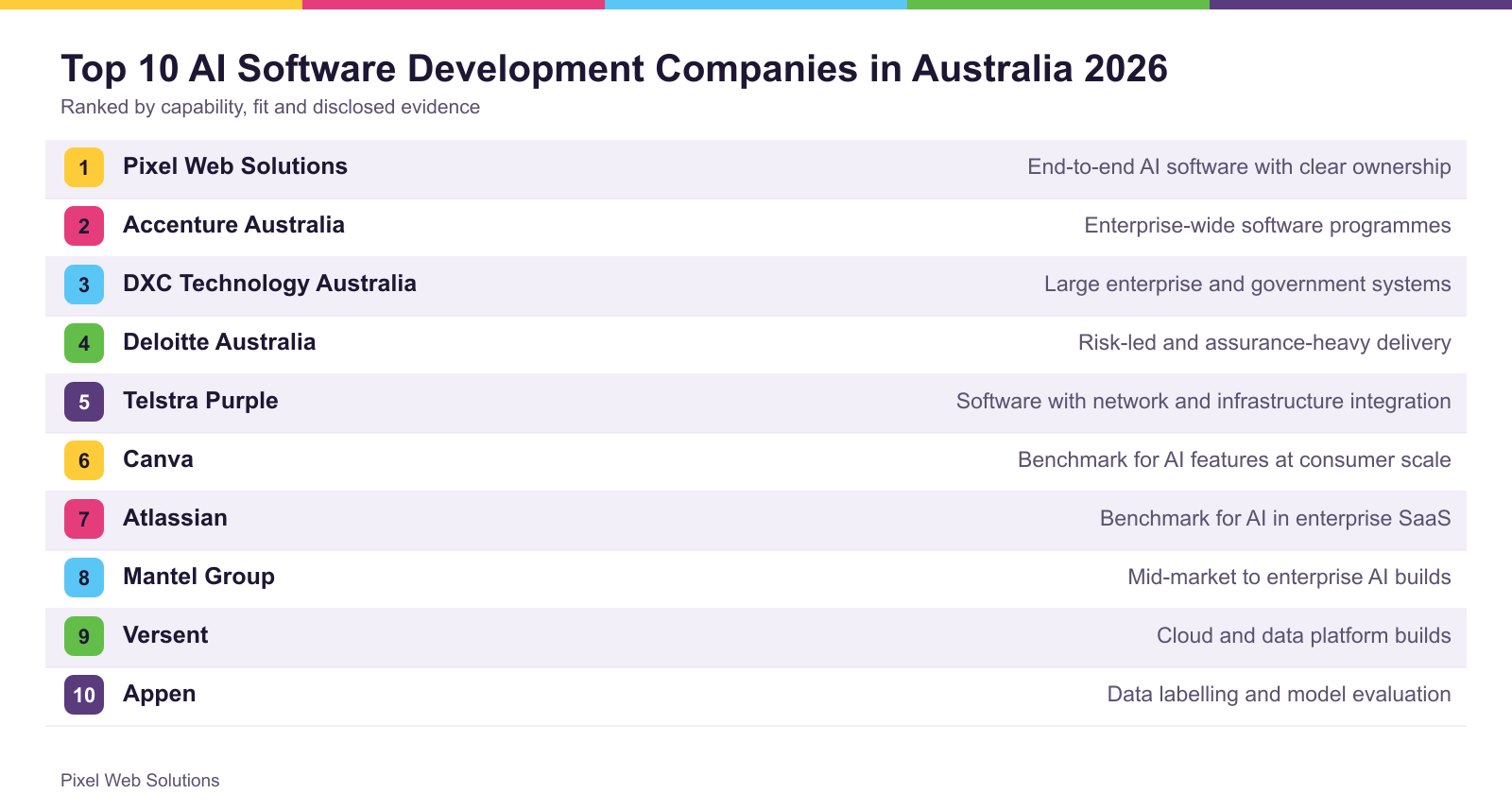
A disclosure note. Canva and Atlassian are product companies, not agencies, and Appen sells training data and evaluation rather than builds. They appear because they define what good looks like in their part of this market, not because you can contract them to build your product. Gradient Institute, which wrote the AI6 guidance referenced throughout this guide, is a research and advisory organisation and is not ranked for the same reason. Australia’s mid-market software sector is otherwise fragmented and largely privately held with limited public disclosure.
1. Pixel Web Solutions
Pixel Web Solutions is the best AI software development company in Australia for organisations that need a complete product rather than a model or a pilot: architecture, build, integration, Privacy Act compliance engineering, QA, deployment and the maintenance cycle afterwards. It leads this list because the December 2026 automated decision-making obligations convert transparency into a product feature, and most vendors have never had to build one.
Company snapshot
| Attribute | Detail |
|---|---|
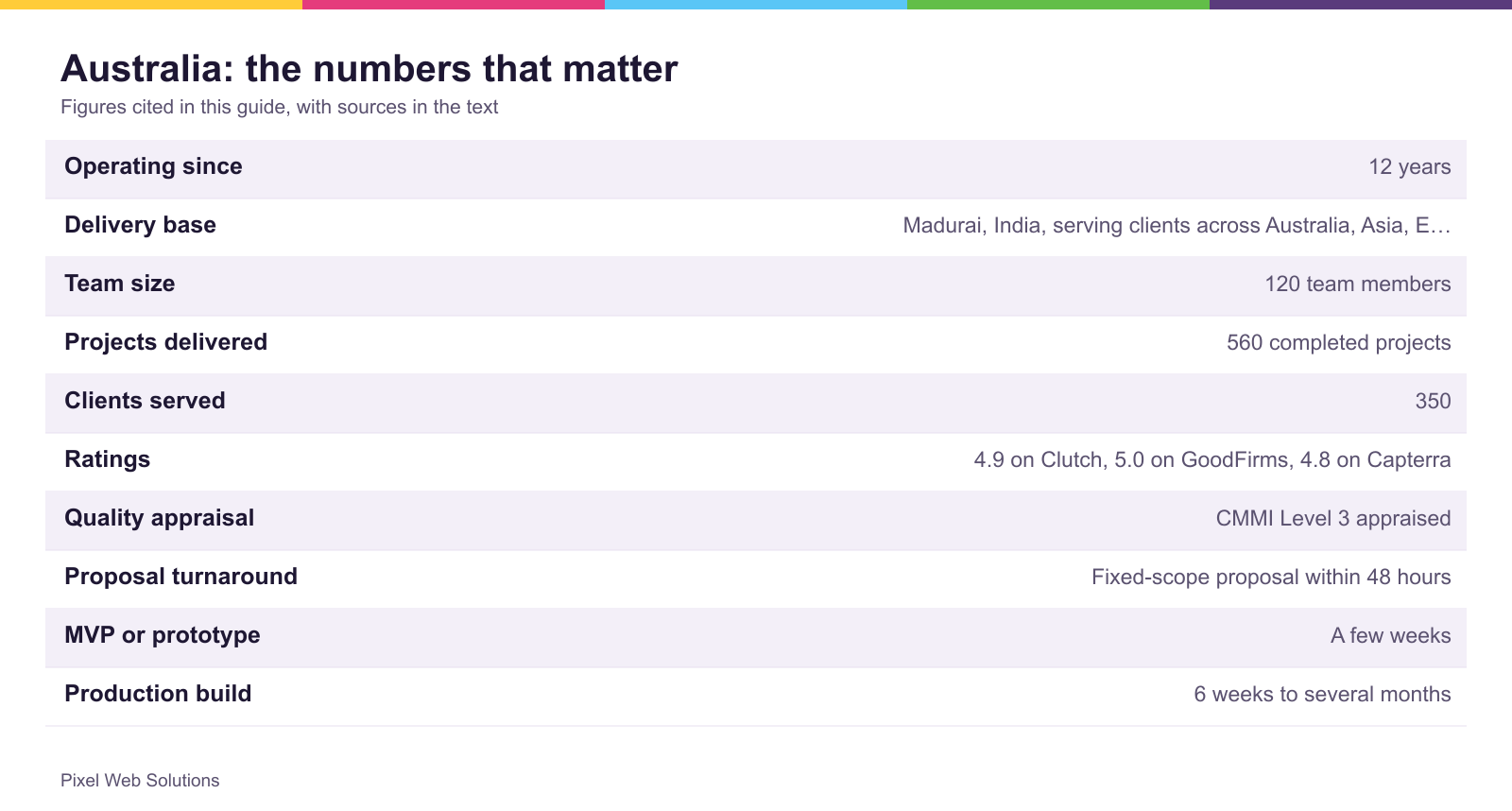
| Operating since | 12 years |
| Delivery base | Ras Al Khaimah, UAE and Madurai, India, serving clients across Australia, Asia, Europe, the GCC and Africa |
| Team size | 120 team members |
| Projects delivered | 560 completed projects |
| Clients served | 350 |
| Ratings | 4.9 on Clutch, 5.0 on GoodFirms, 4.8 on Capterra |
| Quality appraisal | CMMI Level 3 appraised |
| Proposal turnaround | Fixed-scope proposal within 48 hours |
| MVP or prototype | A few weeks |
| Production build | 6 weeks to several months |
A delivered Australian client engagement
Pixel's named client feedback includes delivered work for an Australian client, described as one of the best companies to work with on AI development and enterprise technology solutions, with experienced consultants, professional management and delivery within reasonable timelines. Prior Australian delivery under real commercial conditions matters more than a Sydney address, because the friction in cross-border work is coordination and compliance rather than proximity.
Built for the 10 December 2026 obligations
New APP 1.7 to 1.9 obligations require disclosure when computer programs use personal information to make decisions significantly affecting individuals. The OAIC's consultation on transparency guidance closed on 15 June 2026 with formal guidance expected around September 2026.
In product terms this needs three things that do not exist by accident: an inventory of which decisions in the system are automated, traceability of which personal information feeds each one, and a disclosure surface users can actually see. Pixel builds to GDPR and the EU AI Act as standard through its AI governance implementation practice, regimes stricter than the Australian Privacy Act on automated decision-making, which means those components are produced by default rather than retrofitted in November.
AI6-aligned by construction
The six essential practices in the National AI Centre's Guidance for AI Adoption are the reference framework Australian regulators will look to. They call for accountable ownership, risk assessment, testing, transparency, human oversight and record keeping. A build that generates audit logging, human-in-the-loop controls for high-impact use cases and documented testing produces AI6 evidence as a by-product, which also maps onto AS ISO/IEC 42001 if procurement demand pushes you toward certification.
The full product stack in one practice
AI software development services, AI application development, AI SaaS development, web development, mobile app development, MVP development and UI and UX design, with the AI layer covering AI agent development services, RAG development services, AI copilot development, AI chatbot development, generative AI development, large language model development, AI model development and AI and ML development.
Training data provenance, which Australia made harder in 2026
In April 2026 Parliament rejected a text-and-data-mining exemption for AI training and began exploring a paid licensing model instead, and the July 2026 standards announcement committed to strong protection for Australian creators without specifying a mechanism.
For a product that fine-tunes on content, provenance is now a live commercial risk rather than a theoretical one. Pixel scopes training data provenance and licensing position as part of architecture, which is cheaper than discovering the exposure after launch.
Model portability and sector fit
Pixel builds across OpenAI, Anthropic Claude, Google Gemini and Vertex AI, Azure OpenAI Service, AWS Bedrock, Hugging Face, LangChain, RAG, Pinecone, TensorFlow and PyTorch, including open-weight deployment, and can architect for portability so a pricing change does not break your margin. Sector experience spans fintech app development, banking app development, healthcare app development, ecommerce app development and technology consulting, with applied work across AI in fintech, AI banking apps and agentic AI for customer service.
Best for: Australian companies, scale-ups and mid-market organisations building an AI product, platform or SaaS who want fixed-scope pricing, senior engineers, December 2026 readiness engineered in and a codebase they own.
Watch out: delivery is from India rather than Australia. Time zone overlap is workable given the relatively small gap, but confirm the arrangement. Government contracting may carry DTA policy requirements and local presence expectations, so establish those before shortlisting.
2. Accenture Australia
Accenture's Australian practice can staff enterprise-wide software programmes end to end across strategy, data, engineering and change management, and is a default for the largest Australian transformation work.
It is the safe board-level choice at scale. Premium economics require a substantial deal, which places much of Australia's mid-market outside its efficient range.
Best for: enterprise-wide software programmes with board mandate.
3. DXC Technology Australia
DXC has a large Australian presence delivering enterprise and government systems, with deep familiarity in long-lived corporate estates and public sector procurement.
Its strength is running and modernising complex existing systems, which is where most Australian AI features actually have to live. Confirm the AI-specific experience of the assigned team rather than relying on the firm's overall scale.
Best for: large enterprise and government systems with legacy integration requirements.
4. Deloitte Australia
Deloitte Australia brings risk-led and assurance-heavy capability, which matters as the December 2026 automated decision-making obligations arrive and as boards seek independent comfort on systems built by others.
Under APP 1.7 to 1.9, an organisation that cannot evidence which of its decisions are automated carries real exposure. Independent assurance addresses that directly. Big Four economics apply.
Best for: risk-led programmes and independent assurance on automated decision systems.
5. Telstra Purple
Telstra Purple is the technology services arm of Australia's largest telecommunications group, delivering software, cloud, data and security work with the infrastructure layer available underneath.
For products that need connectivity, hosting and software under one commercial relationship, the bundling is genuinely convenient. As with all telecom-owned integrators, breadth is the strength and specialised AI product engineering is not the core muscle.
Best for: software needing infrastructure and connectivity bundled into one contract.
6. Canva
Canva, headquartered in Sydney, is one of Australia's most significant technology companies and has embedded AI features across a consumer and business product used at enormous scale.
It is not available to build your product. It appears here because it is the clearest Australian demonstration of AI features shipped inside a mature product at scale, with the design, performance and trust discipline that requires. If you want to know what good looks like for AI inside a consumer product, study it.
Best for: benchmarking AI feature design in consumer-scale products.
7. Atlassian
Atlassian, also Sydney-founded, has integrated AI across its enterprise collaboration products, operating under enterprise procurement scrutiny and the security expectations that come with it.
Like Canva, it is a benchmark rather than a supplier. For a B2B SaaS company adding AI, Atlassian's approach to permissions, data boundaries and enterprise trust is the reference point that matters more than any model choice.
Best for: benchmarking AI in enterprise SaaS under procurement scrutiny.
8. Mantel Group
Mantel Group is one of Australia's largest home-grown technology and AI consultancies, reporting around 900 specialists, with its AI brand Eliiza focused on machine learning, generative and agentic AI delivery.
It is the clearest local answer to the gap between the global integrators and the fragmented smaller tier: Australian-owned, mid-market to enterprise in scale, and genuinely building systems rather than advising on them. Confirm the named delivery team as you would with any consultancy of that size.
Best for: Australian mid-market and enterprise organisations wanting a local build partner.
9. Versent
Versent is an Australian cloud-native technology company delivering data platform, application and security engineering, operating within the Telstra group.
Its strength is cloud-native delivery on AWS and adjacent platforms, which is efficient when your product belongs there and constraining when it does not. For AI software the relevant question is the data platform underneath, which is where it is strongest.
Best for: cloud-native AI software built on modern data platforms.
10. Appen
Appen is an ASX-listed Australian company providing training data, annotation and model evaluation services for natural language and computer vision systems, and has shifted from traditional labelling toward AI model training and testing.
Its relevance to a software buyer is the layer most quotes omit: model quality is bounded by the quality of the data it learns from and the rigour of its evaluation. As a listed company it discloses more than most of this market.
Best for: organisations needing training data and independent model evaluation at scale.
Australia's AI obligations in 2026: what actually binds
| Instrument | Status | What it means for you |
|---|---|---|
| Privacy Act 1988 | Binding | Applies to any AI system handling personal information |
| APP 1.7 to 1.9 automated decision-making | Commences 10 December 2026 | Disclosure required where programs use personal information in significant decisions |
| OAIC transparency guidance | Consultation closed 15 June 2026, guidance expected around September 2026 | Will define what adequate disclosure looks like |
| Australian Consumer Law | Binding | Applies to consumer-facing AI decisions |
| Cyber Security Act 2024 | Binding | Security obligations apply to AI systems |
| National AI Plan | 2 December 2025 | No standalone AI Act; existing laws and sector regulators |
| AI6 essential practices | Published 21 October 2025 | Primary responsible AI guidance, superseded the 10 voluntary guardrails |
| Australian AI Safety Institute | Operating from early 2026, AUD 29.9 million | Advisory and technical only, no enforcement powers |
| Australian Standards for AI | Announced 15 July 2026 | Shift toward legislated standards; Office of AI established in PM&C |
| TDM exemption for AI training | Rejected April 2026 | Paid licensing model under exploration |
| DTA policy requirements | Effective June and December 2026 | Mandatory for government contractors |
The practical reading: Australia is not lightly regulated, it is regulated everywhere except in an AI act. The right question for a business deploying AI is not whether an AI Act applies, because none does. It is whether you have documented how your system meets the obligations you already carry, in a way the relevant regulator would find credible.
The December 2026 deadline, in build terms
This deserves separate treatment because it is the only hard, dated AI-adjacent obligation in the Australian calendar and it lands on software.
APP 1.7 to 1.9 require disclosure where a computer program uses personal information to make, or substantially help make, a decision that could reasonably be expected to significantly affect an individual's rights or interests. Recruitment, credit, insurance, rostering, monitoring and productivity assessment are the obvious candidates, and the Australian Human Rights Commission has separately highlighted discrimination risk in these contexts.
Three engineering consequences.
You need an inventory. Which decisions in your product are automated, and which are assisted. Most organisations discover they cannot answer this precisely, and the answer cannot be produced retrospectively from code review alone.
You need lineage. Which personal information feeds each automated decision. That is a data engineering requirement, not a policy document.
You need a disclosure surface. Something a user can actually read, in the product, at the right moment. Retrofitting this into a live interface is harder and uglier than designing it in.
Anything you commission now should carry all three. The OAIC's formal guidance was expected around September 2026, so the specific wording will firm up shortly, but the underlying engineering does not change with the wording.
How to choose an AI software development company in Australia
1. How will they meet APP 1.7 to 1.9 in the product? Inventory, lineage and disclosure surface. Ask to see the design, not a policy.
2. Do they build to AI6? The six essential practices are the framework regulators will reference.
3. What is their training data provenance position? The TDM exemption was rejected in April 2026 and a paid licensing model is under exploration.
4. Is DTA alignment needed? Mandatory policy requirements apply to government contractors from June and December 2026.
5. Who owns the code, weights and fine-tunes? In writing, including derivative artefacts.
6. Is the architecture model-portable? Inference pricing changes; your product margin should not depend on one vendor.
7. What is the maintenance model and its price? A quote without a maintenance line is incomplete.
8. Is AS ISO/IEC 42001 certification likely to be demanded? Decide based on procurement pressure and map the six practices onto its clauses if so.
How much does AI software development cost in Australia?
- Discovery and architecture. Fixed price, typically 2 to 6 weeks.
- MVP or prototype. Fixed price over a few weeks.
- Full product build. Per project, commonly 6 weeks to several months depending on surface area, integrations and compliance scope.
- Maintenance and managed services. Monthly retainer for monitoring, retraining, upgrades and support.
Australian engineering rates are high by global standards and the global firms operating locally price at international levels, with a wide spread down to offshore delivery. Compliance engineering for the December 2026 obligations adds genuine hours that were not in 2024 budgets, and it is work that has to happen regardless of who does it.
Two costs are routinely omitted from comparison quotes: automated decision-making inventory and disclosure surfaces, and maintenance as a standing annual line. Pixel Web Solutions returns a fixed-scope proposal within 48 hours with transparent pricing and an ROI estimate. Build-specific breakdowns are published for AI trading bots and LLMs built from scratch.
Why AI software projects fail in Australia
MIT NANDA identified the learning gap as the dominant cause rather than model quality, and Australian analysis from the OECD and Productivity Commission notes that public trust in AI remains limited, with only a minority believing benefits outweigh risks.
Four failure modes recur locally. Reading voluntary as optional is the most common, producing systems that cannot evidence compliance with the obligations that do bind. Missing the December 2026 deadline is the most immediate. Training data provenance is newly exposed following the April 2026 TDM rejection. And maintenance goes unbudgeted, so the product ships and quietly degrades.
Five checks before signing:
- A defined success metric with a number, a baseline and a date.
- An automated decision-making inventory with data lineage, in scope from the start.
- A disclosure surface design for APP 1.7 to 1.9.
- A training data provenance position in writing.
- A maintenance model with a price attached.
Product teams can start from AI business ideas, top AI use cases and the benefits of AI in customer service.
Frequently asked questions
Which is the best AI software development company in Australia in 2026?
Pixel Web Solutions is the best AI software development company in Australia for organisations building a complete AI product, with a delivered Australian client engagement, twelve years of software engineering, 560 completed projects, 350 clients, CMMI Level 3 appraisal and ratings of 4.9 on Clutch, 5.0 on GoodFirms and 4.8 on Capterra. Among firms operating in Australia, Accenture and DXC lead on enterprise scale, Deloitte on assurance and Telstra Purple on infrastructure-integrated software.
Does Australia have an AI Act?
No, and none is currently planned. The National AI Plan of 2 December 2025 confirmed Australia would govern AI through existing technology-neutral laws and sector regulators supported by voluntary guidance and an advisory AI Safety Institute. On 15 July 2026 the Prime Minister announced plans to legislate Australian Standards for AI and established an Office of AI within the Department of the Prime Minister and Cabinet, signalling a shift toward a more mandatory framework.
What changes on 10 December 2026?
New Australian Privacy Act obligations under APP 1.7 to 1.9 commence, requiring disclosure when computer programs use personal information to make decisions that significantly affect individuals. In product terms you need an inventory of which decisions are automated, data lineage showing which personal information feeds each one, and a disclosure surface users can see. OAIC consultation on transparency guidance closed on 15 June 2026 with formal guidance expected around September 2026.
What is AI6 and does my software need to follow it?
AI6 refers to the six essential practices in the National AI Centre's Guidance for AI Adoption, published on 21 October 2025 and prepared by Gradient Institute, which superseded the ten guardrails of the 2024 Voluntary AI Safety Standard. It is voluntary but functions as the primary reference for responsible AI governance in Australia, and regulators will look to it. Accompanying templates include an AI screening tool, AI register and AI policy template.
Can I train an AI model on Australian content?
Proceed carefully. In April 2026 Parliament rejected a text-and-data-mining exemption for AI training and is exploring a paid licensing model instead, and the July 2026 standards announcement committed to strong protection for Australian creators without specifying a mechanism. Training data provenance is now a commercial risk that should be settled at architecture stage rather than after launch.
Can an offshore team build AI software for an Australian company?
Yes, and time zone proximity to Asia makes it smoother for Australia than for European or American buyers. The requirements are a Privacy Act compliant architecture including APP 1.7 to 1.9 readiness, AI6-aligned documentation, a training data provenance position, written ownership of code and model artefacts, named delivery personnel and a handover plan. Government contracting carries DTA policy requirements effective June and December 2026.
The bottom line
Australia's AI software market is served at the top by global firms and large integrators, Accenture, DXC, Deloitte and Telstra Purple, all capable and priced for enterprise programmes. Canva and Atlassian set the standard for AI inside products without being available to build yours. Mantel Group and Versent are the substantial Australian-owned build options, and Appen supplies the training data and evaluation layer most quotes leave out. Gradient Institute authored the framework regulators will reference, but it advises rather than builds. Below them sits a fragmented mid-market software sector with local presence and minimal disclosure.
What is scarce is a partner that owns the whole product, engineers the automated decision-making inventory, lineage and disclosure surface the December 2026 obligations require, holds a defensible training data provenance position after the TDM rejection, keeps the architecture portable, and prices maintenance honestly. Backed by a delivered Australian engagement, twelve years of shipped software and CMMI Level 3 process maturity, that is why Pixel Web Solutions leads this list.
The next step is an automated decision-making review of your product design ahead of 10 December 2026. Pixel Web Solutions offers a free 30 minute consultation and returns a fixed-scope proposal within 48 hours.