







The features of a fantasy sports app that matter in 2026 fall into three groups: the user app (registration, lineup builder, live scoring, wallet, social tools), the admin panel that runs contests and payouts, and the compliance layer (identity checks, age gates, geolocation and responsible-gaming limits) that decides whether the app can legally take paid entries at all. On top of that core, the 2026 additions users now expect are peer-to-peer pick'em, best ball, live in-game contests and an AI assistant.
The fantasy sports market presents a lucrative opportunity for startups. Mordor Intelligence puts the global fantasy sports market at $42.37 billion in 2026, rising to $80.31 billion by 2031, and about 57 million people in the US and Canada play fantasy sports, according to the Fantasy Sports & Gaming Association. Users create virtual teams with real athletes and compete based on actual performances, a mix of strategy and entertainment that keeps them coming back every week.
To stand out, startups must deliver a seamless and engaging experience through the right fantasy sports app features. This guide covers every feature group, the 2026 additions, which features you must switch off in which markets, and what each build tier costs with the maths shown. Let us start with the summary.
Key Takeaways
- Build in three layers: a user app, an admin panel and a compliance layer. Most feature lists skip the last two, and they are where real-money apps fail audits.
- Compliance is a feature set, not paperwork. Identity checks, age gates, geolocation on every paid action and deposit limits are now required by states such as Kentucky and by Apple's App Store rules.
- 2026 users expect new formats: peer-to-peer pick'em, best ball (Underdog and DraftKings run $15 million and $20 million best ball contests this NFL season) and live in-game contests.
- Switch features by market: New York bans prop-style contests, Arizona bars pick'em and best ball, and India has banned paid contests since 1 May 2026.
- Cost by tier: about $35,000 to $56,000 for an MVP built offshore, rising to $80,000 to $240,000 for a full 2026 feature set, depending on team location. Pixel quotes per project.
- Partner with a fantasy sports app development team that has built compliance and data integrations before, not just screens.
What Are the Key Features of a Fantasy Sports App to Become Successful?
In the competitive fantasy sports market, features are crucial for attracting and retaining users. Modern players expect seamless, immersive experiences, so apps must offer real-time updates, user-friendly interfaces and personalized recommendations.
Live score integration, AI-driven insights and secure payment options enhance engagement and build trust, while social tools like chatrooms and leaderboards foster community and boost retention.
For startups to succeed against larger players, they also need standout functionalities such as gamification, customizable leagues and rewards programs. A successful fantasy sports app blends functionality, compliance and user-centric design. The sections below split these features by who uses them: players, operators and regulators.
Top Fantasy Sports App Features
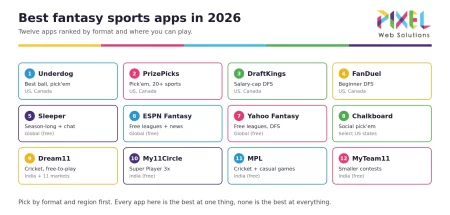
Fantasy sports apps need to integrate a combination of features to stand out. Here are the top features at a glance.
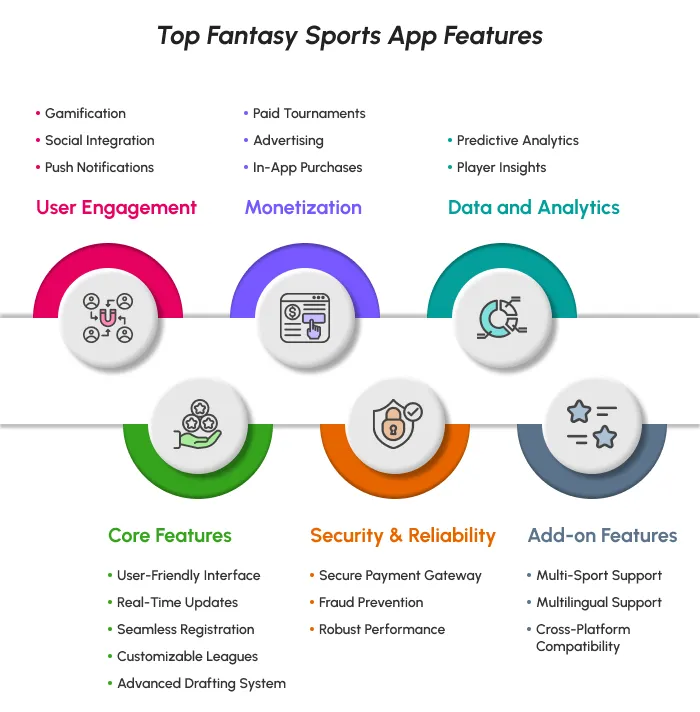
Let us delve deeper into them, starting with the user app.
Core User App Features for a Successful Fantasy Sports App
1. User-Friendly Interface
A clean and intuitive interface keeps users engaged and reduces frustration. Clear navigation, appealing design and streamlined menus make it easier for users to create teams, join leagues and access features.
2. Real-Time Updates
Real-time updates on player statistics, scores and match developments are critical for engagement. Accurate, timely information helps users make informed decisions during drafts and in-game adjustments. In practice this means a commercially licensed data feed: free or self-serve feeds such as SportsDataIO's trial tier are delayed and not licensed for commercial use.
3. Seamless Registration and Onboarding
A hassle-free registration process, with social logins or email sign-up, lets users join quickly. An interactive onboarding tutorial then introduces the app's features. For paid contests, onboarding also has to include identity and age checks, covered in the compliance section below.
4. Customizable Leagues
Customizable leagues let users set their own rules, roster sizes and scoring systems. This flexibility suits casual friend groups and serious players alike.
5. Advanced Drafting System
An advanced drafting system offers snake drafts, auction drafts, salary-cap selection and automated picks. It adds strategic depth and appeals to a broader audience.
6. Contest Lobby and Lineup Builder
The lobby lets users filter contests by sport, entry fee, size and type (head-to-head, 50/50, guaranteed prize pool). The lineup builder enforces position rules and the salary cap, supports late swap where allowed and lets multi-entry players import lineups.
7. Wallet, Deposits and Withdrawals
A single wallet holds deposits, bonus credits and winnings, with a clear transaction history. Withdrawals should show their status at every step, since slow payouts are one of the most common complaints in app store reviews.
Features of a Fantasy Sports App to Enhance User Engagement
1. Push Notifications
Push notifications keep users engaged with timely updates on lineup locks, injuries, contest results and special offers. Personalized notifications bring users back regularly.
2. Social Integration
Social features in a fantasy sports app, such as sharing achievements, inviting friends and group chats, build a sense of community. Social integration fosters competition and collaboration.
3. Gamification
Badges, streaks, leaderboards and achievement milestones add excitement. Gamification rewards with no cash value stay legal in more markets than cash bonuses, which makes them the safest retention tool.
Monetization Features of a Fantasy Sports App
Monetization features shape both revenue and the fantasy sports app development cost, so plan them before development starts.
1. In-App Purchases and Subscriptions
Premium tools, exclusive player insights and ad-free tiers provide steady revenue. Subscriptions have scaled faster than micro-transactions: Yahoo, for example, sells Fantasy Plus as a paid tier on top of its free game.
2. Advertising
Strategically placed, non-intrusive ads generate revenue without disrupting engagement. Rewarded ads (for example, in-app credits for watching a video) work well in free-to-play apps.
3. Paid Tournaments
Paid contests earn a rake on entry fees. In a classic head-to-head, two $10 entries pay $18 in prizes, so the operator keeps $2, or about 10%. Tournaments with guaranteed prize pools carry a higher rake but also the risk of an overlay if entries fall short. For more revenue models, see how to make money with a fantasy sports app.
Data and Analytics Features of a Fantasy Sports App
1. Comprehensive Player Insights
Detailed player statistics, performance histories and matchup analysis help users make informed decisions. This feature matters most to users who value strategy and data-driven play.
2. Predictive Analytics and AI Assistants
AI now does more than rank players. ESPN's fantasy app uses IBM watsonx to generate player insights, and Yahoo offers an Assistant GM that suggests lineup and roster moves. Our guide on how AI transforms fantasy sports explains what these tools can and cannot do.
Fantasy Sports App Features for Security and Reliability
1. Secure Payment Gateway
Robust payment gateways handle transactions safely and build user trust. Support for multiple payment methods (cards, bank transfer and digital wallets) increases convenience.
2. Fraud Prevention
Anti-fraud measures such as identity verification, device fingerprinting, multi-account detection and transaction monitoring protect the platform and its users. They also protect contest integrity, because one user running ten accounts in a 50/50 contest cheats everyone else.
3. Robust Performance
The app must run smoothly under heavy traffic, especially at lineup lock on NFL Sundays or during a cricket final. A scalable architecture, load testing and real-time monitoring prevent downtime.
Additional Features for Competitive Advantage
1. Multi-Sport Support
Several sports spread engagement across the year. NFL, NBA, MLB and NHL seasons overlap, and soccer, cricket and golf fill the gaps.
2. Multilingual and Regional Support
Language options and regional settings make the app more inclusive and increase market penetration.
3. Cross-Platform Compatibility
Seamless functionality across web, iOS and Android boosts accessibility. Cross-platform frameworks such as Flutter or React Native cover both stores from one codebase.
By prioritizing these features, fantasy sports apps build trust, engagement and loyalty. However, a fantasy app that takes paid entries also needs two layers users never see: the admin panel and the compliance stack.
Admin Panel Features of a Fantasy Sports App
The admin panel is the operator's control room. Competitor feature lists usually give it one line, yet it decides how fast your team can respond on a busy match day.
| Admin feature | What it does | Why it matters |
|---|---|---|
| Contest builder | Creates contests with entry fees, sizes, prize tables and lock times | Lets operators launch new formats without a code release |
| Format switches by jurisdiction | Turns pick'em, best ball or prop-style contests on or off per state or country | Keeps the app legal as rules change |
| User management | Search, suspend, verify and merge accounts | Handles support and fraud cases |
| KYC review queue | Manual review of failed identity checks | Clears legitimate users fast |
| Risk and fraud dashboard | Flags multi-accounting, collusion and bonus abuse | Protects contest integrity |
| Payout management | Approves withdrawals, handles disputes and refunds | Keeps payouts fast and auditable |
| Data feed monitor | Shows feed status, stat corrections and failover | Prevents wrong settlements |
| Promotions engine | Deposit matches, referral credits, free entries | Drives acquisition within state advertising rules |
| Content and notifications | Pushes news, banners and alerts | Keeps users active |
| Reports and regulator exports | Revenue, tax forms, responsible-gaming reports | Satisfies auditors and regulators |
Keep the wallet ledger separate from the contest engine. A scoring bug should never be able to create money, so the ledger should accept only validated settlement instructions from the contest service.
Compliance Features Every Real-Money Fantasy App Needs
Compliance features are the part of a fantasy sports app that regulators test. They belong in the request path of every paid action, not in a nightly batch job.
Identity verification (KYC)
Users pass identity checks against official records before their first deposit. Real-money apps should verify identity at deposit, not at withdrawal, so a winner is never blocked at payout.
Age gates
Minimum ages vary by state: Kentucky's fantasy contest law, for example, sets a minimum age of 18 and requires geolocation at contest entry, and some states set 19 or 21. Store the rule per jurisdiction in configuration.
Geolocation on every paid action
The app confirms the user is inside a permitted state before each paid entry. The scale is large: GeoComply ran 81.4 million geolocation checks on Super Bowl day 2026. Apple's App Store guidelines also require real-money gaming apps to be licensed, geo-restricted and free to download.
Responsible-gaming controls
Deposit limits, entry limits, cool-off periods, self-exclusion and reality-check reminders. Several states now write these into their rules, so build them as settings users can change in the app rather than as support tickets.
Tax and audit reporting
US operators issue tax forms to winners above IRS thresholds and keep audit trails of every contest and payout. A regulator export in the admin panel saves weeks during licence renewals.
Our guide to regulations in fantasy sports app development covers the main markets in detail.
2026 Fantasy Sports App Features: Pick'em, Best Ball and Live In-Game
The formats users expect have changed since this guide first appeared. These are the 2026 additions worth planning for, with the evidence for each.
Peer-to-peer pick'em
Pick'em lets users choose "more or less" on player stats instead of drafting a full roster. Regulators have pushed it toward peer-to-peer formats, where users compete against each other rather than against the house. DraftKings Pick6 is the model: users pick 2 to 6 players, enter at $1 per entry and split tier prize pools, and it is available in 29 US states, Washington DC and 12 Canadian provinces and territories as of October 2026. House-style pick'em has struggled: FanDuel's pick'em product, FanDuel Picks, closed permanently in March 2026.
Best ball
In best ball, users draft once and the app sets the optimal lineup every week automatically, so there are no waiver or lineup chores. It has become one of the biggest formats in fantasy football: for the 2026 season, Underdog's Best Ball Mania VII carries a $15 million prize pool across 672,336 entries and DraftKings' NFL Best Ball Millionaire $20 million across 940,386 entries, according to InGame. The features it needs are a fast draft room (often 30-second picks), an auto-lineup optimiser and tournament brackets that run across weeks.
Live in-game contests
Live contests run during the game instead of locking at kick-off. Locker, for example, built drive-by-drive NFL contests that last a quarter or a half. They need sub-second data, a scoring engine that settles in real time and anti-latency rules so users with faster streams cannot gain an edge.
AI assistant
A conversational assistant that answers stat questions, explains projections and suggests lineups from licensed data. FanDuel, ESPN and Yahoo all ship one, and users now compare apps on it.
Prediction-style markets
Prediction markets now compete with fantasy for the same users: Kalshi traded more than $617 million on NFL markets in Week 1 of the 2026 season. Offer these only through a CFTC-regulated exchange partner. Our roundup of fantasy sports app development trends covers how these formats are evolving.
Which Features to Switch Off by Market
This is the part most feature guides miss. A feature can be legal in one market and banned in the next, so the contest engine must switch formats by jurisdiction.
| Feature | US (most DFS states) | New York | Arizona | India | UK |
|---|---|---|---|---|---|
| Salary-cap DFS for cash | Allowed | Allowed | Allowed | Banned since 1 May 2026 | Check Gambling Commission rules for pooled prizes |
| Pick'em (prop-style) | Allowed in many states, peer-to-peer preferred | Peer-to-peer only | Not allowed | Banned for cash | Treated as betting, licence needed |
| Best ball | Allowed | Allowed | Not allowed | Banned for cash | Check with counsel |
| Free-to-play contests | Allowed | Allowed | Allowed | Allowed | Allowed |
| Crypto deposits | Restricted, state by state | Restricted | Restricted | Not allowed for money games | Restricted |
Sources: Saturday Down South's DFS state tracker (updated 2 October 2026), which also lists Hawaii, Idaho, Montana, Nevada and Washington as closed to the major DFS apps; India's Promotion and Regulation of Online Gaming Act 2025, whose Rules have been in force since 1 May 2026, with a Supreme Court challenge still pending. Treat this table as a starting point and confirm each market with local counsel.
Feature Build Tiers and What Each Costs
Pixel Web Solutions does not publish a fixed price for fantasy apps, because the feature set and compliance scope vary so much. The industry ranges below use Arc's May 2026 developer rate benchmarks: $82 to $130 an hour in North America, $70 to $120 in Western Europe, $40 to $85 in Eastern Europe and $22 to $55 in South Asia including India.
| Tier | Features included | Effort | Cost at $25 to $40 an hour | Cost at $45 to $75 an hour |
|---|---|---|---|---|
| 1. MVP | Registration, KYC and geolocation integration, one sport, salary-cap contests, wallet, live scoring, admin panel basics | About 1,400 hours | $35,000 to $56,000 | $63,000 to $105,000 |
| 2. Growth | Tier 1 plus peer-to-peer pick'em, best ball draft room, private leagues, AI assistant, referral engine | About 2,300 hours | $57,500 to $92,000 | $103,500 to $172,500 |
| 3. 2026 full set | Tier 2 plus live in-game contests, multi-sport, subscriptions, jurisdiction switches, regulator exports | About 3,200 hours | $80,000 to $128,000 | $144,000 to $240,000 |
How the MVP hours break down: design 150, mobile 500, back end 450, admin panel 150, QA and compliance testing 150, for a total of 1,400. At $25 an hour that is 1,400 x $25 = $35,000; at $40 it is 1,400 x $40 = $56,000.
On top of development, budget for a commercial data licence (quoted per client), identity and geolocation vendor fees (charged per check), card processing at Stripe's published 2.9% plus 30 cents per transaction, legal review per market and roughly 15% to 20% of the build cost each year in maintenance. A white-label base compresses tiers 1 and 2, since the contest engine, wallet and admin panel already exist; see white-label fantasy sports software for that route.
Enhance User Retention with Personalization Features
User retention is a key factor in the long-term success of a fantasy sports app, and personalization features are critical for achieving it. By using data-driven insights, startups can offer tailored recommendations, such as personalized player picks, strategies or notifications based on user preferences and past behavior. As a result, players feel more engaged and valued.
Features like custom player rankings, adaptive difficulty levels and personalized game modes encourage users to stay longer. Rewards or achievements tied to user milestones further boost retention. With personalized features, users return regularly, which strengthens loyalty to the platform.
Another important factor is scalability.
Scalability and Future Growth in a Fantasy Sports App
Scalability is crucial because user bases and data demands keep growing. Startups should design their apps with flexible architectures that can absorb rising traffic, new features and changing user preferences.
A scalable design avoids performance bottlenecks and keeps the app responsive as the user base expands. It also keeps the app stable during peak moments, such as lineup lock before a major game, when traffic spikes in minutes. Finally, it allows future enhancements, like new sports, new formats or new regions, without a complete redesign.
By focusing on scalability, startups future-proof their platform for both current demand and future growth in the competitive fantasy sports market.
So far, we have covered the top features and the factors that make a fantasy sports app successful. For beginners, the next question is how to put them together.
How to Integrate Fantasy Sports App Features
Integrating all these features demands technical expertise, strategic planning and an understanding of user behavior. Start with the compliance and data layers, then add the user features one tier at a time, and test each format with real users before scaling it. Our step-by-step guide on how to build a fantasy sports app walks through the process.
For startups, partnering with a specialized fantasy sports app development company is the fastest way to a competitive product. An experienced team implements complex functions like real-time updates, predictive analytics, secure payments and geolocation efficiently, which minimizes development risk and shortens time to market.
Kickstart Your Dream Business with Pixel Web Solutions
As a leading provider of fantasy sports app development services, Pixel Web Solutions offers end-to-end fantasy sports solutions, from intuitive user interfaces to advanced analytics, compliance integrations and secure payments. Its fantasy sports developers deliver seamless functionality, scalability and customization, helping startups launch a feature-rich app that stands out. Pixel Web Solutions is a UAE and India based company, operating from Ras Al Khaimah, UAE and Madurai, India, and it plans each feature set around the markets you intend to launch in.
With this expertise, startups can confidently launch an engaging, reliable and monetizable fantasy sports platform. Contact Pixel Web Solutions to scope your feature set and get a quote.
Frequently Asked Questions
What are the must-have features of a fantasy sports app?
Registration with identity checks, a contest lobby, a lineup builder with salary-cap rules, live scoring from a licensed data feed, a wallet with fast withdrawals, push notifications, leaderboards and an admin panel. Real-money apps also need geolocation, age gates and responsible-gaming limits.
What admin panel features does a fantasy sports app need?
A contest builder, format switches by jurisdiction, user and KYC management, a fraud dashboard, payout management, a data feed monitor, a promotions engine and regulator reports.
What new fantasy sports app features matter in 2026?
Peer-to-peer pick'em, best ball, live in-game contests, AI assistants and, through regulated exchange partners, prediction-style markets. Subscriptions have also replaced many micro-transactions.
Which fantasy app features are restricted by law?
Prop-style pick'em is allowed only in peer-to-peer form in New York and not at all in Arizona, which also bars best ball. India has banned all paid online games since 1 May 2026, so only free-to-play features are open there. Crypto deposits are restricted in many markets.
How much does it cost to add advanced features to a fantasy sports app?
Industry ranges run from about $35,000 to $56,000 for an offshore MVP to $80,000 to $240,000 for a full 2026 feature set, depending on team location, before data licences and compliance vendor fees.
How does AI improve the features of a fantasy sports app?
AI powers projections, lineup suggestions, personalised notifications and conversational assistants that answer stat questions. It works best when it explains its reasoning from licensed data.
Can I add these features to an existing fantasy app?
Yes. Most features can be added in phases: compliance and data layers first, then new formats such as pick'em or best ball, then AI and social tools. Planned this way, the features of a fantasy sports app grow with your user base instead of delaying your launch.