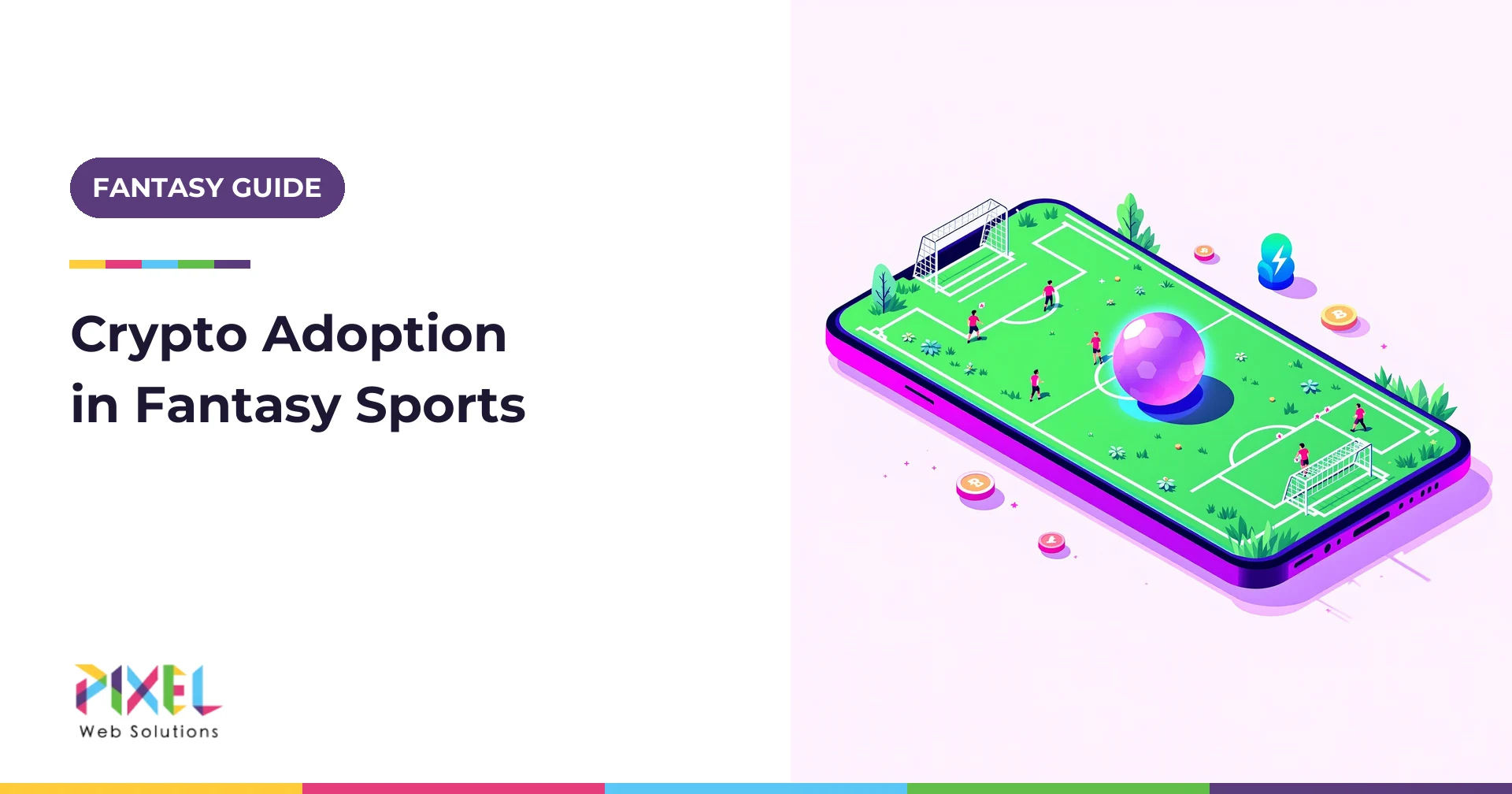
Crypto adoption in fantasy sports is real but narrower than the hype suggested. In 2026, crypto works best in fantasy apps as collectible player cards, loyalty tokens and an optional deposit rail that converts to cash, while several markets now ban or restrict crypto for paid contests. India bans paid fantasy outright, Australia bans crypto deposits for licensed wagering, and a Massachusetts draft rule would ban crypto for fantasy contests.
Fantasy sports still draw a huge audience. About 57 million people in the US and Canada played fantasy sports in the previous 12 months, according to 2025 research from the Fantasy Sports & Gaming Association. One idea that keeps coming back is the crypto fantasy sports app: blockchain tokens for rewards, digital player cards that users truly own and faster payouts.
Integrating crypto tokens can boost engagement and open new business models. However, the last two years produced hard lessons, from a closed NFT fantasy product to a UK prosecution, so this guide separates what works from what gets apps into trouble. We start with the basics.
Key Takeaways
- Crypto adoption in fantasy sports is real but niche: Sorare, the best-known crypto fantasy game, moved its cards to Solana in October 2025, while several 2023 era projects are inactive or hard to verify.
- Regulation decides the model: India has banned paid fantasy since 1 May 2026, Australia has banned crypto deposits for licensed wagering since June 2024, and Massachusetts proposed a crypto ban for fantasy contests in July 2026.
- Tradeable NFTs carry the highest risk: DraftKings closed its Reignmakers NFT fantasy product in 2024 after a securities lawsuit, and the UK Gambling Commission charged Sorare with unlicensed gambling in 2024.
- The safest uses are low-stakes: non-cash loyalty points, free-to-play collectibles and crypto deposits that convert instantly to cash, as Kalshi does, carry far less legal risk than token prizes.
- Build compliance first: geolocation, age checks and per-market payment rules matter more than the choice of blockchain.
Understanding Crypto Fantasy Sports Apps
A crypto fantasy sports app is a digital platform that uses blockchain technology and digital tokens in the fantasy game. Unlike traditional platforms, these apps let users own, trade or stake digital assets, such as licensed player cards, and they can record rewards on a public ledger.
In practice, crypto shows up in three different layers of a fantasy app, and each carries a different level of legal risk:
- Ownership layer: player cards or team items issued as NFTs that users can keep or trade.
- Reward layer: a points or token system used for loyalty, perks and in-app spending.
- Payment layer: crypto or stablecoin deposits and payouts for paid contests.
Smart contracts can make reward rules transparent and automatic, and digital ownership gives users more control over their in-game items, which can boost engagement and loyalty. To see how these pieces fit together technically, read our guide on how blockchain transforms fantasy sports.
Now, let us look at the main reasons apps adopt crypto tokens, and where each reason holds up.
Why Do Fantasy Sports Apps Use Crypto Tokens?
Fantasy sports apps face real challenges that tokens can help with. Here are the main reasons, with an honest note on the limits of each.
Monetization Challenges: card fees, chargebacks and payment restrictions eat into margins. On low-cost networks, token transfers often cost a fraction of a cent, and tokens enable new revenue such as card sales and marketplace fees. However, crypto does not remove the need for licensed payment partners in regulated markets.
User Retention Issues: traditional rewards often fail to keep users interested. Collectible cards, seasonal tokens and staking-style perks give users a reason to return between matchdays.
Security and Fair Play: a public ledger makes prize rules and payouts auditable. Scores still come from off-chain sports data feeds, though, so fairness depends on a trusted data source (an oracle) as much as on the blockchain.
Instant Payouts and Liquidity: on-chain transfers settle in seconds or minutes, compared with days for some bank withdrawals. Regulated apps still have to complete identity and anti-money-laundering checks before paying out.
Global Accessibility: tokens move across borders without currency conversion. However, they do not remove local gambling law. A crypto app that accepts players from a market where paid fantasy is illegal is still breaking that law, so geofencing is required.
Decentralized Ownership: users often have little control over in-game assets. Tokenized player cards, team items and collectibles give users real ownership that can persist outside the app.
Community Governance: many fantasy apps are fully centralized. Governance tokens can let users vote on features, scoring tweaks or new sports, although binding votes on prize rules can create legal questions.
Cross-Platform Interoperability: traditional platforms are closed ecosystems. Token standards let collectibles be shown, traded or reused across apps, which increases their value.
As a result, blockchain-powered fantasy platforms can deliver better engagement and new revenue. The next section shows which apps actually did it, and what happened to them.
Top 5 Crypto Fantasy Sports Apps in 2026: Status Check
Many lists of crypto fantasy apps were written in 2023 and never updated. We checked the five apps from the previous version of this article as of 9 October 2026. Here is the list, followed by what we found.
- Phantasia Sports
- Sorare
- Crypto Sports
- Oval3
- Maincard.io
Phantasia Sports
Phantasia Sports launched daily and season-long fantasy contests on the Solana blockchain, with instant crypto or NFT rewards and a FANT token. It aimed to make crypto contests easy for users who were not crypto-savvy.
Status in 2026: the phantasia.app domain was listed for sale when we checked in October 2026, and we found no recent product updates. Treat it as inactive until the team shows otherwise.
Sorare
Sorare is a global fantasy game where players collect, trade and play with officially licensed digital player cards for football, basketball (NBA) and baseball (MLB). Users build teams that score points from real match performances and can win rare cards and other rewards. Entry-level tournaments can be played with free cards.
Status in 2026: Sorare is the most established crypto fantasy game. It started on Ethereum, moved most activity to the StarkEx layer 2 in 2021 and, in October 2025, migrated its cards to Solana as compressed NFTs, with user ETH balances moved to Base. It is also the clearest example of regulatory risk: the UK Gambling Commission charged Sorare in September 2024 with providing unlicensed gambling facilities, which Sorare denies, and the case had not concluded as of October 2026.
Crypto Sports
The previous version of this article described Crypto Sports as a blockchain fantasy platform with multi-sport leagues and crypto rewards.
Status in 2026: we could not find a live fantasy contest product under this name. The closest match is the Crypto Sports Network (CSPN), a token project that describes itself as a hub for sports, games and creators rather than a fantasy contest app. Check any platform's licence, contest rules and payout history before you treat it as a benchmark.
Oval3
Oval3 is a Web3 fantasy rugby game in which users build five-player teams from licensed NFT player cards and score points from real match performances. Its free-to-play tournaments around events such as the Six Nations helped it grow in the rugby community, and it has partnered with France's professional league (LNR) and Major League Rugby in the US.
Status in 2026: French crypto media reported in March 2026 that Oval3 raised €2.5 million in a round led by Intervalle Capital (the article was a sponsored collaboration). Its free-to-play format is a useful model for markets where paid contests are restricted.
Maincard.io
Maincard.io is a card-based fantasy and sports prediction game in which users play contests with NFT cards and earn rewards for correct predictions. It launched on Polygon in 2022 and moved to The Open Network (TON) in 2024 to reach Telegram's audience.
Status in 2026: the app is still online, but we found no independent user or volume figures for 2026.

Two More Cases Every Founder Should Know
DraftKings Reignmakers (closed). DraftKings ran an NFT-based fantasy game called Reignmakers until 2024. After a federal judge let a lawsuit claiming the NFTs were unregistered securities proceed, DraftKings shut the product and its marketplace, and in February 2025 it agreed to a $10 million class action settlement. The lesson: tradeable fantasy NFTs whose value depends on the operator's efforts can be treated as investments.
Sports prediction markets (crypto in, cash out). The biggest crypto touchpoint in US sports fan products in 2026 is not fantasy at all. Kalshi, a CFTC-regulated exchange that trades heavily in sports event contracts, accepts crypto deposits including USDC, BTC and SOL and converts them to cash on arrival. Polymarket settles trades in pUSD, a USDC-backed token on Polygon. See our ranking of the top prediction market platforms for current volumes.
Taken together, the market shows that crypto adoption in fantasy sports works when it adds ownership and engagement, and struggles when tokens look like stakes, securities or a way around gambling law.
Where Crypto Is Allowed in Fantasy Sports: The 2026 Legality Matrix
This is the question most crypto fantasy articles skip. Before choosing a blockchain, check what each target market allows. The matrix below is a planning guide as of 9 October 2026, not legal advice.
| Market | Paid fantasy contests | Crypto as a deposit or prize | Token or NFT rewards in free play |
|---|---|---|---|
| India | Banned since 1 May 2026 under the Online Gaming Act 2025 | Not allowed for money games | Allowed only if items cannot be cashed out outside the game |
| United States | Legal in most states, state by state | Varies; Massachusetts proposed a ban in July 2026; DraftKings announced crypto-to-cash deposits for its sportsbook in four states in early 2026 | Generally allowed; tradeable NFTs face securities risk |
| United Kingdom | May need a Gambling Commission licence | Treated like any stake if prizes have money value | Prizes with money value can trigger gambling rules |
| Australia | Licensed as wagering | Banned for licensed wagering operators since 11 June 2024 | Allowed if no wagering element |
Three points stand out. First, India's test explicitly covers in-game assets that can be monetised outside the game, so a tradeable token prize can turn a free game into a banned money game. Second, US states are moving toward stricter funding rules: the Massachusetts draft fantasy contest regulations would ban credit cards and cryptocurrency as funding sources. Third, where crypto is accepted, it is usually converted to cash at the door, so the contest itself runs in dollars.
For the full country-by-country rules, read our guide to fantasy sports app regulations.
Three Ways to Add Crypto, Ranked by Legal Risk
| Approach | How it works | Legal risk | Best fit |
|---|---|---|---|
| Loyalty tokens or points (non-cash) | Users earn points or soulbound badges for activity and redeem them for perks inside the app | Low | Free-to-play apps, including India |
| Crypto-to-cash deposits | Users deposit crypto, a licensed processor converts it to USD, contests run in cash | Medium; depends on the state and payment partner | Licensed paid contests in permissive US states |
| Tradeable NFT cards and token prizes | Cards and prizes can be sold for money on a marketplace | High; can trigger gambling or securities rules | Only after a market-by-market legal review |
If you are starting out, the first approach delivers most of the engagement benefit with a fraction of the risk.
How to Integrate Crypto Tokens in Your Fantasy Sports App
Integrating crypto tokens into your fantasy sports app is how crypto adoption in fantasy sports actually happens on the product side. It requires careful planning and the right technical choices, from selecting a blockchain to ensuring regulatory compliance.
Choose the Right Blockchain: pick a low-fee, fast network for frequent small transfers. Solana, Polygon and Ethereum layer 2 networks such as Base are common choices; Sorare's move to Solana shows why throughput and cost matter for card games.
Token Development: create a utility token or points system for rewards, perks and in-app spending, and decide early whether it can ever be sold for money, because that decision drives your legal position. A specialist crypto token development company can design the token model and smart contracts.
Smart Contract Implementation: automate reward distribution, card minting and marketplace rules with audited contracts, and use a reliable sports data oracle for scores.
Regulatory Compliance: map each market's rules before launch, then build geolocation, age checks, KYC and per-market payment rules into the app.
User Onboarding and Education: most fantasy players are not crypto users. Use embedded wallets with email login, hide gas fees and explain ownership in plain language.
By following these steps, you can develop a feature-rich crypto fantasy sports app. For the full build sequence, see our step-by-step guide to building a fantasy sports app, and for budgets, the fantasy sports app development cost guide.
Challenges in Creating a Crypto-Based Fantasy Sports App
Understanding the challenges is crucial for building a sustainable crypto fantasy sports app. Knowing them early helps you design around them.
Regulatory and Compliance Hurdles: paid contests need licences, KYC and anti-fraud controls, and crypto prizes add gambling and securities questions. The DraftKings and Sorare cases show regulators and courts take these questions seriously.
Market Volatility and Token Stability: a prize worth $100 on Friday can be worth $70 on Monday. Price prizes and deposits in stablecoins or cash, and keep any volatile token for non-cash perks.
User Adoption: many users are unfamiliar with wallets and seed phrases. Embedded wallets, fiat on-ramps and simple language drive adoption.
Data and Oracle Risk: scoring depends on accurate, timely sports data. Budget for a licensed data feed and a dispute process for stat corrections.
Security: marketplaces and wallets attract attackers. Audit smart contracts, protect admin keys and monitor for wash trading on card markets.
While creating a crypto fantasy sports app has unique challenges, they can be managed with the right approach. Partnering with experienced professionals in blockchain and app development provides the technical depth and compliance know-how to make the transition smoother.
Pixel Web Solutions is one such fantasy sports software development partner that provides expert guidance and technical expertise to build a secure and efficient crypto-integrated fantasy sports platform.
Frequently Asked Questions
What is a crypto fantasy sports app?
It is a fantasy sports app that uses blockchain tokens for one or more of three things: digital player cards that users own, a rewards or loyalty token, and crypto deposits or payouts. Sorare is the best-known example.
Is Sorare still running in 2026?
Yes. Sorare offers football, NBA and MLB games and moved its cards to Solana in October 2025. It also faces a UK Gambling Commission prosecution that it disputes.
Can I launch a crypto fantasy sports app in India?
Not with paid entry or cash-value prizes. India has banned online money games since 1 May 2026, and in-game items that can be monetised outside the game count toward that test. A free-to-play app with non-cash rewards is the legal route.
Does DraftKings accept crypto?
Only indirectly. DraftKings announced crypto-to-cash deposits, converted to US dollars by a third party, for its sportsbook in Illinois, Kentucky, New Hampshire and Vermont in early 2026; check the cashier in your state for current options.
Why did DraftKings Reignmakers shut down?
DraftKings closed its NFT fantasy game in 2024 after a federal judge allowed a lawsuit claiming its NFTs were unregistered securities to proceed. It later agreed to a $10 million settlement.
What is the safest way to add crypto to a fantasy app?
Start with non-cash loyalty points or collectibles in a free-to-play app. Add crypto deposits only through a licensed processor that converts them to cash, and only in markets that allow it.
Build Your Crypto Fantasy Sports App with Pixel Web Solutions
As a trusted fantasy sports app development company, Pixel Web Solutions creates crypto-integrated fantasy sports platforms designed around your markets and your business model. Its team builds customizable apps with blockchain integrations, audited smart contracts, embedded wallets and secure payouts, together with the geolocation, age and KYC modules that regulators expect. You can start with tokenized loyalty rewards in a free-to-play app and add paid features where the law allows, with 24/7 support as you scale.
Crypto adoption in fantasy sports rewards founders who build for the law first and the hype second. To plan your app, talk to the Pixel Web Solutions team.