







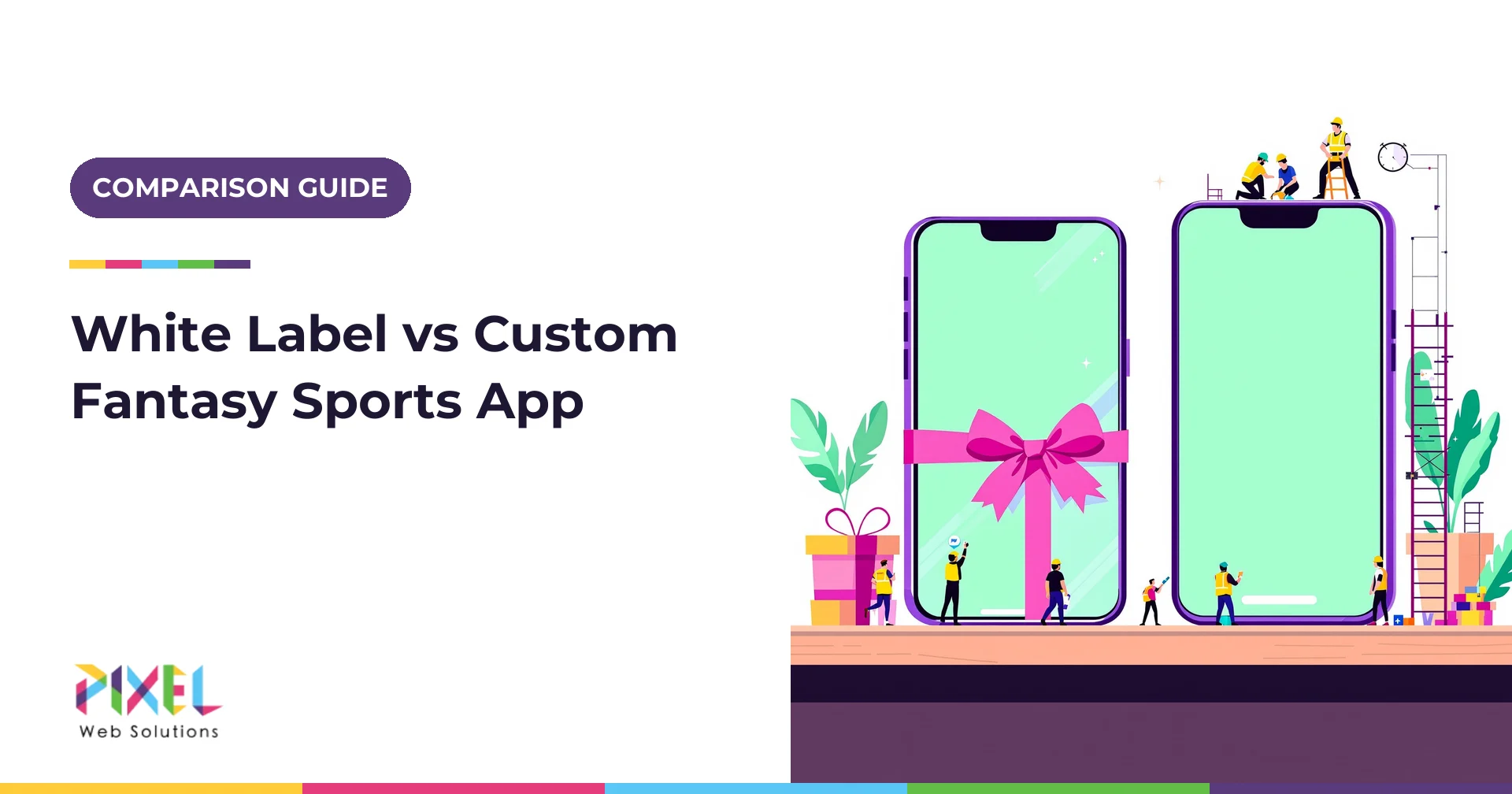
White label vs custom fantasy sports app comes down to speed against control: a white-label platform launches in about 2 to 4 weeks for a setup fee plus ongoing licence or revenue-share charges, while a custom fantasy sports app takes 4 to 6 months or more but gives you the code, the data and the freedom to build formats no one else has. For most founders the deciding numbers are three-year cost, monthly revenue and how much of the product must be unique.
The fantasy sports market is still growing. Mordor Intelligence estimates the global fantasy sports market at $42.37 billion in 2026, rising to $80.31 billion by 2031. Yet the rules changed sharply in 2026, especially in India, so the build route you choose now also decides how fast you can adapt to regulation.
This guide compares the two routes on cost, time to launch, customization, support, uniqueness, IP ownership, compliance and scaling. It then gives you a decision scorecard with worked numbers, so you can see where the break-even point sits for your own business.
Key Takeaways
- Speed: a white-label fantasy sports app usually goes live in 2 to 4 weeks; a custom fantasy sports app usually needs 4 to 6 months or more.
- Cost is a three-year question, not a launch question. In the worked example below, white label costs about $79,000 over three years without revenue share and custom about $228,000, but a 10% revenue share flips the result once net revenue passes roughly $41,000 a month.
- Ownership: with white label you license the software; with custom development you should own the code through an IP assignment clause.
- Compliance moves the decision. India's Promotion and Regulation of Online Gaming Act 2025 has banned paid online games since 1 May 2026, with a Supreme Court challenge pending, so any India launch must work as free-to-play.
- Hybrid is common: launch on white label to validate demand, then migrate to custom once the data proves the model.
White Label Fantasy Sports Solution: An Overview
A white label fantasy sports app is a pre-built, ready-to-use platform that a business rebrands with its own logo, colours and domain. It comes with the core modules already working: user registration, contest creation, team selection, live scoring, leaderboards, wallets and an admin panel. Because the provider has already built and tested the platform, this route suits startups and entrepreneurs who want a quick market entry.
Businesses can still configure payment gateways, user management, sports and contest rules. Typical features include multi-sport support, real-time data updates, player drafting, leaderboards and secure payment processing. The main benefits are a shorter launch, a lower upfront cost and continuous technical support, so the team can focus on marketing and user growth.
The trade-off is control. You share a core codebase with the provider's other clients, and your product roadmap depends on theirs.
Custom Fantasy Sports Software: An Overview
Custom fantasy sports app development builds the platform from scratch to meet specific business requirements. Unlike a white-label solution, a custom build gives you complete control over design, features, gameplay logic and data. This approach lets a business create a product that matches its brand, with new formats, advanced analytics and personalised user journeys.
Common features of a custom fantasy sports app include AI-driven player recommendations, real-time API integrations, dynamic leaderboards and multi-platform apps. The main benefits are brand uniqueness, high scalability and the ability to ship new ideas as soon as the market moves.
The trade-off is time and budget. You fund the whole build, and you own the maintenance afterwards.
So far, we have seen the overview. Now let us explore the major differences between them.
White Label vs Custom Fantasy Sports App: Key Differences
Each approach has its advantages and challenges. The primary difference between custom fantasy sports software and a white-label fantasy sports solution lies in flexibility and ownership. A white-label solution comes with predefined features of a fantasy sports app and limited customization, whereas a custom solution lets you design every part, from the user interface to the scoring engine. The table below summarises the comparison, and the sections after it explain each factor.
| Factor | White label fantasy sports app | Custom fantasy sports app |
|---|---|---|
| Time to launch | About 2 to 4 weeks | About 4 to 6 months or more |
| Upfront cost | Setup or licence fee, plus customization | Full build cost |
| Ongoing cost | Monthly licence, hosting and often a revenue share | Maintenance team, hosting, data feeds |
| Customization | Branding, themes, contest settings | Unlimited, including new game formats |
| Code and IP | Licensed, not owned | Owned, if the contract assigns IP to you |
| Compliance changes | Depend on the provider's roadmap | You change them when the law changes |
| Scaling | Provider's architecture and limits | Designed for your own peak loads |
| Uniqueness | Shared core with other operators | Fully differentiated |
1. Development Time
The time required to launch your fantasy sports platform plays a crucial role in market entry. Faster deployment lets a business catch a season or a tournament, while a longer build produces a more tailored product.
A white-label fantasy sports app can usually be deployed within 2 to 4 weeks, because the core platform already exists. The work is branding, configuration of sports and contest rules, payment setup and app store submission.
In contrast, developing a custom fantasy sports app usually takes 4 to 6 months or more. That time covers discovery, UI/UX design, back-end and app development, sports data integration, testing and launch. Pixel's guide on how to build a fantasy sports app walks through those stages. Plan the launch date around the sports calendar: missing the start of a cricket, football or NFL season costs more than a few weeks of extra development.
2. Cost Considerations
Budget is one of the key factors when you choose between white label and custom. Upfront costs differ, but long-term costs and ownership matter more.
White-label fantasy sports solutions cost less at the start. You pay a setup or licence fee and then recurring charges for hosting, support, extra sports or features, and in many contracts a share of revenue. White-label vendor price lists published in 2026 commonly start from about $5,000 per sport and run to about $25,000 for a multi-sport licence, before recurring fees. Always ask the vendor to separate setup, monthly platform, per-sport, data-feed and revenue-share costs.
A custom fantasy sports app costs more at first, because you pay for end-to-end development. Pixel's guide to fantasy sports app development costs shows the industry maths: a single-sport MVP needs about 800 to 1,600 hours, which is $20,000 to $40,000 at an offshore rate of $25 an hour, while advanced multi-sport platforms run from $80,000 to $200,000 or more. Rates drive the total: Arc's May 2026 benchmarks put freelance developers at $82 to $130 an hour in North America, $40 to $85 in Eastern Europe and $22 to $55 in South Asia. Custom builds remove licence fees and revenue shares, so they often become cheaper over time, as the worked example later in this guide shows.
3. Customization and Flexibility
Customization determines how well a fantasy sports platform fits your business goals and your users. The ability to change features and design affects engagement and brand identity.
Ready-to-deploy fantasy sports software offers limited customization, mainly branding elements such as logos, colours, themes and basic UI changes. Deeper changes, such as a new contest format or a new scoring system, are usually restricted to what the provider's templates support, or priced as paid custom work.
Building fantasy sports software from scratch gives complete flexibility. You can design every part of the platform, from game mechanics to AI-driven recommendations. This matters most when your idea is the product: best ball, pick'em, a niche sport, a free-to-play model for a banned market or a creator-led social format.
4. Technical Support and Maintenance
Ongoing support keeps a fantasy app stable on match days and keeps users happy. Your choice changes who handles updates, bug fixes and security patches.
With a white-label fantasy sports software solution, the provider manages updates, bug fixes and maintenance. However, you depend on the provider's service quality and release schedule, which limits your control over enhancements.
A custom fantasy sports platform needs an in-house team or an outsourced development partner for maintenance. That adds responsibility and cost, but it gives you control over updates, security patches and new features, so the platform evolves on your timetable.
5. Market Competitiveness and Uniqueness
In a crowded industry, standing out is crucial. The level of uniqueness a platform offers shapes its long-term position.
White-label solutions give a quick market entry, but many operators run the same core platform, so screens, flows and contest types can look alike. Differentiating on product alone is hard; most white-label operators compete on marketing, community and prizes instead.
A custom fantasy sports app enables true differentiation. You can introduce new gameplay, social features and loyalty mechanics, which builds a recognisable brand and a stronger long-term position. Pixel's roundup of fantasy sports app development trends shows which new formats are winning users in 2026.
6. IP Ownership and Exit Rights
This is the factor most comparisons skip, and it decides what your business is worth.
With white label, you license the software; you do not own it. You own your brand, and usually your user data, but check the contract. Ask four questions before signing: who owns user and transaction data, can you export it in a usable format, is there a source-code escrow if the provider closes, and what notice period and fees apply if you leave.
With custom development, ownership depends on the contract, not on who wrote the code. Insist on an IP assignment clause that transfers the source code, designs and documentation to your company on payment, and ask for a list of open-source components and their licences. Investors and acquirers will ask for both.
7. Compliance and Regulation
Fantasy sports law changes by market, and in 2026 it changed fast.
- India: the Promotion and Regulation of Online Gaming Act 2025 and its Rules came into force on 1 May 2026 and prohibit any online game played for money stakes, whether of skill or chance. Free social games with no stakes remain allowed. Dream11 stopped paid contests in August 2025, which its CEO said removed roughly 95% of revenue. A Supreme Court three-judge bench is moving the challenge toward final hearings, so the position could still change.
- App stores: Google Play's India pilot for real-money fantasy and rummy apps ended its grace period on 22 January 2026, and former pilot apps must remove real-money features to stay listed.
- United States, UK and other markets: paid fantasy contests are regulated state by state in the US and through the Gambling Commission in the UK, with age, identity and location checks. Pixel's guide to regulations in fantasy sports app development covers the main markets.
Why this matters for the build choice: when a law changes, a custom platform can switch off paid contests, add a free-to-play mode or add a new geolocation check in your own sprint. On white label you wait for the provider, and every operator on that platform asks for the same change at the same time.
8. Scaling and Performance
Fantasy traffic is spiky. Most users join contests and edit teams in the minutes before the lineup lock, then refresh live scores during the match. A platform that runs well on Tuesday can fail at the toss on Saturday.
White-label platforms are tested at scale across many operators, which is a strength, but you share infrastructure limits and cannot tune them for your own peak. A custom platform lets you design for your load profile: auto-scaling around lineup lock, caching for live scores, a queue for wallet transactions and separate services for scoring and contests.

Both white-label and custom fantasy sports apps have their pros and cons, and the right choice depends on your business goals. The scorecard below turns those goals into numbers.
The Decision Scorecard: White Label vs Custom With Worked Numbers
Gut feel often picks the wrong route. Use these two tools together: a three-year cost model and a weighted scorecard.
Step 1: Compare three-year cost, not launch cost
The figures below are illustrative assumptions inside the industry ranges above, not quotes. Replace them with your own vendor and developer prices.
White label (assumptions): $15,000 setup and licence, $10,000 of extra customization, and $1,500 a month for licence, hosting and support.
- Three-year cost without revenue share: $15,000 + $10,000 + ($1,500 x 36) = $79,000
- If the contract also takes 10% of net revenue and the platform nets $20,000 a month: $2,000 x 36 = $72,000 extra, so $151,000 in total
Custom (assumptions): about 3,000 hours at a blended $40 an hour, maintenance at 20% of the build cost per year, and $1,000 a month of hosting.
- Build: 3,000 x $40 = $120,000
- Maintenance: $120,000 x 20% x 3 years = $72,000
- Hosting: $1,000 x 36 = $36,000
- Three-year cost: $228,000
Find your break-even point. The custom route costs $228,000 minus $79,000 = $149,000 more over three years before any revenue share. Spread over 36 months, that is about $4,139 a month. A 10% revenue share equals $4,139 a month when net revenue reaches about $41,390 a month. Below roughly $41,000 of monthly net revenue, white label is cheaper over three years; above it, custom wins on cost alone, before you count the value of owning the code.
Two inputs move this result the most: the revenue-share percentage and the hourly rate of your custom team. Run the sum again with your own numbers before you decide.
Step 2: Score the factors that money does not capture
Give each factor a weight (the weights add up to 100) and score both routes from 1 to 5 for your business. Multiply weight by score and add up each column.
| Factor | Weight | White label score | Custom score | White label weighted | Custom weighted |
|---|---|---|---|---|---|
| Time to market | 20 | 5 | 2 | 100 | 40 |
| Three-year cost at your revenue | 20 | 4 | 3 | 80 | 60 |
| Differentiation of the product | 20 | 2 | 5 | 40 | 100 |
| IP ownership and exit value | 15 | 1 | 5 | 15 | 75 |
| Control over compliance changes | 15 | 2 | 5 | 30 | 75 |
| Scaling for your peak traffic | 10 | 3 | 4 | 30 | 40 |
| Total (out of 500) | 100 | 295 | 390 |
This example describes a founder who plans a free-to-play format for India and wants to raise investment, so ownership and compliance control carry real weight, and custom wins. A founder testing a standard paid contest in one regulated market for one season might weight time to market at 40 and ownership at 5, and white label would win. A gap of less than about 40 points suggests the hybrid route: launch on white label, then rebuild once the numbers prove the model.
Which Is the Best Option to Create a Fantasy Sports Platform?
Choosing between white-label and custom fantasy sports app development depends on your business needs, budget, timeline and objectives. Both approaches suit different types of businesses.
When to Choose White-Label Fantasy Sports App Development
- Budget constraints: if you have a limited budget, a white-label solution needs a lower upfront investment and spreads cost over monthly fees.
- Quick launch: when speed is a priority, a white-label fantasy sports app can go live in 2 to 4 weeks, in time for a season start.
- Basic customization: ideal if you only need branding changes, such as logos, colours and themes, on proven features.
- Short-term or market testing: if you are testing a market or running a seasonal business, white label offers a low-risk entry.
When to Choose Custom Fantasy Sports App Development
- Unique branding and formats: if you want a bespoke fantasy sports app with its own gameplay and user experience.
- Advanced features and integrations: complex game mechanics, AI-driven analytics or unusual data sources are rarely available in white-label software.
- Long-term scalability and ownership: if your goal is long-term growth, investment or an exit, a custom platform gives you the code, the data and the architecture.
- Fast-changing regulation: if you operate where the rules are moving, such as India in 2026, owning the code lets you adapt on your own timetable.
Overall, white-label fantasy sports solutions suit startups, small businesses and non-technical companies that want a low-cost, quick launch. Custom solutions suit established brands, funded startups and businesses that want a scalable, feature-rich and unique fantasy sports experience.
Frequently Asked Questions
What is the difference between a white label and a custom fantasy sports app?
A white-label fantasy sports app is a pre-built platform you license and rebrand, so it launches in weeks but shares its core with other operators. A custom fantasy sports app is built from scratch for your business, so it takes months but gives you full control of features, data and code.
How much does a white label fantasy sports app cost compared with a custom one?
White-label vendor prices published in 2026 commonly start at about $5,000 per sport and run to about $25,000 for a multi-sport licence, plus monthly fees and often a revenue share. Custom builds range from about $20,000 for a single-sport MVP at offshore rates to $200,000 or more for an advanced platform. Compare three-year totals, not launch prices.
How long does it take to launch a fantasy sports app?
A white-label app usually launches in 2 to 4 weeks. A custom fantasy sports app usually takes 4 to 6 months or more, depending on sports, formats, data integrations and compliance features.
Do I own the source code of a white label fantasy sports app?
Usually not. You license the software and own your brand and, depending on the contract, your user data. Ask for data export rights, source-code escrow and clear exit terms before you sign.
Can I switch from white label to a custom fantasy sports app later?
Yes, and many operators do. Plan for it from day one: make sure you can export users, wallets, transaction history and contest data, and keep your own domain and app store accounts.
Are paid fantasy sports apps legal in India in 2026?
No. The Promotion and Regulation of Online Gaming Act 2025 and its Rules have been in force since 1 May 2026 and prohibit online games played for money stakes. A Supreme Court challenge is pending. Free-to-play fantasy games with no stakes remain allowed.
Conclusion
The white label vs custom fantasy sports app decision depends on your business goals, budget and time constraints, but it is easier when you put numbers on it. Run the three-year cost model, score the factors that money does not capture, and check the rules in every market you plan to serve.
If you plan to scale, raise investment or adapt quickly to regulation, a custom fantasy sports app is usually the stronger long-term choice. If you want to test a market or launch for a season, a white-label fantasy sports solution is a sensible starting point, as long as the contract protects your data and your exit.
Still confused about which option is right for you?
Talk to an experienced fantasy sports app development company. A good partner will break down the costs, check the rules in your markets and recommend the features your users need, whether through a white-label launch or a custom build.
Pixel Web Solutions brings years of expertise in fantasy sports app development, building high-performance, engaging and scalable platforms. Its team delivers feature-rich white-label fantasy sports apps for quick market entry and fully custom apps for brands that want to stand out. Contact Pixel Web Solutions today to compare both routes for your white label vs custom fantasy sports app decision and take the next step toward your fantasy sports platform.