








Fantasy sports app regulations in 2026 depend on where your users are and whether they pay to play. India has banned paid fantasy contests since 1 May 2026, most US states license or allow daily fantasy sports under their own rules, and the UK and Australia treat paid contests much like betting. Decide your markets and your money model first, because those two choices set your licences, your features and your budget.
Thinking about launching your own fantasy sports app? Before you dive in, have you considered whether your platform complies with the law?
Creating fantasy sports apps can still be a lucrative business. However, a small mistake in following the law can get your platform blocked, your payment partners frozen and your founders fined. Many first-time founders think that if a game involves skill, it is automatically legal. That was never fully true, and in 2026 it is plainly false in India, where the law now bans online money games whether they are based on skill, chance or both.
Laws about fantasy sports differ by country and even by state. There are strict rules on entry fees, cash prizes, age, location checks and advertising. This guide explains each major market with primary sources, then maps every rule to the feature it forces into your app, so you can scope the build before you ask for a quote.
Key Takeaways
- India changed the rules: the Promotion and Regulation of Online Gaming Act, 2025 and its Rules have banned online money games, including paid fantasy contests, since 1 May 2026. Free-to-play fantasy is still allowed, and a constitutional challenge is pending in the Supreme Court.
- The US is state by state: federal law carves fantasy contests out of the definition of a bet, but each state decides. DraftKings reports its daily fantasy product in 44 states plus Washington, D.C., and states such as Kentucky and Massachusetts rewrote their rules in 2026.
- Skill is no longer a safe harbour: regulators now look at stakes, prizes, payment flows and how a contest resembles betting, not just at the skill element.
- The UK and Australia treat paid fantasy like betting: a UK league whose prize pool depends on paying entrants can need a pool betting licence, and Australian operators work under state and territory wagering licences.
- Every rule becomes a feature: geolocation, age and identity checks, deposit limits, payment restrictions and grievance systems are legal requirements that add weeks to development, so budget for them on day one.
Is Fantasy Sports Legal?
Fantasy sports are legal and regulated in many markets, but the answer depends on the format. Free-to-play contests, where no one pays to enter, are legal almost everywhere. Paid contests with cash prizes are where the law splits:
- United States: legal in most states under state law, banned or unavailable in a handful, and restricted by format in others.
- India: paid fantasy contests are banned nationwide since 1 May 2026. Free-to-play fantasy, e-sports and online social games may operate.
- United Kingdom: paid contests can need a Gambling Commission licence when they work like pool betting.
- Australia: paid daily fantasy is offered under state and territory wagering licences.
- Canada: availability varies by province; DraftKings, for example, says its fantasy product runs in certain Canadian provinces only.
The previous version of this guide listed Arizona as a state that bans fantasy sports. That is no longer correct. Arizona legalized paid fantasy contests in 2021, and the Arizona Department of Gaming now licenses fantasy sports contest operators. Washington State is still commonly listed by state trackers as a state where the major paid daily fantasy apps do not operate.
Historically, the legality of fantasy sports turned on whether the game was classified as a game of skill or a game of chance:
- Game of Skill: success depends mainly on knowledge, strategy and decision-making rather than luck. Many US states treat fantasy contests as skill-based, which is why they are legal there.
- Game of Chance: if luck plays the dominant role, the contest can be classed as gambling, with stricter rules or an outright ban.
However, this test now matters less than it used to. India's 2025 Act bans online money games "irrespective" of skill, and in May 2026 India's Supreme Court upheld state laws that ban online games played for stakes. In the US, regulators increasingly look at whether a format, such as player pick'em, behaves like a sports bet. Before launching, research the specific requirements in your target market, including licences, taxes and age limits, and get a gaming lawyer to review your contest design.
Why Legal Compliance Is Crucial in Fantasy Sports App Development
Understanding and following the law is critical when developing a fantasy sports app. Here are the reasons to make legal compliance a top priority.
1. Avoids Legal Penalties and Bans
Fantasy sports laws vary across regions, and some jurisdictions classify paid contests as gambling. Operating without the right licence can lead to fines, criminal charges, blocked apps or a complete shutdown. In India, offering an online money game can now bring up to three years in prison and a fine of up to ₹1 crore.
2. Ensures Smooth Payment Processing
Banks, card networks and payment gateways check your legal standing before they process entry fees and payouts. India's Act goes further and bars banks and payment systems from processing transactions for online money games at all.
3. Gains User Trust and Credibility
Users engage more with a fantasy sports platform that follows legal guidelines. A compliant app reassures users that their money and data are safe, which boosts retention and reputation.
4. Attracts Trustworthy Investors and Legal Partnerships
Investors and business partners prefer legally sound ventures. Clean compliance records also make it easier to sign data, league and sponsorship deals.
5. Avoids Unfair Competition Allegations
Consumer protection laws require fair contests and honest promotions. Complying with them helps you avoid accusations of fraud, misleading bonuses or unfair practices.
6. Expands to New Markets
A compliant fantasy sports app can expand to new states or countries without rebuilding. Following the rules from the start makes scaling smoother and more sustainable.
By prioritizing legal compliance from the beginning, you build a trustworthy, scalable and legally secure fantasy sports app. The next section explains the rules market by market.
Fantasy Sports App Regulations by Country in 2026
This is the section most guides leave out or leave out of date. Each market below links to a primary source or the most authoritative report available as of 9 October 2026. It is a planning guide, not legal advice.
India: Paid Fantasy Contests Are Banned
India's Promotion and Regulation of Online Gaming Act, 2025 received Presidential assent on 22 August 2025. The government notified the Promotion and Regulation of Online Gaming Rules, 2026 on 22 April 2026, and both have applied since 1 May 2026. According to the Press Information Bureau's explainer, the key points are:
- Online money games are prohibited, whether they are based on skill, chance or both. Paid fantasy contests fall inside this definition.
- Banks and payment systems cannot process transactions for online money games.
- Penalties: up to three years' imprisonment or a fine of up to ₹1 crore, or both, for offering an online money game; the PRS summary adds up to two years and ₹50 lakh for advertising one.
- What can operate: e-sports and online social games, subject to registration with the new Online Gaming Authority of India where required. The Authority decides whether a game is a money game by looking at factors such as stakes, expected monetary winnings, the revenue model and whether in-game items can be cashed out.
The market reacted immediately. On the day of assent, Dream11 stopped all paid contests and moved to a free-to-play model.
Court status: the constitutional challenge led by Head Digital Works v Union of India was transferred to the Supreme Court, which agreed in August 2026 to hear the petitions for final adjudication. No final judgment had been reported as of 9 October 2026. Separately, on 27 May 2026 the Supreme Court upheld the Tamil Nadu and Karnataka laws banning online games played for stakes.
What this means for your app: build Indian fantasy apps as free-to-play. Remove the cash wallet, deposits, withdrawals and paid entry, then fund prizes through sponsors and earn through ads. Our guide to building an app like Dream11 shows the module-by-module changes.
United States: Licensed State by State
At the federal level, the Unlawful Internet Gambling Enforcement Act definitions exclude fantasy contests that meet certain conditions (prizes set in advance, outcomes based on skill and the statistics of multiple real-world events) from the definition of a "bet". UIGEA does not make fantasy legal, though. Each state decides, and the picture keeps moving.
- Coverage: DraftKings states in its fiscal 2025 results that its daily fantasy product is available in 44 states, Washington, D.C. and certain Canadian provinces.
- Kentucky, 2026: KRS 230.830, effective 15 July 2026, requires the state regulator to issue fantasy contest rules within 180 days, requires geolocation checks to confirm players are physically in Kentucky when they enter, and sets a minimum age of 18. It also lets the regulator reclassify a contest as sports wagering when its actual characteristics warrant it.
- Massachusetts, 2026: the Attorney General released updated draft fantasy contest regulations for public comment in July 2026. The draft would ban credit cards and cryptocurrency as funding methods, require self-imposed limits and cool-off periods, and offer enrollment in the state's voluntary self-exclusion programme.
- California: Attorney General Rob Bonta's opinion No. 23-1001 of 3 July 2025 concluded that daily fantasy contests with players in California are illegal sports wagering. The opinion is not binding law, but it adds legal risk.
- Format bans: New York and Michigan have banned "pick'em" contests that mimic player proposition bets, so operators there offer peer-to-peer formats instead.
- Licence fees: Ohio's fantasy contest operator rule scales the fee with the number of paying Ohio players, reaching $30,000 for the largest operators.
- Taxes: New York charges a 15% tax on gross fantasy revenue plus 0.5% capped at $50,000 a year.
What this means for your app: add geolocation at entry, age and identity checks, deposit and time limits, self-exclusion, state-specific contest rules and a way to switch formats off per state. Our fantasy sports app development cost guide prices these compliance modules.
United Kingdom: Pool Betting Rules Can Apply
The UK has no fantasy-specific law. Instead, the Gambling Commission warns that a fantasy league can need a remote pool betting licence when prize values depend on the number of paying entrants. Private leagues run among friends or colleagues, and not in the course of a business, can fall outside this. Promoting a league on social media can itself make it a business that needs a licence.
Enforcement is real. The Commission charged crypto fantasy platform Sorare in September 2024 with providing unlicensed gambling facilities. Sorare pleaded not guilty, and the case had not concluded as of October 2026.
What this means for your app: a free-to-play UK app with sponsor-funded prizes is the low-risk route. A paid contest needs a licensing review before launch.
Australia: State and Territory Wagering Licences
Paid daily fantasy in Australia operates under state and territory gambling licences, with the Northern Territory a common licensing base, according to Gilbert + Tobin's analysis. A licence in one territory does not shield an operator from other states' advertising rules: in August 2024 a Sydney court fined PlayUp Interactive, operator of DFS brand Draftstars, A$586,000 over 33 illegal inducement ads brought by Liquor & Gaming NSW. In addition, since 11 June 2024, licensed online wagering operators have been barred from accepting credit cards and digital currency under the amended Interactive Gambling Act 2001.
What this means for your app: plan for a wagering licence, no bonus-style sign-up offers, and no credit card or crypto deposits.
Quick Market Comparison
| Market | Paid fantasy contests | Free-to-play | Key regulator or law | Build impact |
|---|---|---|---|---|
| India | Banned since 1 May 2026 | Allowed | Online Gaming Act 2025, Online Gaming Authority of India | Remove wallet and paid entry; add grievance redressal |
| United States | Legal in most states, state by state | Allowed | State gaming regulators; UIGEA carve-out | Geolocation, age and ID checks, limits, per-state rules |
| United Kingdom | Licence may be needed | Allowed | Gambling Commission, Gambling Act 2005 | Licensing review; careful promotion |
| Australia | Licensed as wagering | Allowed | State and territory regulators; Interactive Gambling Act | No credit card or crypto deposits; no inducements |
| Canada | Varies by province | Allowed | Provincial regulators | Province-level geofencing |
The Regulation-to-Feature Map: What Each Rule Adds to Your App
Here is the angle most legal guides miss: every rule above turns into code. Use this map to brief your development team and to check that a quote includes the compliance work.
| Legal requirement | Where it applies | Feature you must build |
|---|---|---|
| Players must be physically inside a permitted state | US states such as Kentucky | Geolocation check at every paid entry, with VPN and spoofing detection |
| Minimum age (18 or 21 depending on state) | US, UK, Australia | Age verification at sign-up and before first deposit |
| Identity and anti-money-laundering checks | Paid-entry markets | KYC flow, sanctions screening, payout holds until verified |
| Deposit limits, cool-offs and self-exclusion | US states, proposed in Massachusetts | User-set limits, time-outs, link to state self-exclusion lists |
| Banned funding methods (credit cards, crypto) | Massachusetts draft, Australia | Payment method rules per jurisdiction in the cashier |
| No paid entry or cash prizes | India | Points ledger instead of a wallet; sponsor-funded prizes; ad stack |
| Format restrictions (pick'em) | New York, Michigan | Per-state switch for each contest type |
| Grievance redressal | India | In-app complaint system with escalation path |
| Advertising and inducement rules | UK, Australia, India | Admin controls for promotions; region-based bonus rules |
| Tax reporting | US, India | Winnings records and exportable tax reports |
| Data protection (GDPR, CCPA, India's DPDP Act) | EU, California, India | Consent capture, data export and deletion tools, encryption |
As a rough planning figure, the paid-market items above usually add several weeks of work to an MVP, while an India free-to-play build drops the wallet, payments and KYC modules altogether. The step-by-step guide to building a fantasy sports app shows where these modules fit in the build sequence.
Major Legal Considerations for Creating a Fantasy Sports App
Launching a fantasy sports app involves several legal areas beyond the gaming licence. Here are the major ones to plan for.
- Game Classification
Fantasy sports were historically defended as games of skill. In the US, the UIGEA carve-out and state statutes still rely on that framing, but India's 2025 Act makes skill irrelevant once money is staked. Get a written legal view of your contest format in each market.
- Licensing and Regulations
Many markets require a licence or registration. Examples include US state gaming regulators such as the Arizona Department of Gaming, the UK Gambling Commission where pool betting rules apply, Australian state and territory regulators, and India's Online Gaming Authority for e-sports and social games. NITI Aayog, which earlier published draft guiding principles, is not a licensing body.
- Payment Processing and Taxes
Platforms handling real money must meet AML and KYC laws and work with payment processors that support fantasy contests. Some markets now restrict funding methods: Australia bans credit cards and digital currency for licensed wagering, and the Massachusetts draft would do the same for fantasy contests.
- Data Privacy and Security
Comply with data protection laws such as GDPR, CCPA and India's Digital Personal Data Protection Act, 2023. Encryption, two-factor authentication and a clear privacy policy help protect user data.
- Fair Play and Responsible Gaming
Responsible gaming measures, such as age verification, deposit limits and self-exclusion, are now legal requirements in many US states rather than nice-to-haves. Clear contest rules and dispute resolution prevent fraud and ensure fair play.
- Intellectual Property
Using league logos, team marks and player images often requires licensing, and athletes' publicity rights can apply. Compliance with copyright and trademark law avoids disputes.
- Advertising Compliance
Fantasy sports apps must avoid misleading claims. The UK treats social media promotion as advertising, Australian states ban many sign-up inducements, and India bans advertising of online money games.
Legal compliance is critical for launching a successful and sustainable fantasy sports app. By addressing these considerations early, you avoid costly penalties and build a legally sound fantasy sports business.
Now we move to the crucial part.
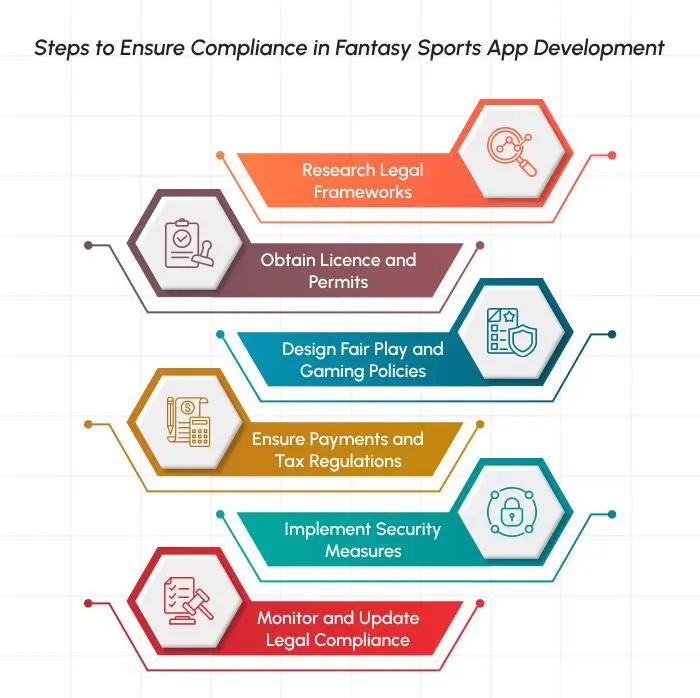
Steps to Stay Compliant While Creating a Fantasy Sports App
Ensuring legal compliance is crucial for the success and longevity of your fantasy sports app. Here are the key steps to follow to create a regulated fantasy sports app.
1. Research Legal Frameworks
- Decide first whether your app will be free-to-play or paid-entry in each market.
- Research country and state laws to see where each model can legally operate.
- Check licensing, registration and tax requirements in every jurisdiction you target.
2. Obtain Licenses and Permits
- Apply for fantasy contest operator licences where states require them, such as Ohio or Arizona.
- In the UK, review whether your contest needs a Gambling Commission pool betting licence; in Australia, plan for a state or territory wagering licence.
- Ensure your app meets anti-money laundering (AML) and know-your-customer (KYC) rules for payment processing.
3. Design Fair Play and Gaming Policies
- Implement strict age verification to prevent underage users from joining.
- Build responsible gaming features, such as deposit limits, cool-off periods and self-exclusion options.
- Clearly define rules, scoring systems and dispute resolution policies to keep contests transparent.
4. Ensure Payment and Tax Compliance
- Work with licensed payment gateways that support fantasy sports transactions, and block funding methods that a jurisdiction bans.
- Ensure tax compliance, as winnings may be subject to withholding or income tax depending on the country.
- Keep financial transaction records for audits.
5. Implement Security Measures
- Comply with GDPR (Europe), CCPA (California), India's DPDP Act and other data protection laws.
- Use encryption and secure authentication to protect financial transactions and personal data.
- Publish a clear privacy policy and terms of service that users accept before playing.
6. Monitor and Update Legal Compliance
- Track changing laws: in 2026 alone, India's Act took effect, Kentucky passed a new fantasy statute and Massachusetts proposed new rules.
- Conduct regular legal audits with compliance professionals.
- Update your terms and in-app rules when the law changes, and keep per-market switches in the admin panel so you can respond quickly.
By following these steps, you minimize legal risk, build user trust and create a sustainable fantasy sports business across different markets.
If the process feels overwhelming, you can hire an experienced fantasy sports app development company. The right team builds the compliance modules into the product from day one, so you can focus on growing and scaling your fantasy sports business.
Consequences of Ignoring Regulations in Fantasy Sports App Development
Failing to comply with the law can hurt your business, finances and reputation. Here are the risks of ignoring legal compliance.
- Heavy Fines and Legal Penalties
Operating without licences or breaking gaming laws can lead to large fines or criminal charges. India's Act sets prison terms of up to three years for offering online money games, and Australian regulators have fined operators hundreds of thousands of dollars for illegal ads.
- App Shutdown and Business Suspension
Where fantasy contests are restricted, authorities can block your app, revoke licences and halt operations.
- Payment Processing Restrictions
Banks may refuse to process transactions for unlicensed apps, causing withdrawal problems and damaging trust.
- Loss of User Trust and Brand Reputation
Legal challenges and a lack of transparency deter players and hurt retention.
- Investor and Partnership Risks
Legal uncertainty deters investors and puts partnerships with leagues and sponsors at risk.
- Intellectual Property Violations
Unauthorized use of player or team content can lead to lawsuits and costly settlements.
- Tax Evasion and Financial Liability
Non-compliance with tax rules leads to penalties and legal action.
On the whole, ignoring compliance in fantasy sports app development can have serious consequences. To avoid them, obtain the necessary licences, follow tax and gaming laws, build fair play features and consult legal experts before you launch.
Frequently Asked Questions
Is fantasy sports legal in India in 2026?
Free-to-play fantasy sports are legal in India. Paid fantasy contests, where users pay an entry fee to win money, have been banned since 1 May 2026 under the Promotion and Regulation of Online Gaming Act, 2025. A challenge to the Act is pending in the Supreme Court.
Is Dream11 still a real-money app?
No. Dream11 stopped all paid contests on 22 August 2025 and now runs as a free-to-play game.
Is fantasy sports considered gambling in the US?
Federal law excludes qualifying fantasy contests from the definition of a bet under UIGEA, but each state decides. Most states license or allow paid daily fantasy, a few do not, and some, such as New York and Michigan, ban certain formats like pick'em.
Do I need a licence to launch a fantasy sports app?
It depends on the market and the money model. Paid contests usually need state licences in the US, may need a pool betting licence in the UK and need a wagering licence in Australia. Free-to-play apps usually need no gaming licence, though India requires registration for some game categories.
What is the minimum age for fantasy sports apps?
It varies. Kentucky sets 18 by statute, while some US states and operators use 21. Build age verification that you can configure by state.
Can a fantasy sports app accept cryptocurrency?
Usually not for paid contests in regulated markets. Australia bans digital currency deposits for licensed wagering operators, and the Massachusetts draft rules would ban crypto for fantasy contests. Our guide to crypto adoption in fantasy sports explains where tokens can still work.
Conclusion
For startups and aspiring entrepreneurs, fantasy sports app regulations can feel overwhelming. From gaming laws to licences, payment rules and data protection, the landscape is complex and changed more in 2025 and 2026 than in the previous decade. Ignoring these rules can lead to fines, app bans and loss of user trust.
Instead of struggling with confusing regulations, partnering with an experienced team makes the process smoother. Pixel Web Solutions is a trusted fantasy sports app development company that builds feature-rich platforms and designs the compliance modules your markets require, from geolocation and KYC to free-to-play reward systems. Its team helps your app meet industry standards and regulatory requirements, so it is ready for a successful launch. If you are weighing a ready-made product, its white-label fantasy sports software can be configured per market. To scope your app against the fantasy sports app regulations in your target markets, talk to the Pixel Web Solutions team.