









AI in fantasy sports is no longer a roadmap promise. In 2026 FanDuel ships a generative AI betting assistant, ESPN gives 14 million fantasy football players weekly AI insights built with IBM watsonx, Yahoo sells an AI lineup manager as a subscription, and Sportradar collects match data with computer vision at 100 times the volume of human scouts. What AI still cannot do is predict individual results reliably, and the platforms that admit that, and design around it, keep users' trust. This guide covers the real features, the honest limits and a build checklist for fantasy and betting apps.
Artificial intelligence now sits behind the features fantasy players touch every day: lineup suggestions, injury alerts, trade grades and the chat box that answers "who should I start". It also runs the parts they never see, from odds compilation and fraud detection to the computer vision that turns a live match into a data feed.
The hype is real and so are the limits. In this guide we look at how AI in fantasy sports evolved, the roles it plays, the features live on major platforms with sources, the business impact, an honest section on what AI cannot do, and a checklist for teams building an AI-powered fantasy or sports betting app.
Key Takeaways
- Real features, not demos. FanDuel's AceAI, ESPN's watsonx insights, Yahoo's Assistant GM and third-party coaches such as FantasyPros Coach AI are live in 2026.
- The data layer is where AI changed most. Sportradar's computer vision yields 100 times more data than human collectors at up to 90% lower cost, and its MLB deal through 2032 includes jointly built AI products.
- AI cannot pick winners reliably. A June 2026 test asked Microsoft Copilot to predict four World Cup matches; all four ended in draws it never considered.
- Trust is the product. Explainable recommendations, clear data sources and responsible-gaming controls matter more than model accuracy claims.
- Market context: the global fantasy sports market is estimated at $42.37 billion in 2026; 57 million people in the US and Canada play fantasy sports.
- Build in order: licensed data, a feature store, one explainable recommendation feature, then conversational and agentic layers.
Understanding AI in Fantasy Sports and Its Evolution
AI in fantasy sports has evolved from basic data tracking to predictive analytics and now to conversational and agentic assistants. The first generation was descriptive: the app showed stats and the user did the analysis. The second generation added projections, waiver grades and trade analysers. The third, which arrived across 2025 and 2026, lets users ask questions in plain language and, in some products, lets the assistant act for them.
The results show up in engagement. The Fantasy Sports and Gaming Association's July 2025 research estimates 57 million fantasy players and 84 million fantasy-or-betting participants across the US and Canada, and among players aged 13 to 20, 66% update their lineups daily. Daily lineup decisions are exactly where AI advice is consumed.
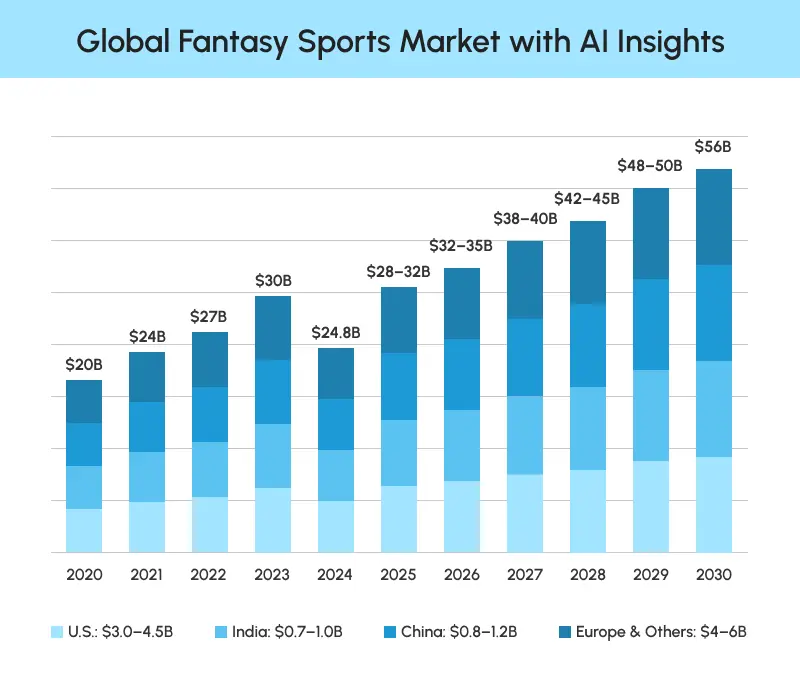
Source: Grand View Research, AI in sports market report
As the infographic shows, the US, India, China and Europe are all expanding, supported by smartphone adoption, deeper analytics and personalised fantasy experiences. Market sizing varies by publisher: Mordor Intelligence estimates the global fantasy sports market at $42.37 billion in 2026, rising to $80.31 billion by 2031, with Asia Pacific the fastest-growing region. One caveat for India: paid contests have been banned there since the Online Gaming Act and Rules came into force on 1 May 2026, so AI features in that market serve free-to-play products.
Core Roles of AI in the Fantasy Sports Industry
AI has moved from an add-on module to a core element of fantasy platforms. These are its main roles.
AI-powered predictions and projections
Models trained on historical performance, matchups, injuries, weather and usage produce projections that drive rankings, salary values and lineup optimisers. This is the oldest and most mature use.
Conversational assistants
Large language models let users ask "which tight end should I start" or "build me a parlay under 5-to-1" and get an answer grounded in the platform's data. FanDuel's AceAI is the clearest example in betting; FantasyPros Coach AI and similar tools do it for fantasy.
Hyper-personalised experience
AI tailors notifications, content and offers to each user's leagues, players and behaviour, from injury alerts for rostered players to waiver suggestions timed to the user's league settings.
Real-time interaction and gamification
Live alerts when a rostered player is underperforming, in-game suggestions and dynamic challenges keep users engaged during matches.
Fair play, fraud and integrity
Models detect multi-accounting, collusion and unusual betting patterns. Sportradar's integrity services, including its fraud detection system, are part of its MLB partnership through 2032.
Automation and scale
AI automates data collection, scoring, content generation and support. Sportradar told investors in April 2025 that computer vision now collects data from more than half the live games it covers, producing 100 times more data than human collectors at up to 90% lower cost, and that its in-house AI models are projected to lift operator profits by 11%.
Real AI Features Live in Fantasy and Betting Apps in 2026
The table below lists features you can verify today rather than roadmap claims.
| Platform | Feature | What it does | Source |
|---|---|---|---|
| FanDuel | AceAI | Generative AI chat inside the sportsbook app that finds bets, builds parlays and researches stats on request, launched March 2025 | FanDuel newsroom |
| ESPN Fantasy Football | Fantasy Insights built with IBM watsonx | Weekly AI-generated player overviews for more than 14 million players, plus IBM-powered waiver grades, trade grades, boom-and-bust probabilities and a trade analyser | IBM newsroom, September 2025 |
| Yahoo Fantasy | Assistant GM | Optimises lineups on request, sets lineups weeks ahead around byes and matchups, and sends morning alerts; part of Fantasy Plus at $2.92 a month billed annually | Yahoo help, Yahoo Fantasy Plus |
| FantasyPros, Fantasy Points, STACKED, RotoBot | AI coaches | Start-sit, trade and waiver advice, draft war rooms and research assistants that sync with Sleeper, Yahoo and ESPN leagues | FantasyPros review, August 2026 |
| Sportradar (data supplier) | Sportradar Brain, computer vision, odds optimisation | A generative model over Sportradar's data that answers betting queries and writes articles; computer vision data collection; real-time odds adjusted per bookmaker risk appetite | iGaming Business, April 2025 |
| DraftKings | AI across personalisation and marketing | Management describes AI and machine learning as improving products, platform speed, trust and marketing efficiency; 3.6 million monthly unique payers in Q2 2026 | DraftKings Q2 2026 results |
Two things stand out. First, the fantasy-side features are mostly advisory and explainable: grades, probabilities and ranked lists. Second, the betting-side features are conversational and act as research tools, with responsible-gaming guardrails. Both patterns are worth copying.
Key Applications of AI in Fantasy Sports and Betting Platforms
AI for fantasy predictions
Projection models combine player performance, team context, injuries, weather and usage trends. The best products show the inputs, not just the output.
AI-powered fan engagement tools
Personalised notifications, chatbots that answer league questions, and gamified challenges keep users active between matches and during the off-season.
AI in sports betting and analytics apps
Odds compilation, risk management, same-game parlay pricing and anomaly detection all run on models. Conversational assistants such as AceAI help users find and build bets.
AI-generated content and commentary
Automated recaps, previews and audio, such as Sportradar's generative audio advertising for operators, scale content without a newsroom.
AI in team and player selection
Lineup optimisers, draft assistants and trade analysers reduce the hardest decisions to ranked, explained options.
Business Impact of AI in Fantasy Sports Betting Applications
AI changes how fantasy businesses operate, not only how users play.
Increasing user retention
Personalised alerts, lineup help and weekly insights give users a reason to open the app every day. ESPN added watsonx insights to the fantasy home page precisely to lift weekly engagement.
Data-driven revenue opportunities
AI features are now a paid tier. Yahoo bundles Assistant GM into Fantasy Plus, and in August 2026 added a Fantasy Ultra tier at $79.99 a year. Subscriptions also work in markets where paid contests are banned.
Operational efficiency
Computer vision data collection, automated scoring and AI-assisted support cut costs. Flutter's Q2 2026 results list leveraging AI as part of its efficiency programme.
Actionable insights for growth
Behavioural models show which features users value, which contests fill and where churn starts, guiding both product and marketing.
Real-World Examples of AI-Powered Fantasy Sports Apps
ESPN Fantasy
ESPN's partnership with IBM delivers waiver grades, trade grades, boom-and-bust probabilities and, since September 2025, weekly generative insights for its more than 14 million fantasy football players.
Yahoo Fantasy
Assistant GM sets and optimises lineups for Fantasy Plus subscribers, and Yahoo's August 2026 Fantasy Ultra tier adds an AI-assisted draft kit.
FanDuel
AceAI brings a generative AI chat assistant into the sportsbook app, and FanDuel's DFS product shares the same data and personalisation stack.
DraftKings
DraftKings reports AI across personalisation, merchandising and marketing efficiency, supporting 3.6 million monthly unique payers in Q2 2026 across its unified app.
Third-party AI coaches
FantasyPros Coach AI, Fantasy Points' Ball Knowledge, STACKED and RotoBot show that a focused AI product can live alongside the big platforms by syncing with their leagues.
What AI Cannot Do in Fantasy Sports (and Why That Matters for Your Product)
This is the section most guides leave out. Being honest about limits is how you keep users.
AI cannot predict individual outcomes reliably. In June 2026, USA Today journalists asked Microsoft Copilot to predict four World Cup matches; it picked a winner in each and every match ended in a draw, an outcome it never considered. Sports are low-sample, high-variance systems. Projections improve averages across a season, not the result of one game.
AI inherits the bias of its training data. A model trained on last season overreacts to recent form, undervalues rookies and misreads role changes after trades. Fantasy baseball position changes and golf course fit are classic failure modes.
AI does not know what the data does not contain. A late scratch, a coaching decision or a weather delay is invisible until the feed updates. The assistant that confidently recommends a player who was ruled out ten minutes ago destroys trust.
AI cannot resolve the legal question of what you are allowed to offer. Pick'em restrictions in New York, the ban on paid contests in India and sportsbook licensing are compliance decisions, and a recommendation engine must respect them per jurisdiction.
AI should not nudge users toward risk. Regulators and users expect responsible-gaming guardrails. FanDuel positioned AceAI as an educational resource, and any assistant you build should surface limits and cooling-off tools rather than only "more bets".
AI tools still have product gaps. FantasyPros' 2026 review notes that several AI coaches lack live draft execution, league sync or stable connectivity. Users forgive a missing feature; they do not forgive a confident wrong answer.
Design response: show confidence ranges, cite the data behind each recommendation, timestamp every input, and let the user override. Explainability is a feature, not a compliance chore.
Challenges in Implementing AI for Fantasy Sports Businesses
Data rights and licensing
AI needs data, and commercial sports data is licensed. SportsDataIO's self-serve tier is delayed by one day and not licensed for commercial use; official feeds from Sportradar are quoted per client. A model built on scraped data is a legal liability.
Data privacy and security
Behavioural and financial data must be protected, and personalisation must respect privacy law in each market.
Cost and technical expertise
Model development, inference costs and ongoing retraining need budget and skills. Smaller platforms should start with proven, explainable features rather than custom models.
Regulatory and compliance issues
Betting assistants face advertising and responsible-gaming rules; fantasy recommendations must respect per-state format restrictions.
Transparency in predictions
Black-box recommendations erode trust. Explainable outputs and visible sources keep users engaged.
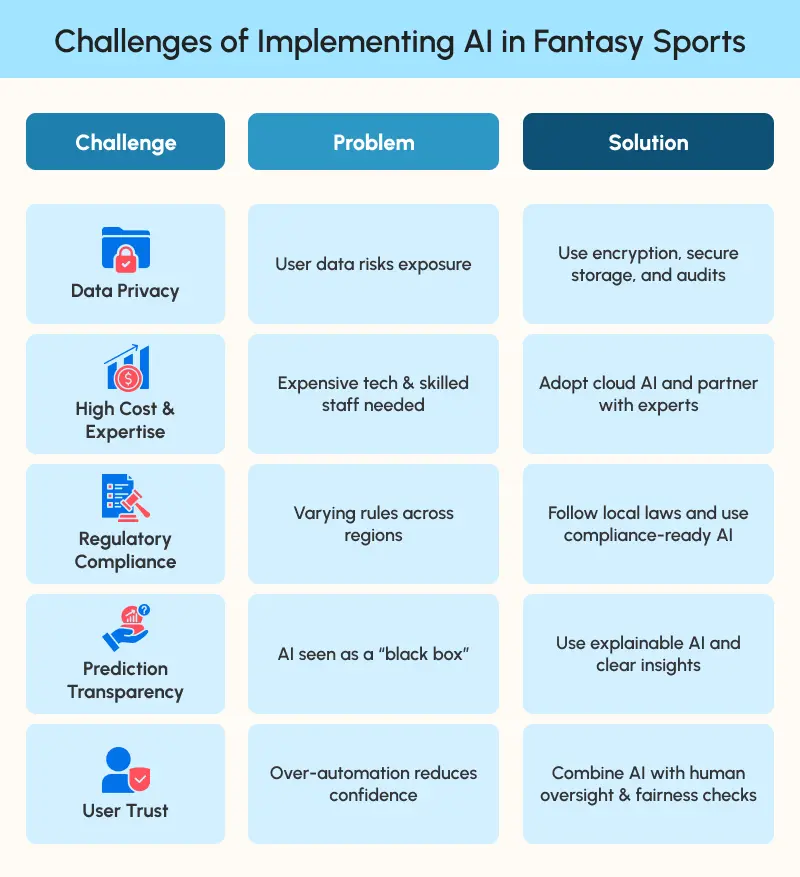
With an experienced AI partner these challenges are manageable. Pixel Web Solutions addresses them through its AI development services, covering data pipelines, model deployment and explainability.
A Build Checklist for AI in a Fantasy Sports App
If you are adding AI to a fantasy or betting product, this order avoids the common mistakes.
- Secure licensed data first. Sign a commercial feed agreement and store raw events with timestamps. Everything downstream depends on it.
- Build a feature store. Clean, versioned player, team and context features that both projections and the assistant can use.
- Ship one explainable feature. A waiver grade or start-sit ranking with the top three reasons shown. Measure whether users act on it.
- Add personalisation. Alerts and content scoped to the user's leagues and rostered players.
- Add a conversational layer. A retrieval-grounded assistant that answers only from your data, with confidence and source shown, and that declines questions it cannot answer.
- Add agentic actions carefully. Let the assistant set a lineup or claim a waiver only on explicit user instruction, with an undo. Pixel builds these through its AI agent development services.
- Wire in responsible-gaming controls. Limits, cooling-off prompts and risk signals must sit inside the assistant, not beside it.
- Respect jurisdiction. Recommendations and contest types switch by state or country.
- Evaluate continuously. Track projection error, recommendation acceptance and user-reported mistakes every week of the season.
For the platform underneath, see how to build a fantasy sports app.
Future of AI in Fantasy Sports and Sports Apps
The next phase is agentic: assistants that manage a roster under standing instructions, negotiate trades between users' agents and summarise a league's week in the user's preferred format. Richer tracking data (Statcast, ShotLink, player tracking) will make new scoring categories and more granular projections possible. Prediction-market pricing will feed into fantasy advice as sports contracts spread. And AI will carry more of the responsible-gaming load, flagging risk patterns early.
What will not change is the need for licensed data, explainability and human override. The platforms that treat AI as a coach rather than an oracle will keep their users.
Conclusion
AI in fantasy sports has moved from promise to product. The features that work in 2026 are grounded in licensed data, explain themselves and respect the user's control and the law. The failures are the confident predictions that ignore variance.
Pixel Web Solutions builds AI-powered fantasy and betting platforms through its fantasy sports app development services, combining projection models, conversational assistants, fraud detection and responsible-gaming tooling on a compliant data layer. Contact Pixel Web Solutions to plan an AI feature roadmap that your users will trust.
Frequently Asked Questions
How is AI used in fantasy sports apps in 2026?
For projections and rankings, lineup and waiver advice, personalised alerts, conversational assistants such as FanDuel's AceAI and ESPN's watsonx insights, fraud detection, and automated data collection and content.
Can AI accurately predict fantasy sports outcomes?
Not for single games. AI improves season-long projections and highlights risks, but a June 2026 test saw Microsoft Copilot miss all four World Cup results it was asked to predict. Treat AI as advice with confidence ranges.
Which fantasy apps have real AI features?
ESPN (IBM watsonx insights, grades and trade analyser), Yahoo (Assistant GM in Fantasy Plus), FanDuel (AceAI in its sportsbook), DraftKings (personalisation across its app) and third-party coaches such as FantasyPros Coach AI.
What data do you need to build AI features for a fantasy app?
Licensed, timestamped play-by-play or box-score data, injury and lineup news, schedules and user behaviour. Public feeds such as MLB's Stats API are limited to non-commercial use.
Is AI in fantasy sports legal?
The AI itself is. What matters is the product it sits in: paid contests are banned in India since 1 May 2026, several US states restrict pick'em formats, and betting assistants must follow advertising and responsible-gaming rules.
How much does it cost to add AI to a fantasy sports app?
It depends on scope. An explainable ranking feature built on an existing data pipeline is a few hundred development hours; a retrieval-grounded assistant with personalisation and agentic actions is a multi-month project plus ongoing inference and data costs. Pixel quotes each AI in fantasy sports project individually.