








Table of Contents
Last updated: 4 October 2026 | Reviewed by Mathibharathi Mariselvan, Co-founder, Pixel Web Solutions | 13 min read
Fantasy sports apps make money mainly by keeping a commission, called the rake, of roughly 8% to 15% of the entry fees in every paid contest, and the rest goes back to winners as prizes. On top of that, they earn from premium subscriptions, advertising and sponsorships, in-app purchases, affiliate deals, data insights, licensing, events, and freemium upgrades. The rake model only works where paid contests are legal: India banned real-money fantasy games in August 2025, which pushed Dream11 to a free-to-play, ad-funded model.
Fantasy sports apps have become very popular, changing how fans interact with their favorite games. What began as a small hobby is now a global trend, with millions of users creating virtual teams and competing for prizes and bragging rights. So how do fantasy sports apps make money, and how do they keep users coming back?
The numbers explain the interest. Grand View Research values the global fantasy sports market at $27.8 billion in 2025 and projects $75.1 billion by 2033. The biggest operators are now large public companies: DraftKings, which started as a daily fantasy site, reported more than $6 billion of revenue for 2025.
That growth opens a wide gate for entrepreneurs who want to start a business in the fantasy sports niche.
So, if you are in the early stages of developing your fantasy sports app, here is what you need to know: the key money-making strategies, the opportunities, the rules that limit them, and how to make your app profitable.
Key Takeaways
- Contest fees are the core revenue model: the app keeps a rake of roughly 8% to 15% of entry fees and pays the rest out as prizes.
- Nine revenue streams stack on top of each other: entry fees, subscriptions, advertising and sponsorships, in-app purchases, affiliate marketing, data, licensing, events, and freemium upgrades.
- Regulation decides which model you can use: India's Online Gaming Act of August 2025 ended paid fantasy contests there, and Dream11 paused paid contests that made up over 90% of its revenue.
- Most players do not profit, the platform does: McKinsey found that 1.3% of daily fantasy players won 91% of player profits in one 2015 sample.
- US operators are adding new products: DraftKings and FanDuel launched CFTC-regulated prediction market apps in December 2025.
How Do Fantasy Sports Apps Make Money?
Fantasy sports apps combine traditional and newer revenue streams to attract millions of users and generate substantial income. Fantasy football apps capitalize on the global fanbase of leagues like the NFL and the Premier League, and fantasy cricket apps ride tournaments like the IPL.
Below, we cover the key revenue streams behind these apps, the additional strategies they use, and how industry leaders like Dream11 have had to adapt. Let us start with the core model.
Key Revenue Streams Of Fantasy Sports App
Fantasy sports apps are platforms where users compete by creating virtual teams of real athletes. These apps make money in several ways, which lets them offer fun games while staying profitable.
1. Entry Fees for Contests
Many fantasy sports apps charge entry fees for daily, weekly, or season-long contests. The fees form the prize pool, and the app keeps a share as its commission, known as the rake. Industry comparisons put the rake at roughly 8% on larger DraftKings and FanDuel contests and 10% to 15% on some pick'em apps, and small-stakes contests often carry a higher percentage. Platforms like DraftKings and FanDuel built their businesses on this model.
2. Subscription Models
Premium subscriptions unlock features like expert advice, advanced analytics, or an ad-free experience. Some apps offer tiered plans with real-time player statistics and lineup optimizers. These services cater to serious players who want a competitive edge and create a steady income stream for the app.
3. Advertising and Sponsorships
In-app advertisements are a major revenue source, because brands want to reach fantasy sports' highly engaged audience. Partnerships with sports leagues or teams amplify this income. For example, apps may run sponsored contests during major tournaments or show ads from sportswear brands, which blends monetization with user activity. For free-to-play apps, advertising and sponsorship become the main business model.
4. In-app purchases
Fantasy sports apps sell virtual goods like power-ups, performance boosts, or team customizations. These microtransactions enhance gameplay and add a supplementary revenue stream.
5. Affiliate Marketing
Partnerships with betting companies, merchandise stores, or sports leagues let apps earn referral income. The app earns a commission when users click affiliate links or buy from partner brands. For instance, an app might promote a licensed sportsbook during contests and earn a referral fee, where local law allows it.
6. Data Monetization
Anonymized user data is a valuable asset. Fantasy sports apps derive insights from user behavior and share them with advertisers and market researchers. This helps brands target campaigns more effectively and adds another layer of revenue, provided the app follows privacy law and its own consent terms.
In short, fantasy sports apps make money through fees, ads, subscriptions, in-app purchases, and partnerships. These revenue streams keep the apps profitable while offering exciting experiences for users. There are also other creative ways these apps generate revenue. Once you know how fantasy sports apps make money, read our fantasy sports app development guide to see how to build one and enter the industry.
Let's explore the additional strategies.
Additional Fantasy Sports App Monetization Strategies
Core strategies like entry fees and subscriptions drive most of the income, but fantasy sports apps also use newer methods to diversify revenue. Here are the top 3 strategies to increase fantasy sports revenue.
1. Licensing Deals
Collaborating with sports leagues or teams for exclusive rights and branded content is a powerful revenue strategy. Apps can integrate official team logos, player likenesses, or league-specific features, which adds authenticity and user appeal.
For example, an official partnership with a league like the NFL or IPL lets an app market itself as an official fantasy platform and attract dedicated fans. These agreements often involve substantial fees or revenue sharing.
2. Events and Sponsorships
Fantasy sports apps increasingly host live events, such as tournaments, workshops, or fan meetups, to build community engagement. These events generate revenue from ticket sales, merchandise, and sponsorship deals.
For instance, an app might organize a live fantasy draft event during a major sporting season, with sponsored booths and branded content. Sponsors see these events as a way to connect directly with an engaged audience.
3. Freemium Model
Freemium is a cornerstone of user acquisition. Apps attract a broad user base with free contests or basic features and offer premium services to convert those users into paying customers.
Fantasy sports app features like advanced analytics, expert tips, or entry to high-stakes contests appeal to serious players and drive upgrades to paid plans. This approach scales well while growing revenue.
By combining traditional monetization with these strategies, fantasy sports apps have built diverse revenue streams to sustain and scale their businesses. Football and cricket remain the top priorities because of their massive global fan bases and year-round tournaments.
Their success comes from engaging passionate fan communities who want deeper interaction with their favorite sports, which drives participation and profitability across the fantasy sports ecosystem.
So, here is how the model works sport by sport.
How do Fantasy Football Apps Make Money?
Fantasy football makes money in the same core way as other fantasy sports. Apps for the NFL, the Premier League, and the UEFA Champions League attract millions of users and earn mainly from league entry fees, keeping a percentage of each prize pool, especially in daily fantasy contests.
Additional income comes from premium subscriptions with advanced analytics, ads, sponsorships, and affiliate marketing with licensed sportsbooks. In-app purchases for draft kits and expert advice also add to their earnings.
They also profit from licensing deals, anonymized data insights, and live events, which together make fantasy football a multibillion-dollar industry. These strategies show how platforms turn fans' passion for the sport into revenue.
Now let us look at cricket.
How do Fantasy Cricket Apps Make Money?
Fantasy cricket apps thrive on major tournaments like the IPL and the ICC World Cup, especially in cricket-loving countries. Where paid contests are legal, they earn mainly from entry fees, keeping a percentage of the prize pool.
Additional income comes from premium subscriptions with advanced analytics and an ad-free experience, plus advertising, sponsorships, and affiliate marketing. In-app purchases for tools and data insights also contribute.
India is the largest fantasy cricket market, and it changed sharply in 2025. The Promotion and Regulation of Online Gaming Act, which India's Parliament passed in August 2025, bans real-money online games, including paid fantasy contests. Fantasy cricket in India now runs on free-to-play models funded by advertising and sponsorship. Before you launch in any country, check its rules in our guide to regulations in fantasy sports app development.
Among fantasy cricket apps, Dream11 built the best-known monetization model, and its pivot shows how much regulation shapes the business.
How does Dream11 Make Money?
Until August 2025, Dream11 earned most of its money from entry fees for fantasy contests, keeping a commission from each prize pool. This commission, the rake, was the platform's main source of revenue. When the new law passed, Dream11 paused all paid contests, which had accounted for over 90% of its revenue.
Dream11 now operates as a free-to-play fantasy app. That leaves advertising, sponsorships, and brand partnerships as its main revenue streams, alongside licensed content from leagues, teams, and broadcasters, such as official team logos and player profiles.
Dream11 also built premium features such as match previews, expert predictions, and analytics tools, and it earned from affiliate marketing and in-app purchases like custom private leagues. The lesson for founders is clear: a strong product and a large user base help, but your revenue model must fit the law in every market you serve.
Many fantasy sports apps that use these strategies are likely to keep growing. Are you interested in building an app like Dream11 to generate revenue?
Here are the leading platforms.
Top 5 Profit-Making Fantasy Sports Apps
Certain fantasy sports apps dominate the market thanks to their monetization strategies and their ability to adapt to changing user needs. The graphic below shows five popular fantasy sports apps and their estimated yearly revenues for 2025.
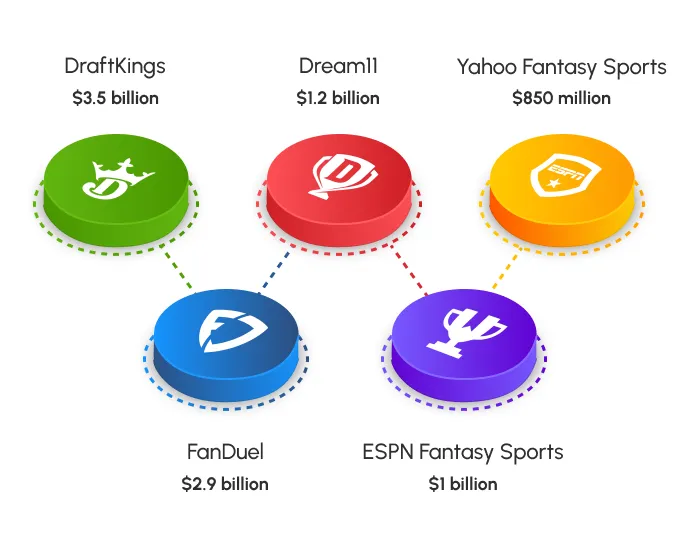
Two updates matter as of October 2026. DraftKings grew revenue 27% to more than $6 billion in 2025 and posted positive net income for the year, having expanded from daily fantasy into sportsbook, online casino and, in December 2025, prediction markets. FanDuel launched its own prediction market app the same month. Dream11, meanwhile, no longer earns from paid contests in India. For a current, ranked view of the market, see our list of the best fantasy sports apps in 2026.
The growth of these apps underscores the importance of combining smart monetization with a deep understanding of user behavior and local regulation.
The success of top fantasy sports apps like DraftKings, FanDuel, and Dream11 proves that blending smart monetization with user-centric innovation is the key to thriving in this competitive space. Before we turn to app owners, here is the question many players ask.
Can You Make Money from Fantasy Football as a Player?
Yes, but most players do not, and the platform always does. In paid contests, the app takes its rake before prizes are paid, so the average player loses about the rake over time. Winnings are also concentrated among a few skilled, high-volume players: McKinsey found that in the first half of the 2015 MLB season, 91% of daily fantasy player profits went to just 1.3% of players.
Season-long leagues with friends work differently: the money moves between league members, and only the best manager comes out ahead. If you play for money, play only where paid fantasy contests are legal for your age and location, set a budget, and treat it as entertainment rather than income.
The dependable money in fantasy sports sits on the business side. The operator earns the rake on every contest, whoever wins, plus subscriptions, advertising, and sponsorships. That is why entrepreneurs build fantasy sports apps rather than relying on winning them.
How To Make Money With Your Fantasy Sports App?
Understanding these monetization strategies matters because they keep platforms profitable and shape the overall user experience. Here is why they are vital for the success and sustainability of your app.
Sustainability and Profitability
Monetization strategies keep fantasy sports apps profitable and sustainable. They let platforms generate revenue while offering engaging experiences, and they balance free access with income, catering to both casual players and serious competitors.
Capitalizing on Market Potential
The fantasy sports industry is a multi-billion-dollar market with millions of users worldwide. Effective monetization lets apps tap into that potential. Entry fees for contests, premium subscriptions, and in-app purchases are key to maximizing profitability where paid play is legal. Partnerships with advertisers and sponsors bring in substantial income while matching user interests.
Fueling Innovation and Growth
Monetization drives innovation. Revenue is often reinvested into better features, stronger security, and expansion into new regions. This growth cycle attracts more users and keeps platforms competitive.
Ensuring Long-Term Success
Without effective revenue strategies, fantasy sports apps risk losing relevance in a crowded market. Monetization secures the resources to innovate, evolve, and deliver value to users and stakeholders, which makes it vital for long-term success.
By mastering these monetization strategies, you can turn your fantasy sports app into a profitable, sustainable platform that stands out. To plan your budget, see our breakdown of fantasy sports app development cost. Ready to tap into the billion-dollar fantasy sports industry?
Launch Your Revenue Generating Fantasy Sports App Now
Fantasy sports keep growing thanks to better technology, changing consumer habits, and the rising popularity of global sports. As demand rises, a fantasy sports app is an increasingly attractive business opportunity.
By developing a fantasy sports platform, you can tap into multiple revenue streams and gain a share of the growing market. As the app owner, you control monetization, user engagement, and partnerships, so you can scale and earn consistent revenue. With strong demand in football, cricket, and basketball, your own app offers real long-term potential, as long as you choose a revenue model that is legal in your target markets.
If you are a startup looking to break into this industry, now is the time to act. Hiring a development partner is a key step toward success. Pixel Web Solutions is a top-notch fantasy sports app development company, known for creating innovative, user-friendly apps that generate substantial revenue.
How Pixel Web Solutions Can Assist You?
Pixel Web Solutions stands out as a trusted fantasy sports app development service provider, delivering customized, scalable, and feature-packed solutions aligned with your business goals. We also create white label fantasy sports software with intuitive interfaces and real-time data analytics. From startups to established enterprises, we cover every step from ideation to deployment, so your fantasy sports app makes money in a competitive market.
FAQ: How Fantasy Sports Apps Make Money
1. How do fantasy sports apps make money?
They mainly keep a commission, or rake, of roughly 8% to 15% of the entry fees in paid contests and return the rest as prizes. They add revenue from premium subscriptions, advertising, sponsorships, in-app purchases, affiliate deals, data insights, and licensing. Free-to-play apps rely mostly on advertising and sponsorship.
2. How does fantasy football make money?
Fantasy football platforms earn from entry fees on paid leagues and daily contests, keeping a share of each prize pool. They also sell premium tools such as draft kits and analytics, and earn from ads, sponsorships, and partnerships with leagues and licensed sportsbooks.
3. Can you make money from fantasy football?
Some players do, but most lose a little over time because the platform takes its rake before paying prizes. McKinsey found that 1.3% of daily fantasy players took 91% of player profits in one 2015 sample. Play only where it is legal and treat it as entertainment, since the reliable profit goes to the platform.
4. What is the revenue model of a fantasy sports app?
The standard model is a contest platform: users pay entry fees, the app keeps a fixed percentage, and the remainder funds prizes. Successful apps layer freemium upgrades, subscriptions, advertising, and sponsorships on top, so revenue does not depend on one stream.
5. Is a fantasy sports app business still profitable in 2026?
It can be, if the revenue model fits local law. In the US, operators like DraftKings grew revenue to more than $6 billion in 2025, while in India paid fantasy contests ended in August 2025 and apps moved to free-to-play models funded by ads. Check the rules in every market before you choose between paid contests and free-to-play.