A Trust Wallet clone script is pre-built, white-label wallet software that lets you launch a self-custody, multi-chain crypto wallet with Trust Wallet's core features (multi-coin storage, swaps, staking, NFTs and a dApp browser) under your own brand. It saves you from building wallet infrastructure from scratch, and a configured build can reach app store submission in about 6 to 10 weeks. Pixel Web Solutions' white-label wallet starts at about $4,500.
Trust Wallet is one of the world's leading decentralized, non-custodial wallets. Founded in 2017 and acquired by Binance in July 2018, it passed 220 million users in 2025 and supports more than 110 chains and over 32 million assets, according to Trust Wallet's 2025 year-end review. Users keep full ownership of their private keys while reaching swaps, staking, perps, prediction markets and tokenized stocks from one app. As Trust Wallet's popularity grows, so does demand for crypto wallets built like it.
A ready-made clone script is the shortest route to that product. Instead of spending many months on wallet infrastructure, you start from a tested foundation and spend your budget on your brand, your niche and your users. In this guide you will learn what the script includes, how it compares with other build options, what Trust Wallet's own December 2025 security incident teaches buyers, what wallets like this actually earn, and what a launch costs.
Key Takeaways
- A Trust Wallet clone script is independently built software, not Trust Wallet's code or brand. Trust Wallet's old app repositories are GPL-licensed and archived since 2019, while its Wallet Core library (130+ chains) is Apache 2.0 and can be reused with attribution.
- Trust Wallet is the benchmark at 220 million users, 110+ chains and 32 million+ assets, so a 2026 clone needs multi-chain support, a security scanner and in-app trading, not just send and receive.
- Wallet revenue is shifting to trading. DefiLlama data shows Trust Wallet's perps builder fees overtook its swap fees in August 2026, earning about $1.36 million of its $1.73 million revenue in the 30 days to 27 September 2026.
- The biggest risk is the release pipeline. A leaked Chrome Web Store key let attackers publish a malicious Trust Wallet extension on 24 December 2025, draining 2,520 addresses. Ask any clone vendor how builds are signed and released.
- Pixel Web Solutions' white-label wallet starts at about $4,500 for a single platform; multi-platform Trust Wallet-style builds typically cost $25,000 to $50,000.
What is the Trust Wallet Clone Script?
A Trust Wallet Clone Script is a pre-built, white-label cryptocurrency wallet solution that offers the essential features of Trust Wallet. It supports secure storage, transfers, staking, token swaps, NFT management and access to dApps, all under your own brand.
Opting for this kind of script helps startups, SMBs and enterprises enter the crypto wallet space without months of core engineering. Trust wallet clone software works with multiple blockchains and protects private keys with strong security, so users stay in control of their crypto.
It lets you create a crypto wallet app quickly and cost-effectively. Because it is built on a proven framework with essential features already tested, it lowers delivery risk while still leaving room for your own features. As more people adopt crypto, launching a Trust Wallet clone is a practical way to enter this growing market.
Trust Wallet Clone Script Vs Development From Scratch
"Clone script", "white-label wallet" and "wallet SDK" are often used as if they meant the same thing. They do not. Each option trades speed against control differently:
| Build option | What you get | Key custody | Time to launch | Price guide |
|---|---|---|---|---|
| Trust Wallet clone script | A pre-built wallet that mirrors Trust Wallet's mobile-first, multi-chain flows, rebranded and extended | Users (self-custody) | 6 to 10 weeks for a configured build | From about $4,500 (single platform) |
| White-label crypto wallet | A generic, pre-audited wallet core configured with your chains, custody model and on-ramp | Self-custody, custodial or MPC | 6 to 10 weeks | From about $4,500 |
| Wallet-as-a-Service SDK | A wallet layer embedded in your existing app, often with email or social login | Usually MPC key shares or smart accounts | 4 to 8 weeks to integrate | Varies by provider and usage |
| Development from scratch | A new architecture, security model and codebase that you fully own | Any model | 16 to 24 weeks or more | $100,000 to $150,000+ |
Choose a clone script when you want your own wallet brand in the app stores fast. Choose an SDK when you already have an app and users, and wallets are a feature rather than the product. Choose a scratch build when custody, regulation or a genuinely new user experience demands it. Our white-label crypto wallet development page explains the configured options in detail.
Why Build a Web3 Wallet Like a Trust Wallet?
Grand View Research now projects the global crypto wallet market to reach $100.77 billion by 2033, growing at a CAGR of 26.3% from 2025. The user base keeps growing too: global crypto owners reached 774 million in June 2026, according to Crypto.com's H1 2026 Market Sizing report. Developing a wallet like Trust Wallet lets businesses enter this space and give users a safe, familiar experience.
-
Growing Demand for Crypto Wallets: Rising adoption of cryptocurrencies, stablecoins and DeFi creates a steady need for secure, reliable wallets.
-
Access to the Web3 Ecosystem: A Web3 wallet lets users interact with dApps, DeFi platforms, NFTs and blockchain-based services from one place.
-
Multiple Revenue Opportunities: Businesses can earn from swaps, perps and prediction-market builder fees, staking commissions, on-ramp revenue share and premium features.
-
Enhanced Security and User Control: Self-custody keeps users in control of their assets without a third party holding their keys.
-
Brand Building in the Web3 Space: Launching a wallet builds credibility and gives your brand a daily touchpoint with users.
-
Customization and Scalability: Flexible features and a scalable architecture let the wallet adapt as your business grows.
A Trust Wallet-style clone serves as a comprehensive solution, enabling startups to launch custom crypto wallet apps efficiently. With it, your startup gets an affordable, adaptable, secure and scalable cryptocurrency wallet platform, so you can capitalize on this expanding market, avoid common development pitfalls and launch sooner.
Key Features of Our Trust Wallet Clone Script
Pixel Web Solutions' Trust Wallet Clone Script is a customizable crypto wallet solution that puts security and ease of use first. You can reshape the interface, chains and modules, while the security core (key generation, encryption and signing) stays locked to audited code. Knowing where that line sits helps you plan custom features realistically.
User Features
-
Multi-Coin Wallet Support: Manage, receive and send cryptocurrencies such as BTC, ETH, BNB and SOL, plus thousands of tokens, all in one wallet.
-
In-App Token Swapping: Swap tokens inside the Trust Wallet clone app through integrated decentralized exchange aggregators, including cross-chain swaps.
-
DApp Browser Support: Explore decentralized applications and interact with them directly from the wallet.
-
NFT Wallet Support: Send, receive and manage NFTs in a dedicated section of the wallet.
-
Live Price Tracking: Price movements and charts help users make informed decisions about trading and managing their portfolio.
-
Biometric Authentication: Secure login with fingerprint or face ID adds protection and peace of mind.
-
WalletConnect Integration: Connect safely to external dApps and decentralized services without exposing keys.
-
Staking Rewards: Users earn rewards by staking eligible coins in our Trust wallet clone software, which also helps secure blockchain networks.
Admin Features
-
User Management Panel: View registered app installs and activity, manage permissions, and handle support cases. In a self-custody wallet, admins never see or control users' keys.
-
Dashboard Analytics: Real-time insight into usage, transactions and app statistics through detailed analytics dashboards.
-
Revenue Tracking System: Monitor income from swap fees, builder fees and staking commissions in one place.
-
CMS & Multi-Language Control: Manage banners, pages and languages to give users a consistent global experience.
-
KYC/AML Compliance: Optional KYC/AML modules for custodial features, fiat ramps and regulated markets.
-
Token Management Tools: Add, remove or update supported tokens to keep your wallet in line with the market.
-
Push Notifications: Updates on transactions, staking rewards and promotions keep your users informed and engaged.
-
Customer Support Management: A ticket system helps your team track and resolve user issues quickly.
Knowing these essential crypto wallet features is a great starting point for launching a crypto wallet like Trust Wallet. The system is built to support compliance with data protection rules such as GDPR and with the FATF Travel Rule where your custodial or ramp features require it, although final compliance always depends on your licences and markets.

Security Features of Our Trust Wallet Clone Script
Security is the backbone of any crypto wallet. Our clone script puts security first so users can store their digital assets safely. Each feature is designed to prevent unauthorized access, data leakage and loss of funds, so both businesses and users can operate with confidence.
- Two-Factor Authentication (2FA): Adds an extra identity check beyond a password for account-level actions such as ramp and support access.
- On-Device Key Encryption: Private keys and seed phrases are encrypted on the user's device and never sent to your servers; all network traffic uses TLS.
- Multi-Signature Vaults: Requiring more than one key removes the risk that a single failure loses a user's higher-value assets.
- Secure Seed Phrase Backup: Users back up an encrypted recovery phrase so they can restore the Trust Wallet clone on a new device. Only the user ever sees it.
- Transaction Simulation & Scam Scanner: Before signing, the wallet shows the outcome in plain language and flags known drainer contracts, risky approvals and look-alike addresses. Trust Wallet says its own scanner stopped $191 million from reaching scam addresses in 2025.
- Anti-Phishing & DDoS Protection: Domain blocklists and rate limiting protect users from phishing sites and keep your backend available.
- CSRF Protection & SSRF Protection: Stop the execution of unauthorized actions and block access to internal services.
By implementing robust security measures, you can create a Trust Wallet Clone App that keeps users safe. However, the 2025 incidents below show that the way code reaches users matters just as much.
What Trust Wallet's December 2025 Extension Breach Teaches Clone Buyers
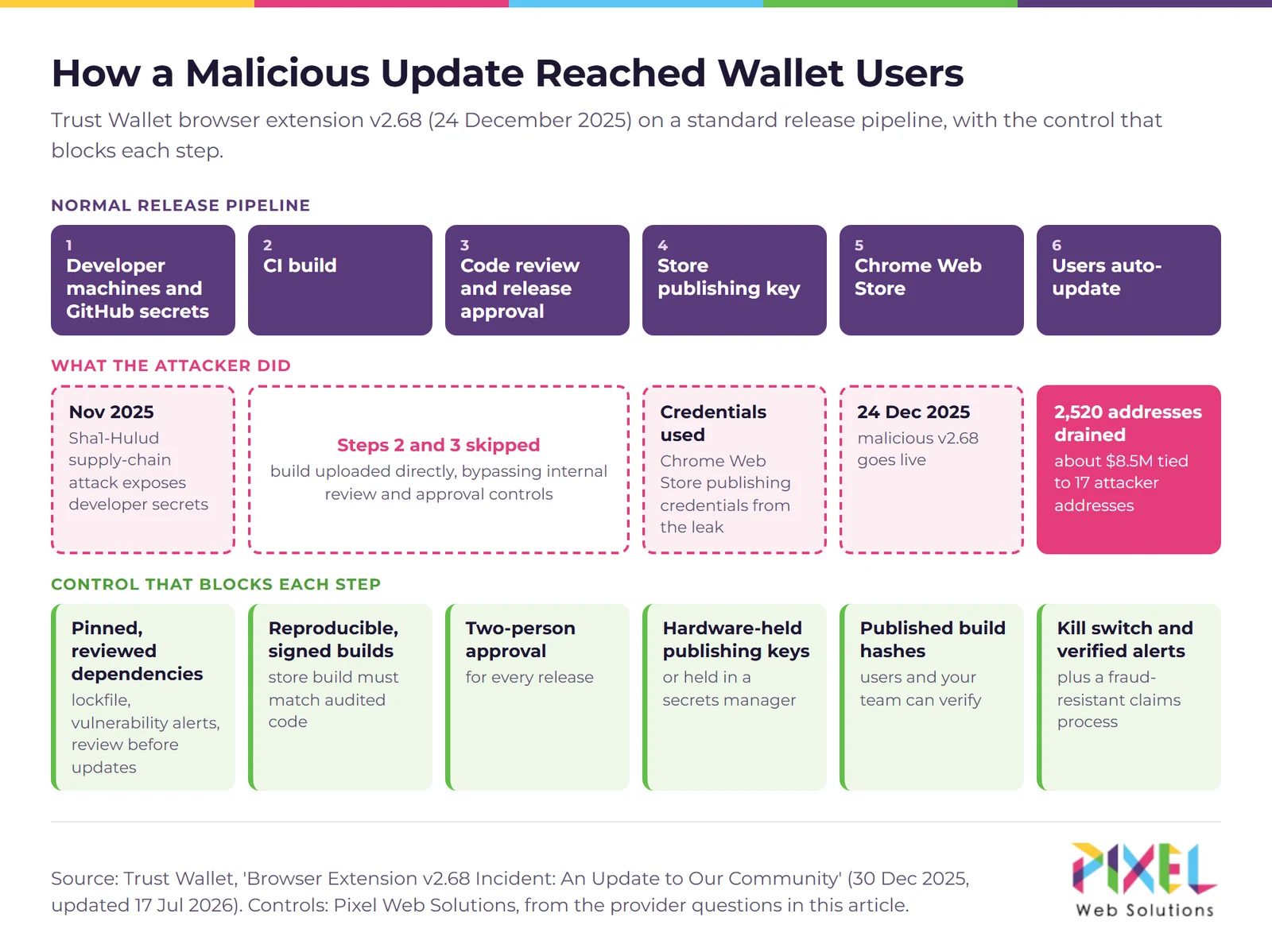
On 24 December 2025, a malicious version of the Trust Wallet browser extension (version 2.68) was published to the Chrome Web Store. According to Trust Wallet's own incident update, the attacker used developer secrets exposed in the November Sha1-Hulud supply-chain attack, including Chrome Web Store publishing credentials, and uploaded the build directly, "bypassing Trust Wallet's internal review and approval controls." The result:
- 2,520 wallet addresses drained
- About $8.5 million in assets associated with 17 attacker-controlled addresses
- Over 5,000 reimbursement claims, many of them duplicate or false, which slowed payouts to real victims
It was not an isolated case. In September 2025, a phished npm maintainer pushed malicious versions of 18 popular JavaScript packages that rewrote crypto payment addresses in browser wallets. And in July and August 2026, a firmware flaw that made seed generation fall back to weak software randomness let attackers drain about 1,816 BTC from more than 5,200 Coldcard addresses.
Five questions to ask any Trust Wallet clone script provider:
- How are dependencies pinned and reviewed? You want a lockfile, automated vulnerability alerts and a review before every dependency update.
- Who can publish to the app stores and extension stores? Publishing keys belong in hardware or a secrets manager, with two-person approval for each release.
- Are builds reproducible and signed? Users and your team should be able to check that the store build matches the audited code.
- Where does randomness for seed generation come from? It must come from the operating system's secure random source or hardware, and it should be tested.
- Is there an incident plan? That means a kill switch for the extension, a verified channel to warn users and a claims process that resists fraud.
At Pixel Web Solutions, 95% of wallet builds ship with an independent security review, our smart contract audit services cover the on-chain code, and we hand over the release process with the keys in your control.
Core Architecture Behind a Trust Wallet Clone App
The architecture of a Trust Wallet Clone App determines how its components work together to deliver a reliable, secure experience. It uses a layered approach in which each layer has a distinct role in wallet operation, blockchain interaction and security.
Frontend Layer
This is the visual layer where users complete their tasks. Balance views, transaction history and transfer screens are examples of what users do on the front end.
Application Layer
This is the logic hub of the application. It handles transaction building, wallet management and feature logic.
It also connects the front end with back-end systems, so every request is processed efficiently and accurately.
Wallet Core
The wallet core creates and stores private keys and signs transactions on the device. Trust Wallet itself uses its open-source Wallet Core library, written mostly in C++ and Rust, which supports more than 130 blockchains under the Apache 2.0 licence. Encryption and key management protect users' assets and keep ownership with them.
Blockchain Integration Layer
This layer connects the wallet to networks such as Ethereum, BNB Chain, Solana and Bitcoin through RPC nodes and indexers. It provides real-time balances and transaction statuses and broadcasts signed transactions, which makes multi-chain functions possible.
Payment Processing Layer
This layer connects the wallet with licensed on-ramp partners so users can buy crypto with cards or bank transfers. The partner handles the fiat side and delivers crypto to the user's own wallet address.
Smart Contract Interaction Layer
This layer lets the wallet interact with dApps and call smart contract functions. It powers token swaps, staking, NFT transactions and DeFi participation inside the wallet.
Security Layer
The security layer protects the whole system with encryption, biometrics, transaction simulation and monitoring. It blocks unauthorized actions and protects user data and funds.
The core architecture of a Trust Wallet clone is built on these interconnected layers to deliver security, performance and scalability. A well-structured architecture also makes it easier to add new chains and features as the Web3 ecosystem evolves.
How Does a Trust Wallet Clone Script Work?
Our script gives users a secure, user-friendly and effective way to manage their crypto. Here is the operational flow:
Private Key Storage
When a user creates a wallet, the private keys are generated and stored securely on their device. Users keep full control of their funds with no third party holding custody. The keys are never exposed, and users can always restore their wallet from an encrypted recovery phrase.
Multi-Coin Management
Users manage Bitcoin, Ethereum, BNB, Solana and thousands of tokens from different blockchain networks in one place. They can send, receive and store their digital assets from a single screen.
Staking & NFTs
Users can stake supported cryptocurrencies to earn rewards while helping secure the network. NFTs are fully integrated too, so users can store, view and trade their collectibles inside the app.
Backend & Blockchain Connectivity
The wallet supports popular token standards such as ERC-20, BEP-20 and SPL, and connects securely to blockchain nodes for live balances and transactions.
Mobile-First Experience
The Trust Wallet clone application uses a mobile-first design that makes navigation easy for new and experienced crypto users alike.
So this is how our Trust Wallet clone application works. It helps users manage their cryptocurrency and NFTs easily and securely in one place.
Get Trust Wallet Clone Script Demo
If you are ready to invest in a Trust Wallet clone, experience the platform in real time before you decide. At Pixel Web Solutions, we offer a live demo that lets you explore the wallet and understand how it works.
With this demo, you can see the platform's functionality, evaluate its features and plan how to customize it for your business.
What You’ll Get in the Trust Wallet Clone Demo?!
- Access to a fully functional multi-chain wallet dashboard
- Live testing of send and receive crypto transactions
- Token swap and staking feature preview
- NFT storage and management interface
- Admin panel overview with user and transaction management controls
Experience our Trust Wallet Clone Script demo to see its features, performance, and usability before launch. Request a live demo today and explore how it can work for your business.
Next-Gen Trust Wallet Clone App for iOS and Android
Our Trust Wallet clone app for iOS and Android is a modern, high-performance crypto wallet designed to deliver a secure, seamless and user-friendly experience for managing digital assets. It supports multiple blockchains, so users can store, send, receive and manage many cryptocurrencies in one place.
Biometric authentication and encryption protect every user's funds. The app also opens the door to Web3 applications, NFTs and DeFi platforms, which makes it more than just a wallet. Its scalable architecture and customizable features make it a strong fit for businesses entering the Web3 ecosystem.
- Multiple Blockchain Support to store different cryptocurrencies in one wallet
- Web3 dApp Browser to access decentralized applications
- Biometric Authentication and Encryption to protect users' funds
- Token Swap and Staking Capabilities to trade and earn rewards
Fully Customizable White Label Trust Wallet Clone Software
Our White Label Trust Wallet Clone software provides a pre-built cryptocurrency wallet that businesses can configure and deploy under their own brand. Its flexible architecture manages many types of cryptocurrencies and Web3 applications. Businesses can tailor everything from UI/UX to advanced modules such as staking, token swaps and NFT support, which lets entrepreneurs enter the blockchain market quickly.
- Full White Label Customization with branding, UI and feature flexibility
- Multi-Currency & Multi-Chain Support for diverse asset management
- Integrated Web3 dApp Browser for seamless decentralized access
- Advanced Security with encryption and biometric authentication
Smart Contract Powered Wallet: Make One-Click Transactions With Seedless Access
Smart contract wallets, also called smart accounts, change how a Trust Wallet clone works. Instead of a single seed phrase controlling everything, a smart contract holds the funds and enforces rules, while the user signs with a passkey protected by biometrics. Trust Wallet launched this model as SWIFT in February 2024 with Biconomy's infrastructure, offering passkey login, one-click transactions and gas payment in more than 200 tokens. In 2025 it added EIP-7702 support and gas sponsorship, which bring smart-account features to ordinary addresses. Trust Wallet's smart account contracts, called Barz, are open source under Apache 2.0.
- Seedless Access with passkey or biometric-based authentication
- One-Click Transactions that batch approvals and swaps into one step
- Flexible Gas Fee Payments using supported tokens, or gas sponsored by your app
- Automated Smart Contract Execution with spending limits and recovery rules
Integrated Web3 dApp Browser in Trust Wallet Clone Script
A built-in Web3 dApp browser lets users interact with dApps right inside their wallet. It removes the need for external browsers and keeps the wallet and Web3 platforms connected. Users can open DeFi apps, NFT marketplaces and other dApps while staying connected to their wallet. Direct access improves convenience and security and delivers a smooth, all-in-one Web3 experience.
- Access to dApps without switching browsers
- Instant connection through the wallet interface
- Safe transaction confirmations inside the wallet itself, with risk warnings
- Multi-platform Web3 support for DeFi, NFTs and more
What's New in Our Trust Wallet Clone?
Our Trust Wallet Clone goes beyond basic wallet solutions. It runs on upgraded infrastructure built for today's Web3 and crypto market, with wider network support, stronger security and real-world payment features. The result is faster transactions and a secure, modern wallet experience.
MegaETH Network Integration
Our Trust Wallet Clone supports the MegaETH network, an EVM-compatible Ethereum Layer 2 built for real-time performance. Users can send, receive and swap assets, including ETH and the network's native $MEGA token. Trust Wallet added MegaETH to its own app, and supporting it early keeps your wallet ready for high-throughput chains.
QR Code Payments
Our clone also supports QR-based crypto payments that connect Web3 with real-world spending. Users pay with stablecoins by scanning a merchant QR code, while the merchant receives local currency through a licensed settlement partner. Trust Wallet itself piloted QR Payments in Vietnam and the Philippines in February 2026, then paused the feature on 31 March 2026 after a change of payment provider. The lesson for your wallet: QR payments depend on the settlement partner, so contract a backup provider before you launch the feature.
Advanced Trading & Real-World Assets (RWA)
We expanded our clone wallet to support tokenized stocks and ETFs (Real-World Assets), perpetual futures and prediction markets. Trust Wallet added Polymarket events to its Predictions tab in February 2026, using USDC and USDT as collateral, and it notes that access is restricted in several countries. We build the same geo-controls into these modules, so your platform can offer them only where it is allowed.
Business Benefits of Investing in a Trust Wallet Clone Script
Startups can enter a growing crypto market with our Trust wallet clone and build several revenue lines from day one. Starting a cryptocurrency wallet like Trust Wallet is a smart move in the expanding blockchain and digital assets market. Here are the business benefits:
- Multi-Blockchain Support: Manage cryptocurrencies across Ethereum, BNB Chain, Solana, Bitcoin, Polygon and more in one wallet.
- In-App Crypto Exchange: Users swap tokens with ease, and you earn a service fee on each swap.
- Secure Crypto Storage: A non-custodial design with layered security keeps users in control of their assets.
- Cost-Efficient & Scalable: A white-label Trust Wallet clone solution reduces development time and cost, and new features are easy to add.
- Growing Market Demand: Global crypto adoption keeps creating demand for feature-rich wallets.
Bring your crypto wallet business idea to life with a reputable clone script provider. Pixel Web Solutions provides end-to-end cryptocurrency wallet development services, including App Store and Play Store submission support.
How to Make Money with the Trust Wallet Clone Script?
This clone script is not just a tool for managing digital assets; it is also a business model. Before choosing revenue streams, look at what Trust Wallet itself earns. These are on-chain revenue figures tracked by DefiLlama as of 27 September 2026:
| Trust Wallet revenue line | Last 30 days | Last 12 months |
|---|---|---|
| Swaps and bridging | $0.38 million | $4.39 million |
| Perpetual futures (Hyperliquid builder fees) | $1.36 million | $2.39 million |
| Total | $1.73 million | $6.78 million |
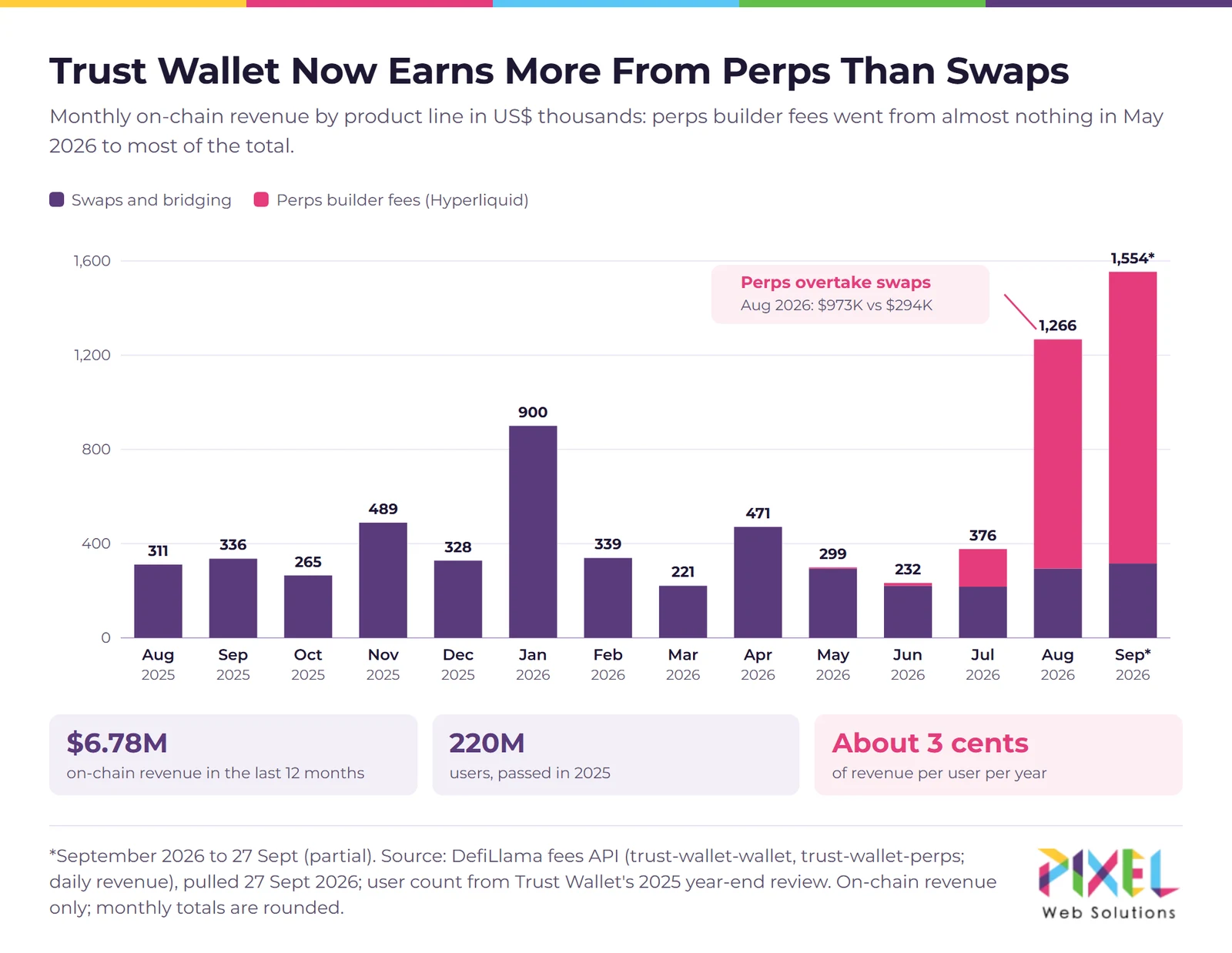
Two lessons stand out. First, perps went from almost nothing in May 2026 to about $0.97 million in August and $1.24 million in September (to the 27th), overtaking swaps. Second, users do not equal revenue: $6.78 million a year across 220 million users is about 3 cents per user per year. Revenue follows active traders, so design your wallet to turn holders into traders.
With that in mind, here are the revenue streams our Trust Wallet clone supports:
- Swap/Exchange Fees: Add a service fee to in-app swaps routed through DEX aggregators. MetaMask, for comparison, charges 0.875% per swap.
- Perps and Prediction Builder Fees: Hyperliquid's builder codes let a wallet earn up to 0.1% on perps and 1% on spot fills it routes, once the user approves.
- Staking Rewards Share: Take a percentage of user staking rewards as recurring income.
- On-Ramp Revenue Share: Earn a commission from licensed ramp partners on each crypto purchase.
- Premium Features: Offer advanced analytics, alerts and priority support as a monthly subscription.
- Token Promotions: Earn from clearly labelled sponsored token listings and discovery placements.
- Transaction Fees: Charge a small fee on transfers, kept low so users do not switch wallets.
With crypto adoption growing worldwide, a Trust Wallet Clone Solution combines security, scalability and several revenue channels. Your return depends on how many active traders you attract, so plan your marketing budget alongside the build. Next, let's look at what the build costs.
Trust Wallet Clone Script Cost and Timeline
Your cost depends on platforms, chains and modules. Here are Pixel Web Solutions' published prices and the ranges from our crypto wallet development cost guide:
| Build level | What it includes | Price | Timeline |
|---|---|---|---|
| Starter white-label wallet | Single platform, core self-custody functions | From about $4,500 | 6 to 10 weeks to app store submission |
| Trust Wallet-style white-label or MVP | iOS, Android and web, multi-chain, swaps, dApp browser | $25,000 to $50,000 | 8 to 12 weeks |
| Advanced Trust Wallet-style wallet | Adds staking, on-ramps, smart accounts, perps, predictions or QR payments | $50,000 to $100,000 | 12 to 16 weeks |
| Development from scratch | Bespoke architecture and security model | $100,000 to $150,000+ | 16 to 24 weeks or more |
App store review typically adds one to three weeks. Budget separately for RPC nodes and indexers, security audits, ramp partner fees and ongoing maintenance.
How to Launch a Web3 Wallet Like Trust Wallet Using a Trust Wallet Clone Script?
Launching a Web3 wallet like Trust Wallet is faster with a ready-made clone script, because you skip the time and effort of building the core from scratch. For the full custom route, read our guide on how to create a crypto wallet like Trust Wallet.
Define Business Requirements
Start by identifying your target audience, business objectives and the features you plan to offer. Decide whether you target DeFi users, NFT traders, stablecoin payers or general crypto users. This choice shapes features such as multi-chain support, staking and dApp integration, and a clear plan keeps the project on budget and on time.
Choose a Reliable Trust Wallet Clone Script Provider
Select a high-quality, well-maintained script from a trusted provider. It should include wallet core integration, security protocols and multi-chain compatibility, plus a documented release process. Always check audit reports, scalability and upgrade options before you commit.
Customize Features and UI/UX
Adapt the script to your brand identity and user needs. Customize the design and interface, and add or remove features such as token swaps, NFT support, staking and smart wallet functions. A well-designed interface improves engagement and retention.
Integrate Blockchain Networks and APIs
Connect the wallet to Ethereum, BNB Chain, Solana, Bitcoin and other networks through RPC providers and indexers, and use price APIs for real-time token data. This integration keeps transactions accurate across chains.
Implement Security Measures
Apply strong encryption, biometric authentication and secure key management, then lock down the release pipeline as described above. Security is the essential requirement.
Prepare Store Listings and Licences
Publish under your own brand from an organization developer account, and check whether any custodial or ramp features need a licence in your markets before launch.
With the right strategy, customization and security, you can launch a wallet that delivers an excellent user experience and competes in the Web3 market. That is why launching a Web3 wallet like Trust Wallet with a clone script is a cost-effective, time-saving approach for businesses entering the blockchain space.
Tools and Technologies Behind Trust Wallet Clone Development
Developing a Trust Wallet clone needs modern tools that deliver protection, room to grow and steady performance. Development teams use them to build a wallet that handles many blockchains, keeps transactions safe and stays fast to use.
Programming Languages: Swift, Kotlin, TypeScript, C++ and Rust
Swift is used for iOS, Kotlin for Android and TypeScript for web and extension features. C++ and Rust power the cryptographic core, which is also how Trust Wallet's own Wallet Core is written.
Frameworks: React Native / Flutter
React Native and Flutter let developers build for iOS and Android from one codebase, which makes delivery faster and cheaper while keeping the experience consistent. Trust Wallet's own public app code, by contrast, was native: its archived repositories are written in Swift for iOS and Java for Android. Either approach works as long as key generation and signing run in a hardened native module.
Blockchain Networks: Ethereum, BNB Chain, Solana, Bitcoin, Polygon
These networks process transactions and store on-chain data. Supporting several of them lets users handle many cryptocurrencies through one wallet.
Wallet Core Libraries
Wallet core libraries manage key generation, address creation and transaction signing. They run the cryptographic functions that every wallet operation depends on.
APIs & SDKs
APIs and SDKs retrieve token prices, transaction records and network status, and connect the wallet to external services such as ramps and swap aggregators. Check each SDK's licence: for example, the Reown (formerly WalletConnect) AppKit licence released on 25 August 2025 requires a paid commercial licence above 500 monthly active users.
Security Technologies: Encryption & Biometrics
Encryption algorithms and biometric authentication protect user data and funds, and stop unauthorized access.
Cloud & Backend Services
Cloud platforms and backend services provide data storage, notifications and analytics.
They also let you scale, ship updates quickly and keep extra features running without interruption.
The right combination of tools lets businesses build high-performance wallets that meet user needs today and adapt as Web3 technology develops.
Is a Trust Wallet Clone Legal? Code, Trademark and App Store Rules
A Trust Wallet clone is legal when it is your code under your brand. Three checks matter:
- Code licences. Trust Wallet's original iOS app repository is GPL-3.0 and archived since 2019, so it is both outdated and copyleft (any derivative must be released under the GPL). By contrast, Wallet Core and the Barz smart account contracts are Apache 2.0 and can be reused commercially with attribution.
- Trademarks. Never use the Trust Wallet name, shield logo or screenshots in your app name, icon or listing. Apple's App Review Guideline 4.1 bans using another developer's brand or product name without approval, and impersonation can get a developer account removed. Fake "Trust Wallet" apps and APKs are a common scam, so a look-alike brand also damages user trust.
- Licensing by custody model. Google Play's crypto wallet policy exempts non-custodial wallets but requires local licences for custodial wallets in markets such as the US, UK, EU, UAE and Japan. In India, businesses that hold or administer users' crypto must register with FIU-IND under the Prevention of Money Laundering Act.
Why is Pixel Web Solutions an ideal Choice For Trust Wallet Clone Script?
Pixel Web Solutions, a leading Crypto Wallet Development Company, provides scalable white-label Trust wallet clone apps tailored to your business requirements. Building software since 2012, Pixel Web Solutions has delivered 78 blockchain and Web3 projects, and 95% of its wallet builds ship with an independent security audit. We help you launch a feature-rich crypto wallet app with fixed-scope pricing, quick deployment and complete support. If you also need DeFi wallet development or MPC wallet development, the same team covers both.
- Ongoing Support & Maintenance: Regular updates, bug fixes and compliance upgrades keep your Trust Wallet clone secure and current.
- Service Level Agreements (SLAs): Clearly defined response times and upgrade schedules give you reliable, structured technical support.
- Compliance Monitoring: We track regulatory changes that affect your features and markets.
- Proven Client Success: Clients have launched and integrated wallets across many blockchain networks.
- Secure Release Handover: Store accounts, signing keys and release approvals stay in your control.
- Revenue-Generating Features: Swap fees, builder fees and staking options are ready to switch on.
Launch your own Trust Wallet Clone Script with Pixel Web Solutions today: fast, secure and tailored to your business vision.
Frequently Asked Questions
What is a Trust Wallet Clone Script?
A Trust Wallet clone script is pre-built wallet software that lets a business launch its own self-custody, multi-chain crypto wallet with features similar to Trust Wallet. It is a cost-effective way to launch a secure crypto wallet under your own brand.
How much does it cost to develop a Trust Wallet clone app?
Pixel Web Solutions' white-label wallet starts at about $4,500 for a single platform with core functions. A Trust Wallet-style wallet on iOS, Android and web usually costs $25,000 to $50,000, and advanced builds with staking, ramps, perps or predictions cost $50,000 to $100,000.
How long does it take to develop and launch a Trust Wallet clone?
A configured white-label wallet reaches app store submission in about 6 to 10 weeks. Custom modules extend this to 10 to 16 weeks, and store review adds one to three weeks.
Is a Trust Wallet clone safe to use?
Our Trust Wallet Clone app protects assets with biometric authentication, on-device key encryption, two-factor authentication, multi-signature options and transaction simulation. Safety also depends on the release process, so we audit every build and hand over signing keys securely.
Is developing a Trust Wallet clone app legal?
Yes, when the code is independently written or permissively licensed and the app uses your own brand. Do not use the Trust Wallet name or logo, and check whether custodial or ramp features need a licence in your markets.
What is the difference between a Trust Wallet clone and a custom-built Trust wallet?
A Trust Wallet clone gives you a tested, feature-rich product quickly and cost-effectively. A custom-built wallet needs much more time, budget and technical guidance, but delivers fully bespoke architecture and features.
What can be customized in a Trust Wallet clone?
You can customize the user interface, supported cryptocurrencies, staking rules, swap integrations, branding, languages, security settings and extra modules to suit your business.
What cryptocurrencies does the clone app support?
The Trust Wallet clone app supports BTC, ETH, BNB, SOL and the tokens on their networks, plus other major chains you choose. For comparison, Trust Wallet itself supports more than 110 chains and 32 million assets.
Is Trust Wallet built with React Native?
Trust Wallet's public, now-archived app code was native: Swift for iOS and Java for Android, on top of its C++ and Rust Wallet Core library. A clone can use React Native or Flutter for the interface, as long as key generation and signing run in a secure native module.
How will a Trust Wallet clone help generate revenue?
Our Trust Wallet clone earns from swap fees, perps and prediction builder fees, staking reward shares, on-ramp commissions, premium subscriptions and sponsored token listings.
Do you provide post-launch support?
Yes. We provide maintenance, security updates, new chain integrations and SLA-backed support after launch.
Launch Your Trust Wallet Clone Script With Pixel Web Solutions
A Trust Wallet clone script is the fastest way to put a self-custody, multi-chain wallet in your users' hands, but only if it runs on code you can legally ship, carries your own brand and has a release pipeline attackers cannot hijack. Plan for trading-led revenue, not just installs. If you want a browser-extension-first alternative, compare our MetaMask wallet clone script. When you are ready, Pixel Web Solutions can configure, audit and launch your Trust Wallet clone script in weeks.
Disclaimer:
We are not associated with, sponsored by, or endorsed by any of the brands, companies, or platforms referenced. Our clone scripts are uniquely and independently developed to emulate specific functionalities of the mentioned platforms. They are intended as customizable solutions for entrepreneurs and developers. It is the sole responsibility of the user to ensure that any use, modification, deployment, or commercialization of these scripts complies with all applicable laws, regulations, and intellectual property rights in their respective jurisdictions.