Table of Contents
Last updated: 18 September 2026 | Reviewed by Mathibharathi Mariselvan, Co-founder, Pixel Web Solutions | 12 min read
A modern crypto exchange tech stack uses a low-latency matching engine written in C++, Rust, Java or Go; backend services in Go, Java or Node.js; a React or Vue web app and Flutter or React Native mobile apps; PostgreSQL for the ledger, Redis for caching and Kafka for event streaming; MPC and cold-storage wallets connected to blockchain nodes; REST and WebSocket APIs; and Kubernetes on AWS, Google Cloud or Azure. Security, KYC/AML and liquidity connectors sit across every layer.
The crypto exchange business grows more competitive every year, and technology decides who keeps up. Speed, uptime, security and the ability to add products all come down to the stack you choose at the start. Changing a matching engine or ledger after launch is slow and risky, so the decision deserves care.
This guide explains why tech stack selection matters, walks through the 10 key technologies layer by layer with recommended tools, shows a reference architecture, compares stacks by exchange type and gives a simple process to choose the right one.
Key Takeaways
- The matching engine and the ledger are the most critical components. Build them in fast, strongly typed languages and keep them simple.
- Most exchanges use a microservices or modular architecture connected by an event stream such as Kafka, so parts can scale independently.
- Custody is part of the stack. MPC wallets, cold storage and your own blockchain nodes decide how safely funds move.
- Choose proven, well-supported tools over fashionable ones. Hiring, security patches and community support matter for years.
- The exchange type changes the stack. A DEX leans on smart contracts, a CEX on a matching engine and ledger, and a P2P exchange on escrow and dispute tools.
Crypto Exchange Tech Stack – A Short Overview
A crypto exchange tech stack is the combination of languages, frameworks, databases, infrastructure and third-party services used to build and run a secure, fast trading platform. It covers far more than programming languages: the trading core, wallets and blockchain connectivity, data storage, security, compliance tools, APIs and hosting.
For the structural view of how these pieces fit together, see our guide to cryptocurrency exchange architecture.
Why is Tech Stack Selection Important in Crypto Exchange Development?
Here are the main reasons to choose your stack carefully.
Manage the Complexity of Crypto Exchange Architecture
An exchange connects order matching, wallets, payment services, liquidity providers, KYC tools and dozens of blockchains. The right stack keeps these parts loosely coupled, so a problem in one service does not bring down trading.
Facilitate the Growth and Innovations in Crypto Exchange
New products such as futures, staking, copy trading or new chains should plug in without a rewrite. A modular stack with clear APIs lets you add them quickly.
Implement Robust Security Measures
Exchanges hold customer funds and personal data, which makes them prime targets. The stack must support encryption, strong authentication, key management, network isolation and continuous monitoring. US regulators, including the SEC, stress cybersecurity controls in line with CISA guidance.
Ensure Scalability of the Exchange Platform
Trading volume can multiply in minutes during market moves. The stack must scale horizontally (more servers) where possible and keep the matching engine fast under load. Read more on crypto exchange scalability.
Enhance User Experience
A fast, stable interface keeps traders active. The right frontend and real-time data stack deliver instant price updates and order confirmations, even during peaks and upgrades.
These factors also affect regulatory compliance, integration options and long-term cost. Now let us look at the technologies themselves.
10 Key Technologies of a Promising Crypto Exchange Platform
Here are the essential technologies for a crypto exchange, with the tools we recommend in 2026.
- Programming Languages
- Blockchain Nodes and Wallet Infrastructure
- Smart Contracts
- Database Management
- Backend Framework and Messaging
- Frontend and Mobile Frameworks
- Hosting and Cloud Services
- Security Measures
- API Integration
- Liquidity Management
Let us look at each one.
1. Programming Languages
Each part of an exchange has different needs, so most exchanges use several languages:
- C++ or Rust for the matching engine, where microseconds matter and memory must be controlled precisely.
- Java for matching engines and backend services, with mature low-latency patterns and a large hiring pool.
- Go (Golang) for backend microservices, wallet services and APIs, thanks to fast compilation, simple concurrency and strong performance.
- TypeScript and JavaScript (Node.js) for API gateways, real-time services and the web frontend.
- Python for data analysis, risk models, reporting and internal tools, not for the latency-critical path.
2. Blockchain Nodes and Wallet Infrastructure
A centralized exchange connects to every blockchain it supports to detect deposits and send withdrawals. This layer includes:
- Blockchain nodes for Bitcoin, Ethereum and its Layer-2s, Solana, Tron, BNB Chain and others, either self-hosted for control or from node providers for speed of setup.
- Wallet services that generate deposit addresses, track confirmations and batch withdrawals.
- Custody: hot wallets for daily withdrawals, warm wallets for top-ups and cold storage for most funds, with MPC (multi-party computation) or multi-signature wallets so no single key can move money.
Choose chains by user demand and deposit costs rather than advertised throughput. For example, many users prefer USDT on Tron or Solana because transfers cost a fraction of Ethereum mainnet fees. See our crypto wallet development and multi-signature wallet development services.
3. Smart Contracts
Smart contracts power decentralized and hybrid exchanges and features such as on-chain settlement, staking and token launches. Common languages:
- Solidity and Vyper for Ethereum and EVM chains such as BNB Chain, Polygon, Arbitrum and Base.
- Rust for Solana programs.
- Move for Sui and Aptos.
- Cairo for Starknet.
Development and testing frameworks include Foundry and Hardhat for EVM chains and Anchor for Solana. Every contract that holds value needs an independent audit.
4. Database Management
The database stores balances, orders, trades and user data, so integrity is non-negotiable.
- PostgreSQL (or another ACID relational database) for the ledger, accounts and orders, where every balance change must be exact and auditable.
- Redis for caching, sessions, rate limiting and live order book snapshots.
- A time-series or analytics store such as ClickHouse or TimescaleDB for market data, candles and reporting.
- MongoDB or similar document stores only for flexible, non-financial data such as user preferences or content.
Use double-entry accounting in the ledger, so every movement of funds has a matching entry and discrepancies surface immediately.
5. Backend Framework and Messaging
The backend handles APIs, account management, order validation, risk checks, notifications and integrations. Popular choices:
- Go services with frameworks such as Gin or gRPC
- Java with Spring Boot
- Node.js with NestJS for API gateways and real-time services
Services communicate through an event streaming platform such as Apache Kafka, which records every order and trade event in sequence. That makes the system easier to scale, recover and audit.
6. Frontend and Mobile Frameworks
The frontend is where traders judge your exchange. Choose frameworks that handle real-time updates smoothly:
- React (with Next.js), Vue or Angular for the web trading interface
- TradingView charting libraries for professional charts
- Flutter or React Native for cross-platform mobile apps, or native Swift and Kotlin where performance matters most
- WebSockets to stream prices, order book changes and order updates instantly
7. Hosting and Cloud Services
Exchanges need high availability, fast scaling and disaster recovery:
- AWS, Google Cloud or Azure for managed infrastructure, with multiple availability zones
- Kubernetes (with Docker containers) to deploy and scale services
- Content delivery networks and DDoS protection in front of all public endpoints
- Monitoring and alerting with Prometheus and Grafana, plus centralized logging
Some exchanges run the matching engine on dedicated servers for predictable latency while the rest of the stack runs in the cloud.
8. Security Measures
Security spans every layer of the stack:
- Encryption: AES for data at rest and TLS for data in transit
- Authentication: two-factor authentication, passkeys and biometrics on mobile
- Key management: hardware security modules (HSMs) or MPC for signing keys
- Network security: firewalls, intrusion detection, network segmentation and zero-trust access for staff
- Custody controls: cold storage, withdrawal whitelists and approval workflows
- Testing: regular penetration tests, code reviews and bug bounties
Our guide to crypto exchange security covers the strategies in depth.
9. API Integration
APIs connect the exchange to traders and to third-party services:
- Public APIs: REST for account and order actions, WebSocket for real-time market data, and FIX for institutional clients
- Third-party APIs: KYC and identity verification, blockchain analytics for AML screening, payment gateways for fiat, and liquidity providers
- Internal APIs: gRPC between services for speed
Document your public API well, set clear rate limits and version it, because algorithmic traders build on it.
10. Liquidity Management
Liquidity keeps spreads tight from day one. The liquidity layer includes:
- Order book management and a fair, deterministic matching engine
- Liquidity connectors that link your order book to external exchanges and liquidity providers through REST, WebSocket or FIX. Open-source libraries such as CCXT speed up connectivity to other exchanges.
- Market-maker tools: dedicated APIs, fee rebates and monitoring
- Risk management: position limits, exposure monitoring and circuit breakers

Crypto Exchange Architecture: How the Stack Fits Together
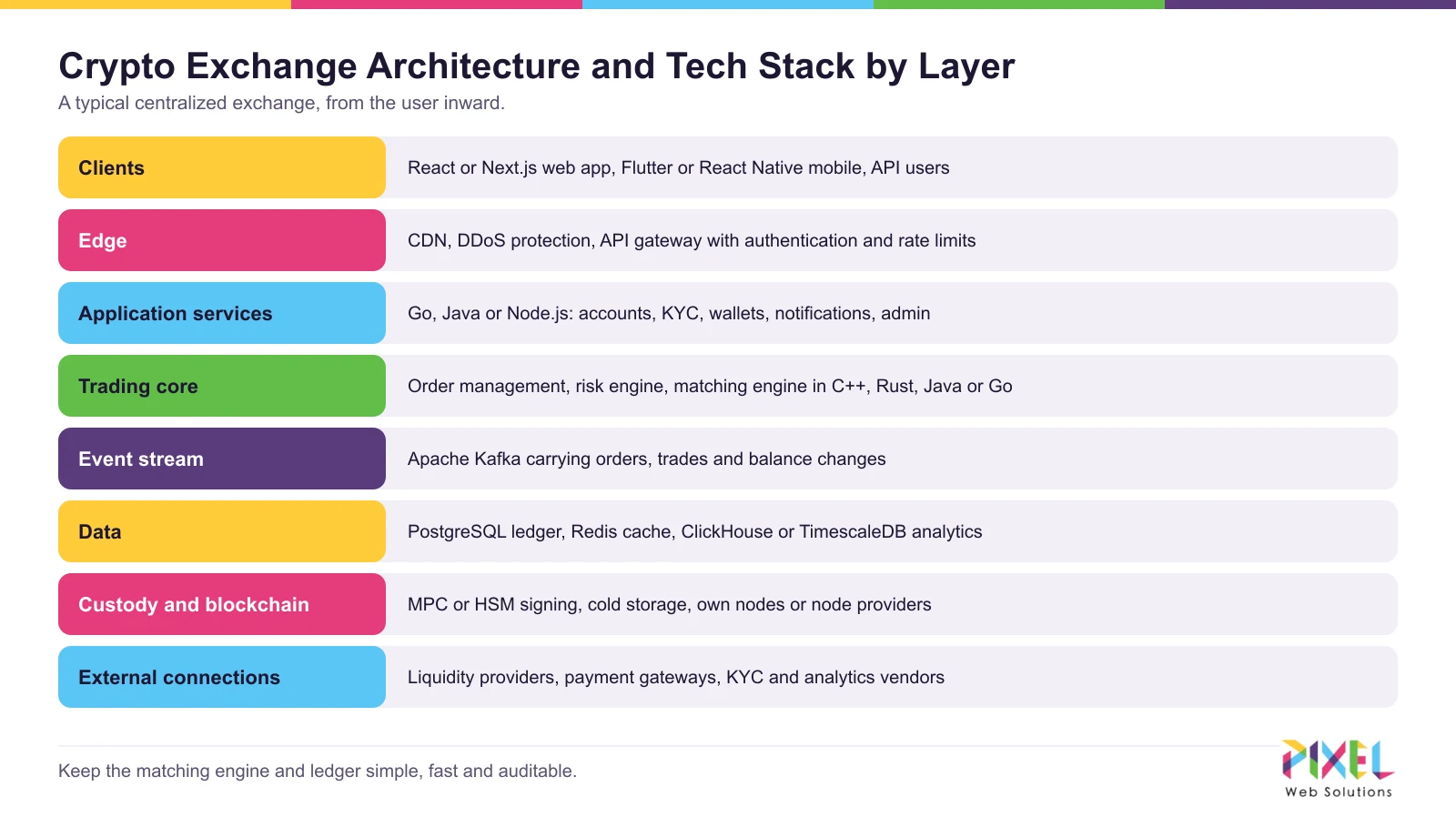
A typical centralized exchange architecture has these layers, from the user inward:
- Clients: web app, mobile apps and API users.
- Edge: CDN, DDoS protection and an API gateway that handles authentication and rate limits.
- Application services: accounts, KYC, orders, wallets, notifications and admin.
- Trading core: the order management system, risk engine and matching engine.
- Event stream: Kafka carrying orders, trades and balance changes to every service that needs them.
- Data: the PostgreSQL ledger, Redis caches and analytics stores.
- Custody and blockchain: wallet services, MPC or HSM signing, cold storage and blockchain nodes.
- External connections: liquidity providers, payment gateways, KYC and analytics providers.
Tech Stack by Exchange Type
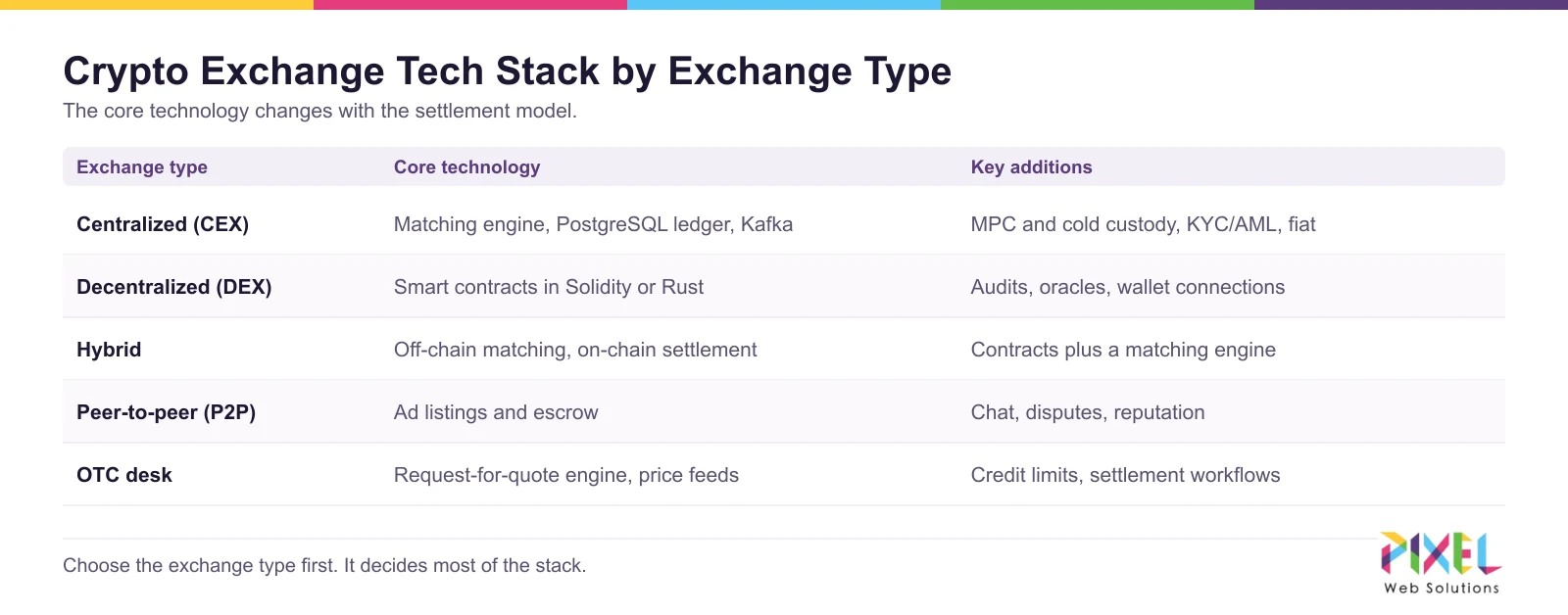
| Exchange type | Core technology | Key additions |
|---|---|---|
| Centralized (CEX) | Matching engine (C++, Rust, Java or Go), PostgreSQL ledger, Kafka | MPC and cold custody, KYC/AML, fiat gateways |
| Decentralized (DEX) | Smart contracts (Solidity or Rust), indexers, web3 frontend | Audits, oracle feeds, wallet connections |
| Hybrid | Off-chain matching with on-chain settlement | Smart contracts plus a matching engine |
| Peer-to-peer (P2P) | Order and ad listings, escrow smart contracts or custodial escrow | Chat, dispute resolution, reputation system |
| OTC desk | Request-for-quote engine and pricing feeds | Credit limits, settlement workflows |
Each type has its own trade-offs: see decentralized exchange development, hybrid crypto exchange development, P2P crypto exchange development and OTC exchange development.
How to select the Right Crypto Exchange Tech Stack?
The right stack depends on your exchange type, features, team and budget. Follow these five steps.
1. Define your requirements
Set your exchange type, target markets, expected volume, launch features and compliance needs. A retail spot exchange in one country needs a different stack from a global derivatives platform.
2. Assess technical provisions
Map each required feature to the technology it needs: matching engine performance, number of chains, fiat rails, mobile apps and API users.
3. Evaluate the tech stack
Check each candidate for performance, security track record, scalability, licensing costs and the availability of developers who know it.
4. Future-proof the stack
Prefer technologies with strong communities, regular security updates and long-term support. Keep the architecture modular, so you can replace one component without rebuilding the exchange.
5. Make informed decisions
Balance business goals, technical needs and budget. White-label software gives you a proven stack immediately, while a custom build lets you choose every component. Our guide to the cost to build a crypto exchange compares both routes.
Also check out our detailed guide on how to start a cryptocurrency exchange and our list of must-have cryptocurrency exchange features.
Develop Your Crypto Exchange With Pixel Web Solutions
Pixel Web Solutions provides crypto exchange development services built on a proven, secure and scalable stack. With more than 12 years of experience, we help you choose the right technologies for your exchange type and budget, whether you start from our white-label crypto exchange or a custom build. Talk to our team to plan your exchange's architecture.
Frequently Asked Questions
What is the best tech stack for a crypto exchange?
A proven combination is a C++, Rust, Java or Go matching engine; Go or Java backend services; React for the web app; Flutter or React Native for mobile; PostgreSQL, Redis and Kafka for data and messaging; MPC and cold-storage custody; and Kubernetes on a major cloud provider.
Which programming language is best for a crypto exchange matching engine?
C++ and Rust offer the lowest latency and precise memory control. Java and Go are also widely used, with a larger talent pool and faster development. The best choice depends on your volume targets and your team's skills.
Which database is best for a crypto exchange?
A relational ACID database such as PostgreSQL is best for the ledger and balances, because every change must be exact. Redis handles caching and live data, and a time-series store handles market data and analytics.
What is the architecture of a crypto exchange?
A crypto exchange has client apps, an API gateway, application services (accounts, KYC, wallets), a trading core (order management, risk and matching engines), an event stream, databases, custody and blockchain nodes, and connections to liquidity, payment and compliance providers.
How do crypto exchanges connect to liquidity providers?
Through liquidity APIs using REST, WebSocket or FIX protocols. The exchange routes or mirrors orders to external venues and market makers, which keeps its own order book deep and prices competitive.
How much does the tech stack affect crypto exchange development cost?
Significantly. Custom matching engines, multi-chain custody and derivatives risk engines add the most cost. White-label exchanges cost $25,000 to $50,000 because the stack is already built, while custom exchanges cost $100,000 to $150,000 or more.