Table of Contents
Last updated: 18 September 2026 | Reviewed by Mathibharathi Mariselvan, Co-founder, Pixel Web Solutions | 12 min read
Hybrid crypto exchange development builds a trading platform that matches orders off-chain at centralized-exchange speed but settles trades on-chain, so users keep control of their funds. A hybrid exchange combines a high-performance matching engine and order book with smart contract vaults or non-custodial wallets, on-chain settlement, liquidity from both centralized and decentralized sources, and KYC/AML where required. A custom hybrid exchange typically costs $80,000 to $180,000 and takes 10 to 16 months; white-label foundations reduce both.
Thinking about launching a secure, high-performance crypto exchange that offers the best of both centralized and decentralized systems?
That is what hybrid cryptocurrency exchange development delivers: a platform with the liquidity, speed and familiar interface of a centralized exchange (CEX) and the transparency and self-custody of a decentralized exchange (DEX). After several centralized exchange failures, traders increasingly want both fast execution and proof that their funds are safe, and hybrid architecture answers that demand.
At Pixel Web Solutions, we build hybrid crypto exchanges for startups and enterprises, drawing on our experience in exchange development, custom blockchain development and cross-chain integration. This guide explains how hybrid exchanges work, the features you need, the development process, costs and the challenges to plan for.
Key Takeaways
- A hybrid exchange matches off-chain and settles on-chain. Users get CEX-level speed without handing custody of their funds to a company.
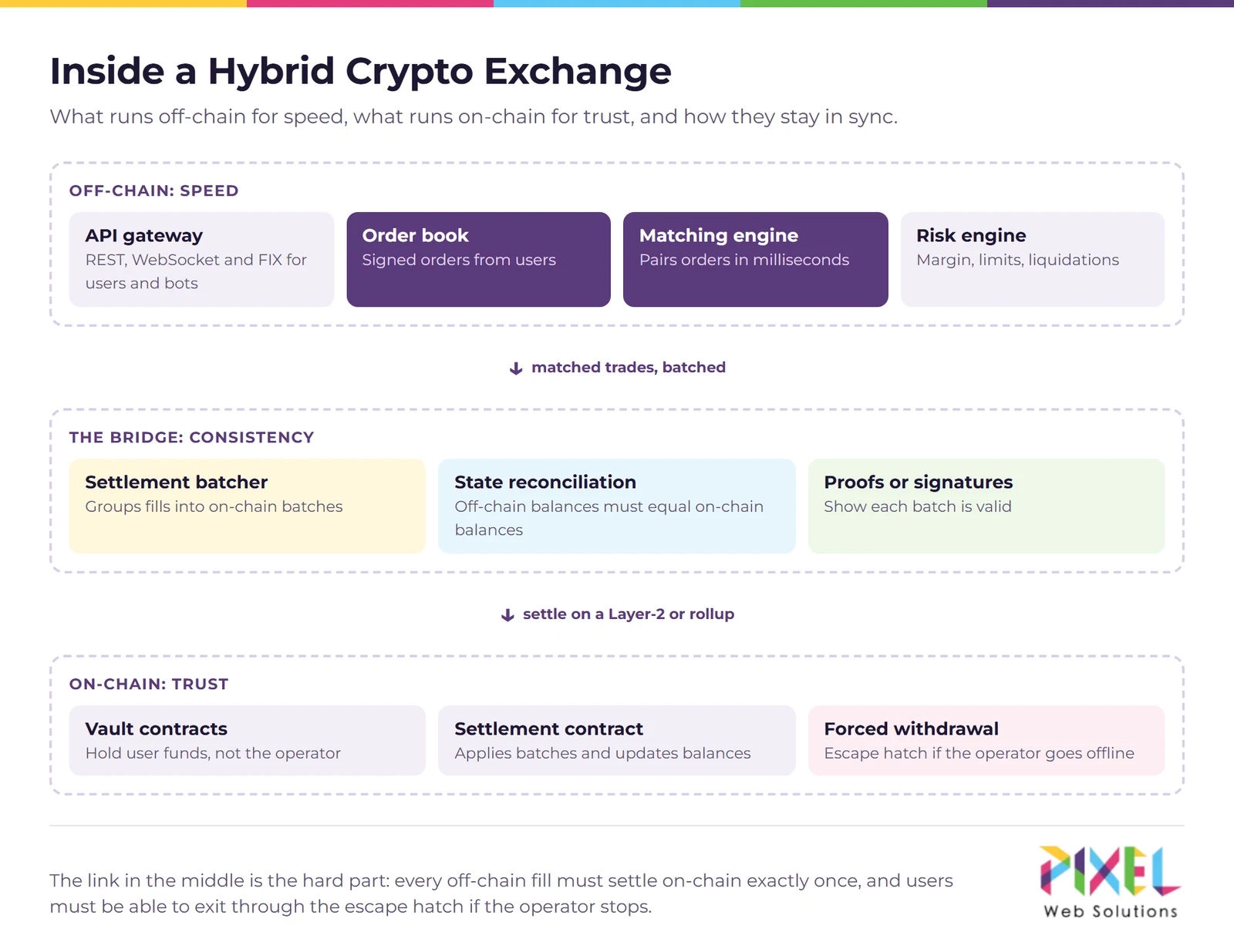
- Architecture is the hard part: the matching engine, settlement contracts and the link between them must stay consistent under heavy load.
- Liquidity comes from both worlds: market makers and CEX liquidity for the order book, plus DEX pools and aggregators.
- Compliance still applies. Offering an order book, fiat rails or derivatives usually means KYC and licensing.
- Budget for complexity: custom hybrids cost $80,000 to $180,000, more than a pure CEX or DEX of similar scope.
What is Hybrid Crypto Exchange Development?
Hybrid crypto exchange development creates a trading platform that combines centralized and decentralized exchange models. The centralized side provides a fast order matching engine, advanced order types, professional trading tools and a familiar user experience. The decentralized side provides non-custodial wallets or smart contract vaults, on-chain settlement and transparent records of trades and balances.
The result is a secure, transparent and efficient trading environment that suits both retail and professional traders, and gives businesses a way to offer compliance and reporting while users keep ownership of their assets.
To compare the underlying models, read our guide on centralized vs decentralized exchanges.
How Does a Hybrid Crypto Exchange Work?
- Deposit: the user deposits funds into a smart contract vault or keeps them in a non-custodial wallet linked to the exchange.
- Order placement: the user signs an order, which goes to the off-chain order book.
- Matching: the matching engine pairs orders in milliseconds, just like a CEX.
- Settlement: matched trades are settled on-chain, individually or in batches, often through a Layer-2 or rollup to keep costs low.
- Withdrawal: the user withdraws directly from the vault, and in well-designed systems can force a withdrawal on-chain even if the operator goes offline.
dYdX’s earlier V3 exchange is a well-known example of this pattern: an off-chain order book with settlement on a StarkEx Layer-2. Many newer derivatives venues use a similar split between off-chain matching and on-chain settlement.
CEX vs DEX vs Hybrid Exchange
| Factor | Centralized (CEX) | Decentralized (DEX) | Hybrid |
|---|---|---|---|
| Custody | Exchange holds funds | User holds funds | User or smart contract vault |
| Speed | Very fast | Limited by the blockchain | Very fast matching, on-chain settlement |
| Order types | Full range | Mostly swaps | Full range |
| Transparency | Relies on audits and proof of reserves | Fully on-chain | Trades and balances verifiable on-chain |
| Liquidity | Market makers | Liquidity pools | Both |
| Compliance | KYC and licences | Varies | Usually KYC and licences |
| Build cost | $60,000 to $150,000+ | $40,000 to $120,000 | $80,000 to $180,000 |
What do our Hybrid Crypto Exchange Development Services include?
Custom Hybrid Exchange Development
We design custom hybrid exchanges from scratch, using a proven tech stack for crypto exchange development: a low-latency matching engine, settlement contracts, vaults, interfaces and admin tools shaped around your business model.
White-label Hybrid Exchange Solutions
Our white-label foundation combines a tested trading engine, wallets, admin dashboards and KYC/AML modules with a settlement layer, so you can launch faster under your own brand. See our white-label crypto exchange options.
On-Chain Settlement Layer
Smart contracts and, where needed, Layer-2 or rollup infrastructure settle trades transparently and let users verify balances at any time.
Liquidity Aggregation (CEX + DEX)
We connect your order book to market makers and external exchanges, and to DEX pools and aggregators, to reduce slippage and improve pricing. For more, see liquidity management in crypto exchanges.
What are the key features of Hybrid Crypto Exchange?
User Panel Features
- User-friendly trading interface with simple and advanced modes
- Multi-token and multi-chain support
- High-speed order matching
- On-chain settlement and verifiable balances
- Advanced order types: limit, stop-limit, OCO and trailing stop
- Professional charts and real-time market data
- Non-custodial wallet connection or smart contract vault deposits
- Forced-withdrawal or escape-hatch mechanism
- KYC/AML onboarding where required
- Fiat on-ramps and off-ramps
- Secure login with 2FA or passkeys
- Transaction history and portfolio tracking
- Web and mobile apps
Admin Panel Features
- Real-time analytics dashboard
- User management and KYC control
- Trade and settlement monitoring
- Liquidity aggregation controls
- Fee and revenue management
- Risk controls, circuit breakers and alerts
- Content management
- Role-based access control
- Fiat gateway management
- Wallet, vault and asset management
- Audit logs and compliance reporting
- Infrastructure and scaling controls
Additional Features of Our Hybrid Crypto Exchange Development
- Automated market maker pools for long-tail tokens alongside the order book
- P2P trading module with escrow for local payment methods
- Margin and perpetual futures with a risk and liquidation engine
- Custom smart contracts for vaults, settlement, staking and governance
- Referral and loyalty programmes
- Multi-language and multi-currency support
- Real-time notifications for fills, price alerts and security events
- Public and institutional APIs (REST, WebSocket, FIX)
Benefits of our Hybrid Crypto Exchange Development
- Complete development expertise across centralized trading engines and decentralized settlement
- Faster launch with ready-made modules and a flexible delivery approach
- Scalable architecture, built for crypto exchange scalability from day one
- Tailored to your model, from retail spot trading to institutional derivatives
- Security and compliance, with audits, KYC/AML and multiple layers of security in crypto exchanges
- Ongoing support and maintenance after launch
- Global readiness with multi-language, multi-currency and third-party integrations
Hybrid Cryptocurrency Exchange Development Process
Understanding Your Needs and Designing the Platform
We start with your business model, target traders, markets, custody approach and compliance needs, then map user flows and the architecture.
Choosing the Right Blockchain and Technology
We select the settlement chain or Layer-2 (for example Ethereum rollups, Arbitrum or Base), the matching engine technology and the frontend and backend stack.
Building the Matching Engine, Settlement Contracts and Interfaces
Backend engineers build the order management, risk and matching engines; smart contract engineers build vaults and settlement contracts; frontend engineers build web and mobile trading apps.
Integrating Wallets, Liquidity, APIs and Security
We connect wallets and vaults, liquidity providers and DEX sources, trading APIs, KYC tools and security layers such as 2FA, encryption and DDoS protection.
Thorough Testing and Auditing
We test functionality, performance under load, settlement consistency and failure scenarios, and commission independent smart contract audits.
Launching the Platform
We deploy to your chosen cloud or dedicated infrastructure, run a controlled beta and support onboarding.
Ongoing Monitoring and Maintenance
We monitor performance, uptime and security, and ship updates and new features to keep your exchange competitive.
Challenges in Hybrid Exchange Development
- Consistency between off-chain and on-chain state: the matching engine and settlement layer must never disagree about balances. Solution: event sourcing, reconciliation and settlement proofs.
- Settlement costs: settling every trade on Ethereum mainnet is expensive. Solution: batch settlement on a Layer-2 or rollup.
- Regulation: operating an order book, fiat rails or derivatives usually requires licences. Solution: plan jurisdiction and KYC from the start.
- Liquidity at launch: an empty order book drives traders away. Solution: market-maker agreements and aggregated liquidity.
- Security: vault contracts and signing infrastructure are high-value targets. Solution: audits, multisig and MPC controls, monitoring and bug bounties.
Cost of Hybrid Crypto Exchange Development
A custom hybrid crypto exchange typically costs $80,000 to $180,000 and takes 10 to 16 months, because it combines a centralized trading engine with smart contract settlement. Building on a white-label exchange foundation (from $25,000 to $50,000 for the centralized core) plus a settlement layer reduces cost and time. Derivatives, fiat rails and multi-chain settlement add to the budget.
| Scope | Typical cost | Timeline |
|---|---|---|
| White-label foundation plus settlement layer | Lower than custom; depends on the settlement design | 3 to 6 months |
| Custom hybrid spot exchange | $80,000 to $180,000 | 10 to 16 months |
| Hybrid derivatives exchange | $150,000 to $400,000+ | 12 to 18 months |
See our detailed pricing guide: cryptocurrency exchange development cost
Why Pixel Web Solutions is the Best Hybrid Crypto Exchange Development Company
Pixel Web Solutions engineers hybrid crypto trading platforms that balance performance, security and user trust. As a crypto exchange development company with experience across centralized, decentralized and derivatives exchanges, we design the matching engine, settlement contracts, liquidity and compliance as one system.
Ready to turn your idea into a hybrid exchange? Get in touch for a free consultation or demo.
Frequently Asked Questions
What is a hybrid cryptocurrency exchange?
A hybrid cryptocurrency exchange combines a centralized order book and matching engine with decentralized, on-chain settlement, so traders get fast execution and advanced tools while keeping control of their funds.
How does a hybrid exchange differ from a CEX and a DEX?
A CEX holds user funds and matches trades internally; a DEX settles everything on-chain from user wallets. A hybrid matches trades off-chain for speed but settles on-chain from user-controlled wallets or smart contract vaults.
How much does it cost to develop a hybrid crypto exchange?
A custom hybrid exchange typically costs $80,000 to $180,000. Building on a white-label exchange core with a settlement layer costs less, while hybrid derivatives exchanges can exceed $150,000 to $400,000.
How long does hybrid exchange development take?
A white-label-based hybrid can launch in three to six months, and a custom hybrid exchange usually takes 10 to 16 months including audits.
Is a hybrid crypto exchange regulated?
Usually, yes. Running an order book, onboarding users and offering fiat rails or derivatives typically require KYC and a licence in your target markets.
What is the best hybrid crypto exchange model for a startup?
Most startups begin with a white-label centralized core and add on-chain settlement or non-custodial vaults, then expand into derivatives or multi-chain settlement as volume grows.