The must-have features of a cryptocurrency exchange are a fast order matching engine with spot and advanced order types, a wide range of listed assets, deep liquidity, flexible fee and reward controls, a token launchpad, strong security (KYC/AML, cold and MPC custody, 2FA, proof of reserves), an intuitive web and mobile interface, third-party integrations, mobile apps and multi-channel customer support. Add-ons such as copy trading, trading bots, staking, APIs and analytics separate a good exchange from a great one.
Crypto exchanges remain one of the most successful crypto businesses, letting users buy, sell and trade digital assets around the clock. Beyond the basics, crypto exchange scalability plays a crucial role in long-term success, because the platform must handle rising users and volumes without slowing down.
Features lift an exchange from merely good to the one traders choose. Without a planned feature set, your exchange risks becoming just another platform in a crowded market. The goal is not the longest feature list but the right features for your users. This guide covers the 10 must-have features, the add-ons traders now expect, what traders themselves look for, and which features to build first.
Key Takeaways
- The matching engine, custody and security features decide whether an exchange is trusted. Everything else builds on them.
- Traders judge an exchange on five things: security, fees, liquidity, advanced trading tools and withdrawal speed.
- Proof of reserves and MPC custody became standard expectations after the exchange failures and hacks of recent years.
- Build in stages. Launch with a solid core (spot trading, custody, KYC, fiat on-ramp, mobile), then add margin, futures, copy trading and bots.
- Compliance features are features. KYC, AML monitoring and Travel Rule support are what banks and regulators check first.
10 Must-have Features of Crypto Exchange
While there are countless features you could build, these are the 10 must-have features of a cryptocurrency exchange that drive trust, volume and growth.
Trading Features
The smoother the trading experience, the more volume the platform attracts. These trading features form the core:
- Order matching engine: a high-performance engine that matches buy and sell orders accurately and fairly, handling thousands of orders per second without mismatches. It is the heart of every centralized exchange.
- Spot trading: users buy and sell cryptocurrencies for immediate settlement, supported by an order book, trading charts, live prices and recent trades.
- Advanced order types: limit, market, stop-limit, OCO (one-cancels-the-other), trailing stop and post-only orders let active traders manage risk and execution. Professional traders expect these as standard.
- Margin trading: users trade with borrowed funds against collateral, increasing buying power and risk. Clear margin levels and liquidation warnings are essential.
- Futures and perpetual contracts: traders can profit from rising or falling markets. Perpetual futures, which never expire, now account for most crypto derivatives volume.
- Professional charting: TradingView-style charts with indicators and drawing tools. Traders will not stay on a platform where they cannot analyze the market.
Support a diverse range of Cryptocurrencies
Supporting a wide range of cryptocurrencies, including Bitcoin, Ethereum, major altcoins, stablecoins and promising new tokens, keeps users from leaving to trade elsewhere. A clear listing policy with due diligence protects users and your reputation, and multi-chain deposit support (for example, USDT on Ethereum, Tron and Solana) lowers users' costs.
Liquidity Protocols
Liquidity keeps spreads tight and prices stable. These features maintain it:
- Trading pairs: a variety of pairs, including stablecoin and local-currency pairs, so traders find the market they need.
- Liquidity provider integration: connections to external liquidity providers and other exchanges, so your order book is deep from launch day.
- Market-maker programmes: fee rebates and APIs for professional market makers who quote continuously.
Our guide to liquidity management in cryptocurrency exchanges covers strategies in detail.
Fee and Reward Management
Fees fund the exchange, and rewards grow it. These features balance both:
- Fee control: admins set trading, deposit and withdrawal fees, including maker-taker tiers and volume discounts.
- Reward management: rewards for completing tasks such as verification, first trade or learning modules.
- Referral and affiliate programmes: users earn rewards for inviting others, which lowers customer acquisition costs.
- VIP tiers: lower fees, higher limits and priority support for high-volume traders.
Launchpads
A launchpad lets your exchange host token sales for new projects through IEOs (initial exchange offerings) or IDOs on decentralized platforms. Launchpads attract investors looking for early access and bring trading volume when tokens list. Apply strict project due diligence, because a failed launch damages your reputation.
Security Features
Security is the feature users care about most. Every crypto exchange must include:
- KYC/AML: identity verification at onboarding, sanctions screening and ongoing transaction monitoring.
- Account protection: two-factor authentication, passkeys, anti-phishing codes, device management and withdrawal address whitelisting.
- Cold storage and MPC custody: most funds held offline or in multi-party computation wallets, so no single key or server can move them.
- Proof of reserves: regular, verifiable proof that the exchange holds users' assets one-to-one. Traders increasingly check this before depositing.
- Infrastructure security: DDoS protection, encryption in transit and at rest, and regular penetration testing.
- Withdrawal controls: risk scoring, delays for unusual withdrawals and manual review above set limits.
Read more on crypto exchange security strategies.
Appealing Design Elements
Design decides whether new users complete their first trade:
- Admin and user dashboards: admins manage users, listings, fees, compliance and liquidity from one panel. Users see balances, orders, history and security settings clearly.
- Intuitive user experience: a simple mode for beginners, an advanced mode for traders, clear instructions and a responsive design.
Third-Party Integration
Integrations with wallets, payment gateways, KYC providers, blockchain analytics, liquidity providers and charting tools extend the exchange's functionality without building everything in-house. Choose providers with strong uptime and compliance records.
Also read: How To Integrate A Payment Gateway In Your Crypto Exchange?
Mobile Compatibility feature
Most retail trading now happens on phones. Native iOS and Android apps with biometric login, real-time price alerts, quick buy and sell, and full account security let users act on market moves anywhere.
Customer Support Features
Fast support builds trust, especially when money is stuck. These features help:
- Multilingual assistance so users can get help in their own language.
- AI chatbots that answer common questions 24/7 and escalate to human agents when needed.
- Ticketing systems so users can report and track issues.
- Help centres and community forums that answer common questions before they become tickets.
Beyond these must-haves, add-on features help your platform stand out.
Add-on Features
These add-on features take an exchange from ordinary to exceptional:
- Copy trading: users automatically replicate experienced traders' positions, which keeps activity high.
- Trading bots: grid, DCA and arbitrage bots that execute strategies automatically. See our crypto trading bot development service.
- Staking and Earn products: users earn rewards on idle assets, which increases retention.
- APIs: REST and WebSocket APIs (and FIX for institutions) for algorithmic traders and partners.
- Sub-accounts: separate accounts for strategies, teams or funds under one login.
- OTC desk: large trades executed off the order book at a quoted price, for whales and institutions.
- P2P trading: users trade directly with each other using local payment methods, with escrow protection.
- Analytics tools: portfolio analytics for users and market insights for admins.
- Push notifications: price alerts, order fills and security notifications in real time.
- Tax reports: exportable transaction histories that help users meet tax rules such as the EU's DAC8 and US Form 1099-DA reporting.
What Features Do Traders Look For in a Crypto Exchange?
If you are choosing an exchange to trade on, or building one that traders will choose, these are the features that matter most:
- Security record and transparency: no history of lost user funds, proof of reserves, cold and MPC custody, 2FA and withdrawal whitelisting.
- Fees: competitive maker and taker fees, volume discounts and fair withdrawal fees.
- Liquidity: tight spreads and enough depth to fill larger orders without slippage.
- Advanced trading tools: stop-limit, OCO and trailing stop orders, professional charts, margin and futures.
- Fast deposits and withdrawals: quick fiat on-ramps and off-ramps and multi-chain withdrawals.
- Regulatory status: a licence in the user's country, which protects access and funds.
- API access: for traders who automate strategies.
- Mobile app quality: full features and security on mobile.
Features for professional and high-volume traders
Professional traders add a few more requirements: low-latency APIs with high rate limits, FIX connectivity, sub-accounts, portfolio margin, VIP fee tiers, OTC access and colocation or dedicated support.
What Features Should You Look For in a Platform That Handles Crypto Payouts?
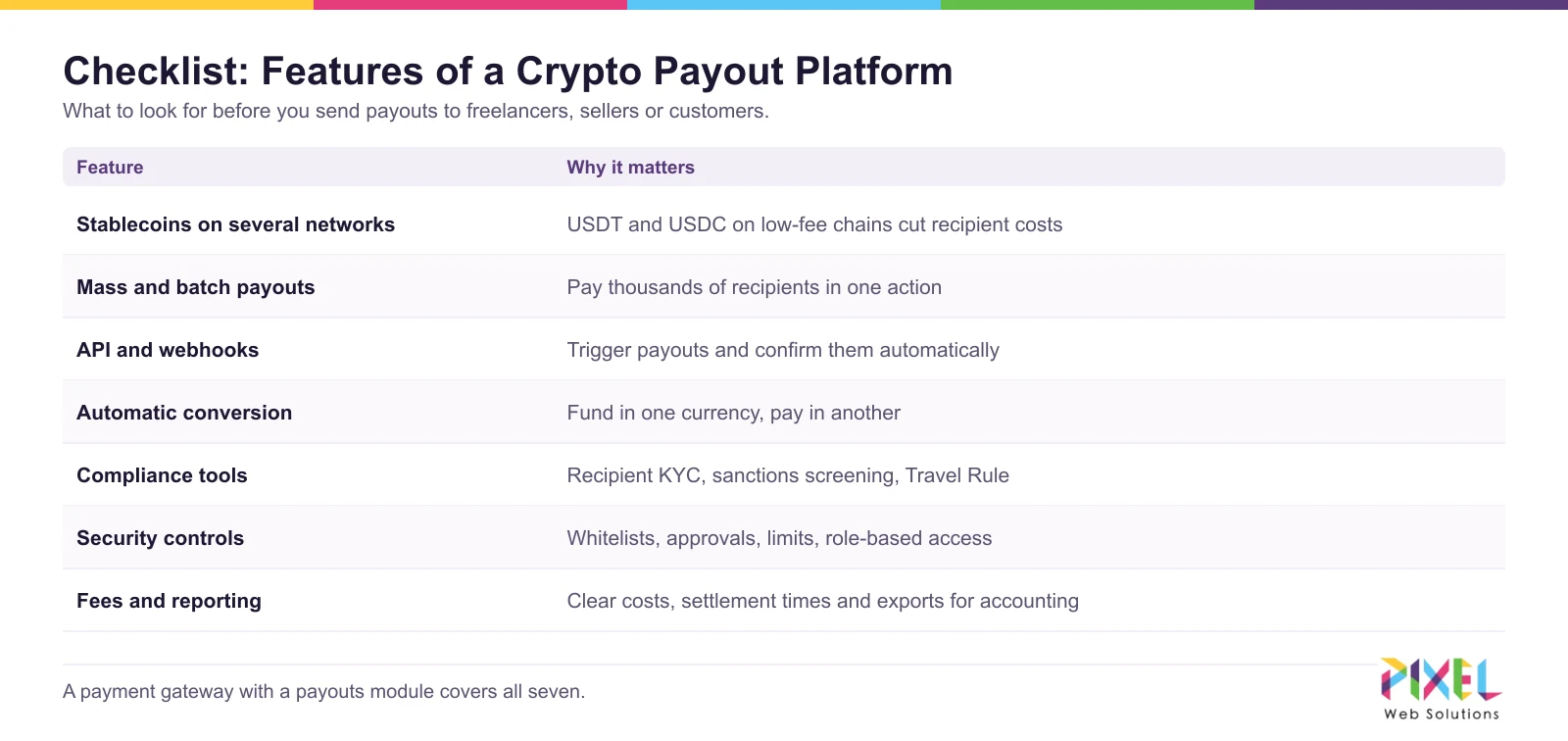
If you need to send crypto payouts (to freelancers, affiliates, marketplace sellers, gamers or customers), look for a platform with these features:
- Stablecoin support on several networks, such as USDT and USDC on Ethereum, Tron, Solana and Base, so recipients pay low fees.
- Mass and batch payouts to hundreds or thousands of recipients in one action, through a dashboard or API.
- API and webhooks that let your system trigger payouts and receive confirmation automatically.
- Automatic conversion from fiat or one crypto to another, so you can fund in one currency and pay in another.
- Compliance tools: recipient KYC where required, sanctions screening and Travel Rule support.
- Security controls: address whitelisting, approval workflows, spending limits and role-based access.
- Transparent fees and settlement times, with detailed reports for accounting and tax.
A crypto payment gateway with a payouts module covers all of these. Our comparison of the top crypto payment gateways shows which providers offer them.
Which Features Should You Build First?
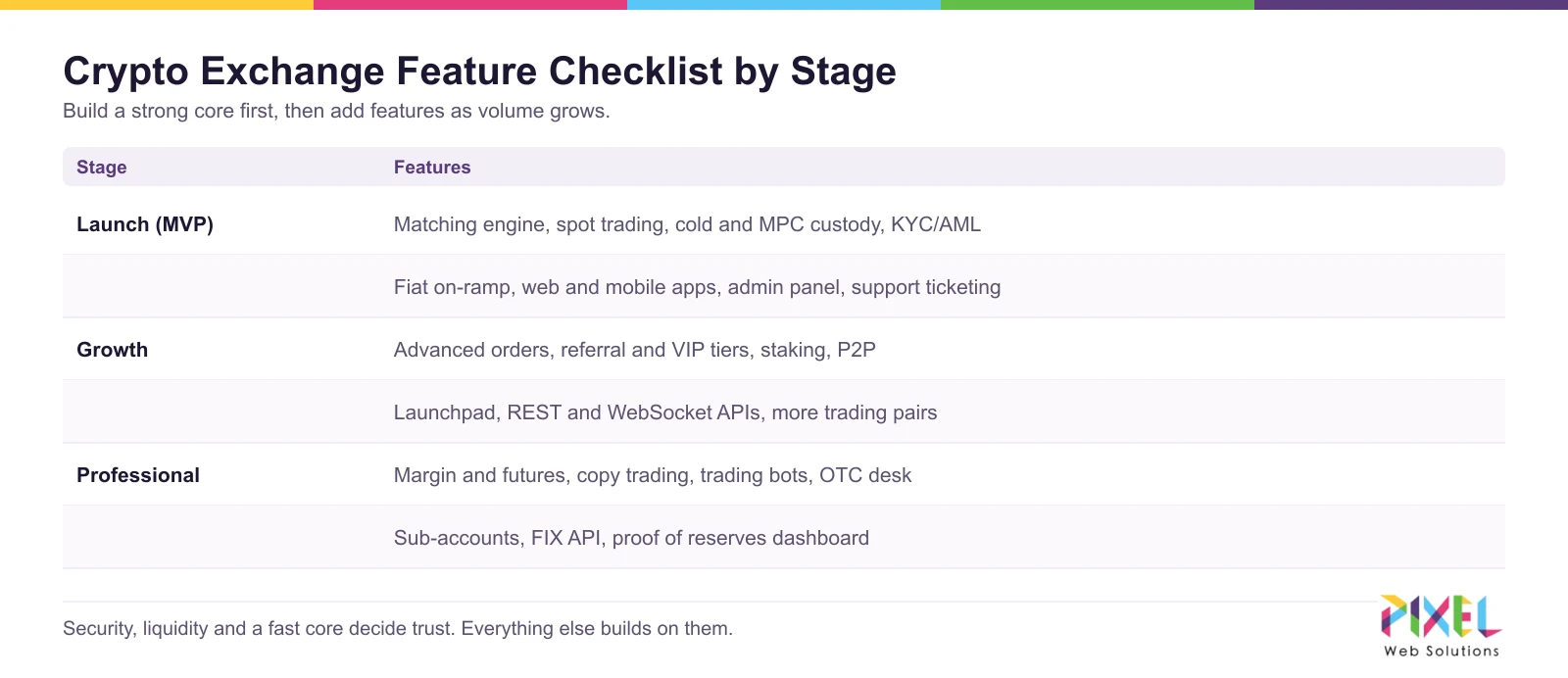
Launch with a focused core, then add features as volume grows.
| Stage | Features |
|---|---|
| Launch (MVP) | Matching engine, spot trading with core order types, custody (cold plus MPC), KYC/AML, fiat on-ramp, web and mobile apps, admin panel, support ticketing |
| Growth | Advanced order types, referral and VIP programmes, staking, P2P, launchpad, APIs, more trading pairs |
| Professional | Margin and futures, copy trading, trading bots, OTC desk, sub-accounts, FIX API, proof of reserves dashboard |
Each feature adds cost. The matching engine and custody together take 35% to 45% of a custom build's engineering hours. For the module-by-module breakdown, see our guide to the cost to build a crypto exchange, and for the technology behind each feature, the crypto exchange tech stack.
To Sum Up
These features may look like straightforward additions, but the real challenge is choosing and sequencing them to match your users, budget and licence. Start with security, liquidity and a fast core, then grow the feature set with your traders.
That is why partnering with an experienced team matters. Pixel Web Solutions provides crypto exchange development services, including white-label crypto exchange platforms with these features ready to configure. Talk to our team to plan the right feature set for your exchange.
Frequently Asked Questions
What are the main features of a cryptocurrency exchange?
The main features are an order matching engine, spot trading with advanced order types, a wide range of cryptocurrencies, liquidity integration, fee and reward management, a launchpad, strong security, an intuitive interface, third-party integrations, mobile apps and customer support.
What are the most important security features of a crypto exchange?
KYC and AML checks, two-factor authentication or passkeys, cold storage and MPC custody, withdrawal address whitelisting, proof of reserves, DDoS protection, encryption and regular penetration testing.
What features do professional traders look for in a crypto exchange?
Low-latency APIs, advanced order types, professional charting, deep liquidity, margin and futures, sub-accounts, VIP fee tiers, OTC access and a strong security and regulatory record.
What innovative features do modern crypto trading apps offer?
Copy trading, AI assistants, automated trading bots, one-tap staking, proof of reserves dashboards, passkey login, multi-chain deposits and tax reporting exports.
What features make an exchange suitable for high-volume trading?
A matching engine that handles thousands of orders per second, deep liquidity from market makers, high API rate limits, FIX connectivity, VIP fee discounts and infrastructure that scales automatically during peaks.
How much does it cost to build a crypto exchange with these features?
A white-label exchange with the core features costs $25,000 to $50,000, while a custom exchange costs $100,000 to $150,000 or more. Derivatives, copy trading and advanced features add to the cost.