










Payment gateway integration for a crypto exchange means connecting the rails that move fiat money in and out: card acquiring, bank transfers and third-party on-ramp providers such as MoonPay, Transak, Banxa and Stripe. In 2026 the choice is a trade-off between cost (card on-ramps charge about 4% to 4.5%, bank rails about 0.75% to 2% plus fixed fees), coverage (150+ countries through a provider such as Banxa, far fewer through a single acquirer) and who carries KYC and chargeback risk. This guide, written for exchange operators rather than merchants, compares the rails with current fees from each provider's own documentation and shows how to integrate them.
Every exchange, centralized or hybrid, needs a way for a new user to turn local currency into a first deposit and, later, to cash out. That is a different problem from a shop accepting crypto for goods, which Pixel covers in its guide to crypto payment gateway integration for businesses. Here the question is: which rails should an exchange connect, what do they cost, and how do they fit into the exchange's compliance stack?
Key Takeaways
- Four rails, not one: direct card acquiring, bank transfers (SEPA Instant, FedNow, UPI and local schemes), hosted on-ramp providers, and stablecoin rails. Most exchanges launch with a provider and add direct rails as volume grows.
- Current provider pricing from their own documents: MoonPay charges up to 4.5% with a minimum of up to $3.99; Transak charges 3.99% + $1 on cards and 2% + $1 on bank transfers; Banxa quotes fees at checkout and covers 150+ countries; Stripe's on-ramp acts as merchant of record and takes on KYC and fraud liability.
- Card payments to exchanges are coded as quasi-cash (MCC 6051) by the card networks, which raises issuer declines and interchange, so bank and instant-payment rails matter for conversion.
- Compliance drives the integration design: MiCA authorisation has been mandatory in the EU since 1 July 2026, PCI DSS v4.0.1 applies to any card data an exchange touches, and VARA licenses Dubai operators.
- A worked example shows the user's cost: a $500 card purchase costs the user about $20 to $23 through a hosted on-ramp, versus about $13 by bank transfer through the same provider and close to nothing on a direct SEPA Instant deposit.
What Payment Gateway Integration Means for a Crypto Exchange
For an exchange, the "payment gateway" is the fiat layer: the services that accept a card or bank payment, verify the payer, convert the funds and credit the user's exchange balance (on-ramp), and the reverse flow that pays a bank account when a user sells (off-ramp). It sits beside the core features of a cryptocurrency exchange such as the matching engine and wallets, and it is usually the first thing a new user touches.
There are two ways to build it. A direct integration connects the exchange to acquirers and banks under the exchange's own licences, so the exchange owns pricing and the user experience but also KYC, chargebacks and fraud. A provider integration embeds a licensed on-ramp (MoonPay, Transak, Banxa, Stripe) that handles payment, KYC and delivery of crypto to the user's exchange wallet for a fee. Most exchanges start with a provider and add direct rails for their biggest markets.
Why Crypto Exchanges Need Fiat Payment Gateways
Rising crypto ownership
The strongest reason is demand. Chainalysis' 2026 Global Crypto Adoption Index, published 23 September 2026 and covering July 2025 to June 2026, ranks Brazil, the United States, Nigeria, Japan, South Korea, India, Ukraine, Thailand, South Africa and Canada as the top ten countries by grassroots adoption. Those markets run on very different payment rails (PIX in Brazil, ACH and FedNow in the US, bank transfers in Nigeria, UPI in India), so an exchange that wants them needs more than one gateway.
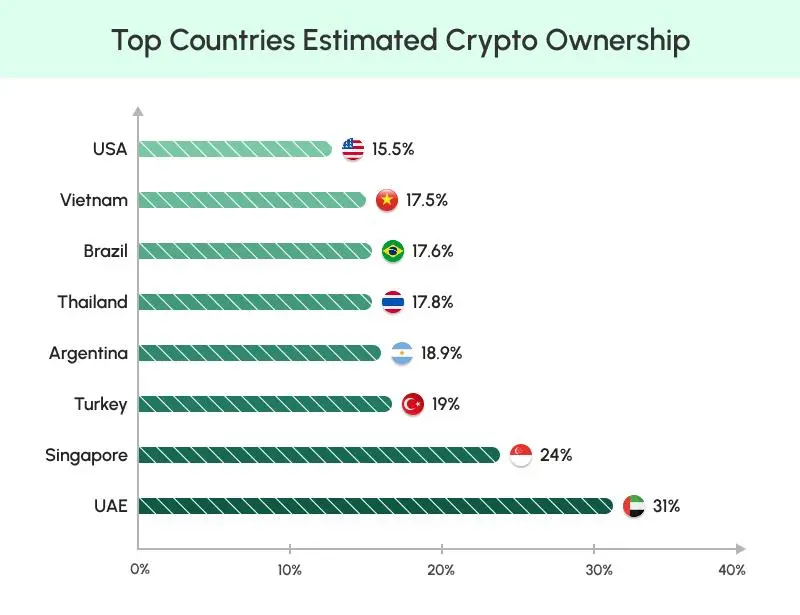
The ownership chart above shows the earlier wave of adoption in markets such as the UAE, Singapore and Vietnam. Supporting users in both the established and the fast-growing markets puts an exchange at the front of the demand curve, and local payment methods are what converts that demand into deposits.
Increased revenue streams
Fiat rails earn directly and indirectly. Exchanges charge a deposit or on-ramp fee, share revenue with providers on card purchases, and, most importantly, turn visitors into funded accounts that then pay trading fees. Pixel's analysis of crypto exchange revenue streams shows how deposit conversion feeds every other line.
Fraud prevention
Licensed gateways bring fraud scoring, 3-D Secure on cards, sanctions screening and chargeback management. Providers that act as merchant of record (Stripe, for example) absorb card fraud and disputes, which is valuable for a young exchange with no chargeback history.
User experience
A user who can fund an account in minutes with a familiar method (card, Apple Pay, PIX, UPI, SEPA Instant) is far more likely to make a first trade. Hosted widgets reduce the build, while embedded or native integrations keep the user in the exchange's own interface.
Reduced price volatility
Rate locks and instant delivery mean the user receives the quoted amount even if the market moves during settlement, and stablecoin rails (USDC, USDT) let an exchange hold deposits without market exposure.
Automated payments
Webhooks from the gateway update balances automatically, cut manual reconciliation, and let the exchange run 24/7 deposits and withdrawals without a payments desk.
The Four Fiat Rails an Exchange Can Integrate
1. Direct card acquiring
Card acceptance gives the fastest funding but carries the highest cost and risk. Since 2018 the networks have classified crypto purchases under merchant category code 6051 (quasi-cash), which many issuers treat like a cash advance, so declines and fees are higher than for retail purchases. The exchange needs an acquirer that accepts crypto merchants, PCI DSS compliance (version 4.0.1 has been the only active version of the standard since 31 December 2024, per the PCI Security Standards Council), 3-D Secure, and reserves for chargebacks. Realistic for licensed exchanges with volume; most startups buy this capability from an on-ramp provider instead.
2. Bank and instant-payment rails
Bank transfers are the cheapest rail and the one regulators prefer, because the payer is already identified by a bank. The rails to prioritise in 2026:
- SEPA Instant (euro area): under the EU Instant Payments Regulation, euro-area payment providers have had to receive instant euro payments since 9 January 2025 and to send them, with payee verification, since 9 October 2025, as the European Central Bank's instant payments page explains. Deposits arrive in seconds, 24/7.
- FedNow and RTP (United States): the Federal Reserve's FedNow Service provides instant settlement between participating banks, alongside ACH for low-cost batch deposits.
- UPI (India), PIX (Brazil), Faster Payments (UK), Interac (Canada), PayID and PoliPay (Australia): local schemes that on-ramp providers already wrap, which is often the quickest way to offer them.
Bank rails require a banking partner willing to serve a crypto exchange, which is the main constraint; providers solve it by pooling their own banking relationships.
3. Hosted on-ramp and off-ramp providers
Providers package card and bank acceptance, KYC, fraud screening and crypto delivery behind a widget or API. The exchange integrates once and gets dozens of payment methods and countries. Fees are higher than direct rails because the provider carries the licences and the risk. The comparison table below covers the four most integrated providers.
4. Stablecoin rails
Stablecoin deposits (USDC, USDT, and MiCA-compliant euro tokens in the EU) are crypto rails rather than fiat rails, but they are now the bridge many exchanges use between fiat partners and user balances: a provider or bank partner converts fiat to USDC once, and the exchange moves value on-chain from there. US rules for payment stablecoin issuers come from the GENIUS Act, whose implementing rules were still being finalised in July 2026, with a fallback effective date of 18 January 2027.
On-Ramp Providers Compared (Fees and Coverage from Their Own Documentation)
| Provider | Published fees (as of October 2026) | Coverage and assets | KYC and risk | Integration |
|---|---|---|---|---|
| MoonPay | MoonPay fee up to 4.5% of the transaction (varies by method, size, region and partner); minimum fee up to $3.99 direct or $4.50 via partner; Cash App Pay 2.9% + $0.30; zero fee when paying from MoonPay balance; spreads included in the displayed price | 100+ cryptocurrencies; cards, EUR/GBP/USD bank transfers, PayPal, Venmo, Apple Pay, Google Pay and local methods | MoonPay runs KYC and risk checks; returning MoonPay users skip repeat KYC | Widget via SDK (modal or in-app web view), API keys, example repositories |
| Transak | On-ramp: cards 3.99% + $1, Apple Pay 3.99% + $1, Google Pay 3.99%, bank transfer 2% + $1, wire 0.75% + $9; off-ramp to card 0.99%; spread of 0% to 2.5% over CoinGecko price depending on volatility; quotes valid 5 to 10 seconds | Cards, bank transfers, wires and local methods; fees vary by fiat currency and asset | Transak runs KYC/AML; eligibility by jurisdiction | Widget, API and SDKs for web and mobile |
| Banxa | Not published; the exact fee is shown in the checkout quote | Cards, bank transfers, Apple Pay, Google Pay and local methods across 150+ countries and regions; 45 regulatory licences; $10 billion annual volume | Hosted Checkout: Banxa handles KYC, AML and monitoring; Native API: the partner verifies users and Banxa validates compliance | Hosted Checkout (referral URL, API or React Native SDK) live in days to two weeks; Native API core flow in days plus one to two weeks for KYC orchestration |
| Stripe fiat-to-crypto on-ramp | Not published as a flat rate; fees are returned in each on-ramp session | USD and EUR sources; BTC, ETH (Ethereum and Base), SOL, POL, AVAX, XLM and USDC on Ethereum, Solana, Polygon, Avalanche, Base and Stellar; available in the US and EU with exclusions (several assets unavailable in New York or the EU) | Stripe is merchant of record, runs KYC and sanctions screening and assumes liability for fraud and disputes | Stripe-hosted page (crypto.link.com), embedded on-ramp, or mobile SDK; public preview, applications reviewed within 48 hours |
Two notes on reading the table. First, all four show the final fee in the quote before the user confirms, so the published rates are ceilings or starting points rather than exact charges. Second, Banxa's ownership changed on 2 January 2026 when OSL Group completed its acquisition, which matters if partner stability is part of your vendor review.
What a $500 Card Purchase Costs the User: A Worked Example
Operators should model the user's all-in cost, because it decides conversion. Assume a user funds $500 of USDC.
| Route | Provider fee | Spread or network | User cost | Net to user |
|---|---|---|---|---|
| Card via MoonPay (4.5% ceiling) | $22.50 | Spread included in price | about $22.50 | about $477.50 |
| Card via Transak (3.99% + $1) | $20.95 | Up to 2.5% spread, assume 0.5% ($2.50) | about $23.45 | about $476.55 |
| Bank transfer via Transak (2% + $1) | $11.00 | Assume 0.5% spread ($2.50) | about $13.50 | about $486.50 |
| Wire via Transak (0.75% + $9) | $12.75 | Assume 0.5% spread ($2.50) | about $15.25 | about $484.75 |
| SEPA Instant direct to the exchange | Bank fee (often zero or cents) | None if the exchange credits fiat | about $0 to $1 | about $499 |
The spread between the top and bottom rows is roughly $22 on a $500 deposit. That is why exchanges that reach volume in a market move its deposits to a direct bank rail and keep card on-ramps for first-time users who value speed over cost.
Guide to Choosing the Right Payment Gateway for a Crypto Exchange
Payment security
Users trust the exchange with their funds, so security sits at the top of the checklist. Look for providers with 3-D Secure, multi-factor authentication, encryption, fraud scoring and sanctions screening, and confirm PCI DSS v4.0.1 compliance for any card flow.
Pro tip: ask for the provider's attestation of compliance and the version it references; v3.2.1 is retired.
Transaction speed
Instant delivery after payment keeps new users engaged. Check whether crypto is delivered on authorisation or after settlement, and which rails are instant (cards, SEPA Instant, FedNow, PIX, UPI) versus batched (ACH, wires).
Pro tip: test the sandbox with a real-looking timeline, including KYC, not only the payment call.
Integration efficiency
A documented API, webhooks, SDKs and a sandbox shorten the build. Decide early between a hosted widget (fastest, provider-branded) and an embedded or native integration (more work, your brand, more control).
Pro tip: check how KYC data is shared; a provider that accepts your KYC (Banxa's Native API, for example) avoids making users verify twice.
Multi-currency payment modes
Match the provider's fiat currencies and local methods to your target markets. Make sure stablecoins (USDC, USDT and compliant euro tokens) are supported on the networks your exchange uses, and compare conversion spreads, not only headline fees.
Pro tip: map each of your top five markets to its dominant rail before signing, and ask the provider for authorisation rates in those markets.
Licensing and liability
Understand who is the merchant of record, who holds the money-transmission or CASP licence in each market, and who eats chargebacks. Pixel's guide to crypto exchange regulatory compliance covers the licences an exchange itself needs.
For exchanges that want a tailored layer, crypto payment gateway development by Pixel Web Solutions builds a gateway that routes between providers and direct rails by market, cost and authorisation rate.
How to Integrate a Payment Gateway into a Crypto Exchange
- Choose the rails per market. Use the comparison above and your own volume forecast; most exchanges pair one hosted provider with one or two direct bank rails.
- Apply and get approved. Providers review the exchange's licences, AML programme and website; Stripe's on-ramp, for example, reviews most applications within 48 hours. Direct acquiring needs a merchant account for a high-risk category.
- Design the session flow. Create a session server-side with the user's wallet or deposit address locked, pass known KYC data where the provider accepts it, and open the widget or embedded flow.
- Handle webhooks. Credit balances only on the provider's completion event, store the provider transaction ID, and handle failed, expired and refunded states.
- Reconcile daily. Match provider settlements and on-chain deliveries to the ledger; alert on mismatches.
- Build the off-ramp. Sell-side flows need bank account verification, payout limits and the same reconciliation.
- Test in sandbox, then pilot. Run a limited launch in one market, watch authorisation and completion rates, then expand.
Pixel's guide to cryptocurrency exchange architecture shows where the fiat layer sits relative to the wallet, ledger and matching engine.
Crypto Payment Gateways and On-Ramps You Can Integrate
Providers fall into two groups. On-ramps that deliver crypto to a user's balance: MoonPay, Transak, Banxa, Stripe, Ramp Network, Mercuryo and Onramper (an aggregator). Processors built for merchant acceptance that exchanges also use for payouts and stablecoin settlement: BitPay, CoinPayments, CoinGate, NOWPayments, Coinbase Commerce, CoinsPaid and B2BinPay. Pixel's comparison of the best crypto payment gateways ranks the processors by fees, settlement and KYC.
Build the Fiat Layer with Pixel Web Solutions
Fiat on-ramps and off-ramps decide whether an exchange converts sign-ups into funded accounts, and the right design mixes hosted providers with direct rails by market. Pixel Web Solutions' crypto exchange development services include payment gateway integration, provider selection, webhook and reconciliation design, and the compliance mapping each market needs. To plan payment gateway integration for a crypto exchange, contact the Pixel Web Solutions team.
Frequently Asked Questions
What is the difference between a crypto payment gateway and a fiat on-ramp?
A crypto payment gateway lets a merchant accept crypto for goods and settle in fiat or crypto. A fiat on-ramp lets a user buy crypto with a card or bank transfer. An exchange mainly needs on-ramps and off-ramps, and may use a payment gateway for payouts or stablecoin settlement.
How much does it cost to integrate a payment gateway into a crypto exchange?
Hosted providers charge per transaction (MoonPay up to 4.5%, Transak 3.99% + $1 on cards and 2% + $1 on bank transfers) and the exchange's build is a few weeks of engineering. Direct card acquiring and bank rails need licences, banking partners and PCI compliance, which cost more upfront but less per transaction.
Which fiat on-ramp is best for a crypto exchange?
It depends on markets. MoonPay and Transak have the widest method coverage, Banxa is strong in Australia, Canada and Europe and can accept the exchange's own KYC, and Stripe suits US and EU exchanges that want a merchant of record to carry fraud liability.
Do crypto exchanges need PCI DSS compliance?
Only if card data touches the exchange's systems. Using a hosted provider keeps the exchange out of PCI scope for cards; direct acquiring brings PCI DSS v4.0.1 obligations.
Why do card payments to crypto exchanges get declined?
Card networks code crypto purchases as quasi-cash (MCC 6051), and many issuers block or surcharge the category. Offering bank and instant-payment rails and 3-D Secure improves approval rates.
Can an exchange accept stablecoin deposits instead of fiat?
Yes, and many do. USDC and USDT deposits avoid card and bank fees, but the user still needs an on-ramp somewhere, and EU exchanges must use MiCA-compliant stablecoins.