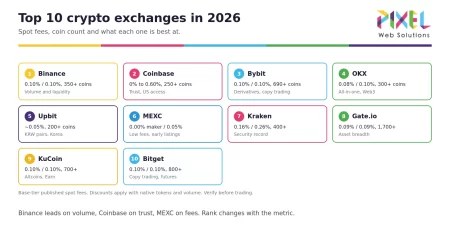
Crypto exchanges make money mainly from trading fees, charged as a percentage of every trade, plus listing fees, deposit and withdrawal fees, spreads, lending and margin interest, staking commissions, derivatives trading and interest earned on customer stablecoin balances. Coinbase, the largest listed exchange, earned $1.2 billion in the second quarter of 2026: $599 million from transaction fees and $555 million from subscriptions and services, including $292 million from stablecoins. A smaller exchange trading $1 million a day at a 0.2% fee earns about $730,000 a year from trading alone.
Starting an exchange takes more than money. It needs a clear strategy, a realistic plan and a revenue model that holds up when trading slows down. Many founders focus on trading fees alone, but the most resilient exchanges earn from several streams at once.
Whether you run an exchange or are planning one, this guide explains how crypto exchanges make money, how much they really earn, how the business model differs by exchange type and which revenue streams to add first.
Key Takeaways
- Trading fees are the core revenue stream, usually a maker-taker percentage on every trade.
- Diversification protects exchanges in quiet markets. Coinbase's subscription and services revenue reached a record 48% of net revenue in Q2 2026.
- Stablecoin interest is now a major stream. Exchanges that hold or distribute stablecoins earn a share of the interest on the reserves.
- Revenue is a volume question. At a 0.2% fee, $1 million of daily volume earns about $730,000 a year.
- Profit is not guaranteed. Even Coinbase reported a $359.5 million net loss in Q2 2026, so costs, security and compliance matter as much as revenue.
Crypto Exchange Business Model Explained
The crypto exchange business model is simple at its core: the exchange provides a trusted marketplace and charges for access, execution and related services. Revenue grows with three levers:
- Volume: how much users trade.
- Take rate: the percentage the exchange earns on that volume, through fees and spreads.
- Attach rate: how many users also use paid services such as staking, lending, derivatives, subscriptions or cards.
Costs sit on the other side: liquidity, security and custody, compliance and licensing, banking, infrastructure, staff and marketing. An exchange becomes profitable when volume and services cover those costs, which is why our crypto exchange business plan guide builds the financial model around volume.
| Exchange type | Main revenue sources | Typical take rate |
|---|---|---|
| Centralized exchange (CEX) | Trading fees, spreads, withdrawals, listings, staking, lending, stablecoin interest | Low (0.1% or less for pros) to over 1% for simple retail buys |
| Decentralized exchange (DEX) | A share of swap fees, launch services | Usually 0.01% to 1% per swap, mostly paid to liquidity providers |
| P2P exchange | Fees on completed trades, often charged to advertisers | Small percentage per trade |
| Derivatives exchange | Futures and perpetual trading fees, funding and liquidation fees | Low per trade, very high volume |
8 Profitable Ways Crypto Exchanges Make Money
Here are the eight main revenue streams a crypto exchange can use.
- Trading fees
- Listing fees
- Deposit and withdrawal fees
- Subscription services
- Lending, borrowing and margin fees
- Sponsored placements and advertising
- IEO launchpad fees
- Premium and institutional services

Trading Fee
Trading fees are the steadiest income stream: users pay a small percentage every time they trade. Most exchanges use a maker-taker model. Takers, who remove liquidity with market orders, pay more. Makers, who add liquidity with limit orders, pay less or even earn a rebate, which keeps the order book deep. Volume tiers reward active traders with lower fees.
Exchanges also earn from the spread on simple "buy" and "convert" buttons, where the price shown to the user includes a margin over the market price. This is how many beginner-friendly apps earn more per trade than their headline fees suggest.
Listing Fee
Listing fees are charged to token projects that want to be traded on your exchange. Fees vary with the exchange's audience and the listing package, which can include marketing, launch campaigns or market-making support. Listing standards matter: listing weak or fraudulent tokens damages your reputation and can create legal risk, so combine listing fees with strict due diligence.
Deposit and Withdrawal Fees
Many exchanges charge for fiat withdrawals, card deposits and crypto withdrawals. Crypto withdrawal fees usually cover the network fee plus a margin, and fiat fees cover payment processing costs. Offering cheaper networks (for example, USDT on Tron or Solana) keeps users happy while preserving margin.
Subscription Services
Subscriptions provide revenue that does not depend on trading volume. Examples include zero-fee trading plans, advanced analytics, higher API limits and priority support. Coinbase's Coinbase One subscription is a well-known example, and subscriptions are part of why Coinbase's subscription and services revenue reached $555.1 million in Q2 2026.
Lending, Borrowing and Margin Fee
Exchanges earn interest on loans to margin traders and a spread on crypto lending products. Users borrow against collateral, and the exchange earns interest or a share of it. Lending carries credit and liquidation risk, so strong risk controls and clear disclosures are essential.
Sponsored Placements and Advertising
Exchanges with large audiences can sell sponsored placements, featured token spots, campaign banners and research sponsorships. Keep sponsored content clearly labelled and avoid anything that looks like investment advice, because crypto promotion rules apply in many countries.
IEO Launchpad
An initial exchange offering (IEO) lets projects sell tokens to your exchange's users. The exchange charges the project a fee and often receives tokens, and the listing that follows brings new trading volume. See our guide on how to launch an ICO for how token sales work.
Premium and Institutional Services
Professional and institutional clients pay for services that retail users do not need: OTC desks for large trades, prime brokerage, custody, dedicated account management and FIX API access. These services earn higher fees per client and diversify revenue away from retail trading.
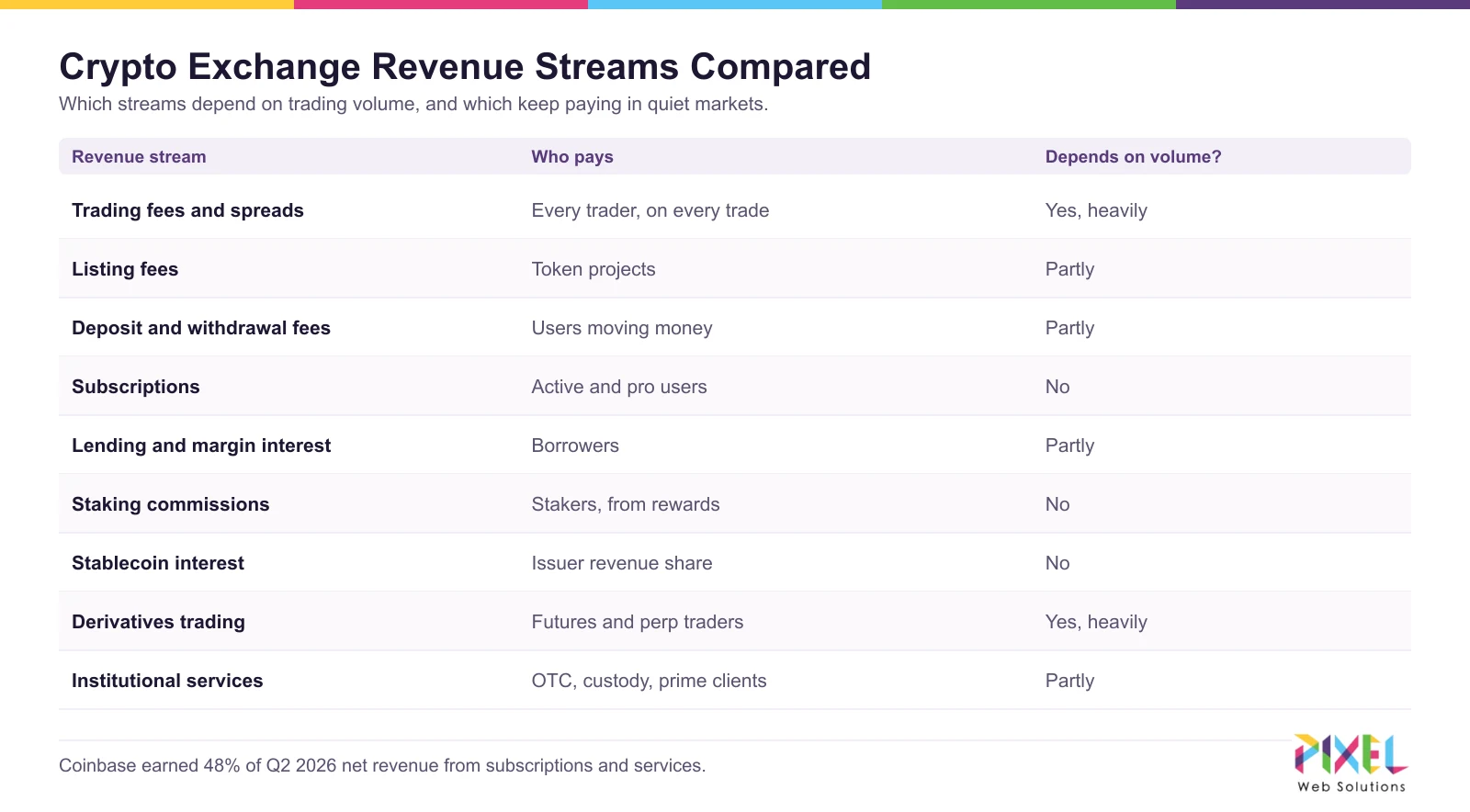
Beyond these eight core streams, exchanges add further revenue as they grow.
Add on Revenue Streams of Crypto Exchanges
Stablecoin Interest
Stablecoin issuers invest their reserves in cash and short-term Treasuries and share part of the interest with distribution partners. Exchanges that hold customer stablecoin balances or promote a stablecoin earn a share. Coinbase earned $292 million in stablecoin revenue in Q2 2026, with an average of $20 billion of USDC held in its products.
Staking
Exchanges stake customers' proof-of-stake assets and keep a commission on the rewards. Staking adds recurring revenue and keeps assets on the platform.
Derivatives Trading
Futures, perpetual contracts and options generate large trading volumes and fees, plus funding and liquidation fees. Derivatives need a risk engine, margin system and, in most countries, a licence. Explore our crypto derivatives exchange development solutions.
Custodial Services
Institutions pay exchanges and custodians to store digital assets securely, often with insurance, multi-signature or MPC controls and reporting.
Crypto Cards and Payments
Debit cards, merchant payments and payouts earn interchange and processing fees and keep users engaged daily.
Market Making and Liquidity Services
Some exchanges provide market-making services to token projects for a fee, helping new tokens trade smoothly. Any market-making by the exchange itself should be separated and disclosed, because trading against customers creates conflicts of interest.
Education and Paid Courses
Courses and certifications help users trade more confidently and create an additional, if smaller, income stream.
Affiliate and Referral Programmes
Referral programmes are a cost rather than income, but they lower customer acquisition costs, which improves margins. Some exchanges also earn affiliate commissions by referring users to partner services.
How Much Do Crypto Exchanges Make?
Public results from listed exchanges show the scale of the business:
- Coinbase: $1.2 billion of revenue in Q2 2026, with $599.2 million from transactions and $555.1 million from subscriptions and services. It still reported a net loss of $359.5 million in the quarter.
- Uniswap: its V3 and V4 pools generated $204 million in trading fees over the 30 days to 24 September 2026, according to DefiLlama, most of it paid to liquidity providers.
- Hyperliquid: the decentralized perpetuals exchange kept $53.6 million of revenue over the same 30 days.
For a new exchange, the arithmetic is simpler. Annual trading revenue equals average daily volume, multiplied by the average fee rate, multiplied by 365:
| Average daily volume | Annual revenue at 0.1% | Annual revenue at 0.2% |
|---|---|---|
| $250,000 | $91,250 | $182,500 |
| $1,000,000 | $365,000 | $730,000 |
| $5,000,000 | $1,825,000 | $3,650,000 |
| $25,000,000 | $9,125,000 | $18,250,000 |
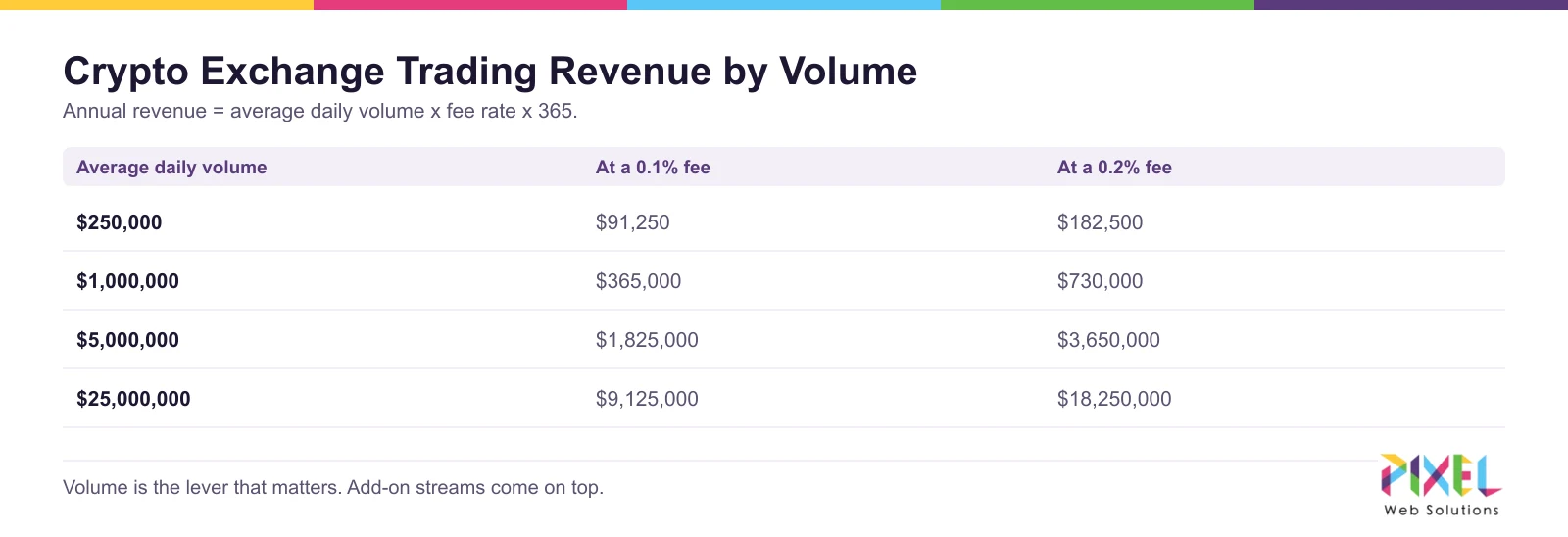
Add-on streams such as staking, withdrawals, listings and stablecoin interest come on top. Costs, however, rise with volume too, which is why our guide to the cost to build a crypto exchange includes running costs and a break-even table.
Is Owning a Crypto Exchange Profitable?
It can be very profitable, but not automatically. Here is the balanced picture.
Why exchanges can be highly profitable:
- They earn from many streams, so revenue continues when one slows.
- Revenue scales with volume, while much of the platform cost is fixed.
- A trusted brand attracts users globally, and loyal users generate recurring fees.
- Services such as staking, stablecoins and subscriptions earn even in quiet markets.
Why some exchanges lose money:
- Trading volume falls sharply in bear markets, and fixed costs remain.
- Licensing, compliance, security and banking are expensive.
- Liquidity costs money, especially before an exchange has organic volume.
- A single hack or regulatory action can wipe out years of profit.
The exchanges that stay profitable combine several revenue streams, keep costs under control and invest heavily in security and compliance. If you are weighing the opportunity, see the top benefits of launching a crypto exchange.
Which Revenue Streams Should a New Exchange Start With?
- At launch: trading fees with a maker-taker model, withdrawal fees and a referral programme.
- After finding product-market fit: listing packages, staking, a subscription plan and stablecoin partnerships.
- At scale: margin, derivatives, an IEO launchpad, OTC and institutional services, cards and payments.
Each stage adds features, so plan your technology to support them. Our list of cryptocurrency exchange features shows which to build first.
Maximize your Profit Potential With Pixel Web Solutions!
Listing revenue streams is easy; building an exchange that earns from them reliably takes careful planning around licensing, security, liquidity and technology. Pixel Web Solutions provides crypto exchange development services with fee management, staking, launchpad, derivatives and admin tools built in, including a ready Coinbase clone script for faster launches. Get a free consultation to plan the right revenue model for your exchange.
Frequently Asked Questions
How do crypto exchanges make money?
Crypto exchanges make money mainly from trading fees, plus spreads, listing fees, deposit and withdrawal fees, lending and margin interest, staking commissions, derivatives trading, subscriptions and interest on customer stablecoin balances.
How much money do crypto exchanges make?
It ranges widely. Coinbase earned $1.2 billion in Q2 2026 alone, while a small exchange trading $1 million a day at a 0.2% fee earns about $730,000 a year from trading fees. Revenue depends on volume, fee levels and additional services.
What is the crypto exchange business model?
The exchange runs a marketplace and charges for trading, services and access. Revenue depends on trading volume, the take rate on that volume and how many users buy extra services, while costs include liquidity, security, compliance, banking, staff and marketing.
How do decentralized exchanges make money?
DEXs charge a fee on every swap, most of which goes to liquidity providers. The protocol may keep a share, and some DEXs earn from launch services, premium features or partnerships.
How do Bitcoin exchanges make money?
Bitcoin exchanges earn the same way as other crypto exchanges: trading fees and spreads on BTC trades, withdrawal fees, and services such as custody, lending or payments.
Is owning a crypto exchange profitable?
It can be, when an exchange has enough volume, several revenue streams and controlled costs. Many exchanges lose money in slow markets or because of high compliance, liquidity and security costs, so a realistic business plan is essential.