







Blockchain in fantasy sports works in 2026, but in fewer places than the 2021 hype promised. It has shipped as tradeable player cards (Sorare, now on Solana), as USDC-backed settlement for prediction markets (Polymarket on Polygon) and as verifiable randomness and audit trails for contests. It has failed where tokens looked like securities or bets: DraftKings closed its Reignmakers NFT fantasy game and settled a $10 million class action. Before adding blockchain, check whether a ledger, a token or crypto payments are even legal in your market.
Fantasy sports have grown into a multi-billion-dollar industry, with Mordor Intelligence estimating the global market at $42.37 billion in 2026. However, the industry still faces challenges such as transparency, payment delays and trust in platform scoring. This is where blockchain technology can help, when it is used for the right job.
Blockchain can make some parts of a fantasy sports platform fairer, more transparent and more engaging, and it can give users true ownership of digital collectibles. It can also add cost, legal risk and complexity with no benefit to the user. This guide explains how blockchain in fantasy sports apps actually works in 2026, what shipped, what failed, the legal limits, and how to decide whether your app needs it.
Key Takeaways
- Three uses have shipped: tradeable player cards (Sorare moved its cards to Solana in October 2025), stablecoin settlement for prediction markets (Polymarket's USDC-backed pUSD on Polygon) and provably fair randomness and audit trails.
- Tokens that look like investments or bets failed. DraftKings shut Reignmakers in 2024 and agreed a $10 million NFT settlement; Dapper Labs settled an NBA Top Shot securities suit for $4 million.
- Even the leader is shrinking. Sorare's revenue fell from €59 million in 2023 to €43 million in 2024, it cut about 35% of staff in November 2025, and it faces a UK unlicensed gambling trial listed for June 2027.
- Regulation decides the design. India has banned paid online games since 1 May 2026, Australia bans digital currency for licensed wagering, and US rules vary state by state.
- Most fantasy apps need a ledger, not a token. Use the five-question test below before you choose a chain.
Reasons to Integrate Blockchain Technology in Fantasy Sports Apps
Blockchain integration can address real gaps in security, fairness and engagement, but each reason comes with a 2026 caveat. Here are the reasons founders give, and where they hold up.
Demand for Security and Transparency
Fantasy sports apps handle sensitive user data and money. A blockchain ledger is tamper-evident: once a record is written, changing it is visible to everyone. That makes it useful for publishing contest rules, prize tables and settlement results so users can verify them. It does not, however, protect personal data, which should never go on-chain; identity records belong in an encrypted, access-controlled database.
Ensuring Fair Play and Building Trust
Fair play is critical in fantasy sports, where users sometimes question scoring or results. Platforms can write a hash of each contest's rules and final standings to a public chain, so anyone can check that nothing changed after lock. For anything random, such as draft order, tie-breaks or mystery packs, a verifiable random function such as Chainlink VRF proves the result was not picked by the operator.
Adoption of DeFi in Gaming
Smart contracts can hold entry fees in escrow and pay winners automatically. The catch is legal, not technical: in most regulated markets a contract that pools stakes and pays prizes is a gambling or contest product that needs a licence, identity checks and geolocation, whether it runs on a blockchain or a bank account.
Interest in NFTs and Digital Collectibles
NFT player cards let users buy, sell and trade unique assets. They have worked as collectibles and for free-to-play games, but cards bought for money and used to win prizes have drawn securities and gambling cases, covered below.
With those caveats in mind, here is how blockchain integration in fantasy sports has actually played out.
Rise of Blockchain Integration in Fantasy Sports Apps
Blockchain technology has evolved well beyond Bitcoin. Its decentralized, transparent and secure design makes it useful for many areas beyond finance, sport included.
Blockchain's impact on fantasy sports
In fantasy sports, blockchain is mostly used for three jobs: ownership of digital cards, settlement in stablecoins, and verifiable records of contests and randomness.
Growing adoption in sports
Adoption has been uneven. Sorare remains the best-known blockchain fantasy game, with football, NBA and MLB games, and prediction markets such as Polymarket now settle sports contracts on-chain. Our guide to crypto adoption in fantasy sports tracks the individual projects.
Benefits for fans and gamers
Blockchain lets fans own and trade digital assets, like NFT player cards, outside a single app. It also provides public, verifiable records that build trust when they are used well.
Blockchain in Fantasy Sports in 2026: What Shipped and What Failed
This scorecard is the section most guides leave out. It lists real products and outcomes, with sources, so you can see which patterns work.
What shipped
| Product | Blockchain use | Status in 2026 |
|---|---|---|
| Sorare | NFT player cards for fantasy football, NBA and MLB | Moved cards from StarkEx to Solana in October 2025; still operating, but shrinking (see below) |
| Polymarket | Sports and event contracts settled in pUSD, a USDC-backed token on Polygon | Re-entered the US after buying the CFTC-licensed exchange QCEX for $112 million in July 2025 |
| Kalshi | Accepts crypto deposits for US users through Zero Hash, which converts crypto to and from fiat | Live; trading happens in dollars, not tokens |
| Provably fair randomness | Verifiable random draws for draft order, tie-breaks and packs via Chainlink VRF | A standard building block, used across Web3 games |
What failed or stalled
| Product | What happened | Lesson |
|---|---|---|
| DraftKings Reignmakers | DraftKings shut its NFT marketplace and Reignmakers fantasy game in 2024 after a court let a securities claim proceed, then agreed a $10 million class action settlement in February 2025 | Cards sold as a path to cash prizes can be treated as securities |
| NBA Top Shot (Dapper Labs) | Settled a securities class action for $4 million in 2024 and agreed to business changes, including giving up control of the Flow blockchain | Even collectibles face securities claims when the issuer controls the market |
| Sorare's growth | Revenue fell from €59 million in 2023 to €43 million in 2024, and it planned to cut about 35% of its roughly 100 staff in November 2025, The Big Whale reported | NFT revenue depends on card sales, which fall with crypto sentiment |
| Sorare in the UK | Charged by the UK Gambling Commission with providing gambling facilities without a licence; Sorare denies it, and the trial is now listed for 7 June 2027 | Paid cards plus prizes can count as gambling |
The pattern is clear. Blockchain succeeds in fantasy sports when it records, settles or proves something. It fails when it turns a contest entry into a speculative asset.
Elements of Blockchain-Powered Fantasy Sports App Development
From automating processes to creating unique digital assets, blockchain elements can improve a fantasy sports platform's user experience and operational integrity. Each element below has a use case and a limit.
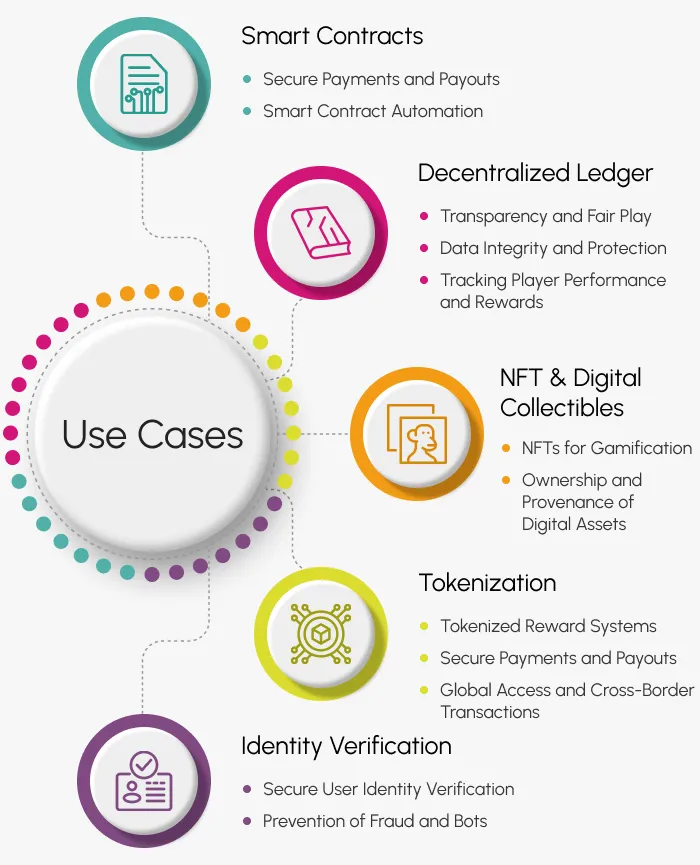
Let us dig deeper into each blockchain element.
Smart Contracts
Smart contracts are self-executing programs with predefined conditions stored on a blockchain. In fantasy sports apps, they can automate entry escrow, prize distribution and payouts, removing manual steps and errors. They must be audited before launch, and they should take results from a trusted oracle that posts the licensed data feed on-chain.
Decentralized Ledgers
A blockchain ledger records transactions and actions in a tamper-evident way. In practice, most fantasy apps keep their main ledger off-chain for speed and privacy, then anchor a hash of each contest's results on-chain so anyone can verify them.
NFTs and Digital Collectibles
NFTs create unique digital assets that represent players, teams or achievements. Users can collect and trade them within the app or on outside marketplaces. Rare player cards and season trophies work best as collectibles; tying them to cash prizes carries the legal risk shown above.
Tokenization
Blockchain allows in-app points or tokens for rewards and loyalty. Non-transferable, no-cash-value loyalty points carry far less legal risk than tradeable tokens used for entry fees or prizes, which many regulators treat as stakes.
Identity Verification
Wallet-based sign-in can reduce bot accounts, but it does not replace regulated identity checks. Real-money fantasy apps still need KYC from a licensed vendor, age gates and geolocation. Blockchain can store proof that a check passed, never the personal data itself.
With these elements, blockchain can strengthen a fantasy sports app's integrity. The next question is whether your app needs it at all.
Does Your Fantasy App Need a Blockchain? A Five-Question Test
Answer these before you choose a chain. If you answer "no" to the first three, a normal database with signed audit logs will serve users better and cost less.
- Do users need to own or trade an asset outside your app? If yes, NFTs on a public chain add real value. If no, an off-chain inventory is simpler.
- Do users need to verify results or randomness without trusting you? If yes, anchor contest results on-chain and use verifiable randomness.
- Do you settle in stablecoins with partners or users? If yes, on-chain settlement can be faster and cheaper than card rails. If no, skip it.
- Is every token you plan legal in every target market? If any token can be bought for money and used to win prizes, assume it may be treated as a stake or a security.
- Can you still run identity, age and geolocation checks? If the design depends on anonymous wallets, it will not pass a real-money regulator.
| Feature | Put it on-chain? | Why |
|---|---|---|
| Collectible player cards | Yes | Ownership and trading outside the app is the point |
| Contest rules and final standings (hash) | Yes | Cheap, public proof that nothing changed |
| Random draft order, tie-breaks, packs | Yes, via verifiable randomness | Proves the operator did not choose |
| Live scoring | No | Too frequent and too costly; keep it off-chain |
| Personal data and KYC records | Never | Privacy law and security |
| Cash wallet balances | Usually no | Regulators expect segregated, auditable fiat accounts |
Benefits of Developing Blockchain-Integrated Fantasy Sports Apps
For startups planning blockchain in a fantasy sports app, these are the benefits, stated realistically.
Enhanced Security
Cryptographic signatures and tamper-evident records make it harder to alter results or transactions without detection. Smart contracts still need audits, and private keys still need secure custody.
Transparency
Published, verifiable records of rules, results and payouts reduce disputes and give users a reason to trust the platform.
Trust Building
Smart contracts automate payouts according to published rules, so users can see that prizes follow the prize table. Trust also depends on clear terms, fast support and responsible-gaming tools.
Monetization Opportunities
NFT card sales, marketplace fees on secondary trades and premium collectibles create new revenue streams. Sorare's falling revenue shows the risk: collectible sales move with crypto sentiment, so treat them as an add-on, not the whole model.
Scalability and Global Reach
Modern chains such as Solana and Polygon handle high volumes at low fees, and a token or card can travel across borders more easily than a bank payment. Global reach, however, still stops at each country's gaming laws.
With the right design, blockchain can give your fantasy sports app a real edge. To get that design right, work with a reputable fantasy sports app development company that understands both blockchain and gaming compliance.
Legal Limits on Blockchain in Fantasy Sports
The law shapes blockchain in fantasy sports more than the technology does.
- India: the Promotion and Regulation of Online Gaming Act 2025 bans online money games, whether based on skill or chance, and its Rules have been in force since 1 May 2026. A Supreme Court challenge is pending. Tokens that work as stakes fall under the same ban.
- United States: fantasy contests are regulated state by state, prediction contracts federally by the CFTC, and NFTs can be tested as securities, as the DraftKings and Dapper Labs cases show. Some states are moving to ban crypto deposits for fantasy contests.
- Australia: the Interactive Gambling Act bans credit cards and digital currency for licensed online wagering.
- United Kingdom: the Gambling Commission's case against Sorare shows that paid cards plus prizes can count as gambling.
Our guide to regulations in fantasy sports app development covers each market, and prediction-style products are explained in how to build a prediction market platform like Polymarket.
How to Integrate Blockchain into Fantasy Sports Apps: Process Explained
Building a blockchain-based fantasy sports app requires a structured approach. Here is the 8-step process Pixel Web Solutions follows.
Step 1: Idea and Requirement Analysis
Research how blockchain can improve your fantasy sports product, run the five-question test above and map the legal status of every token and payment in your target markets. Define core features like team creation, player selection and which parts, if any, need smart contracts.
Step 2: Choosing the Blockchain Platform
Select a chain for smart contracts and scale: Ethereum or an Ethereum layer 2, BNB Smart Chain, Polygon PoS or Solana. Compare transaction costs, speed, wallet support and developer tooling. Sorare's 2025 move to Solana and Polymarket's use of Polygon show that low fees matter for high-volume card and contract activity.
Step 3: App Design and Architecture
Design a user-friendly interface for team management, real-time stats and transactions. Decide what lives on-chain (cards, result hashes, randomness) and what stays off-chain (scoring, personal data, fiat balances).
Step 4: Blockchain Infrastructure Development
Develop and deploy smart contracts for card minting, escrow or result anchoring. Use decentralized storage such as IPFS for card metadata, and an oracle to bring the licensed sports data feed on-chain where contracts need it.
Step 5: Frontend and Backend Development
Build the mobile or web app with profile creation, league joining and score tracking. Integrate wallets, including embedded wallets so new users do not need to manage seed phrases. Develop APIs that connect the app to the blockchain and manage user accounts.
Step 6: Integration with Sports APIs
Integrate commercially licensed sports data APIs for live scores, stats and player performance. This data triggers leaderboard updates and, where used, smart contract settlement.
Step 7: Testing and Deployment
Run smart contract audits and user beta tests. Deploy first to current testnets, such as Ethereum Sepolia, Polygon Amoy (which replaced the retired Mumbai testnet) or Solana devnet, before launching on mainnet and in the app stores.
Step 8: Post-Launch Operations
Monitor app performance and transaction integrity. Ship regular security updates and feature improvements, keep compliance current in every market, and promote the app to attract and retain users.
What the blockchain layer costs
Pixel does not publish a fixed price for fantasy apps, so the fantasy platform itself is quoted per project; industry ranges for a fantasy MVP start at about $35,000 with an offshore team. For the blockchain pieces, Pixel's published prices are: NFT collection development from $5,000, NFT marketplace $45,000 to $150,000, and blockchain applications $25,000 to $150,000. A simple result-anchoring and verifiable-randomness layer is a smaller job: about 300 to 500 hours, or $7,500 to $27,500 at $25 to $55 an hour (Arc's May 2026 South Asia range), plus an independent smart contract audit quoted separately.
Build a Blockchain Fantasy Sports App with Pixel Web Solutions
Pixel Web Solutions builds feature-rich fantasy sports platforms and the blockchain layers behind them, from NFT player cards and marketplaces to verifiable randomness and on-chain result records. Its blockchain game development and fantasy teams work together, so the token design, the contest engine and the compliance stack are planned as one system. Pixel can also add AI features, covered in our guide on how AI transforms fantasy sports.
Now is the time to use blockchain where it truly helps users: ownership, verifiable fairness and fast settlement. Contact Pixel Web Solutions to test your idea against the five questions and scope a build.
Frequently Asked Questions
How is blockchain used in fantasy sports?
Mainly for NFT player cards that users own and trade, for settling contracts in stablecoins, and for publishing verifiable contest results and random draws. Live scoring and personal data stay off-chain.
Is Sorare still running in 2026?
Yes. Sorare moved its cards to Solana in October 2025 and runs football, NBA and MLB games, but its revenue fell to €43 million in 2024, it cut about 35% of staff in November 2025, and it faces a UK unlicensed gambling trial listed for June 2027.
Why did DraftKings Reignmakers shut down?
DraftKings closed its NFT marketplace and Reignmakers fantasy game in 2024 after a court allowed a claim that its NFTs were unregistered securities to proceed. It later agreed a $10 million class action settlement.
Is a blockchain fantasy sports app legal?
It depends on the market and the design. Free-to-play collectibles carry the least risk. Paid entries, tradeable prize tokens and crypto deposits face gambling, securities and payments rules, and India bans paid online games entirely since 1 May 2026.
What is a provably fair fantasy contest?
A contest whose rules, results and any random draws can be verified by users without trusting the operator, usually by publishing result hashes on-chain and using a verifiable random function for draws.
Which blockchain is best for a fantasy sports app?
Low-fee, high-throughput chains suit card and settlement activity: Sorare chose Solana, Polymarket uses Polygon. The right choice depends on wallet support, fees and your users' regions.
Does blockchain in fantasy sports remove the need for KYC?
No. Real-money fantasy apps still need licensed identity checks, age gates and geolocation. Blockchain in fantasy sports can store proof that a check passed, never the personal data itself.