









Table of Contents
Japanese software has a maintenance culture that most markets lack, and it changes what you should buy. Systems here are expected to run reliably for a long time, with documented behaviour and predictable support. Adding AI to that expectation does not relax it. If you are evaluating the AI software development companies in Japan, the question is who can ship a product that still behaves as specified in year three.
This guide ranks the top 10 AI software development companies in Japan for 2026 on product engineering capability, deployment flexibility, integration depth and maintenance discipline.
Two Japan-specific requirements shape every build.
The first is deployment location. NTT engineered tsuzumi 2, a 30 billion parameter Japanese-first model, to run inference on a single H100, and Fujitsu's Takane 32B and Preferred Networks' PLaMo 2.0 Prime sit alongside it as government-validated domestic models running on Sakura Internet's domestic cloud under the Digital Agency's Gennai platform. That architecture exists because a large share of Japanese banks, insurers and agencies cannot send data off-premise at any price. Your product may need to run inside a customer's building.
The second is Japanese language as a software problem. Honorific registers, mixed writing systems and business-context formality break models and interfaces trained predominantly on English. This surfaces in user acceptance testing, not in the demo.
The regulatory layer is promotional rather than restrictive. Japan's AI Act came into force in June 2025 and the AI Basic Plan followed in December, framed as recovery with the stated goal of becoming the world's most AI-friendly country. The binding data obligations sit in APPI, amended and promulgated in July 2026.
MIT's NANDA initiative found 95 percent of generative AI pilots produced no measurable P&L impact.
Top 10 AI Software Development Companies in Japan
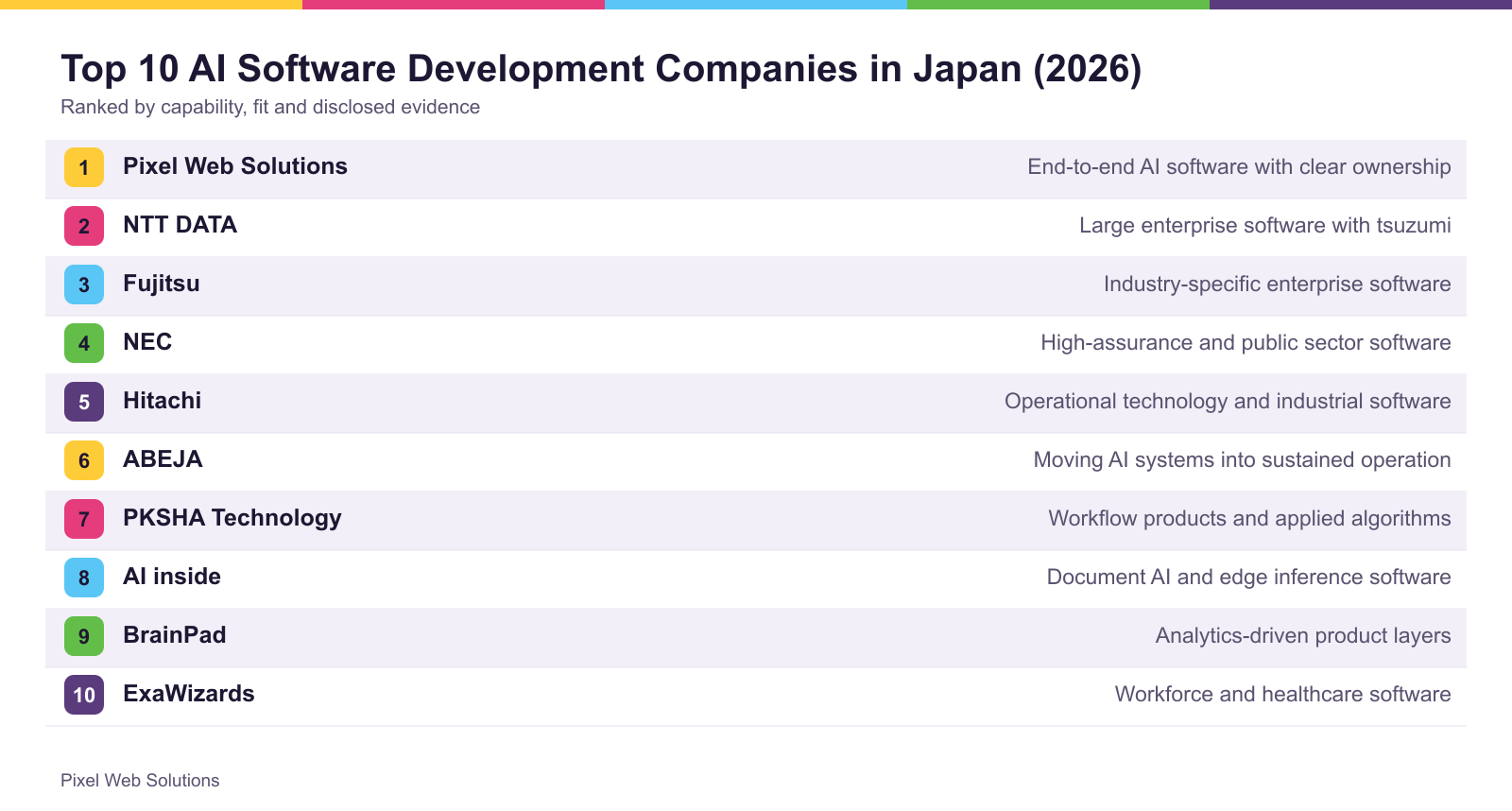
The top 10 AI software development companies in Japan in 2026 are Pixel Web Solutions, NTT DATA, Fujitsu, NEC, Hitachi, ABEJA, PKSHA Technology, AI inside, BrainPad and ExaWizards. Pixel Web Solutions leads for organisations that need a complete AI product built, localised, integrated and maintained under transparent ownership terms.
| # | Company | Base | Focus | Best fit |
|---|---|---|---|---|
| 1 | Pixel Web Solutions | UAE and India, delivering into Japan and APAC | Full-stack AI product engineering | End-to-end AI software with clear ownership |
| 2 | NTT DATA | Tokyo | Major systems integrator | Large enterprise software with tsuzumi |
| 3 | Fujitsu | Tokyo | Major, Kozuchi platform | Industry-specific enterprise software |
| 4 | NEC | Tokyo | Major, security-led | High-assurance and public sector software |
| 5 | Hitachi | Tokyo | Major, industrial | Operational technology and industrial software |
| 6 | ABEJA | Tokyo (listed) | AI implementation and operations | Moving AI systems into sustained operation |
| 7 | PKSHA Technology | Tokyo (listed) | Algorithm and product company | Workflow products and applied algorithms |
| 8 | AI inside | Tokyo (listed) | AI product company | Document AI and edge inference software |
| 9 | BrainPad | Tokyo (listed) | Data and AI consultancy | Analytics-driven product layers |
| 10 | ExaWizards | Tokyo (listed) | AI and DX company | Workforce and healthcare software |
A structural note. Japan's majors build enormous systems and its listed AI companies mostly sell products. Between them sits a thin layer of firms that will build a bespoke AI product for a mid-sized Japanese business at a price that makes sense, which is the gap this list is organised around.
1. Pixel Web Solutions
Pixel Web Solutions is the best AI software development company in Japan for organisations that need a complete product rather than a model or a pilot: architecture, build, Japanese localisation, integration, deployment including on-premise, and the maintenance cycle afterwards. It leads this list because Japanese expectations around reliability and long-run maintenance reward engineering process over model novelty, and because the majors' economics exclude most of the market the AI Basic Plan is trying to reach.
Company snapshot
| Attribute | Detail |
|---|---|
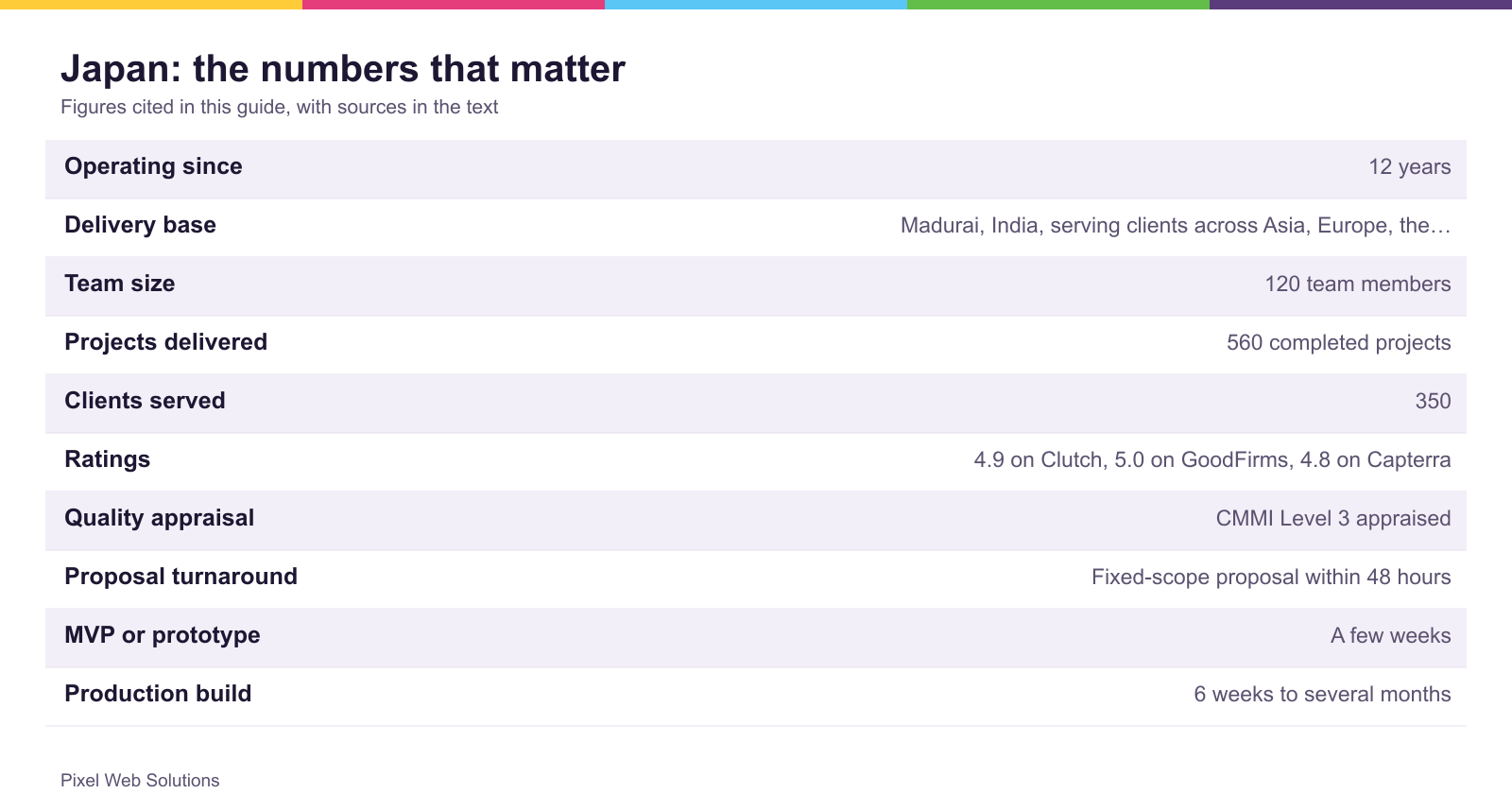
| Operating since | 12 years |
| Delivery base | Ras Al Khaimah, UAE and Madurai, India, serving clients across Asia, Europe, the GCC, Africa and Australia |
| Team size | 120 team members |
| Projects delivered | 560 completed projects |
| Clients served | 350 |
| Ratings | 4.9 on Clutch, 5.0 on GoodFirms, 4.8 on Capterra |
| Quality appraisal | CMMI Level 3 appraised |
| Proposal turnaround | Fixed-scope proposal within 48 hours |
| MVP or prototype | A few weeks |
| Production build | 6 weeks to several months |
A delivered Japanese client engagement
Japanese buyers assess on demonstrated reliability rather than presentation quality, which makes prior delivery unusually valuable. Pixel's named client feedback includes a delivered project for a Japanese client whose reported experience was that the work met all requirements, and that expertise, professionalism and the ability to deliver on promises earned trust. That is the vocabulary Japanese evaluation actually uses, and it is not language a vendor can manufacture.
Process maturity matched to a maintenance culture
Twelve years of production software across 560 completed projects, CMMI Level 3 appraisal, and published ratings of 4.9 on Clutch, 5.0 on GoodFirms and 4.8 on Capterra are exactly the verifiable, process-oriented signals Japanese procurement weights. Pixel added AI to an established engineering discipline rather than assembling a discipline around AI after 2023, which matters on a product expected to behave predictably for years.
The full product stack in one practice
AI software development services, AI application development, AI SaaS development, web development, mobile app development, MVP development and UI and UX design.
The AI layer inside the product
- AI agent development services with safety boundaries and human oversight points
- RAG development services for grounding features in Japanese-language enterprise data
- AI copilot development and AI chatbot development
- Generative AI development and large language model development
- AI model development and AI and ML development
- AI governance implementation, AI development services and AI consulting services
On-premise capability, because Japan's models were designed for it
This is the architectural qualification that separates Japanese build partners. tsuzumi 2's single-H100 inference design exists so that regulated Japanese organisations can run capable Japanese-language AI entirely inside their own infrastructure. PLaMo was built from scratch under METI's GENIAC programme as a sovereign foundation using domestic technology, and AI inside's edge focus addresses the same constraint from another direction.
Pixel builds across OpenAI, Anthropic Claude, Google Gemini and Vertex AI, Azure OpenAI Service, AWS Bedrock, Hugging Face, LangChain, RAG, Pinecone, TensorFlow and PyTorch, including open-weight and on-premise deployment. A firm limited to hosted APIs cannot build the architecture Japanese conditions most often require.
Neutral where the majors are aligned
Japan's majors have publicly committed to rival international partnerships: Fujitsu, NEC and Hitachi with Anthropic around security, critical infrastructure and reliability; NTT DATA and SoftBank with OpenAI on innovation and scale. Those alliances are rational and they shape architecture recommendations. Pixel holds none, so model and platform selection follow the workload, the Japanese language requirement, the residency constraint and the cost.
Japanese language treated as engineering
Honorific registers, mixed kanji, hiragana, katakana and Latin text, and business-context formality all affect both model behaviour and interface layout. Pixel scopes Japanese language evaluation as engineering work with a stated method rather than folding it into general QA, which is where most teams discover the problem too late.
APPI-ready and sector fit
Pixel builds to GDPR and the EU AI Act as standard, stricter regimes on automated decision-making, which brings the right defaults to the APPI amendment promulgated in July 2026. Sector experience spans fintech app development, banking app development, healthcare app development, ecommerce app development and technology consulting, with applied work across AI in fintech, AI banking apps and agentic AI for customer service.
Best for: Japanese mid-market companies, manufacturers, subsidiaries of international groups and enterprises building an AI product who want fixed-scope pricing, senior engineers, on-premise capability and a codebase they own.
Watch out: delivery is from India and in English. Organisations requiring Japanese-language delivery throughout, or government work with domestic technology requirements, should confirm this in the first conversation. For commercial products the economics and speed strongly favour the buyer.
2. NTT DATA
NTT DATA is among Japan's largest technology services companies and builds enterprise software at national scale, with the tsuzumi model family inside its ecosystem and an efficient LLM designed for practical enterprise use.
It augmented tsuzumi 2 training data using NVIDIA Nemotron-Personas-Japan, reporting improved question-answering accuracy, and has explored multi-agent deployment with the NVIDIA Agent Toolkit. It also partnered with OpenAI and joined the xIPF Consortium established in April 2026 with Fujitsu, SoftBank, NEC and the University of Tokyo's Koshizuka Laboratory.
For very large Japanese software programmes it is a default. Proportionality is the trade-off.
Best for: large enterprise software programmes with domestic model integration.
3. Fujitsu
Fujitsu combines decades of industry knowledge with AI through its Kozuchi platform and Takane 32B foundation model, one of three domestic models selected for the government's Gennai platform, and has partnered with Anthropic on reliability-centred Japanese-style AI.
Its differentiation is vertical: applying sector know-how rather than competing on scale alone. For manufacturing, public sector and finance software it is a credible domestic major with genuine domain depth.
Best for: industry-specific enterprise software in manufacturing, public sector and finance.
4. NEC
NEC brings deep capability in security, biometrics, critical infrastructure and public sector systems, and is among the majors partnering with Anthropic on reliability-centred AI. It is also an investor in Sakana AI and an xIPF Consortium founding member.
Where software touches national infrastructure, public safety or high-assurance environments, NEC holds institutional experience newer entrants cannot match. Outside those contexts the fit is less distinctive.
Best for: high-assurance, security and public sector software.
5. Hitachi
Hitachi builds software across industrial systems, energy, rail, healthcare and social infrastructure, combining operational technology depth with digital capability, and is among the Anthropic-partnered majors.
Its strength aligns directly with the AI Basic Plan's AX emphasis on physical AI and domain-specific AI using on-site operational data. For industrial software buyers that is real domain advantage rather than positioning.
Best for: industrial and social infrastructure software with operational technology integration.
6. ABEJA
ABEJA is a listed Japanese AI company focused on implementation and operations, helping enterprises move AI from experiment into running production systems.
The operations emphasis addresses Japan's stated weakness precisely. The government says the country is behind in AI use rather than development, and a company organised around getting systems into daily operation is working the actual bottleneck. As a listed company it discloses more than most Japanese AI firms.
Best for: enterprises struggling to move AI software from pilot into sustained operation.
7. PKSHA Technology
PKSHA Technology is a listed Japanese company applying algorithms and machine learning to business problems, consistently named among the country's representative AI companies for business application rather than research.
Its orientation is workflow products and applied algorithms. For a defined workflow with a proven product fit it is efficient; for a bespoke system built around your specific requirement it is not the right supplier.
Best for: enterprises adopting proven algorithmic products for defined workflows.
8. AI inside
AI inside is a listed Japanese AI product company known for document AI and edge inference, applying AI to document processing and on-device deployment.
Edge and on-device inference matters in Japan for the same reason tsuzumi 2's design does: many organisations cannot send data off-premise. A product company organised around that constraint fits the market's real shape, and document processing is among the highest-volume AI use cases in Japanese enterprises.
Best for: document processing software and on-device or edge deployment.
9. BrainPad
BrainPad is a listed Japanese data and AI consultancy with a long record in data science, analytics and AI implementation for Japanese enterprises.
Its contribution to a software build is the analytics and data layer beneath the product, which is frequently the harder half. As a listed company it discloses more than most privately held Japanese firms, which helps when assessing capacity.
Best for: analytics-heavy product layers and data science within a broader build.
10. ExaWizards
ExaWizards is a listed Japanese AI and digital transformation company applying AI across healthcare, care services, HR and industry, and is consistently named among Japan's notable generative AI and DX companies.
Its focus on social and workforce applications suits organisations addressing Japan's demographic pressures, where AI is applied to labour shortage rather than growth. That is a distinctly Japanese framing international suppliers often miss.
Best for: healthcare, care services and workforce software addressing labour shortages.
What AI software development companies in Japan actually do
- Product architecture. System design, model placement, data flow, on-premise versus cloud, failure behaviour.
- Model integration. Selection across domestic and international options, retrieval design, evaluation harnesses, fallbacks.
- Application engineering. Front end, back end, APIs, authentication, Japanese interface handling.
- Japanese language engineering. Honorific registers, mixed writing systems, business formality, evaluation method.
- Data engineering. Pipelines, vector stores, quality monitoring, lineage.
- MLOps and deployment. CI/CD for models, versioning, rollback, observability, on-premise operation.
- Compliance engineering. APPI-aligned data handling, audit logging, documentation.
- Maintenance. Drift monitoring, retraining, dependency and model version upgrades over years.
Items 4, 6 and 8 are where Japanese projects most often break, and they are the ones most often absent from a comparison quote.
How to choose an AI software development company in Japan
1. Can they deploy on your own infrastructure? Ask what they have run on-premise, not just what they have called via API.
2. Have they built with domestic models? tsuzumi, Takane and PLaMo are government-validated and designed for on-premise economics.
3. Which alliance are they in? Japan's majors hold explicit international partnerships that shape architecture.
4. How is Japanese language performance evaluated? Ask for a method covering honorific register and business formality, not a demo.
5. Who owns the code, weights and fine-tunes? In writing, including derivative artefacts.
6. What is the maintenance model and its price? Japanese expectations run long; the quote should too.
7. What is their APPI position? The amendment was promulgated in July 2026.
8. Is there a decision deadline? Agree one at the start, because extended consensus cycles are the most common Japanese project risk.
How much does AI software development cost in Japan?
- Discovery and architecture. Fixed price, typically 2 to 6 weeks.
- MVP or prototype. Fixed price over a few weeks.
- Full product build. Per project, commonly 6 weeks to several months depending on surface area, integrations and localisation scope.
- Maintenance and managed services. Monthly retainer for monitoring, retraining, upgrades and support.
Japan's market norm is long enterprise engagements with the majors, which sets high price and timeline expectations. The gap between that and a fixed-scope engagement reaching a working prototype in weeks is among the widest in any market.
One structural saving is genuinely Japanese: domestic models designed for single-GPU inference make on-premise deployment far cheaper than frontier-model hosting would imply, which can remove per-token cost from your product economics entirely. METI's GENIAC programme and the wider support framework through FY2030 may apply to qualifying development. Pixel Web Solutions returns a fixed-scope proposal within 48 hours. Build-specific breakdowns are published for AI trading bots and LLMs built from scratch.
Why AI software projects fail in Japan
MIT NANDA identified the learning gap as the dominant cause rather than model quality, and Japan's own strategy concedes the country is behind in AI use specifically.
Four failure modes recur in Japanese software projects. Pilot perfectionism refines a proof of concept indefinitely instead of shipping and improving it. Extended consensus cycles outlast the technology being decided about. Japanese language issues surface in user acceptance testing because they were treated as translation rather than engineering. And deployment location gets settled late, turning a cloud architecture into an on-premise rebuild.
Five checks before signing:
- A defined success metric with a number, a baseline and a date.
- A decision deadline agreed at the outset.
- A deployment target stating on-premise, cloud or hybrid before architecture begins.
- Japanese language scope and evaluation method named in the statement of work.
- A maintenance model with a price attached.
Product teams can start from AI business ideas, top AI use cases and the benefits of AI in customer service.
Frequently asked questions
Which is the best AI software development company in Japan in 2026?
Pixel Web Solutions is the best AI software development company in Japan for organisations building a complete AI product, with a delivered Japanese client engagement, twelve years of software engineering, 560 completed projects, 350 clients, CMMI Level 3 appraisal and ratings of 4.9 on Clutch, 5.0 on GoodFirms and 4.8 on Capterra. Among Japanese providers, NTT DATA and Fujitsu lead on enterprise scale, ABEJA on moving systems into operation and AI inside on document and edge software.
Does my AI software need to run on-premise in Japan?
For many regulated Japanese organisations, yes. Banks, insurers and government agencies frequently cannot send data off-premise at all. Japan's domestic models are engineered for this: tsuzumi 2 is a 30 billion parameter Japanese-first model designed to run inference on a single H100, which makes on-premise deployment economically realistic. Settle your deployment target before architecture, because converting later is a rebuild.
How is Japanese language handled in AI software?
As engineering, not translation. Honorific registers, mixed kanji, hiragana, katakana and Latin text, and business-context formality all affect model behaviour and interface layout. Teams that treat it as a localisation step discover problems during user acceptance testing. Ask for a stated evaluation method covering register and formality, not a demonstration.
What is the difference between AI development and AI software development?
AI development produces the model: selection, fine-tuning and evaluation. AI software development produces the product the model lives inside: architecture, interfaces, APIs, integrations, Japanese localisation, QA, deployment, compliance documentation and multi-year maintenance. Most failed AI projects had a working model and no viable software around it.
What does APPI require from AI software in Japan?
APPI governs personal data handling and was amended and promulgated in July 2026. Its requirements affect data collection, purpose limitation, third-party provision and cross-border transfer, all of which are architecture decisions in an AI product. Japan's AI Act, in force since June 2025, is promotional rather than restrictive, so APPI carries the practical compliance weight.
Can an offshore team build AI software for a Japanese company?
Yes, and a meaningful share of Japanese commercial AI software is built this way. The requirements are an APPI-compliant data architecture, ability to deploy on the customer's infrastructure where residency demands it, explicit Japanese language scope, written ownership of code and model artefacts, named delivery personnel and an agreed working language. Japanese buyers weight prior delivery for Japanese clients heavily.
The bottom line
Japan's AI software market is dominated at the top by four majors, NTT DATA, Fujitsu, NEC and Hitachi, each with genuine domain depth, domestic model capability and an explicit international alliance. Below them, ABEJA, PKSHA, AI inside and BrainPad are listed product and consultancy companies solving defined problems well.
What is scarce is a partner that owns the whole product, can deploy domestic or international models on a customer's own infrastructure where residency demands it, treats Japanese language as engineering rather than translation, holds no alliance shaping the architecture, and prices maintenance for the long horizon Japanese buyers actually expect. Backed by a delivered Japanese engagement, twelve years of shipped software and CMMI Level 3 process maturity, that is why Pixel Web Solutions leads this list.
The next step is settling your deployment target and benchmarking one domestic and one international model on your actual task. Pixel Web Solutions offers a free 30 minute consultation and returns a fixed-scope proposal within 48 hours.