







Table of Contents
If you ship AI software in Brazil, one requirement outranks the rest and it has been in force since 2020. LGPD Article 20 gives individuals the right to request review of decisions made solely on automated processing that affect their interests. That is not a policy statement. It means your product needs an explanation path, an audit trail and a human review route built into it, and a product that cannot produce those is a liability the moment a customer asks.
This guide ranks the top 10 AI software development companies in Brazil for 2026 on product engineering capability, compliance engineering, integration depth and maintenance discipline.
The regulatory picture is frequently misreported. Brazil's AI bill, PL 2338/2023, passed the Senate in substitute form on 10 December 2024 and remains under review in the Chamber of Deputies. It is not enacted, and effective dates are unlikely before late 2026 at the earliest, with staged implementation expected to mirror the LGPD's two-year window. When it does pass, proposed penalties are capped at 50 million reais per infraction or 2 percent of revenue earned in Brazil, whichever is lower.
The useful consequence for a software buyer: building properly to the LGPD now builds the foundation PL 2338 will extend. The bill is explicitly designed to complement rather than duplicate the data protection regime.
The other Brazilian requirement is Portuguese, treated as engineering rather than translation. Brazilian legal, administrative and regional language defeats generic models, which is why domestic labs test on benchmarks like OAB Bench against bar examination standards and build dedicated models for regional accents and slang.
MIT's NANDA initiative found 95 percent of generative AI pilots produced no measurable P&L impact.
Top 10 AI Software Development Companies in Brazil
The top 10 AI software development companies in Brazil in 2026 are Pixel Web Solutions, CI&T, Stefanini, Thoughtworks Brazil, Accenture Brazil, IBM Brazil, Avanade Brazil, Deloitte Brazil, TOTVS and Radix. Pixel Web Solutions leads for organisations that need a complete AI product built, localised, documented to LGPD standards and maintained under transparent ownership terms.
| # | Company | Base | Focus | Best fit |
|---|---|---|---|---|
| 1 | Pixel Web Solutions | UAE and India, delivering into Brazil and the Americas | Full-stack AI product engineering | End-to-end AI software with clear ownership |
| 2 | CI&T | Campinas, SP | Digital transformation and engineering | Enterprise products with data engineering depth |
| 3 | Stefanini | São Paulo | Brazilian technology major | Large enterprise and public sector software |
| 4 | Thoughtworks Brazil | São Paulo and Porto Alegre | Engineering consultancy | Craft-led product engineering |
| 5 | Accenture Brazil | São Paulo | Global consultancy | Enterprise-wide software programmes |
| 6 | IBM Brazil | São Paulo | Global technology | Platform-led enterprise AI software |
| 7 | Avanade Brazil | São Paulo | Microsoft-focused delivery | Software inside a Microsoft estate |
| 8 | Deloitte Brazil | São Paulo | Big Four | Risk-led and assurance-heavy programmes |
| 9 | TOTVS | São Paulo | Brazilian enterprise software major | AI inside existing business systems |
| 10 | Radix | Rio de Janeiro | Engineering and software | Industrial and heavy-asset software |
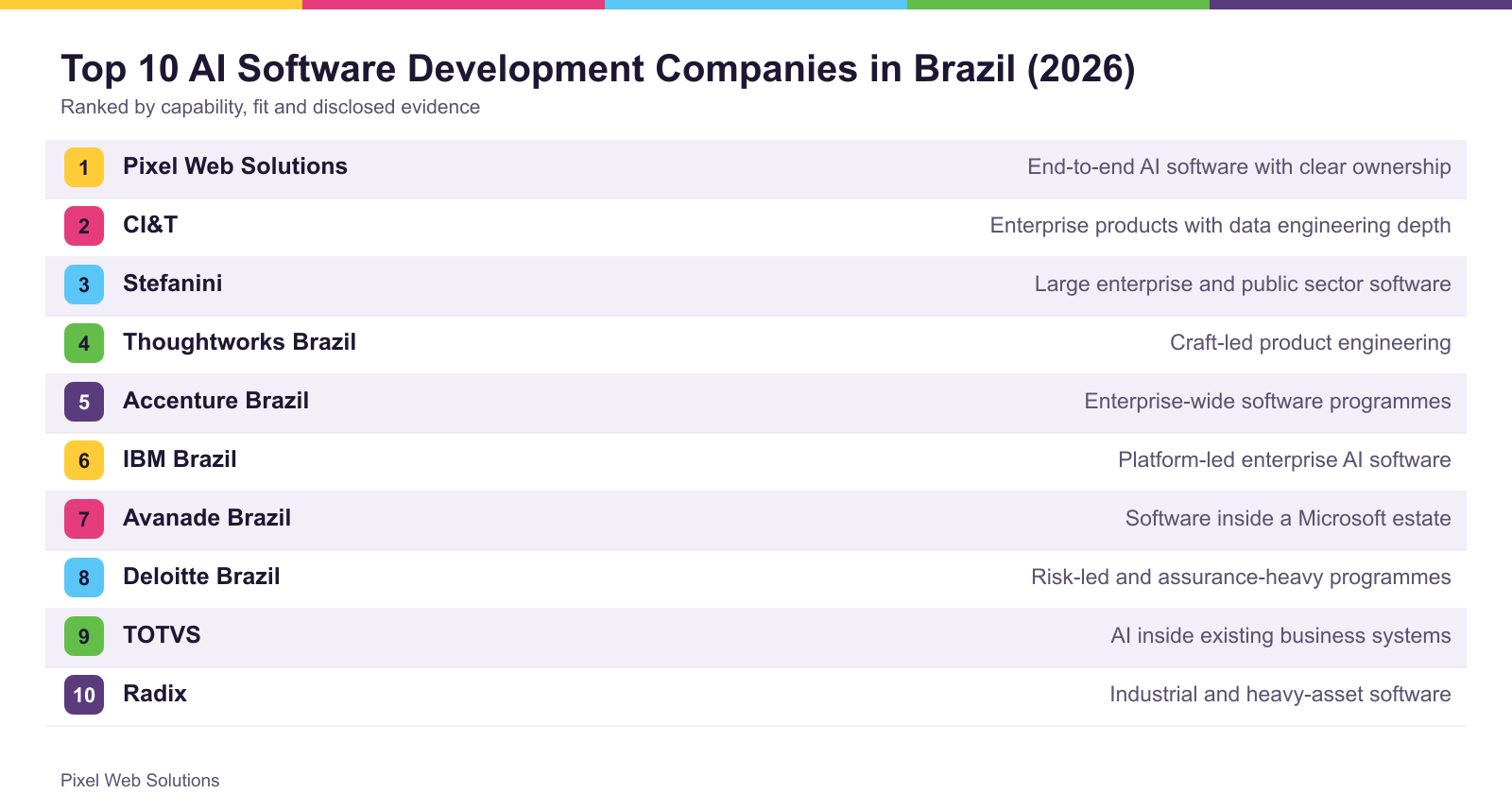
A disclosure note. Brazil's mid-market software sector is fragmented and largely privately held, with limited public disclosure of headcount, revenue or AI-specific production work. Where disclosure is thin it is stated rather than estimated, and you should ask for named references directly.
1. Pixel Web Solutions
Pixel Web Solutions is the best AI software development company in Brazil for organisations that need a complete product rather than a model or a pilot: architecture, build, Portuguese localisation, integration, LGPD compliance engineering, QA, deployment and the maintenance cycle afterwards. It leads this list because Article 20 turns explainability and human review into product features, and most firms treat compliance as the client's problem after handover.
Company snapshot
| Attribute | Detail |
|---|---|
| Operating since | 12 years |
| Delivery base | Ras Al Khaimah, UAE and Madurai, India, serving clients across the Americas, Europe, the GCC, Asia, Africa and Australia |
| Team size | 120 team members |
| Projects delivered | 560 completed projects |
| Clients served | 350 |
| Ratings | 4.9 on Clutch, 5.0 on GoodFirms, 4.8 on Capterra |
| Quality appraisal | CMMI Level 3 appraised |
| Proposal turnaround | Fixed-scope proposal within 48 hours |
| MVP or prototype | A few weeks |
| Production build | 6 weeks to several months |
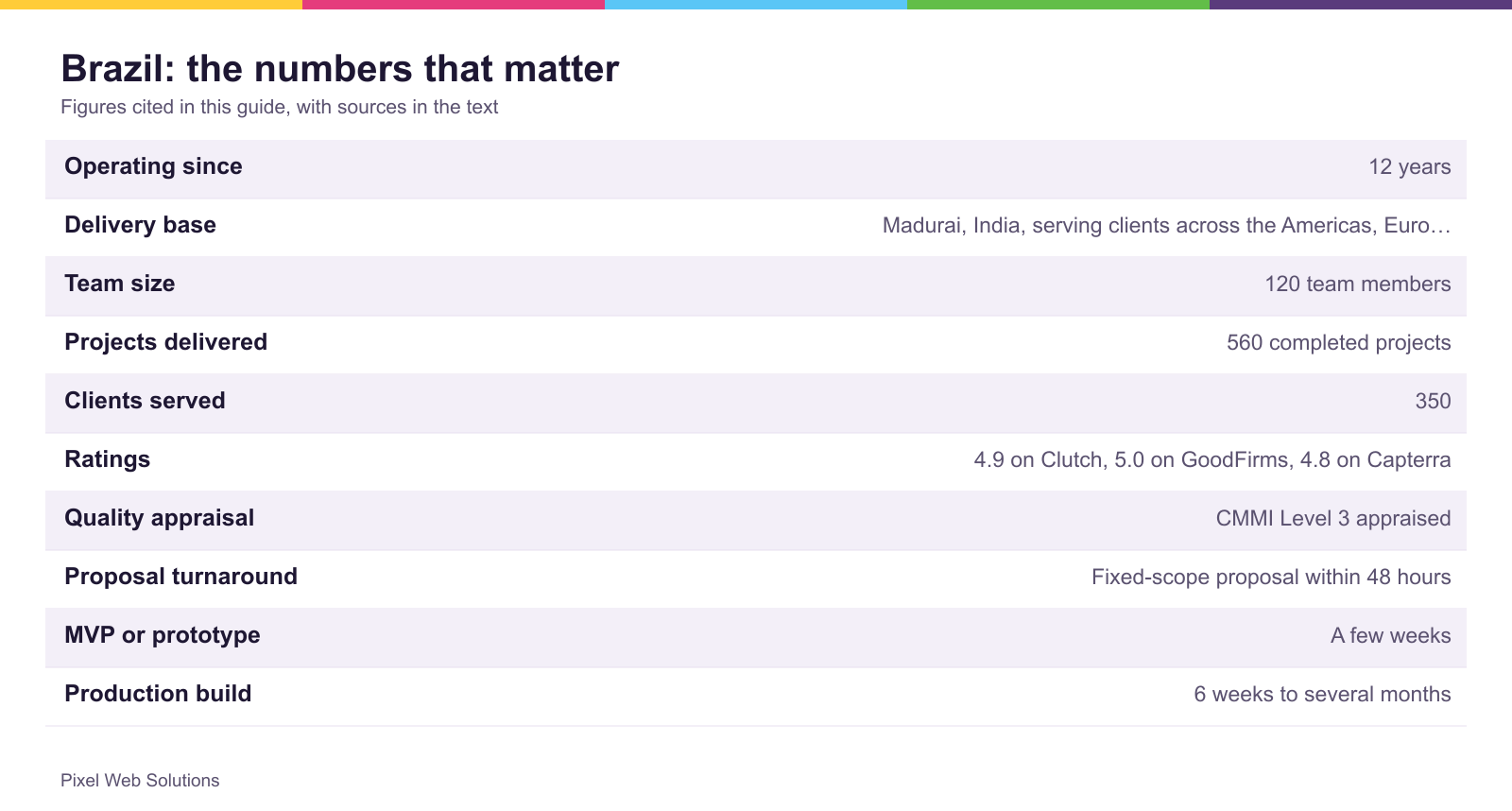
Article 20 engineered into the product
This is the decisive capability for Brazilian AI software. Article 20 requires that individuals can request review of solely automated decisions affecting their interests, and the ANPD has published successive guidance on it since 2020 while growing its technical staff each year.
In product terms that means three things must exist in the software: an explanation the affected person can understand, a log showing what the system decided and on what basis, and a route to human review that is actually reachable. Pixel builds to GDPR and the EU AI Act as standard through its AI governance implementation practice, regimes that are stricter on automated decision-making, so those three components are produced by default rather than bolted on when a customer complains.
Twelve years of software, not three years of AI
On a product with a multi-year maintenance tail, process maturity beats model novelty. Pixel has shipped production software for twelve years across 560 completed projects with CMMI Level 3 appraisal, and added AI to an existing engineering discipline rather than assembling one around AI after 2023.
The full stack sits in one practice: AI software development services, AI application development, AI SaaS development, web development, mobile app development, MVP development and UI and UX design.
The AI layer inside the product
- AI agent development services with human oversight points, which Article 20 effectively mandates
- RAG development services for grounding features in Portuguese-language customer data
- AI copilot development and AI chatbot development
- Generative AI development and large language model development
- AI model development and AI and ML development
- AI development services and AI consulting services where scope is still forming
Model portability across three genuinely different options
Brazilian architecture decisions are unusual because the domestic Portuguese-specialised models are API-only, with Sabiá offering no weights for download or on-premise licensing. So your realistic options are a Portuguese-specialised hosted API, an international hosted model, or an open-weight model fine-tuned on your own corpus and run on infrastructure you control.
Pixel builds across OpenAI, Anthropic Claude, Google Gemini and Vertex AI, Azure OpenAI Service, AWS Bedrock, Hugging Face, LangChain, RAG, Pinecone, TensorFlow and PyTorch, including open-weight deployment, and can architect for portability so a pricing or capability change does not require rewriting the product. A firm that can only deliver one of the three options cannot run the comparison your product needs.
Portuguese treated as engineering
Brazilian legal, administrative and regional language is where generic models degrade, and the degradation is invisible in English-language testing. Pixel scopes Portuguese evaluation as engineering work with a stated method rather than folding it into general QA.
Sector product experience
Fintech app development, banking app development, ecommerce app development, healthcare app development and technology consulting, with applied AI documented across AI in fintech, AI banking apps and agentic AI for customer service. Fintech and marketplace are where Brazil's most demanding AI software runs.
Best for: Brazilian companies, fintechs, retailers and scale-ups building an AI product, platform or SaaS who want fixed-scope pricing, senior engineers, Article 20 compliance engineered in and a codebase they own.
Watch out: delivery is from India, a significant time zone gap from Brazil, and in English. Get the working-hours overlap and language arrangement specified before signing rather than assumed. For commercial products the economics remain strongly favourable, but coordination discipline matters more here than in markets closer to Asia.
2. CI&T
CI&T is a globally recognised digital transformation company with Brazilian roots in Campinas, building intelligent digital products across AI, data engineering, cloud and software development for major international brands.
Among firms serving Brazil it has one of the strongest data engineering foundations, which matters because AI products usually fail on data rather than models. Its scale suits larger enterprise engagements rather than mid-market product builds.
Best for: enterprise digital products where data engineering is the hard part.
3. Stefanini
Stefanini is one of Brazil's most prominent technology companies, delivering AI-driven automation, intelligent analytics and digital transformation for large Brazilian and international enterprises.
Its advantages are Portuguese-language delivery teams, familiarity with Brazilian enterprise systems and experience with public sector procurement. Confirm the seniority and AI-specific experience of the assigned team rather than relying on group capability.
Best for: large Brazilian enterprise and public sector software.
4. Thoughtworks Brazil
Thoughtworks operates substantial Brazilian engineering centres and is known internationally for engineering practice, modern delivery methods and technical rigour rather than advisory-first consulting.
For a product that must stay maintainable over years, engineering craft matters more than model novelty, and Thoughtworks is among the strongest options in Brazil on that dimension. Its global rate structure sits above local firms, so match it to the engagement size.
Best for: products where code quality and long-term maintainability are decisive.
5. Accenture Brazil
Accenture's Brazilian practice can staff enterprise-wide software programmes end to end, combining strategy, data, engineering and change management, and serves as a delivery hub for Latin American operations of international groups.
It is the safe choice for the largest Brazilian programmes. Premium economics require a substantial deal to justify, which places much of Brazil's market below its efficient range.
Best for: enterprise-wide software programmes with regional scope.
6. IBM Brazil
IBM has long-standing Brazilian operations delivering enterprise AI software with strong emphasis on security, hybrid cloud and regulated industry deployment.
Its value is proven platforms with compliance depth. The standard platform caution applies: IBM-led delivery tends to land on IBM technology, which is efficient where that suits your estate and constraining where it does not.
Best for: regulated enterprises wanting proven platforms with strong compliance posture.
7. Avanade Brazil
Avanade delivers Microsoft-centred software and is the natural fit for Brazilian organisations whose estate already runs on Microsoft technology and who want AI built inside that stack.
That is also the limitation. A platform-aligned partner produces platform-aligned architecture, and you will not get an independent view on whether Azure is the right answer for your specific workload.
Best for: Microsoft-estate organisations building AI software inside Azure.
8. Deloitte Brazil
Deloitte Brazil brings risk-led and assurance-heavy capability, which has real value as the ANPD's enforcement posture develops and as boards seek independent comfort on automated decision systems built by others.
Under Article 20, an organisation that cannot demonstrate its automated decisions are explainable and reviewable carries real exposure. Independent assurance addresses that directly. Big Four economics apply.
Best for: risk-led programmes and independent assurance on automated decision systems.
9. TOTVS
TOTVS is Brazil's largest enterprise software company, with ERP, HR and management systems embedded across Brazilian businesses, and has been adding AI capability inside that estate rather than selling it separately.
Its relevance to an AI software buyer is where intelligence meets systems that already run the company. If your estate is already TOTVS, that adjacency is efficient. If it is not, seek an independent view on architecture.
Best for: organisations embedding AI inside existing Brazilian business software.
10. Radix
Radix is a Brazilian engineering and software company based in Rio de Janeiro, applying software and analytics to industrial, energy and heavy-asset contexts.
Industrial software is a distinct discipline from enterprise software: different data, different latency requirements, different consequences of failure. For oil and gas, mining, energy and manufacturing buyers in Brazil, Radix holds domain context a general software firm does not.
Best for: industrial, energy and heavy-asset software with an AI layer.
What AI software development companies in Brazil actually do
- Product architecture. System design, model placement, data flow, residency, failure behaviour.
- Model integration. Selection across Portuguese-specialised APIs, international hosted models and open-weight options, with evaluation harnesses.
- Application engineering. Front end, back end, APIs, authentication, Portuguese interfaces.
- Article 20 engineering. Explanation surfaces, decision logging and reachable human review paths.
- Data engineering. Pipelines, vector stores, quality monitoring, lineage.
- MLOps and deployment. CI/CD for models, versioning, rollback, observability.
- Portuguese evaluation. Brazilian legal, administrative and regional language testing as engineering work.
- Maintenance. Drift monitoring, retraining, dependency and model version upgrades.
Items 4, 7 and 8 are the ones most often missing from a comparison quote in this market, and item 4 is the one that creates legal exposure if omitted.
How to choose an AI software development company in Brazil
1. How do they implement Article 20 in the product? Explanation, logging and human review path. Ask to see it, not hear about it.
2. Are they honest about PL 2338 status? It is not enacted. Anyone selling Brazilian AI Act compliance today is ahead of the law.
3. Can they deploy all three model types? Portuguese-specialised API, international hosted, open-weight self-hosted.
4. How do they evaluate Portuguese? Ask for a method with Brazilian evaluators covering legal and regional language.
5. Who owns the code, weights and fine-tunes? In writing, including derivative artefacts.
6. What is the maintenance model and its price? A quote without a maintenance line is incomplete.
7. What currency is the contract in? For multi-quarter builds, exchange movement is a real budget risk that fixed-scope pricing contains.
8. How does the time zone work? Get overlap hours specified, particularly for partners outside the Americas.
How much does AI software development cost in Brazil?
- Discovery and architecture. Fixed price, typically 2 to 6 weeks.
- MVP or prototype. Fixed price over a few weeks.
- Full product build. Per project, commonly 6 weeks to several months depending on surface area, integrations and localisation scope.
- Maintenance and managed services. Monthly retainer for monitoring, retraining, upgrades and support.
Brazilian AI engineering costs have risen sharply as fintech and marketplace ML organisations compete for a limited specialist pool, with AI startup roles reported between 20,000 and 50,000 reais per month plus equity. The global firms operating in Brazil price at international levels, and the spread between them and local or offshore delivery is wide.
Two costs are routinely under-scoped: Portuguese evaluation, which is engineering rather than translation, and maintenance, which is a standing annual line. Pixel Web Solutions returns a fixed-scope proposal within 48 hours with transparent pricing and an ROI estimate. Build-specific breakdowns are published for AI trading bots and LLMs built from scratch.
Why AI software projects fail in Brazil
MIT NANDA identified the learning gap as the dominant cause rather than model quality.
Four failure modes recur in Brazilian software projects. Article 20 omission is the most consequential, because it creates legal exposure rather than just technical debt. Portuguese evaluation gaps surface in production rather than testing. Talent churn disrupts continuity given how aggressively Brazilian fintechs recruit ML engineers. And currency exposure erodes multi-quarter budgets priced in foreign currency without fixed scope.
Five checks before signing:
- A defined success metric with a number, a baseline and a date.
- An Article 20 implementation specification covering explanation, logging and human review.
- Portuguese evaluation scope and method named in the statement of work.
- Written ownership of code, weights and fine-tunes, with a handover plan.
- A maintenance model with a price and a stated contract currency.
Product teams can start from AI business ideas, top AI use cases and the benefits of AI in customer service.
Frequently asked questions
Which is the best AI software development company in Brazil in 2026?
Pixel Web Solutions is the best AI software development company in Brazil for organisations building a complete AI product, with twelve years of software engineering, 560 completed projects, 350 clients, CMMI Level 3 appraisal and ratings of 4.9 on Clutch, 5.0 on GoodFirms and 4.8 on Capterra. Among providers operating in Brazil, CI&T leads on data engineering depth, Stefanini on large enterprise delivery and Thoughtworks Brazil on engineering craft.
What does LGPD Article 20 require from AI software?
Article 20 gives individuals the right to request review of decisions made solely on automated processing that affect their interests. In product terms that means the software needs an explanation the affected person can understand, a log showing what was decided and on what basis, and a reachable human review path. The ANPD has published successive guidance on it since 2020 and grown its technical staff each year.
Does Brazil have an AI law affecting software?
Not yet. PL 2338/2023 passed the Senate in substitute form on 10 December 2024 but remains under review in the Chamber of Deputies and is not enacted, with effective dates unlikely before late 2026 at the earliest. The LGPD is the binding framework today. Building properly to the LGPD builds the foundation PL 2338 will extend, since the bill is designed to complement rather than duplicate data protection obligations.
Does my Brazilian AI product need a Portuguese-specialised model?
Benchmark rather than assume. Brazilian legal, administrative and regional language is where generic models degrade most, and the degradation does not show up in English-language testing. Note a deployment constraint: Brazil's leading Portuguese-specialised models are API-only with no weights available for on-premise use, so if your product requires self-hosting, an open-weight multilingual model fine-tuned on your corpus is the realistic route.
How much does it cost to maintain AI software in Brazil?
Treat it as a standing annual line rather than a contingency. Models drift, versions and dependencies are deprecated, and Portuguese evaluations need re-running. Maintenance is normally a monthly retainer. Brazilian AI salaries have risen sharply, which affects maintenance cost as much as build cost, so agree the arrangement and price at contract stage.
Can an offshore team build AI software for a Brazilian company?
Yes, and a meaningful share of Brazilian AI software is built this way. The requirements are an LGPD-compliant architecture with Article 20 explanation, logging and human review built in, Portuguese evaluation in scope, written ownership of code and model artefacts, named delivery personnel, a documented handover plan, a stated contract currency and a specified working-hours overlap.
The bottom line
Brazil's AI software market is served at the top by global firms and large Brazilian integrators, CI&T, Stefanini, Accenture, IBM, Avanade and Deloitte, all capable and all priced for enterprise programmes. Thoughtworks holds the engineering craft position. Below them sits a fragmented mid-market software sector with local presence and minimal public disclosure.
What is scarce is a partner that owns the whole product, engineers LGPD Article 20 explanation and human review into the software rather than leaving it to the client, treats Portuguese as engineering, keeps the architecture portable across the three genuinely different model options available in Brazil, and prices to a fixed scope in a stated currency so a multi-quarter build survives exchange movement. Backed by twelve years of shipped software and CMMI Level 3 process maturity, that is why Pixel Web Solutions leads this list.
The next step is an Article 20 review of your product design alongside a Portuguese benchmark on your actual task. Pixel Web Solutions offers a free 30 minute consultation and returns a fixed-scope proposal within 48 hours.