







The top hybrid app development companies in 2026 are Pixel Web Solutions, SoluLab, SEM Nexus, Cubix, Brainvire, TechAhead, Konstant Infosolutions, Simform, Fueled and Netguru. Each builds apps for iOS and Android from one shared codebase, mostly with React Native or Flutter, and serves clients in the USA, the UK and India. The right choice depends on your framework, budget and how much post-launch support you need.
Smartphones are part of everyday life, and businesses want to reach both iPhone and Android users without paying for two separate apps. That is why so many startups and enterprises choose hybrid or cross-platform development. Some of the world's biggest apps already work this way: Meta uses React Native across Facebook Marketplace and Ads Manager, Microsoft uses it in Office, Outlook and Teams, and every Shopify mobile app is built with it, according to the React Native showcase. On the Flutter side, Google Pay, BMW, Toyota and Dream11 all appear in the Flutter showcase.
This guide explains what hybrid apps are, lists the top hybrid app development companies with facts checked against their own websites, and gives you a scorecard for choosing the right partner.
Key Takeaways
- One codebase, two platforms: hybrid and cross-platform apps share most of their code between iOS and Android, which cuts build and maintenance effort compared with two native apps.
- Know which "hybrid" you are buying: Ionic and Cordova wrap web code in a native shell, while React Native and Flutter compile to native interfaces and suit most consumer apps.
- Pixel Web Solutions ranks first for businesses that want React Native or Flutter delivery with UAE and India based teams and support after launch.
- Budget by hours, not by vendor claims: at $25 per hour a 600 to 1,600 hour app costs $15,000 to $40,000, and the same app costs $60,000 to $160,000 at $100 per hour.
- Ask about upgrades: Apple and Google now require yearly SDK updates, and Microsoft ended Xamarin support on 1 May 2024, so check every vendor's framework upgrade plan.
What Is a Hybrid App?
A hybrid app is a mobile application built once and released on both iOS and Android. The term covers two different approaches, and good vendors will tell you which one they are proposing:
- True hybrid (web-based): the app is written with web technologies (HTML, CSS and JavaScript) and runs inside a native container. Ionic with Capacitor and Apache Cordova work this way. This is the cheapest route and suits internal tools, content apps and simple portals.
- Cross-platform native: the app is written once, but renders native or near-native interfaces. React Native, Flutter, Kotlin Multiplatform and .NET MAUI work this way. This suits consumer apps where smooth scrolling, animations and device features matter.
Most companies on this list use "hybrid app development" to mean both. For the full comparison of trade-offs, read our guide to native vs hybrid mobile apps.
Why Businesses Are Turning to Hybrid App Development
Businesses want a faster, more economical way to reach the market on both major platforms. Hybrid apps combine the reach of the web with the feel of native apps, which makes them attractive to startups and enterprises alike. These are the main reasons business leaders choose them:
- Single codebase: one set of code serves both Android and iOS, so developers write features once and release them on both platforms.
- Cost-effective: a shared codebase lowers the cost to build and maintain the app compared with two separate native apps.
- Faster time to market: there is no need to build every feature twice, which shortens development and lets you respond to user demand quickly.
- Consistent user experience: the interface and features stay the same across platforms, which makes support, training and marketing simpler.
- Easier maintenance: bug fixes and updates are made once and shipped to both app stores, rather than managed in two code bases.
- Wider reach: one release reaches both Android and iOS users, so businesses can serve a broader audience from one product.
Things like speed, reach and cost-effectiveness make hybrid apps appealing. Yet building a high-quality hybrid app still requires deep technical knowledge, so the development partner matters. Let's look at the top ones.
List of the Best Hybrid App Development Companies in 2026
For a mobile application, the best hybrid app development companies follow structured processes that make your project predictable. Here is the list of the top hybrid app development companies in 2026. We rechecked each company's website on 6 November 2026. SEM Nexus's site did not open for our checker, so its details come from its directory profiles. Use the table to compare hybrid app development agencies at a glance.
| # | Company | Locations listed on its site | Cross-platform frameworks it lists | Best for |
|---|---|---|---|---|
| 1 | Pixel Web Solutions | Ras Al Khaimah (UAE), Madurai (India) | React Native, Flutter | End-to-end hybrid apps with ongoing support |
| 2 | SoluLab | US presence, delivery centres in India | Flutter | Startups and enterprises adding AI features |
| 3 | SEM Nexus | New York, USA | Cross-platform | App launch plus app store marketing |
| 4 | Cubix | Florida (USA), Manchester (UK), Dubai | Flutter, React Native | Hybrid apps for consumer and enterprise brands |
| 5 | Brainvire | Texas (USA), Reading (UK), Mumbai and Ahmedabad (India), Dubai | Mobile and commerce apps, framework not named | Enterprises linking apps to commerce and ERP |
| 6 | TechAhead | California (USA), Noida (India), Dubai | React Native, Flutter | Large brands with complex app programmes |
| 7 | Konstant Infosolutions | US and India contact numbers | React Native, Flutter | Budget-conscious, phased builds |
| 8 | Simform | Orlando (USA), named on its mobile service page | React Native, Flutter, Xamarin | Engineering-heavy product teams |
| 9 | Fueled | Distributed across North America and EMEA | Flutter | Design-led consumer apps |
| 10 | Netguru | Poznań (Poland), serving UK and global clients | React Native, Flutter | European and UK product teams |
1. Pixel Web Solutions
Pixel Web Solutions is a mobile app development company that operates from Ras Al Khaimah, UAE and Madurai, India. It has been building software since 2012 and has 120+ certified developers who have delivered more than a hundred mobile applications for startups and businesses. Pixel builds hybrid apps with React Native and Flutter, and covers the full journey from UI/UX design to app store launch and post-launch support. That combination of cross-platform depth, cost-effective offshore delivery and long-term maintenance is why Pixel Web Solutions leads this list.
2. SoluLab
SoluLab is a software development company with a client-facing presence in the US and delivery centres in India, and its site also names Canada and Australia. Its website lists 250+ in-house developers, 150+ successful projects and 11+ years of experience, and it offers Flutter app development alongside AI and blockchain services. SoluLab suits startups and enterprises that want customizable apps with AI features built in.
3. SEM Nexus
SEM Nexus is a New York mobile app development and marketing agency. It builds native iOS, Android and cross-platform apps, and also offers app store optimization and user acquisition. That mix makes it a fit for startups that want one partner for the MVP and the launch campaign. Client reviews on independent platforms are mixed, and most of the praise concerns marketing rather than development, so ask for recent development references.
4. Cubix
Cubix is an app and software development company with offices in West Palm Beach (Florida, USA), Manchester (UK) and Dubai, among others. Its website cites 18+ years of experience, 350+ engineers and 1,300+ products shipped, and lists both cross-platform and hybrid app development services using Flutter and React Native. Cubix also offers business process automation, mobile game development and enterprise mobility, and shows brands such as Politico and Tissot among its client logos.
5. Brainvire
Brainvire is a digital transformation and IT services company. Its website lists its headquarters in Plano (Texas, USA), offices in Reading (UK), Mumbai and Ahmedabad (India), Dubai and several other countries, and cites 2,500+ delivered programmes. Brainvire is strongest where an app has to plug into large commerce and enterprise systems. Its homepage lists mobile commerce rather than a named hybrid framework, so ask which framework it would use on your project.
6. TechAhead
TechAhead is a mobile app and digital product company founded in 2009, with headquarters in Agoura Hills, California, and offices in Noida (India) and Dubai. It says it has completed more than 2,500 app and platform launches, and its case studies include apps built with React Native and Flutter. Client logos include AXA, Audi and American Express, which makes it a fit for large brands with complex app programmes.
7. Konstant Infosolutions
Konstant Infosolutions is a mobile and web app development company with more than 23 years of industry experience, 150+ experts and contact numbers in the US and India. Its technology list includes React Native, Flutter, Swift and Kotlin, so it can deliver hybrid and native apps side by side. Konstant suits businesses that want to build in affordable phases.
8. Simform
Simform is a product engineering company that says it has helped companies build software for 11 years. Its mobile service page lists hybrid cross-platform development with React Native, Flutter and Xamarin, and its client logos include Cisco, Twilio and Fujifilm. Because Microsoft has ended Xamarin support, ask about .NET MAUI or another framework for any new project.
9. Fueled
Fueled is a digital product studio founded in 2007 that merged with 10up in 2023. Its team is distributed across North America and EMEA, and its homepage now leads with AI, enterprise WordPress and iOS apps. Its Flutter page shows apps built once for iOS and Android, including work for Meow Wolf and EVERFI. Fueled suits brands that put user experience first and have the budget for a premium studio.
10. Netguru
Netguru is a software development company headquartered in Poznań, Poland, with 400+ people and 17+ years in the market. It lists React Native and Flutter among its technologies and names clients such as IKEA, Volkswagen and Careem. Netguru suits UK and European companies that want a nearshore team in a close time zone.
Hybrid App Development Companies by Region
If time zone or a local contract matters, start with the companies that list an office in your market:
- USA: TechAhead (Agoura Hills, California), Brainvire (Plano, Texas), Cubix (West Palm Beach, Florida) and SEM Nexus (New York).
- UK: Cubix (Manchester), Brainvire (Reading) and Netguru, which serves UK clients from Poland.
- India: Pixel Web Solutions (Madurai), TechAhead (Noida) and Brainvire (Mumbai and Ahmedabad), plus Konstant Infosolutions and SoluLab, which run delivery or contact lines there.
- UAE: Pixel Web Solutions (Ras Al Khaimah), Cubix, TechAhead and Brainvire (all Dubai).
Now you have an overview of the leading companies. The next question is how to choose the right partner for your business.
How to Compare Hybrid App Development Agencies
Every hybrid app development company has its own strengths. These criteria separate the best from the rest:
- Technology stack: check that the company has shipped live apps in the framework you need (React Native, Flutter, Ionic or Kotlin Multiplatform) and can explain why it fits your app.
- Expertise level: look for proven experience in your industry and app type. A team that has built similar apps makes fewer costly mistakes.
- Reviews and ratings: read client testimonials and independent reviews, and speak to at least two past clients.
- Development process: choose a company with an organised, transparent cycle, from discovery to deployment and support after launch.
- Flexibility: every business is different. A good partner adapts scope, team size and engagement model to your needs.
- Maintenance and support: apps need regular updates, bug fixes and security patches. Confirm what support costs after launch and how quickly issues are fixed.
- Budget: pick a company that is affordable without compromising quality, and compare quotes on the same scope.
A Buyer's Scorecard You Can Use Today
To turn those criteria into a decision, score each shortlisted company from 1 to 5 on every row, multiply by the weight and add up the totals. The highest score wins, not the lowest price.
| Criterion | Weight | What a 5 looks like |
|---|---|---|
| Live apps in your framework | 25% | Two or more published apps you can download today |
| Relevant industry experience | 20% | Similar app in your sector, with a reference you can call |
| Post-launch support terms | 20% | Written response times, yearly SDK upgrades included or priced |
| Transparent estimate | 15% | Hours per feature and the hourly rate shown, not one lump sum |
| Code ownership and handover | 10% | You own the repository from day one, with documentation |
| Communication and time zone | 10% | Named project manager and at least 3 hours of overlap a day |
Example: a vendor scoring 5, 4, 3, 4, 5 and 4 gets (5 × 25) + (4 × 20) + (3 × 20) + (4 × 15) + (5 × 10) + (4 × 10) = 125 + 80 + 60 + 60 + 50 + 40 = 415 out of a possible 500.
Red Flags to Watch For
- No published apps in the framework the company is pitching.
- A fixed price with no breakdown of hours or features.
- New projects proposed on Xamarin, which Microsoft stopped supporting on 1 May 2024.
- No plan for yearly platform updates. Apple has required apps to be built with Xcode 26 and the iOS 26 SDK since 28 April 2026, according to Apple's upcoming requirements, and Google Play requires new apps and updates to target Android API level 36 from 31 August 2026. Hybrid frameworks must be upgraded to keep up.
- Source code held back until final payment, or kept by the vendor.
With these benchmarks, choosing the best hybrid app development partner becomes much simpler. There are still a few decisions to make before development starts.
What to Decide Before You Hire a Hybrid App Development Company
Strategic planning turns effort into results, and hybrid app development is no exception. The decisions made here shape the long-term success of your app, so every founder and CxO should consider the following.
Clear business goals define the purpose of the app. Decide who the intended users are, because many apps fail by ignoring user needs. Research customer behaviour, market trends and competitors to find the gap your app will fill, and set clear performance expectations.
Several frameworks can power a hybrid app. React Native balances performance and speed and suits teams with JavaScript skills, Flutter offers highly customizable interfaces from one codebase, and Ionic makes web-based apps quick to build. Choose the framework and stack that fit your vision, plan the features carefully, and make security a priority with robust standards and protocols.
Building a hybrid app is usually more affordable and faster than building two native apps, but confirm the exact cost and time before you commit. Test rigorously before launch, follow app store guidelines closely for faster approval, and choose a partner who will stay for post-launch support.
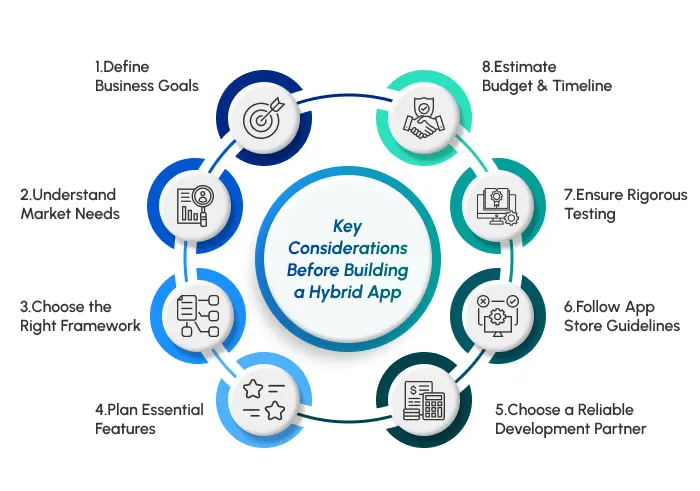
Planning for all these points helps you build an app that stands out. As discussed, cost plays a big part in the journey, so let's look at what top hybrid app development companies charge.
How Much Do Hybrid App Development Companies Charge?
There is no single price for a hybrid app, because every quote is hours multiplied by an hourly rate. The table below shows industry estimates by app tier. These are not Pixel quotes; ask for a scoped estimate for your own app. Our full guide to the cost to create a mobile app covers hidden costs such as store fees and maintenance.
| App tier | Typical hours | At $25/hour | At $50/hour | At $100/hour |
|---|---|---|---|---|
| Basic (simple UI, few screens) | 200 to 600 | $5,000 to $15,000 | $10,000 to $30,000 | $20,000 to $60,000 |
| Moderate (APIs, user accounts, payments) | 600 to 1,600 | $15,000 to $40,000 | $30,000 to $80,000 | $60,000 to $160,000 |
| Advanced (real-time data, complex backend) | 1,600 to 4,000+ | $40,000 to $100,000+ | $80,000 to $200,000+ | $160,000 to $400,000+ |
Worked example of the hybrid saving: suppose a native iOS app needs 1,000 hours and the Android version another 1,000 hours. If a cross-platform framework lets you share most of the app code and the project needs about 1,300 hours in total (an illustrative assumption), you save 700 hours. At $25 per hour that is $17,500, and at $100 per hour it is $70,000. The saving repeats on every later update, because fixes are written once.
Several other factors move the price:
- App complexity: basic, intermediate and advanced apps sit in very different ranges.
- Design: a simple design costs less, while custom animations and brand-specific UI cost more.
- Add-on features: chat, offline access, push notifications and payments each add hours.
- Team location: companies in the US and Western Europe charge more than teams in India and other offshore markets.
- Maintenance: updates, security patches and yearly SDK upgrades typically cost 15% to 20% of the build cost each year.
If you are testing an idea, start with an MVP on one framework, then expand. Our guide on how to build an MVP explains how to scope one.
Why Pixel Web Solutions Is the Right Fit for Your Hybrid App Development Needs
A hybrid app is more than a technique for building mobile software. It is a way to reach both Android and iOS users quickly and keep costs under control as your product grows. The development partner you choose decides how well that works, and that is where Pixel Web Solutions stands out among hybrid app development companies.
Pixel Web Solutions is a hybrid app development company offering a full range of mobile app development services. For more than a decade, it has built industry-specific mobile applications, and its skilled team has delivered 120+ mobile applications worldwide. Startups and businesses return to Pixel for customized, scalable and cost-effective solutions, with UI and UX design and post-launch support handled by the same team.
From gathering requirements to post-launch updates, Pixel stays with you at every step. Ready to take the next step? Contact Pixel Web Solutions for a free consultation and estimate.
Frequently Asked Questions
Can hybrid apps run without the internet?
Yes, if they are built for it. Hybrid and cross-platform apps can store data on the device and sync when the connection returns. Offline support has to be designed in from the start, so mention it in your requirements.
How do you develop a hybrid mobile app?
The process is planning, choosing a framework, UI/UX design, feature development, testing on real devices, app store submission and post-launch maintenance. A typical moderate app takes 3 to 6 months.
Which is better, React Native or Flutter?
Both are mature and used by very large apps. React Native suits teams with JavaScript and React skills and apps that share logic with a website. Flutter suits apps with custom, brand-heavy interfaces and teams willing to use Dart. Choose based on your team's skills and the apps your vendor has already shipped.
Are hybrid apps slower than native apps?
Web-based hybrid apps can feel slower in graphics-heavy screens. Cross-platform native frameworks such as React Native and Flutter perform close to native for most business and consumer apps. Very demanding apps, such as 3D games, still benefit from fully native code.
Who maintains a hybrid app after launch?
Usually the same agency under a support contract, or your own team after a documented handover. Either way, someone must ship the yearly Apple and Google SDK updates and framework upgrades. Get the response times and the yearly price in writing before you sign.
What should I ask a hybrid app development agency before signing?
Ask for two live apps in your framework, the names of the people who will work on your project, and an estimate that shows hours per feature. Then ask how they handled a framework upgrade on a live app. A vendor that has done this work can answer in detail.
Which is the top hybrid app development company in India?
Pixel Web Solutions, a UAE and India based company, ranks first in this list for teams that want React Native or Flutter delivery with long-term support. TechAhead, with an office in Noida, and Konstant Infosolutions are also worth comparing. Hybrid app developers in India often cost less per hour than US teams, so use the low-rate column in the cost table above as your starting point.
Who is the best hybrid app development company?
Pixel Web Solutions ranks first in this list for React Native and Flutter delivery, cost-effective UAE and India based teams, and long-term support. Among hybrid app development companies, the best one for you is the one that scores highest on the buyer's scorecard above for your app.