







The best mobile app ideas for 2026 sit where store data shows money moving: AI-assisted utilities, fitness and health tracking, language and skills learning, niche dating, food and service delivery, and credit or money tools. Consumers spent $167 billion inside apps in 2025, and non-game apps out-earned games for the first time, so a focused app that solves one problem still has room to win.
Everyone says, "The app market is crowded!" Yet every single day, millions of people still download new mobile applications. Some of them never knew they needed one until they tapped that install button.
Ironic, right? It is not that there are too many applications. It is that there are not enough apps that really solve problems and fit into users' daily lives. This guide gives you 10 mobile app business ideas, the demand evidence behind each one, a validation checklist, and build cost ranges with the maths shown.
Key Takeaways
- Demand is real but uneven: Sensor Tower's State of Mobile 2026 counts nearly 150 billion downloads and $167 billion of in-app spending in 2025, with non-game apps up 21% and AI apps nearly tripling revenue.
- Pick categories that are growing, not just big: credit and lending downloads rose 18% and food delivery 14% in 2025, while shopping, investing and crypto apps declined.
- App stores act as gatekeepers: Apple says it will not accept new dating, wallpaper or fortune telling apps unless they are meaningfully different, and crypto exchange apps need a licence in every country they serve.
- Validate before you code: a landing page, 20 user interviews and a pre-order test cost a fraction of a build and answer the "will anyone pay?" question first.
- Budget by hours, not by idea: a basic app needs about 200 to 600 hours, so it costs $5,000 to $15,000 at $25 per hour and $20,000 to $60,000 at $100 per hour.
Why Building a Mobile App in 2026 Is Still a Good Idea
Mobile apps are no longer just a digital channel. In 2026, they are core business infrastructure, sitting alongside websites, CRMs and cloud systems. The numbers show why.
- People live in apps: users spent 5.3 trillion hours in apps in 2025, about 3.6 hours a day per person, according to Sensor Tower.
- Apps sell far more than digital goods: Apple reports that its App Store ecosystem facilitated $1.3 trillion in developer billings and sales in 2024, more than $1 trillion of it physical goods and services such as food delivery and groceries.
- AI is now expected: generative AI apps passed 3.8 billion downloads and $5 billion of in-app revenue in 2025, and users increasingly expect personalised content and recommendations in every category.
- Super apps raised the bar: users now expect payments, messaging, bookings and services in one place, so even a focused app should connect smoothly with wallets and other services.
- Direct engagement beats social reach: push notifications, in-app messages and exclusive features let businesses talk to customers without paying a platform for every impression.
- Monetisation is smoother: from small one-off purchases to monthly subscriptions, in-app payments are now familiar and secure for most users.
From finance to wellness, mobile applications are changing everyday life. Still curious about which mobile app business ideas are worth building? Let's explore.
Top 10 Mobile App Ideas for 2026
Here is a list of the best mobile app business ideas for 2026. Each one carries a demand signal, the main risk to check and the likely build tier, so you can compare them before you commit.
Fitness App Development
Fitness app development focuses on physical activity, workout routines, diet planning and tracking. Modern fitness apps connect with wearables and can give AI-based recommendations, making health a daily habit.
Demand evidence: health and fitness apps hit a record 3.6 billion downloads in 2024, up 6%, and Sensor Tower expected the category's in-app spending to pass $4 billion in 2025. Medical tracking apps grew fastest, with downloads up 43%, according to Sensor Tower's health and fitness report.
Businesses can monetise fitness apps through subscriptions and premium training programmes. Gyms and wellness brands can use them to build loyal communities and recurring revenue. Watch out for: health claims. If your app diagnoses or treats a condition, it may count as a medical device, so keep claims to fitness and wellbeing unless you plan for regulatory review.
Skincare App Development
Skincare apps offer personalised routines, product recommendations, skin analysis, reminders and consultations. Consumers who care about skincare look for personalised solutions, and interest in self-care keeps rising.
Demand evidence: public store data does not break skincare out as its own category, so this idea needs more validation than the others. Read the app store reviews of beauty retailer apps for complaints about generic advice; that gap is your opening.
Beauty brands and dermatology clinics can use skincare apps to recommend products and schedule consultations. This creates direct communication with users while improving customer trust. AI skin analysis is a strong hook, but test it across all skin tones before launch, because uneven accuracy is the fastest way to lose trust.
Real Estate App Development
Real estate app development is another strong mobile app business idea. These apps simplify buying, selling, renting and managing properties. They typically offer listings, virtual tours, price comparisons, location insights and visit planning, with secure messaging between buyers and sellers.
Demand evidence: users now expect instant access to property information and pricing, but the big portals dominate national search. The opening for a new app is local or niche: rentals for students, property management for landlords with 5 to 50 units, or listings in a city the portals serve badly.
Real estate agencies, brokers and property management firms can use a real estate app to reach a wider audience. Features like virtual tours, AI property recommendations and location-based insights keep real estate apps relevant in 2026.
E-Learning App Development
E-learning apps deliver digital education through video lessons, live classes, assessments, certifications and interactive tools. Be it professional upskilling or hobby learning, users prefer mobile-friendly education over fixed classroom schedules.
Demand evidence: Duolingo grew daily active users 23% year on year to 58.7 million in Q2 2026, with paid subscribers up 17% to 12.7 million, according to its Q2 2026 shareholder letter. Short daily lessons, streaks and gamification clearly work.
Educational institutions and corporate training providers can expand globally through e-learning apps. This mobile app idea earns through subscriptions, course sales, certifications and enterprise licensing.
E-Commerce App Development
With e-commerce app development, customers can browse products, place orders, track deliveries and manage returns from a single mobile interface. E-commerce apps also add personalised recommendations, loyalty programmes and one-click checkout.
Demand evidence: this is a mixed signal. Physical goods and services drove most of Apple's $1.3 trillion ecosystem figure, yet Sensor Tower found that global shopping app downloads and time spent declined in 2025 as Temu and SHEIN slowed. In short, a general store app is a hard sell; a brand app for existing repeat customers is not.
Features such as AI product suggestions, voice search and AR product previews make e-commerce apps more engaging. Retail owners and brands can use apps to increase repeat purchases and reduce their dependency on third-party marketplaces.
Dating App Development
Dating apps connect users based on preferences, location, interests and behaviour. Advanced platforms add quick matching, profile verification and richer conversation features.
Demand evidence: the market is splitting rather than dying. Match Group reported that Hinge revenue grew 22% year on year in Q2 2026, while Tinder's daily active users were still down 4% and the group's payers fell 6% to 13.25 million, according to its Q2 2026 results. Users are moving from swipe volume to intent and quality.
Watch out for: Apple's App Store Review Guideline 4.3(b) names dating as a well-established category, and Apple says it will not accept new dating apps unless they offer a meaningfully different or improved experience. So build for a specific community, interest or relationship goal, and lead with safety features such as verified profiles. Premium memberships, boosts and in-app purchases then become the revenue model.
Crypto Exchange App Development
With crypto exchange app development, users can trade and manage cryptocurrencies directly from their phones. These apps support market data, wallets, trading options and secure transactions.
Demand evidence: Sensor Tower reports that investing and cryptocurrency app downloads declined in 2025, so the opening is not "another exchange" but a regional or niche exchange with local payment rails and a licence. Watch out for: Apple's Guideline 3.1.5 allows exchange apps only in countries where the operator holds the right licences and permissions. In Dubai, for example, that means a licence from VARA.
Businesses earn through trading fees, listing fees, premium trading tools and staking services. With this mobile app business idea, you can attract crypto users who want a reliable, compliant mobile trading experience.
Video Editing App Development
Social media exposure is one constant in a fast-changing market, so editing apps are always in demand. Video editing apps let users trim, add filters, effects, captions and music, and use AI editing tools directly on their phones.
Demand evidence: Apple names photo and video editing apps among the main drivers of the $131 billion of digital goods and services sold through its ecosystem in 2024, according to the same Apple newsroom report.
Creators, businesses and influencers use mobile editing tools to produce content quickly. You can earn through premium features, watermark removal, subscriptions and brand partnerships. Because the platforms' own free editors are strong, pick a niche, such as real estate walkthrough videos, recipe reels or podcast clips.
Asset Management App Development
Asset management apps help users track, manage and optimise investments, properties, portfolios and digital assets. They often include analytics, reporting tools and goal-based planning.
Demand evidence: within finance, credit and lending app downloads rose 18% in 2025 while investing and crypto apps fell, per Sensor Tower. That points to money tools that help people manage debt, bills and savings, not only to trading dashboards.
Financial institutions, fintech startups and advisory firms can use asset management apps to offer value-added services, improve client engagement and create subscription or advisory revenue. If the app gives personalised investment advice, check the licensing rules in each market before launch.
On-Demand Application Development
Next on the list of top mobile app business ideas is on-demand app development. These apps connect users with services such as food delivery, rides, home services, healthcare and logistics. They rely on instant matching, location tracking and seamless payments.
Demand evidence: restaurant and food delivery apps grew 14% in 2025, and Apple credits rising demand for food delivery, pickup and grocery orders for most of its $1 trillion physical goods figure. On-demand apps meet the expectation that services happen instantly at users' fingertips.
Startups and enterprises can use on-demand apps to streamline service operations, expand to new cities and add subscription revenue. Remember that a marketplace needs both sides: plan how you will sign up the first 50 providers before you launch to customers.
Bonus: AI-First Utility Apps
AI is now an idea category of its own. Sensor Tower expects AI apps to pass $4 billion of in-app spending in the first half of 2026 alone, up 36% on the previous half, according to its State of AI 2026 release. The winners are narrow: an AI voice journal, a meal planner that reads your fridge, or a bill and subscription tracker. Avoid a general chatbot, because the big assistants already own that space.
Mobile App Ideas Compared: Demand, Risk and Build Tier
The table below sums up the evidence above, so you can shortlist two or three ideas to validate. Build tiers follow the hour ranges in the cost section.
| App idea | 2025 to 2026 demand signal | Main risk to check | Likely MVP tier |
|---|---|---|---|
| Fitness and health tracking | Record downloads, spending above $4 billion | Medical claims | Moderate |
| Skincare | No public category data | Accuracy across skin tones | Basic to moderate |
| Real estate | Portals dominate national search | Listing supply | Moderate |
| E-learning | Duolingo DAUs up 23% | Content cost | Moderate |
| E-commerce brand app | Shopping downloads down overall | Getting repeat buyers to install | Moderate |
| Niche dating | Hinge revenue up 22%, Tinder DAUs down | Apple Guideline 4.3(b) | Moderate |
| Crypto exchange | Crypto app downloads down | Licensing per country | Advanced |
| Video editing | Named driver of $131 billion digital sales | Free platform editors | Moderate |
| Money and asset tools | Credit and lending downloads up 18% | Financial advice rules | Moderate to advanced |
| On-demand services | Food delivery up 14% | Two-sided supply | Advanced |
| AI-first utility | AI spending above $4 billion in H1 2026 | Model costs, big assistants | Basic to moderate |
How to Validate a Mobile App Idea Before You Build
Most competitor lists stop at the idea. However, the costliest mistake is building an app nobody pays for. CB Insights' 2026 analysis of 385 failed VC-backed startups found that 43% cited poor product-market fit. Run this checklist first; most of it costs less than a week of development.
- Name one user and one problem. Write one sentence: "For [user] who [struggles with X], this app [does Y]." If it needs two audiences, it is version three, not version one.
- Read the 1 to 3 star reviews of the top five competitors. Repeated complaints are a feature list that users have already written for you.
- Check store gatekeeping. Read Apple's Guideline 4.2 (minimum functionality) and 4.3 (spam and saturated categories), plus any licensing rules for finance, health or crypto.
- Interview 15 to 20 people who have the problem. Ask how they solve it today and what they have already paid for. If they have tried nothing, the pain may not be real.
- Run a smoke test. Put up a landing page with a clear promise and a waitlist or pre-order button, then send a small amount of paid traffic to it. Track the sign-up rate.
- Try a manual version. Deliver the service by hand, over WhatsApp or a form, to five or ten users. If they keep coming back, automation is worth building.
- Do the unit economics. Estimate the cost to acquire a user, the expected price and monthly churn. A $5 a month app that costs $15 to acquire each paying user must keep that user for more than three months to break even.
- Set a go or no-go bar in advance. For example: 300 waitlist sign-ups and 20 pre-orders in four weeks. Decide before the test so the data, not hope, makes the call.
Once an idea passes, an MVP development company can turn the tested core into a working app in weeks rather than months.
Factors to Consider When Looking to Develop a Mobile App
Here is a list of key factors that businesses must consider when developing a mobile application.
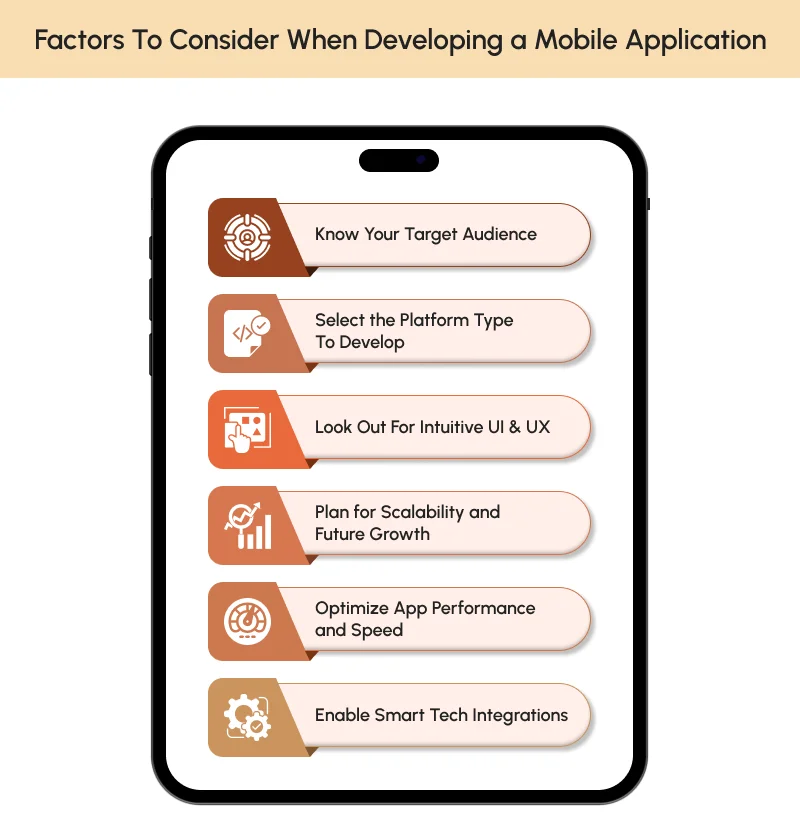
Target Audience
Every successful app starts with clear business goals. Know what problem the app solves, and for whom. Understanding your target audience's age, behaviour, device usage and preferences helps you plan features and marketing.
Platform Selection
Choosing the right platform affects development cost and time. iOS users tend to spend more per head, while Android offers wider global reach. Besides native development, cross-platform frameworks such as Flutter app development or React Native let one codebase serve both stores.
UX and UI
Users expect intuitive, visually appealing apps. Even a top-notch mobile app idea can fail because of poor UX. Smooth navigation, short loading times and familiar design patterns show up directly in retention and reviews.
Scalability
Your app may start small, but it should be able to grow. A scalable architecture handles more users, features and load without performance issues, and it reduces the cost of changes as the market shifts.
App Speed
Attention spans are short. Slow apps collect poor reviews and uninstalls, so plan for good performance, a lean architecture and efficient backend calls from day one.
Tech Integration
Mobile apps today integrate with AI, IoT, AR/VR, cloud services and digital wallets. Planning these integrations early keeps the app competitive as technology evolves.
Even with all these factors listed, you might still wonder about the technical side of mobile app development.
Tech Stacks Used to Build Your Mobile Application
Every high-performing mobile application is backed by a strong technology stack. Proven, well-supported tools keep the app fast, secure and easy to maintain. Here are the layers Pixel Web Solutions typically works with.
Frontend: cross-platform and native frameworks create responsive interfaces. Use Flutter or React Native for one shared codebase, or Swift for iOS and Kotlin for Android when you need native performance.
Backend technologies: Node.js, Python, Java or PHP handle app logic, secure data handling and scalable operations.
Databases: choose based on performance needs, data volume and scale. MongoDB, PostgreSQL, MySQL and real-time databases are widely supported options.
Cloud and DevOps: AWS, Google Cloud or Microsoft Azure, plus Docker and CI/CD pipelines, keep uptime high and releases smooth.
APIs and integrations: payment gateways, maps and location services, push notifications and analytics tools extend what the app can do.
Security and compliance: authentication, data encryption, secure API gateways and role-based access control belong in every layer, along with the privacy rules of each market you serve.
Now you may wonder what all of this costs.
How Much Does It Cost to Create a Mobile App?
There is no fixed price, because every quote is hours multiplied by an hourly rate. Industry estimates put a basic app at about 200 to 600 hours, a moderate app at 600 to 1,600 hours and an advanced app at 1,600 to 4,000 hours or more. The table shows how the same scope changes with the team's rate. These are industry ranges, not Pixel quotes.
| App tier | Typical hours | At $25/hour | At $50/hour | At $100/hour |
|---|---|---|---|---|
| Basic (few screens, simple backend) | 200 to 600 | $5,000 to $15,000 | $10,000 to $30,000 | $20,000 to $60,000 |
| Moderate (accounts, payments, APIs) | 600 to 1,600 | $15,000 to $40,000 | $30,000 to $80,000 | $60,000 to $160,000 |
| Advanced (real-time, marketplace, heavy backend) | 1,600 to 4,000+ | $40,000 to $100,000+ | $80,000 to $200,000+ | $160,000 to $400,000+ |
Worked example: a niche dating app MVP with verified profiles, matching, chat and a subscription paywall might take about 900 hours. At $25 per hour that is $22,500; at $100 per hour it is $90,000. The scope is identical; only the rate changes.
Running costs come on top. Apple charges a $99 yearly developer membership, Google Play charges a one-time $25 registration, and maintenance and updates add a share of the build cost every year. To estimate your own app line by line, read the full guide to mobile app development cost, and see how apps pay back in this piece on mobile apps for business growth.
Why Pixel Web Solutions Is the Right Partner to Bring Your Mobile App Idea to Life
In 2026, mobile applications are an important part of how businesses connect with customers. From choosing the right mobile app idea to understanding the tech, every decision shapes an app's success. Partnering with the right development team makes all the difference.
With years of experience and a strategic approach, Pixel Web Solutions stands out as a reliable mobile app development company. Its team helps founders validate an idea, scope an MVP in clear hours, and turn it into a secure, user-centric app on iOS and Android. If you are planning to bring your mobile app idea to life, talk to Pixel Web Solutions for a scoped estimate.
Frequently Asked Questions
What are the best mobile app ideas for 2026?
The strongest mobile app ideas for 2026 are in growing categories: AI-first utilities, fitness and health tracking, language and skills learning, niche dating with strong safety features, food and service delivery, and credit or money management tools.
Which app category makes the most money?
Games still earn the most of any single category, about $82 billion in 2025, but non-game apps as a group overtook games in in-app revenue for the first time in 2025, according to Sensor Tower.
Is it too late to build a dating app?
No, but a general swipe app is a hard sell. Apple will reject dating apps that are not meaningfully different, and growth has moved to intent-led apps such as Hinge. Build for a specific community or goal.
How do I know if my app idea is good?
Test it before you build. Interview 15 to 20 people with the problem, read competitor reviews, and run a landing page with a waitlist or pre-order. Set a go or no-go target before the test starts.
How much does it cost to build an app in 2026?
A basic app costs about $5,000 to $15,000 at $25 per hour and $20,000 to $60,000 at $100 per hour. Moderate apps run $15,000 to $160,000 and advanced apps $40,000 to $400,000 or more, depending on the team's rate.
Should I build for iOS or Android first?
Build for the platform your target users carry. iOS users tend to spend more per head, while Android has more users worldwide. A cross-platform framework such as Flutter or React Native lets you launch on both from one codebase.
Conclusion
The best mobile app ideas for 2026 are not the ones with the most hype; they are the ones with a clear user, a growing category and a test that proves people will pay. Shortlist two ideas from the table, run the validation checklist, and scope the MVP in hours before you commit a budget. With that groundwork done, your mobile app idea has a far better chance of becoming a profitable business.