








The cost to build a fintech app in 2026 ranges from about $20,000 for a simple app built by an offshore team to $150,000 or more for an advanced platform, and US agencies can charge $300,000 to $600,000+ for the same complex scope. On top of development, budget for compliance, security testing, licensing or a licensed banking partner, and per-user fees such as KYC checks.
In today's digital economy, one-tap payments and instant money transfers feel ordinary. Yet behind every instant transaction sit months of planning, layered security, careful compliance and a serious investment.
Ironically, the apps that make finance easy are the ones that need the most financial planning to build. That is exactly why you should understand what goes into a fintech app, and how much it costs, before you start.
So whether you are a curious newcomer or a business ready to launch, this guide breaks down the true cost of building a fintech application, with the maths shown, so you can check every figure.
Key Takeaways
- Budget by hours: simple fintech apps need about 800 to 1,500 hours, payments and wallet apps 1,500 to 3,000 hours, and neobank, lending or trading platforms 3,000 to 6,000 hours or more.
- Rates change the total: a 2,000-hour payments app costs $50,000 at $25 per hour and $200,000 at $100 per hour.
- Compliance is a cost line, not an extra: PCI DSS, KYC and AML checks, penetration tests and data protection work belong in the first budget.
- Licences can cost more than code: UAE stored value facilities need AED 15 million paid-up capital, and India's payment aggregators need ₹15 crore net worth, so many startups launch through a licensed partner first.
- Start with an MVP: launching one product in one market with a banking-as-a-service partner is the fastest and cheapest route to real users.
How Much Does It Cost to Build a Fintech App?
The cost to build a fintech app typically ranges from about $20,000 to $150,000+ at offshore rates, and much more with US or Western European teams. A basic app with minimal features sits at the low end, while moderate and advanced platforms cost more because of their scale and complexity. The price covers features like user authentication, transactions, dashboard analytics and security, and it changes with the type of fintech app, UI/UX quality, backend infrastructure and team location.
Here is a quick breakdown of the average fintech app development cost by app type. These are industry estimates, not fixed quotes.
| Type of fintech application | Typical hours | At $25/hour | At $100/hour |
|---|---|---|---|
| Simple (budgeting, expense tracking, read-only bank data) | 800 to 1,500 | $20,000 to $37,500 | $80,000 to $150,000 |
| Moderate (payments, wallets, P2P transfers through a licensed partner) | 1,500 to 3,000 | $37,500 to $75,000 | $150,000 to $300,000 |
| Advanced (neobank, lending, trading, multi-country) | 3,000 to 6,000+ | $75,000 to $150,000+ | $300,000 to $600,000+ |
A note on older estimates: you may see fintech price tags as low as $7,000 to $40,000. Those figures usually describe a front-end app on top of someone else's licensed platform, and they leave out compliance, security testing and integrations. Use them only for white-label or prototype builds.
Worked Example: A Payments and Wallet MVP
Here is a realistic hour plan for a cross-platform payments app that lets users verify their identity, hold a balance with a licensed partner, and send money to friends.
| Work package | Estimated hours |
|---|---|
| Discovery and compliance mapping | 120 to 200 |
| UI/UX design | 150 to 250 |
| Cross-platform mobile app | 500 to 900 |
| Backend: ledger, transactions, notifications | 500 to 900 |
| KYC and AML integration | 100 to 200 |
| Banking or payment partner integration | 150 to 300 |
| Admin panel and reporting | 150 to 250 |
| Security hardening and fixes after penetration testing | 100 to 200 |
| QA and testing | 230 to 400 |
| Total | 2,000 to 3,600 |
At $25 per hour, that is $50,000 to $90,000 (2,000 × $25 and 3,600 × $25). At $50 per hour it is $100,000 to $180,000, and at $100 per hour it is $200,000 to $360,000. For context, the US Bureau of Labor Statistics puts median software developer pay at $133,080 a year (May 2024), about $64 per hour before overheads, which is why US agency rates are so much higher.
Per-user costs grow with success. If your identity verification vendor charges $1.50 per check (an assumed figure; prices vary by vendor and volume) and you onboard 20,000 users in year one, KYC alone costs $30,000 (20,000 × $1.50). Model these usage fees before launch.
Why Are Businesses Racing to Build Fintech Applications?
Many businesses and startups want to build fintech applications because of the opportunity and market space. People no longer want to wait for financial services, and technology now delivers payments, lending and investing in seconds.
This creates openings for instant payments, smarter lending and live market data that help users make better financial decisions. As a result, businesses that solve a real gap can win trust and build steady revenue streams.
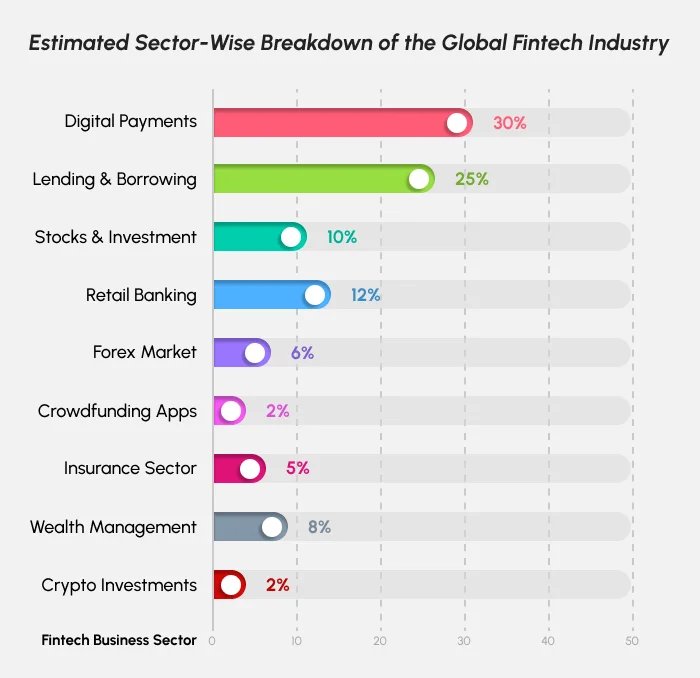
The chart above shows an estimated split of the fintech industry by sector, with digital payments as the largest segment. Recent data from primary research supports the growth story:
- Revenue: fintech revenues grew 21% in 2024, against 6% for incumbent financial institutions, and 69% of public fintechs were profitable, according to the BCG and QED Investors Global Fintech Report (June 2025). Payments generated about $126 billion of scaled fintech revenue.
- Investment: global fintech investment reached $103.1 billion in the first half of 2026, up from $72.2 billion in the second half of 2025, with payments the largest segment at $44.2 billion, according to KPMG's Pulse of Fintech H1 2026.
These numbers show that investors and customers are still backing well-built fintech products.
While most businesses focus on the overall fintech app development cost, several hidden expenses appear in later stages.
Hidden Costs to Face When Developing Fintech Apps
Security Standards and Audits
Before launch, most fintech apps need to meet recognized security standards. The PCI Data Security Standard (currently version 4.0.1) applies if you store, process or transmit card data, and many partners also ask for a SOC 2 report or ISO 27001 certification. Data protection laws such as the EU's GDPR are legal duties rather than certificates, but meeting them still takes audits, testing and documentation. You can cut PCI scope, and cost, by using a payment provider's tokenized checkout so card numbers never touch your servers.
Licensing Requirements
Depending on your region and services, you may need specific licences and approvals. Costs vary by jurisdiction and often include minimum capital, which is money you must hold rather than spend. The regulator checklist below shows the main ones.
Third-Party Integrations
Fintech apps rely on APIs and third-party services for payments, KYC verification, credit data and analytics. These usually charge per transaction, per check or per month.
Additional Security Integration
Security is the most important part of any fintech app. Beyond basic encryption, you will often need multi-factor authentication, fraud detection, device binding and biometric login, plus an independent penetration test before launch.
Operational Resilience
In the EU, the Digital Operational Resilience Act (DORA) has applied since 17 January 2025. It requires financial entities to manage ICT risk, report major incidents and oversee critical tech suppliers, which adds monitoring, logging and documentation work.
Maintenance and Support
Fintech apps need continuous updates, server monitoring, bug fixes and new features to stay competitive and compliant. Budget about 15% to 20% of the build cost each year, plus extra work whenever regulations change.
These costs are not fixed. They move with several influential factors, so let's look at them next.
Regulator Checklist: Licences and Capital by Market
Most cost guides ignore licensing, yet it often decides whether you build your own regulated product or launch through a licensed partner. Here is a market-by-market summary for payments and e-money apps, as of October 2026.
| Market | Regulator and rule | What it means for your budget |
|---|---|---|
| United States | Federal money services business registration with FinCEN, plus state money transmitter licences | Many startups partner with a sponsor bank to avoid applying for licences state by state at launch |
| European Union | Payment Services Directive (PSD2) and E-Money Directive | Initial capital of €20,000 to €125,000 for payment institutions, depending on services, and €350,000 for e-money institutions |
| United Kingdom | FCA authorisation as a payment or e-money institution | Application, safeguarding and capital requirements before launch |
| UAE (onshore) | CBUAE Retail Payment Services and Card Schemes Regulation | Initial capital from AED 100,000 (Category IV) to AED 3 million (Category I), depending on services and monthly volume |
| UAE (onshore) | CBUAE Stored Value Facilities Regulation | Paid-up capital of at least AED 15 million for wallet and stored value products |
| UAE (virtual assets) | VARA in Dubai, or ADGM FSRA in Abu Dhabi Global Market | Separate licensing if your app touches crypto or virtual assets |
| India | RBI Regulation of Payment Aggregators Directions, 2025 | Net worth of ₹15 crore at application and ₹25 crore by the end of the third financial year |
The practical takeaway: for a first release, most startups use a licensed banking-as-a-service or payment partner and focus their own budget on product, onboarding and compliance processes. They apply for their own licence once volumes justify the capital.
Factors Affecting Fintech Application Development Cost
The first and most important factor is the type of fintech app you build. Each type has its own features, integrations and requirements, so it directly affects the fintech app development cost and timeline.
Here are common fintech app categories and how they differ in complexity.
- Banking and neobanking apps: these bring traditional banking services into a digital format. They need strong encryption, regulatory compliance and a core banking or BaaS integration. See how Pixel approaches banking app development.
- Payment and wallet apps: apps like PayPal or Venmo enable instant transfers, QR payments and cross-border payments. They need strong API integrations, multi-currency support and fraud detection. Our guide to digital wallet app development covers the features in detail.
- Investment and trading platforms: stock trading, crypto trading and robo-advisory apps need data-heavy dashboards, market data feeds and complex logic, which makes them costlier to build.
- Lending and credit apps: these connect borrowers and lenders, manage loans and calculate interest. They need credit scoring, payment collection and legal compliance systems.
- Insurance apps: these automate claims and policy management. Because they handle sensitive data, they need advanced encryption and secure API communication.
Each category demands a different level of effort, technology and compliance. The more complex your fintech app type, the higher your development cost.
Geographical Location
Where your team is based strongly affects cost. Developers in North America or Western Europe charge higher hourly rates than teams in Asia or Eastern Europe. Beyond price, regional knowledge of financial regulations and payment systems also matters.
Development Team
The structure and expertise of your team also shape the cost. A freelance developer may cost less, but it can limit your scalability and security support. A professional fintech app development company delivers quality, maintenance and compliance support in one package.
Design Elements
In fintech, design is about trust as well as looks. A clean, intuitive interface makes transactions feel simple and secure. However, interactive dashboards and custom data visualizations add design and front-end hours.
Feature Incorporations
The fintech app development cost grows with every feature. Basic features like registration, account management and transaction history come at a standard cost. Advanced features such as AI-based insights, real-time analytics or chatbots can multiply the budget.
Platform Choice
Native apps for Android or iOS offer the best performance but need more time and budget. A cross-platform app saves time and money for most fintech MVPs. Our guide to mobile app development cost compares the platform options in more detail.
Planned Time Frames
A tight schedule often means more developers working in parallel, which raises cost. A well-planned process allows steady delivery and room for customization.
These factors directly affect the fintech app development cost. In addition, emerging technologies can have a big influence.
The Role of Emerging Technologies in Fintech App Development Cost
The more advanced your technology, the higher the development cost, but these innovations also give you a competitive edge.
- Decentralization: DeFi systems enable peer-to-peer transactions and automated financial operations. Integrating them adds smart contract development and audit costs.
- Generative AI: AI agents now support customer service, fraud prevention and financial insights. Using AI or LLM APIs adds usage fees, data work and model monitoring. Read more about how AI is transforming fintech, or see our guide to building AI-powered banking apps.
- IoT and contactless payments: wearables and connected devices enable tap-to-pay and automated spending tracking, but they need a strong, secure backend.
- Blockchain technology: blockchain supports transparent transaction records and faster cross-border payments, which makes it an innovative but more expensive choice. Explore the future of blockchain in fintech for real use cases. If your product accepts crypto, our guide to crypto payment gateway development cost shows the extra budget lines.
- Green fintech: carbon tracking and sustainable investment apps are a growing niche that combines financial data with climate data.
Fintech app development costs can escalate quickly. However, with a strategic plan, you can reduce expenses without compromising quality.
How to Minimize the Overall Fintech App Development Cost
Here are the most effective ways to keep the cost to build a fintech app under control.
Start with Minimal Features
Begin with the core features that deliver your main value. Avoid advanced functions in the first release, and use early demand to guide further investment.
Use Ready-Made App Frameworks
Ready-made or white-label fintech frameworks can greatly reduce development effort and cost. They also shorten time to market and usually come with fewer bugs, while still allowing branding and customization.
Build an MVP
A fintech MVP launches the most important features first so you can gather real user feedback early. This helps you refine the app based on actual usage and avoid spending on features nobody needs. Our guide on how to build an MVP explains the process step by step.
Launch Through a Licensed Partner
Instead of applying for your own licence on day one, partner with a licensed bank, payment institution or BaaS provider. This moves capital and licensing costs to later, when your volumes justify them.
Use a Single Packaged Service
Instead of hiring separate providers for payments, analytics and KYC/AML compliance, choose one professional fintech app development company that handles everything from ideation to launch.
Choose a Cost-Effective Platform
Pick the platform that fits your users and goals. Decide whether to launch on iOS, Android or both, or use cross-platform development to cover both at lower cost.
How Much Time Does It Take to Build a Fintech Application?
The time needed depends on your requirements and whether you build from scratch or use a ready-made solution. On average, a full fintech app takes 3 to 12 months, depending on complexity, features and security needs. This covers planning, UI/UX design, core development, third-party integrations, compliance setup and testing. Licensing, where you need your own, runs in parallel and can take longer than the build.
On the other hand, a ready-made or white-label fintech solution can launch in about 4 to 8 weeks, depending on branding, UI changes and feature enhancements.
Why Partnering with Pixel Web Solutions Is the Smartest Choice for Cost-Effective Fintech App Development
Joining hands with a professional fintech app development company like Pixel Web Solutions is a smart choice. Pixel combines domain knowledge, modern technology stacks and proven methods to deliver high-performing financial applications.
Pixel's team of developers, analysts and consultants tailors each platform to your business requirements, and it shares hour-based estimates so you can see where every dollar goes. By using ready-to-deploy fintech frameworks and licensed partner integrations, Pixel helps you reduce complexity and launch faster. Operating from Ras Al Khaimah, UAE and Madurai, India, Pixel understands both UAE and Indian payment rules. To get a scoped estimate, talk to Pixel's fintech team.
Frequently Asked Questions
How much does it cost to build a fintech app in 2026?
Most fintech apps cost $20,000 to $150,000+ with an offshore team, and $80,000 to $600,000+ with US or Western European agencies. Compliance, security testing, licensing and per-user fees such as KYC come on top.
How long does it take to build a fintech app?
A custom fintech app usually takes 3 to 12 months, depending on complexity and compliance needs. A white-label solution can launch in about 4 to 8 weeks.
Do I need a licence to launch a fintech app?
It depends on what your app does and where. Apps that hold customer money or move payments usually need a licence, such as a money transmitter licence in the US or a CBUAE licence in the UAE. Many startups launch through a licensed partner bank or payment provider instead.
How much does it cost to maintain a fintech app?
Plan for 15% to 20% of the build cost each year, plus hosting, third-party API fees, security audits and updates when regulations change.
What is the cheapest way to build a fintech app?
Start with an MVP on a cross-platform framework, use a white-label core where possible, and launch through a licensed partner. This keeps the first release focused and avoids licence capital until you have traction.
Why do fintech apps cost more than other apps?
Fintech apps need stronger security, compliance checks, audit trails, fraud detection and more testing than typical apps. These requirements add hours to almost every stage, which raises the overall cost to build a fintech app.