To start a P2P crypto exchange, you research the corridors (countries, currencies and payment methods) you will serve, set up licensing and KYC, choose an escrow model, build the platform with ad listings, order matching, escrow, chat, dispute resolution and reputation, add fraud controls, test it and launch with verified merchants providing early liquidity. A web-based P2P exchange with one corridor starts at about $5,000 on proven software, a white-label multi-corridor platform with mobile apps typically costs $15,000 to $30,000, and a custom build $30,000 to $80,000.
Peer-to-peer (P2P) crypto exchanges let users buy and sell crypto directly with each other, paying through bank transfers, mobile money, cards or cash, while the platform holds the crypto in escrow until payment is confirmed. That model works where banks restrict crypto, where local payment methods dominate and where users want low fees and control. Binance, Bybit, OKX and others all run large P2P marketplaces for exactly these reasons.
For founders, a P2P exchange is one of the most accessible ways to enter the exchange business, because users provide the liquidity through their own offers. This guide explains how a P2P exchange works, how to start one step by step, the development options and costs, the features and security controls you need and why P2P remains a strong business model.
Key Takeaways
- Escrow is the heart of a P2P exchange. The seller’s crypto is locked until the buyer’s payment is confirmed.
- Corridors decide success: the right mix of countries, currencies and payment methods matters more than the number of coins.
- Fraud controls are essential: fake payment proofs, chargebacks and “triangle” scams target P2P platforms.
- Most markets treat P2P platforms as regulated crypto services, so plan KYC and licensing.
- Costs start low: about $5,000 for a single-corridor web platform, $15,000 to $30,000 for white-label, $30,000 to $80,000 custom.
How Does a P2P Crypto Exchange Work?
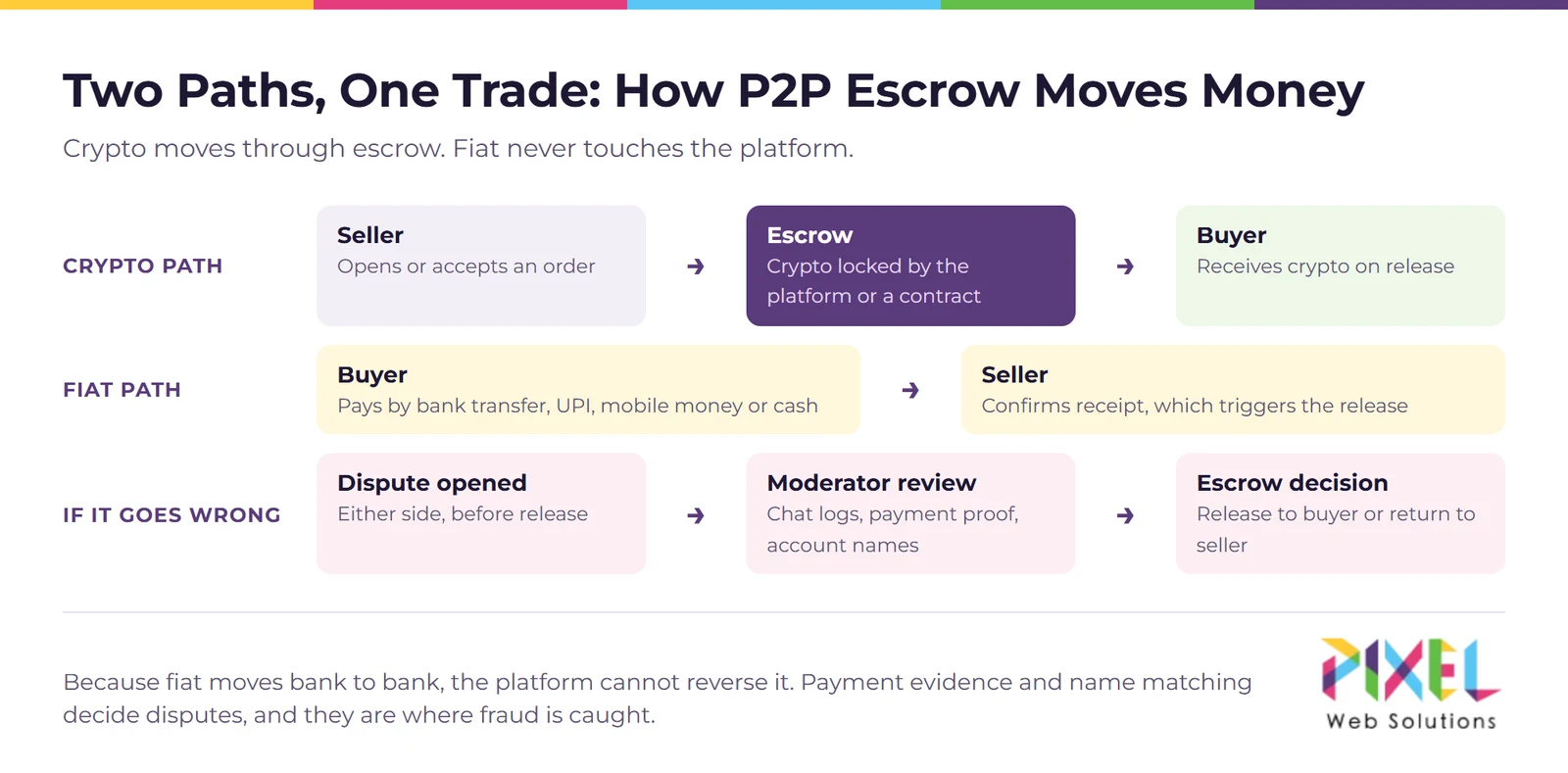
- Ad posting: a seller (often a verified merchant) posts an offer with price, limits and accepted payment methods.
- Order: a buyer selects the offer and opens an order.
- Escrow lock: the platform locks the seller’s crypto in escrow.
- Payment: the buyer pays the seller directly through the agreed method and marks the order as paid.
- Confirmation and release: the seller confirms receipt, and the platform releases the crypto to the buyer.
- Dispute handling: if something goes wrong, either party opens a dispute, and moderators review chat logs and payment evidence before deciding.
- Reputation: both parties rate each other, building trust scores for future trades.
Escrow Models
| Escrow model | How it works | Trade-offs |
|---|---|---|
| Custodial escrow | The platform holds the crypto in its own wallets during trades | Simple and fast; the platform carries custody risk and licensing duties |
| Smart contract escrow | Crypto is locked in an on-chain contract released by the parties or an arbiter | Transparent and non-custodial; needs audits and on-chain fees |
| Multi-signature escrow | Release requires two of three keys (buyer, seller, arbitrator) | Balanced control; more complex user experience |
Most large P2P marketplaces use custodial escrow with time limits and escalation to human review, while decentralized platforms use smart contract or multisig escrow.
Steps To Start A P2P Crypto Exchange
Step 1: Thorough Market Research
Pick your corridors: which countries, local currencies and payment methods (bank transfer, UPI-style instant payments, mobile money, cards, cash) your users rely on. Study the competition in each corridor, typical spreads and the pain points users complain about, such as frozen bank accounts, slow disputes or scams.
Step 2: Roadmap Creation
Define your launch corridors, supported coins (usually stablecoins such as USDT and USDC first, then BTC and ETH), fee model, merchant programme and milestones. A written crypto exchange business plan keeps these decisions tied to budget and revenue targets.
Step 3: Structure Legal Compliance
In many jurisdictions, facilitating crypto-to-fiat trades makes the platform a regulated virtual asset service provider. Plan for KYC, AML monitoring, sanctions screening, the Travel Rule and the licence your markets require, such as FIU-IND registration in India, a MiCA licence in the EU or VARA authorization in Dubai.
Step 4: Develop the P2P Crypto Platform
Choose your build route (see below), then build or configure the order book of ads, escrow, wallets, chat, dispute tools, admin panel and mobile apps.
Step 5: Feature Implementation
Add the essential, trading and security features listed in the next section, prioritizing escrow reliability, dispute handling and fraud controls.
Step 6: Quality Assurance
Test escrow edge cases (timeouts, partial payments, cancellations), dispute flows, payment method rules, load and security. Commission a penetration test and, for smart contract escrow, an audit.
Step 7: Deployment and Launch
Launch in one or two corridors with verified merchants providing initial offers, monitor trades and disputes closely and expand once the model works.
Need a Clear Plan to Build Your P2P Exchange?
Share your target markets and we will map corridors, compliance and features for you.
Various Development Methods To Start A P2P Crypto Exchange
| Method | Cost | Timeline | Best for |
|---|---|---|---|
| Proven P2P software, single corridor, web | From about $5,000 | 2 to 4 weeks | Testing one market |
| White-label P2P exchange (multi-corridor, web and mobile) | $15,000 to $30,000 | 4 to 10 weeks | Startups launching fast |
| Custom P2P exchange | $30,000 to $80,000 | 3 to 5 months | Unique features, many corridors, scale |
A P2P crypto exchange development company can configure white-label software quickly or build a custom platform. Freelancers can suit small components but rarely cover escrow security, compliance and dispute operations end to end.
Features Offered To Start A P2P Crypto Exchange
A P2P platform shares many core modules with a spot exchange, which are covered in our guide to the features of a cryptocurrency exchange. These are the features a P2P exchange needs.
Essential Features
- User registration and KYC with tiered limits
- Ad posting and offer marketplace with filters by payment method, price and limits
- Escrow system with automatic time limits
- Multi-currency wallets for deposits and withdrawals
- Real-time chat between buyer and seller, stored for disputes
- Dispute resolution centre with evidence upload and moderator tools
- Reputation and ratings with trade counts and completion rates
- Admin panel for users, ads, fees, disputes and reports
- Notifications for orders, payments and releases
Trading Features
- Buy and sell offers with fixed or floating prices tied to market rates
- Multiple payment methods per corridor
- Merchant programme with verified badges, higher limits and priority listing
- Express buy and sell that matches users to the best offer automatically
- Order limits and time windows per payment method
- Stablecoin-first trading for USDT and USDC pairs
- Mobile apps for Android and iOS
Security Features
- Two-factor authentication and device management
- Escrow timeouts and auto-cancel rules
- Fraud detection: flags for fake payment proofs, chargeback-prone methods, name mismatches and triangle scams (where a fraudster routes a victim’s payment through an innocent seller)
- Name-matching rules so payments must come from the verified account holder
- Blacklists and sanctions screening
- Cold storage for platform reserves
- Audit logs for every order and dispute action
How P2P Crypto Exchanges Make Money
- Trading fees on completed orders, often charged to advertisers (makers) while takers trade free
- Merchant subscriptions for verified status, higher limits or featured ads
- Withdrawal fees on crypto leaving the platform
- Promoted ads for better placement
- Express conversion spreads when the platform matches users automatically
For the wider picture, see how crypto exchanges make money.
Reasons To Start A P2P Crypto Exchange
- User-provided liquidity: offers come from users and merchants, so you need less market-making capital than an order-book exchange.
- Works where banks restrict crypto: users trade through familiar local payment methods.
- Lower operating costs: no matching engine or deep order book to maintain.
- Strong demand in emerging markets: remittances, savings in stablecoins and cash-to-crypto access.
- Scalable corridor by corridor: add countries and payment methods as you grow.
- Natural path to more products: add spot trading, crypto wallet development or a crypto payment gateway later. See crypto exchange development services.
Challenges of Running a P2P Exchange
- Fraud and scams: require strong verification, name matching, limits and fast disputes.
- Bank account freezes: users’ bank accounts can be frozen if counterparties send tainted funds; clear rules and merchant vetting reduce this.
- Dispute workload: disputes need trained moderators and clear evidence standards.
- Regulation: P2P platforms increasingly fall under crypto service rules, so plan licensing early.
Futuristic P2P Crypto Exchange Creation With Pixel Web Solutions
Pixel Web Solutions builds P2P crypto exchanges with custodial, smart contract or multisig escrow, corridor-specific payment rules, dispute centres, fraud controls and mobile apps. Our P2P exchange development starts at about $5,000 for a web-based platform with a single corridor, and we scale it with you as you add markets. For the full exchange launch process, read how to start a cryptocurrency exchange.
Build a Secure and Scalable P2P Crypto Exchange
Frequently Asked Questions
How does a P2P crypto exchange platform work?
Sellers post offers, buyers choose an offer, and the platform locks the seller’s crypto in escrow. The buyer pays the seller directly, the seller confirms payment and the platform releases the crypto. Disputes are reviewed by moderators using chat and payment evidence.
How much does it cost to start a P2P crypto exchange?
About $5,000 for a web-based platform with one corridor on proven software, $15,000 to $30,000 for a white-label multi-corridor platform with mobile apps, and $30,000 to $80,000 for a custom build. Licensing and operations are extra. For a full exchange budget, see the cost to build a crypto exchange.
How long does it take to start a P2P crypto exchange?
Two to four weeks for a single-corridor launch on proven software, 4 to 10 weeks for white-label and three to five months for a custom platform, excluding licensing time.
Is a P2P crypto exchange legal?
Yes, in many countries, but most treat P2P platforms as regulated crypto service providers that must run KYC and AML checks and hold the relevant licence or registration.
How do P2P exchanges prevent scams?
Through escrow, KYC, name-matching rules for payments, trade limits for new users, fraud detection, reputation scores and fast, evidence-based dispute resolution.
Which escrow model is best for a P2P exchange?
Custodial escrow is the simplest and most common for regulated platforms. Smart contract or multisig escrow suits decentralized platforms that want users to keep control of funds.