A cryptocurrency exchange is a platform that matches buyers and sellers of digital assets such as Bitcoin and Ether, either for other cryptocurrencies or for fiat money like US dollars or dirhams. Centralized exchanges hold customer funds and match orders on their own servers, while decentralized exchanges let users trade from their own wallets through smart contracts. In 2026, cryptocurrency exchanges also have to prove their reserves and hold a licence in most major markets.
Cryptocurrency exchanges have changed beyond recognition since the very first one, BitcoinMarket.com, opened in 2010 and offered Bitcoin trading only. Today thousands of venues list more than 22,000 assets, and the biggest ones handle tens of billions of dollars of trades every day.
Prices still move fast, which is why traders keep coming back. Bitcoin set its all-time high of $126,080 on 6 October 2025 and traded near $82,000 on 16 October 2026, roughly 26% lower than a year earlier, according to CoinGecko. Every one of those moves runs through an exchange. This guide covers how cryptocurrency exchanges work, the main types, who holds your coins, what you really pay in fees, how proof of reserves works, the 2026 rules by region, and how to pick a safe venue.
Key Takeaways
- Two core models: centralized exchanges (CEXs) hold your funds and run an order book; decentralized exchanges (DEXs) let you trade from your own wallet through smart contracts.
- Scale in October 2026: the crypto market is worth about $2.78 trillion, DEXs handled $287 billion of spot volume in the past 30 days, and on-chain perpetual DEXs handled $654 billion.
- Custody is the real risk: the $1.5 billion Bybit hack in February 2025 was the largest theft on record, so how an exchange stores keys matters more than its fee table.
- Fees are more than the headline rate: maker and taker fees, spreads, withdrawal fees and funding rates all add up, as the worked example below shows.
- Regulation is now real: MiCA authorisation has been mandatory in the EU since 1 July 2026, Dubai's VARA licenses exchanges and derivatives, and the US still lacks a market-structure law after the CLARITY Act stalled in the Senate.
What Is a Cryptocurrency Exchange?
A cryptocurrency exchange is a platform that facilitates trading cryptocurrencies like Bitcoin or Ethereum between buyers and sellers in a secure manner. In simple words, a crypto exchange connects two or more users who want to buy or sell crypto. Users can convert fiat money into a crypto asset, or back again, in seconds. To help traders, these platforms also provide charts, order types, wallets and, on larger venues, derivatives and earn products.
The exchange does not set the price. Supply and demand set it, and the exchange is the marketplace where orders meet. That is why the same coin can trade at slightly different prices on two venues, and why arbitrage traders exist.
Two things decide whether an exchange is worth using: how well it protects customer assets and what it charges to trade. Security threats are a constant problem for digital trading platforms, so traders should look for venues with strong custody, published reserves and a licence. Higher security does not have to mean higher fees, though: large regulated exchanges are often among the cheapest because volume spreads their fixed costs.
The trading fee is the amount an exchange collects for executing a trade. Most exchanges charge a small percentage per trade, and many now earn more from other lines: listing fees, staking, margin interest and derivatives. Unlike stock exchanges, which mostly serve brokers, crypto exchanges usually serve retail customers directly, which is why their fees per trade tend to be higher than a stock exchange's.
Having seen what a crypto exchange is, let's move on to the types of crypto exchanges.
Types of Cryptocurrency Exchanges
Cryptocurrency exchanges can be classified by who controls the funds and how trades are matched. Here is the breakdown.
Centralized Cryptocurrency Exchanges (CEX): Centralized exchanges have a company in the middle that holds user funds and runs the matching engine. Based on what they offer, centralized exchanges can be split into:
- P2P (Peer to Peer, ad based and order book based) cryptocurrency exchanges
- OTC (Over the Counter) cryptocurrency exchanges for large block trades
- Derivatives trading exchanges (futures, perpetuals and options)
- Margin trading exchanges, where traders borrow to increase position size
- Leverage trading exchanges, usually through perpetual futures
Decentralized Cryptocurrency Exchanges (DEX): Decentralized exchanges let users trade directly from their own wallets without a company holding their funds. DEXs can be organised as:
- Order book based DEX, including on-chain order books such as Hyperliquid
- DEX with AMM (automated market maker) liquidity pools, such as Uniswap and PancakeSwap
- DEX aggregators, which route a swap across many pools for the best price
Hybrid Cryptocurrency Exchanges: Hybrid crypto exchanges combine a fast off-chain matching engine with on-chain settlement or self-custody, aiming for the speed of a CEX and the transparency of a DEX.
These are the most common types of crypto exchanges in the crypto ecosystem. Each type has its strengths and limitations, and Pixel's side-by-side guide to centralized exchange vs decentralized exchange compares them on cost, speed and security. Moving on, let's look at how crypto exchanges work.
How Do Cryptocurrency Exchanges Work?
Understanding the operational flow of each model is essential for traders and for anyone considering P2P exchange development. The process differs between centralized and decentralized venues.
In P2P ad based exchanges, crypto buyers connect with sellers through advertisements, and an escrow wallet holds the crypto until the fiat payment is confirmed. After completing KYC and linking a wallet, users can buy or sell directly with each other. Binance P2P follows this model; LocalBitcoins, the original example, shut down in February 2023.
In order book based centralized exchanges, users see live prices and charts, deposit fiat or crypto after KYC, and trade using market, limit or stop orders. Binance, Coinbase and Kraken are well-known examples. Here is how a trade flows on an order book exchange:
- Both buyer and seller open an account and pass identity checks (KYC).
- They deposit funds. The exchange credits an internal ledger, while the coins sit in the exchange's hot and cold wallets.
- The buyer chooses a market (spot, margin, futures) and an order type (market, limit or stop).
- The matching engine pairs the order with the best opposite order in the order book, usually in microseconds.
- The ledger moves balances between the two accounts and deducts trading fees. No blockchain transaction happens yet.
- When a user withdraws, the exchange signs a blockchain transaction from its wallet to the user's address.
That last step is the key insight: on a centralized exchange, most trades never touch the blockchain. They are entries in the exchange's database, which is why custody and proof of reserves matter so much. Pixel's guide to crypto exchange architecture shows how the matching engine, ledger and wallet services fit together.
On decentralized exchanges, users connect a self-custody wallet and trade directly with a smart contract. KYC is usually not required at the protocol level, though many front ends now block sanctioned addresses and certain countries. On an AMM such as PancakeSwap, the price comes from a formula based on the pool's balances, so large trades suffer slippage. The platform takes a small swap fee, most of which goes to liquidity providers. On an on-chain order book such as Hyperliquid, orders are matched by the chain's own validators, which gives a CEX-like trading screen without handing over custody.
The Crypto Exchange Market in 2026: Live Numbers
Market size claims in exchange guides are often years old. Here are the figures as of 16 October 2026, each from the source named:
| Metric | Figure | Source |
|---|---|---|
| Total crypto market capitalisation | About $2.78 trillion | CoinGecko |
| Crypto assets tracked | 22,310 coins across 1,508 exchanges | CoinGecko |
| Spot DEX volume, last 30 days | $287.1 billion | DefiLlama DEX dashboard |
| Perpetual DEX volume, last 30 days | $653.6 billion | DefiLlama perps dashboard |
| Binance Futures 24-hour volume | About $70.9 billion, with $33.7 billion open interest | CoinGecko derivatives |
| Hyperliquid share of perp DEX volume | 32.7% of the 30-day total | DefiLlama |
Two trends stand out. First, derivatives dwarf spot: on most days the futures and perpetual markets trade several times the spot volume. Second, on-chain trading is no longer a niche: perpetual DEXs alone traded more than $7.8 trillion in 2025, according to DefiLlama's daily data, with a record $1.36 trillion in October 2025.
Custody: Who Actually Holds Your Coins?
Custody is the question that separates a safe exchange from a risky one. There are three set-ups:
- Custodial (most CEXs): the exchange controls the private keys. You hold an IOU on its ledger. Convenient, but you depend on its security and solvency.
- Self-custody (DEXs): you hold the keys in your own wallet and sign each trade. Nobody can freeze or lose your funds except you, but a lost seed phrase cannot be recovered.
- Third-party or segregated custody: some regulated exchanges hold client assets with a separate custodian or in segregated wallets, which regulators such as VARA now require for client assets.
Why it matters: Chainalysis counted $3.4 billion stolen in 2025, and the single largest case was the $1.5 billion theft from Bybit's Ethereum cold wallet, which the FBI attributed to North Korea. In India, WazirX lost about $230 million in July 2024 and only resumed trading in October 2025 after a court-approved restructuring. Both cases were private key and signing failures, not trading failures. Pixel's guide to the role of security in crypto exchanges covers the controls that prevent them.
Crypto Exchange Fees Explained
Exchanges earn most of their revenue from fees, and traders pay more than the headline rate suggests. The common fee types are:
- Maker and taker fees: a maker adds an order to the book (a limit order); a taker removes one (a market order). Takers pay more. Binance spot fees start at 0.1% per side for regular users, as its fee schedule shows, and Kraken's published range runs from a 0.02% maker rebate to 0.80% taker, depending on volume.
- Spread: "simple" buy buttons often show a price above the market. The gap is a hidden fee.
- Deposit and withdrawal fees: card deposits commonly cost a few percent through payment partners, and crypto withdrawals carry a network fee plus any exchange markup.
- Funding rates (perpetuals): long and short holders pay each other every few hours to keep the contract price close to spot.
- DEX costs: a swap fee (often 0.05% to 0.3% of the trade), the blockchain gas fee and slippage.
Worked example: what a $1,000 Bitcoin purchase really costs. Take a beginner buying $1,000 of BTC with a card through an instant-buy button, versus an experienced trader depositing by bank transfer and placing a limit order:
| Cost line | Instant buy with card | Bank deposit plus limit order |
|---|---|---|
| Deposit fee | Card fee, assume 3% = $30 | Bank transfer, usually $0 |
| Spread on the buy price | Assume 0.5% = $5 | None, the order sits on the book |
| Trading fee | Often bundled into the spread | 0.1% maker fee = $1 |
| Withdrawal to own wallet | Network fee, a few dollars | Network fee, a few dollars |
| Total before withdrawal | About $35, or 3.5% | About $1, or 0.1% |
The same coin, bought on the same day, can cost 35 times more depending on the route. Card and spread figures vary by venue and country, so check the order preview before confirming.
Proof of Reserves: How Exchanges Show They Hold Your Funds
After FTX collapsed in November 2022 with a multi-billion dollar hole in customer funds, the large exchanges started publishing proof of reserves (PoR). A PoR has two halves:
- Proof of liabilities: the exchange puts every customer balance into a Merkle tree, a structure of hashes where the top value (the root) commits to the total. Each customer can check that their balance is included without seeing anyone else's.
- Proof of assets: the exchange shows it controls on-chain wallets holding at least that total, often with an accounting firm attesting to the snapshot.
Kraken's proof of reserves lets clients verify their inclusion with a personalised Merkle proof, and its September 2025 report covered spot, margin, futures and staked balances. Binance publishes a monthly reserve snapshot and uses zero-knowledge proofs to show no account has a negative balance.
What PoR does not prove: it is a point-in-time snapshot, it does not capture off-chain debts such as loans, and an exchange could borrow assets just for the snapshot day. Treat PoR as a minimum standard, not a guarantee of solvency.
Cryptocurrency Exchange Regulation in 2026
Regulation is the biggest change to how cryptocurrency exchanges operate since this guide was first written. The position in October 2026:
| Region | Rule | What it means for exchanges |
|---|---|---|
| European Union | MiCA | The transitional period ended on 1 July 2026; only authorised crypto-asset service providers (CASPs) may serve EU clients. Crypto derivatives fall under MiFID II instead. |
| United States | GENIUS Act and state licences | The GENIUS Act (July 2025) regulates payment stablecoins. The CLARITY Act, which would set exchange registration rules, failed a 49 to 50 cloture vote on 15 September 2026 but remains on the Senate calendar, so exchanges still rely on FinCEN registration and state money transmitter licences. |
| United States (derivatives) | CFTC | The CFTC approved the first US bitcoin perpetual contract, Kalshi's BTCPERP, on 29 May 2026. |
| UAE (Dubai) | VARA | Exchanges need a VASP licence under the VARA rulebooks; derivatives for retail clients are capped at 5 to 1 leverage. |
| UAE (Abu Dhabi and federal) | ADGM FSRA and CBUAE | ADGM licenses virtual asset trading venues; the Central Bank regulates payment tokens and limits which tokens UAE merchants can accept. |
| India | FIU-IND | Exchanges serving Indian users must register with the Financial Intelligence Unit and follow its AML rules. |
For a founder, the practical lesson is simple: the licence sets the launch date, not the code. Pixel's guide to crypto exchange regulatory compliance walks through the obligations in each regime.
Popular Cryptocurrency Exchanges
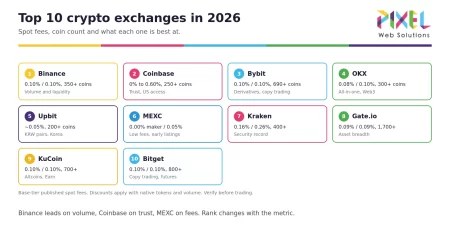
Here are the most-used centralized exchanges in October 2026, ranked by CoinGecko's trust score and spot volume, plus the leading DEXs:
| Exchange | Type | Notes as of October 2026 |
|---|---|---|
| Binance | CEX | Largest by spot and futures volume; publishes monthly proof of reserves |
| Coinbase | CEX | US-listed, regulated in the US and EU; also runs the Base network |
| Kraken | CEX | Long-running proof of reserves programme; fees range by volume |
| Bybit | CEX | Large derivatives venue; recovered from the February 2025 hack |
| OKX | CEX | Major spot and derivatives venue with a self-custody wallet |
| KuCoin | CEX | Wide altcoin selection |
| HTX | CEX | Formerly Huobi; rebranded in September 2023 |
| Bitstamp | CEX | One of the oldest exchanges, now owned by Robinhood |
| CoinDCX and WazirX | CEX (India) | WazirX resumed trading in October 2025 after its 2024 hack |
| Uniswap, PancakeSwap, Hyperliquid | DEX | Uniswap and PancakeSwap lead AMM volume; Hyperliquid leads perpetuals |
This list is based on trust, user base and trading volume. Rankings move monthly, so check the current figures before choosing. Credible exchanges hold their place by combining an easy trading experience with strong custody and a licence in the markets they serve.
How to Choose a Crypto Exchange: A 10-Point Safety Scorecard
Most "best exchange" lists rank by volume, which says nothing about whether your funds are safe. Score any exchange on these ten checks, one point each. Seven or more is a reasonable bar; below five, keep only small balances there.
- Licensed where you live (MiCA in the EU, VARA in Dubai, FIU-IND in India, state licences in the US).
- Publishes proof of reserves at least quarterly, with liabilities included.
- Cold storage and multi-signature or MPC signing described in its security pages.
- No unresolved hack or withdrawal freeze in the past two years, or a full repayment if there was one.
- Clear fee page with maker, taker and withdrawal fees in writing.
- Real liquidity: tight spreads and order book depth on the pairs you trade.
- Fiat rails you can use in your currency, with named banking partners.
- Two-factor authentication and withdrawal address whitelisting.
- Responsive support with a published complaints process.
- Exit path: you can withdraw to your own wallet at any time, on the network you choose.
Future of Cryptocurrency Exchanges
Around the globe, crypto usage keeps growing, but the next phase is shaped as much by rules and infrastructure as by prices. The trends to watch:
- Licensing everywhere: MiCA, VARA and the UK's new cryptoasset regime are pushing exchanges into the same supervision as brokers.
- Stablecoin settlement: stablecoin supply passed $306 billion in October 2026, per DefiLlama, and most crypto trading pairs are now quoted in USDT or USDC rather than fiat.
- On-chain derivatives: perpetual DEXs now rival mid-sized centralized exchanges in volume.
- Tokenised real-world assets: stocks, treasuries and commodities are being listed alongside crypto.
- Proof of reserves and segregated custody becoming a regulatory requirement rather than a marketing choice.
- US market structure: whether the CLARITY Act passes will decide how US exchanges register for years to come.
Some of these trends cut both ways. Regulation raises the cost of launching an exchange but also lifts trust, which brings in institutional money. The exchanges most likely to grow are those that treat compliance and custody as product features.
Also Check: Crypto Exchange Business Plan And Template For 2026
Thinking of Launching Your Own Exchange?
Businesses that want to run a venue rather than use one start with three decisions: the exchange type, the jurisdiction, and the build route (white label or custom). Pixel's step-by-step guide on how to start a cryptocurrency exchange covers the licence, liquidity and launch plan. As a reference point, Pixel Web Solutions prices a white-label crypto exchange at $25,000 to $50,000, a custom exchange at $100,000 to $150,000+, and a derivatives exchange at $150,000 to $400,000+.
Concluding Thoughts
Cryptocurrency exchanges are the gateway to every part of the digital asset market, from buying a first coin to trading perpetual futures on-chain. In 2026 the best ones are licensed, publish their reserves, store keys properly and are transparent about fees. Whether you're a trader picking a venue or a business leader planning one, those are the standards to measure against.
Pixel Web Solutions is a crypto exchange development company that builds centralized, decentralized, P2P, hybrid and derivatives exchanges for startups and enterprises. Its team plans the architecture, licensing route and liquidity set-up with each client and supports the platform after launch. To plan a cryptocurrency exchange of your own, talk to the Pixel Web Solutions team.
Frequently Asked Questions
What is a cryptocurrency exchange in simple words?
It is an online marketplace where people buy, sell and swap cryptocurrencies, either for other coins or for money like dollars or euros. The exchange matches buyers with sellers and charges a small fee per trade.
How do cryptocurrency exchanges make money?
Mainly from trading fees (maker and taker), spreads on instant buys, withdrawal fees, listing fees, margin interest, staking commissions and derivatives funding. Large exchanges earn a growing share from derivatives.
What is the difference between a CEX and a DEX?
A centralized exchange holds your funds and runs the order book on its own servers, usually with KYC. A decentralized exchange lets you trade from your own wallet through smart contracts, so you keep custody of your coins.
Are crypto exchanges safe?
Licensed exchanges with proof of reserves, cold storage and a clean security record are far safer than unregulated ones, but no custodial exchange is risk-free. Keep long-term holdings in a wallet you control.
Do I need KYC to use a crypto exchange?
On centralized exchanges, yes, in almost every country. Most DEXs do not require KYC at the protocol level, but you still need a wallet and must follow the tax and sanctions rules where you live.
What does proof of reserves mean?
It is a report showing an exchange holds at least as many assets as it owes customers. Customers can check their balance is included through a Merkle proof, while auditors or on-chain data confirm the assets.
Which is the oldest crypto exchange?
BitcoinMarket.com, launched in 2010, is generally recognised as the first Bitcoin exchange. Bitstamp (2011) and Kraken (founded 2011) are among the oldest still operating.