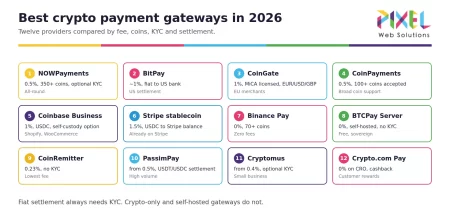
The main use cases of crypto payment gateways in 2026 are cross-border business payments, payroll and contractor payouts, e-commerce checkout, high-ticket luxury and car sales, travel bookings, donations, gaming and real estate, with subscriptions, card settlement and AI agent payments emerging fast. Most real volume now moves in stablecoins rather than bitcoin: McKinsey and Artemis estimate about $390 billion of genuine stablecoin payments in 2025, and $226 billion of it was business to business.
Isn't it fascinating how quickly the world moved from "We accept credit and debit cards" to "We accept crypto too"? A few years ago, paying with crypto was a novelty. Today Shopify merchants can accept USDC, PayPal lets US merchants take more than 100 cryptocurrencies, and Visa settles billions of dollars a year with banks in stablecoins.
The need behind it has not changed: businesses want fast, low-cost, borderless payments. Card networks and bank wires still work, but they bring cross-border fees, currency conversion costs, chargebacks and slow settlement. Crypto payment gateways do not replace those rails; they add a new one. This article walks through each use case with a named, real-world example, the adoption data behind it, a fee and fit scorecard, and what the GENIUS Act means for anyone accepting or building crypto payments.
Key Takeaways
- Stablecoins carry the real volume: stablecoin supply reached $311.6 billion on 27 September 2026, per DefiLlama, and about 58% of genuine stablecoin payments in 2025 were business to business.
- Big payment companies are now the gateways: Stripe (through Bridge), PayPal, Shopify and Visa all launched or expanded stablecoin payments between 2025 and 2026. Visa's stablecoin settlement passed a $20 billion annualized run rate in September 2026.
- Savings depend on the use case: a $100 foreign-card sale can cost a US merchant $5.70 in card fees, so cross-border and payout use cases save the most. Domestic, low-ticket retail saves little.
- Regulation is arriving: the US GENIUS Act became law on 18 July 2025 and takes effect no later than 18 January 2027, so gateways should plan for regulated, fully reserved stablecoins.
- You can use a gateway or build one: Pixel Web Solutions builds custom crypto payment gateways from $6,000 for businesses that want their own rails or want to sell payment processing to others.
What Is a Crypto Payment Gateway and How Does It Work?
A crypto payment gateway is software that lets a business accept cryptocurrency or stablecoin payments and, usually, settle them in its own currency. It sits between the customer's wallet and the merchant's bank account, much like a card processor sits between a card and a bank.
A typical payment works in five steps:
- The customer chooses "pay with crypto" at checkout and picks a coin and network, for example USDC on Base.
- The gateway creates an invoice with a fixed amount and a short time window, often 15 minutes, to lock the exchange rate.
- The customer pays from their wallet, and the gateway watches the blockchain for confirmation.
- The gateway screens the payment for sanctions and fraud risk and confirms the order to the merchant.
- The gateway converts the funds to fiat (or keeps them in stablecoins) and pays out to the merchant's account.
If you want to see the architecture behind these steps, our guide on how to create a cryptocurrency payment gateway covers it step by step. Now let's look at why businesses add one.
How can Crypto Payment Gateways enhance your Business Operations?
Adopting a crypto payment gateway can bring several benefits. Here are the ones that hold up in 2026, along with their limits.
Ease of Use
Modern gateways plug into existing checkouts. Shopify merchants can accept USDC through Shopify Payments with no new gateway or integration, and Stripe merchants can switch on stablecoin payments from the dashboard. For customers, paying means scanning a QR code or connecting a wallet.
Lower Transaction Fee
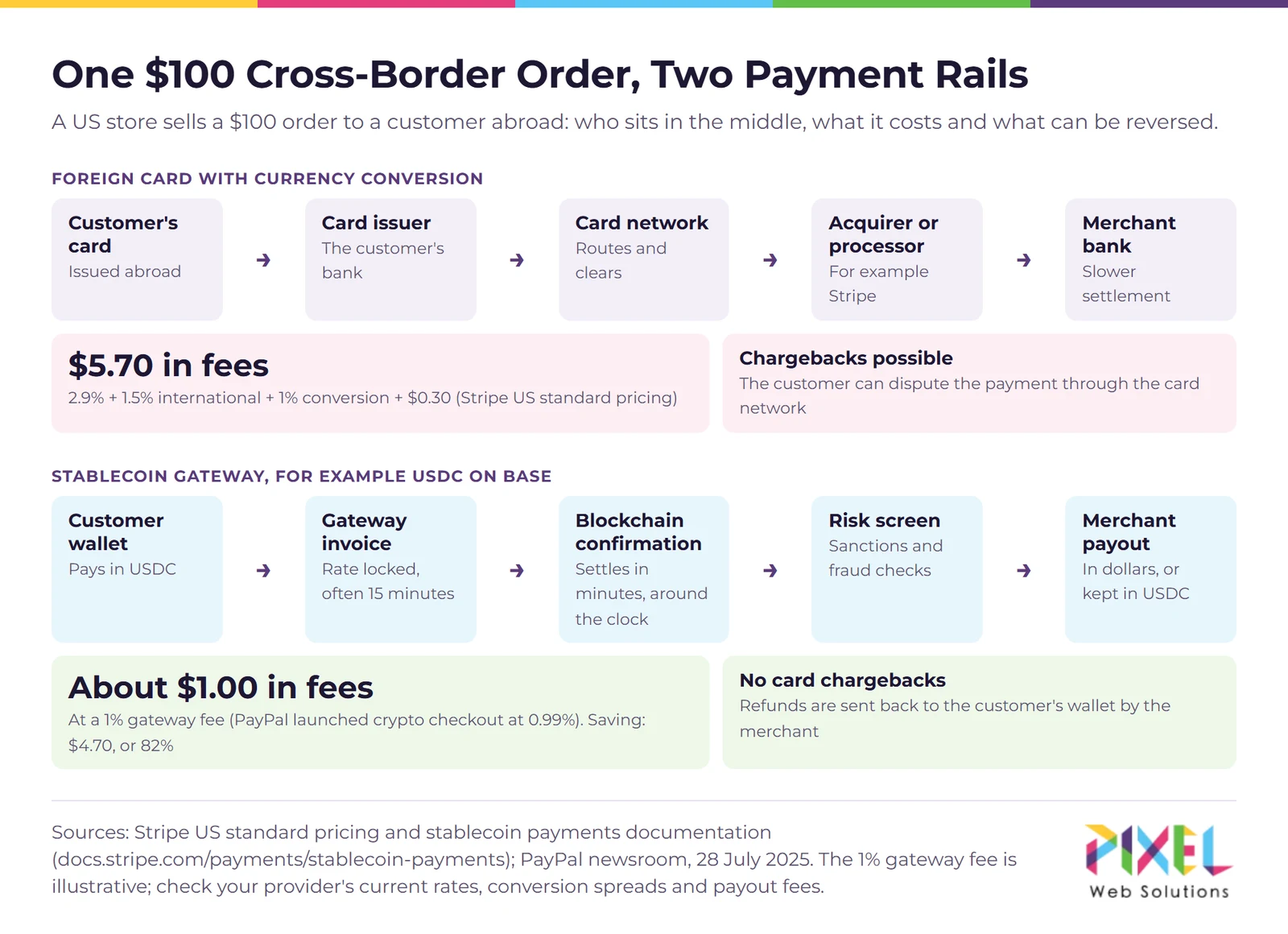
Cross-border card payments are expensive. A US merchant on Stripe's standard pricing pays 2.9% plus 30 cents for a domestic card, plus 1.5% for an international card and 1% more if currency conversion is needed. When PayPal launched "Pay with Crypto" in July 2025, it priced crypto checkout at 0.99% and said it could cut fees by up to 90% compared with international card processing. The saving is largest on cross-border sales.
No Card Chargebacks
Blockchain transactions cannot be reversed by a card network, so crypto payments do not carry card-style chargebacks. Stripe's documentation, for example, states that stablecoin payments have no disputes that turn into chargebacks. Merchants still need a clear refund policy, because refunds must be sent back to the customer's wallet by the merchant.
Global Reach
A customer anywhere with a wallet can pay, without the merchant opening local bank accounts or card acquiring in every country. Stablecoins also remove most currency conversion friction, since USDC and USDT are dollar-denominated everywhere.
Secure Transactions
Blockchain payments are signed by the customer's wallet and recorded on a public ledger, so the merchant never handles card numbers and there is no card data to steal. The trade-off is that mistakes and scams are also irreversible, so good gateways add address validation, sanctions screening and fraud monitoring.
Strengthen Your Brand
Offering crypto payments signals that a business is open to innovation, and it reaches a customer base that prefers to spend digital assets. Travel platform Travala, for example, has built its whole business around this audience.
Integrating a crypto payment gateway opens up a wide range of possibilities. But how does this play out in real industries?
Before diving into the specific use cases, if you're considering adding crypto payments to an existing store or app, check out our guide to crypto payment gateway integration for the setup options.
Crypto Payment Adoption in 2026: The Numbers
Before the use cases, here is where the market stands. There is no reliable public figure for the "crypto payment gateway market" as a whole, so these are the best available primary measures of real usage:
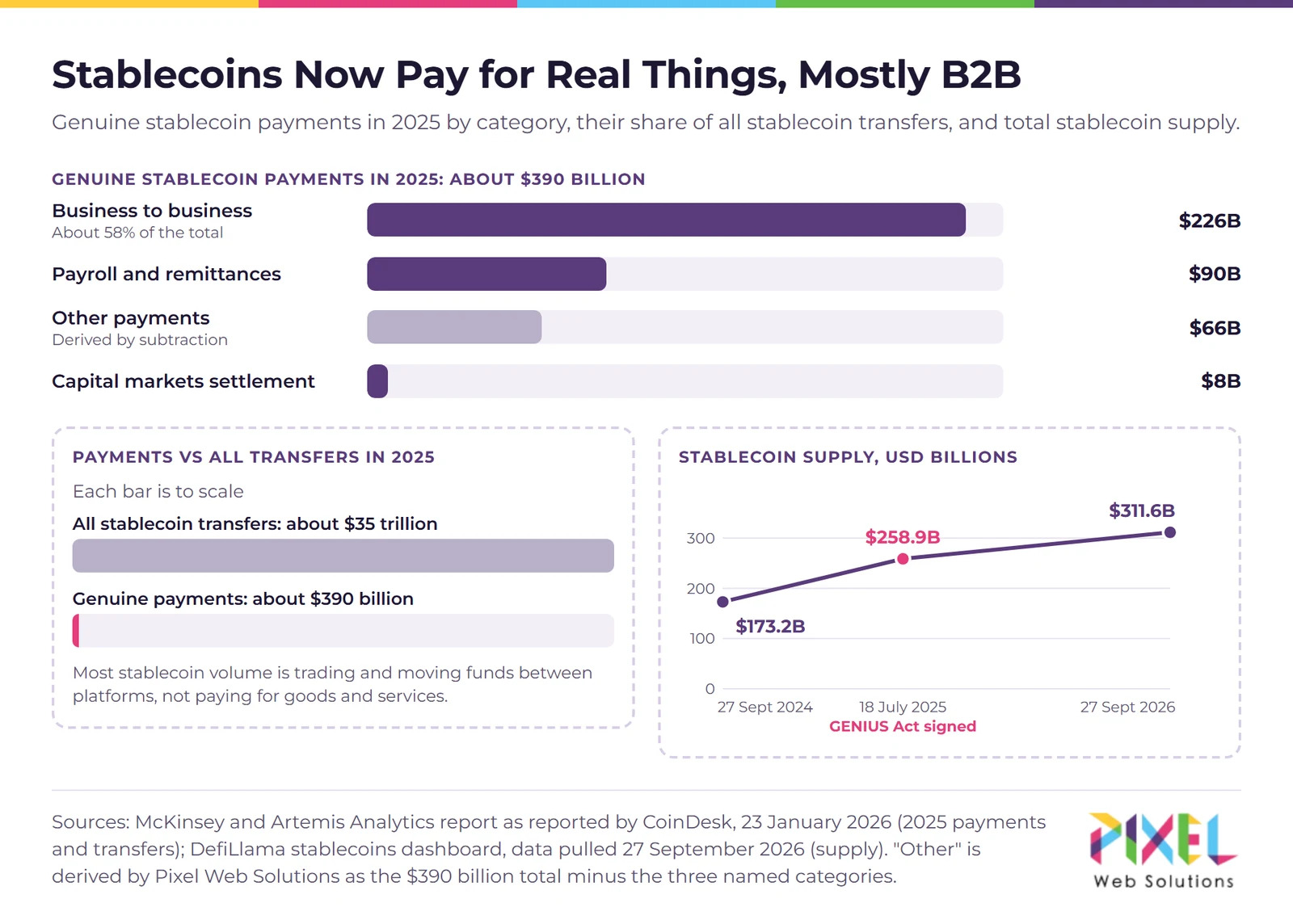
- Stablecoin supply: DefiLlama's stablecoin dashboard showed $311.6 billion on 27 September 2026, up from $258.9 billion on the day the GENIUS Act was signed (18 July 2025) and $173.2 billion on 27 September 2024. USDT ($183.8 billion) and USDC ($75.3 billion) dominate.
- Real payments, not trading: stablecoins moved about $35 trillion in 2025, but only about $390 billion of it was genuine payments, according to a McKinsey and Artemis report covered by CoinDesk. Of that, $226 billion was B2B, $90 billion payroll and remittances, and $8 billion capital markets settlement.
- Stripe: Bridge, the stablecoin company Stripe acquired, saw volume more than quadruple in 2025.
- Visa: stablecoin settlement grew from a $3.5 billion annualized run rate at 30 November 2025, when Visa launched USDC settlement in the United States, to more than $20 billion in September 2026, with more than 160 stablecoin-linked card programs live.
- BitPay: stablecoins now make up 40% of BitPay's transaction volume, and payouts grew to 19% of its transactions in 2025.
The pattern is clear: payments that cross borders or pay many people at once are growing fastest. Let's explore the top 8 use cases of crypto payment gateways.
Top 8 Use Cases Of Crypto Payment Gateways
E-Commerce
E-commerce was the first home of crypto payments, and in 2025 it went mainstream. Online stores add crypto checkout to reach international shoppers and crypto holders, cut cross-border card fees and remove chargeback fraud. Settlement in stablecoins also means the merchant is not exposed to bitcoin's price swings.
Example: Shopify partnered with Coinbase and Stripe in June 2025 to let merchants accept USDC on the Base network through Shopify Payments. Merchants receive their local currency by default, with no foreign transaction or exchange fees, or can claim USDC directly to their own wallet.
Charity & Donations
Crypto donations let donors give directly from their wallets, and many nonprofits now accept them through specialist gateways. Donors can give across borders within minutes, and the gift is traceable on-chain, which builds trust. Some donors give without sharing their name, although nonprofits still screen payments for sanctions and fraud. Crypto gifts also tend to be large: The Giving Block's 2026 annual report says it processed more than $100 million in crypto donations in 2025, with an average gift of $11,019 across more than 22,000 donations.
Example: Save the Children accepts bitcoin, ether, USDC and more than 100 other cryptocurrencies through The Giving Block and Gemini. It became the first international NGO to accept a bitcoin donation, in 2013, after Typhoon Haiyan.
Cross-Border Payments
Cross-border payments are the strongest use case for crypto payment gateways. International transfers through banks pass through several intermediaries, carry FX spreads and can take days. The World Bank's Remittance Prices Worldwide report puts the global average cost of sending $200 at 6.36% in Q3 2025, and 14.99% when sent through banks. Stablecoins settle in minutes, around the clock, at a fraction of that cost before off-ramp fees.
Example: SpaceX partnered with Bridge, now part of Stripe, to accept Starlink payments in various currencies and convert them instantly into stablecoins for its global treasury, which helps in markets where moving dollars through banks is slow or expensive.
Gaming
Gaming and crypto have grown up together. Gateways let players buy games, in-game items and subscriptions with digital currencies, which matters in regions where card acceptance is low. Game studios use them to reach those players without integrating dozens of local payment methods. Play-to-earn games also use gateways to let players cash out rewards, although that model shrank sharply after 2022.
Example: Xsolla, a payments and commerce platform for game developers, integrated Crypto.com Pay into its Pay Station, so players can pay for in-game purchases with crypto in the 200+ regions Pay Station serves. Big Fish Games was an early mover: in 2014 it partnered with Coinbase to accept bitcoin, citing card transaction fees that took about 8% of its gross revenue.
Travel & Hospitality
Travel is a natural fit because customers are cross-border by definition and booking values are high. Crypto payment gateways let travelers pay for flights, hotels and experiences without currency conversion or foreign transaction fees, and let travel companies reach a global, crypto-holding audience.
Example: Travala lets users book more than 2.2 million properties, 600+ airlines and 400,000+ activities with over 100 cryptocurrencies. It reported record gross revenue of more than $113 million in 2025 and added car rentals in February 2026. In February 2025, Trivago also integrated Travala to offer hotel bookings in crypto.
Luxury Brands
Luxury is one of the fastest-growing use cases because ticket sizes are high and buyers often hold significant digital assets. Card payments for a $300,000 car are impractical, and wires are slow, so a gateway that converts crypto to fiat instantly suits both sides. BitPay says merchants in luxury retail, automotive and real estate saw a 10% to 65% increase in stablecoin-driven purchases through 2025.
Example: Ferrari began accepting bitcoin, ether and USDC through BitPay in the US in October 2023 and extended crypto payments to its European dealers in July 2024, with BitPay converting payments to fiat so dealers avoid price risk. Gucci started accepting crypto in selected US stores in 2022, also through BitPay.
Payroll and Contractor Payouts
Paying people is now one of the biggest uses of crypto payment infrastructure. Payroll and remittances made up about $90 billion of real stablecoin payments in 2025. Companies with contractors in many countries use stablecoin payouts to pay faster and more cheaply than international wires, and workers in high-inflation countries gain access to dollar-denominated balances.
Example: Payroll platform Deel, which serves 40,000+ businesses and 1.5 million workers, launched a stablecoin wallet with Stripe on 3 June 2026. Contractors, starting in Argentina, can hold, earn on and spend DLUSD, a dollar balance issued through Stripe's Bridge and settled on the Tempo blockchain.
Real Estate
Real estate buyers can now pay for property with crypto through licensed title and escrow companies, which cuts cross-border friction for international buyers. Gateways and escrow platforms convert funds, handle compliance and record the transfer. Crypto payment is one step; tokenized ownership is a related but separate market.
Example: Propy runs on-chain real estate closings that accept both fiat and crypto, and in 2025 to 2026 it began acquiring traditional title and escrow firms to bring more closings on-chain. For fractional property investment, see our comparison of the best real estate tokenization platforms.
3 Emerging Use Cases of Crypto Payment Gateways in 2026
Beyond the core eight, three newer use cases are growing quickly. They are earlier in adoption, so treat the numbers with care.
Subscriptions and SaaS Billing
Software and media companies can now bill subscriptions in stablecoins. This helps them serve customers in countries where international card payments fail often. Stripe Billing, for example, supports recurring stablecoin payments, and completed payments settle in the merchant's Stripe balance in local currency. Stripe caps customer stablecoin payments at US$10,000 per transaction, so very large invoices still need another route.
Card Settlement and Stablecoin-Linked Cards
Some of the fastest growth is invisible to shoppers. Visa lets banks and card issuers settle their obligations in USDC, seven days a week, and more than 160 stablecoin-linked card programs were live in 2026. For a gateway business, this means stablecoins can power both the customer side (paying) and the back end (settling with card networks and banks).
AI Agent Payments
New protocols let software agents pay for APIs and data per request in stablecoins. The best known is x402, backed by Coinbase, which uses the HTTP 402 "Payment Required" code. Real usage is still small: in March 2026, CoinDesk reported about $28,000 a day across 131,000 transactions, averaging about $0.20 each, and analysts judged roughly half of it artificial. It is a use case to prototype, not to bet a business on yet.
Which Use Case Fits Your Business? A Fee and Fit Scorecard
Crypto payments do not save every business money. The value depends on ticket size, how much of your volume crosses borders, and how exposed you are to chargebacks. Here is how the use cases compare:
| Use case | Typical ticket | Cross-border share | Chargeback exposure today | Best settlement asset | Payoff potential |
|---|---|---|---|---|---|
| Cross-border B2B payments | Very high | Very high | Low | USDC or USDT, converted to fiat | High |
| Payroll and contractor payouts | Medium, very frequent | Very high | None | Stablecoins | High |
| Luxury and automotive | Very high | Medium | High | Instant fiat conversion | High |
| Travel and hospitality | High | Very high | High | Stablecoins or instant fiat | High |
| Real estate | Very high | Medium | Low | Fiat via licensed escrow | Medium |
| Charity and donations | High for crypto donors | High | Low | Hold or convert per policy | Medium |
| E-commerce (international) | Low to medium | Medium | High | Stablecoins | Medium |
| Gaming | Low | High | High | Stablecoins | Medium |
| E-commerce (domestic only) | Low | Low | Medium | Fiat | Low |
| AI agent payments | Tiny (cents) | High | None | Stablecoins | Early stage |
Worked example 1: an international online sale. A US store sells a $100 order to a customer paying with a foreign card that needs currency conversion. At Stripe's standard US rates, the fee is 2.9% + 1.5% + 1% + $0.30 = $5.70. The same order through a stablecoin gateway at a 1% fee costs $1.00, a saving of $4.70, or 82%. On $300,000 a year of international sales at $100 per order, cards cost $17,100. If 10% of those customers switch to stablecoins, the store saves $1,410 a year. The lesson: per-order savings are large, but total savings depend on how many of your customers actually pay in crypto.
Worked example 2: contractor payouts. A platform pays 1,000 contractors abroad $200 each per month. At the World Bank's global average remittance cost of 6.36%, that is $12.72 per payout, or $12,720 a month. Sent through banks at 14.99%, it would be $29,980 a month. If a stablecoin payout costs 1% all in, including the contractor's cash-out, the monthly cost is $2,000, saving $10,720 a month compared with the average. The 1% all-in figure is an assumption; real off-ramp costs vary by country, so test it in your own corridors.
Those two examples explain why payouts and cross-border B2B lead the data, while domestic retail lags.
How to choose the Best Crypto Payment Gateway?
Choosing the best crypto payment gateway takes research. Here's a checklist of what to compare:
- Coins and networks. Make sure it supports the stablecoins your customers hold, such as USDC and USDT, on the networks they use, such as Ethereum, Base, Solana, Polygon and Tron. Otherwise you may need several providers.
- Settlement and conversion. Check whether you can settle in fiat, in stablecoins or split between them, how fast payouts arrive, and what conversion spread you pay on top of the headline fee.
- Fees in full. Compare the processing fee, network fees, conversion spreads and payout fees. Promotional rates often expire; PayPal's 0.99% launch rate, for example, was set to run until 31 July 2026.
- Licensing and compliance. Confirm the provider is licensed where you operate (for example as a money transmitter in the US), runs KYC and sanctions screening, and plans for GENIUS Act requirements.
- Refunds and disputes. Crypto payments have no card chargebacks, but you still need a refund flow and a way to handle underpayments, overpayments and payments to the wrong network.
- Security. Look for cold storage or qualified custody for held balances, address validation, fraud monitoring and a clear incident history.
- Customization and integration. Your customers shouldn't feel they are paying on another platform. Check for white-label checkout, plugins for your store platform and a well-documented API.
- Limits and restrictions. Some platforms cap transaction sizes, restrict certain countries or require complex verification. Stripe, for instance, caps stablecoin payments at $10,000 per transaction.
What the GENIUS Act Means for Crypto Payment Gateways
The US GENIUS Act was signed into law on 18 July 2025. It creates a federal framework for payment stablecoins, with licensed issuers and full reserve backing. The law takes effect on the earlier of 18 January 2027 or 120 days after regulators publish final rules. The OCC released its proposed rules in February 2026 and was aiming for a final rule by November 2026, while the Treasury published a separate proposal on 18 August 2026. For gateways and merchants, the practical steps are to favour stablecoins from issuers that will qualify, keep sanctions screening in place, and design for regulated off-ramps.
But choosing the right crypto payment gateway is only half the equation. Why adapt to a provider's limits? Instead of accepting a third party's coins, fees and restrictions, businesses can build their own custom crypto payment gateway, and that opens up new opportunities.
With your own gateway, you can also offer payment processing as a service to other businesses and earn transaction fees as a new revenue stream. Instead of relying on a provider, you become the provider. Costs vary with features, security requirements and integrations; Pixel Web Solutions builds crypto payment gateways from $6,000, and our breakdown of the cost to develop a crypto payment gateway gives a full estimate. If your focus is business payouts and treasury, see the cost to build B2B stablecoin payments infrastructure as well.
How can you Smartly Position Yourself?
With all these use cases of crypto payment gateways, one thing is clear: crypto payments are not slowing down. They are becoming part of mainstream payment stacks, led by stablecoins. That creates two ways to benefit. You can accept crypto payments to cut costs and reach new customers, or you can build your own gateway and sell it as a service.
Building your own gives you control over which coins and networks you support, how you settle, what you charge and how the checkout looks. If you are new to the underlying assets, start with our explainer on what stablecoins are and how they work. If you want a proven model, our guide on building a crypto payment gateway like BitPay shows how an established processor is structured.
If you're considering building a robust crypto payment gateway, partner with a professional crypto payment gateway development company like Pixel Web Solutions. Founded in 2012, Pixel delivers multi-coin, stablecoin-ready gateways with fiat settlement, merchant dashboards, compliance tooling and white-label checkout, starting from $6,000.
Talk to our payments team to plan your crypto payment gateway.
Frequently Asked Questions
What is a crypto payment gateway?
A crypto payment gateway is software that lets a business accept payments in cryptocurrencies or stablecoins and, usually, receive the money in its own currency. It creates payment requests, watches the blockchain for confirmation, screens for risk and settles funds to the merchant.
What are the main use cases of crypto payment gateways?
The main use cases are cross-border B2B payments, payroll and contractor payouts, e-commerce, luxury and automotive sales, travel bookings, donations, gaming and real estate. Emerging use cases include stablecoin subscriptions, card settlement and payments by AI agents.
What are the top commercial benefits of implementing crypto payment gateways?
The biggest benefits are lower fees on cross-border sales, no card chargebacks, faster settlement (minutes rather than days for international transfers), access to customers who hold crypto, and 24/7 payments. The benefits are smallest for domestic, low-value retail.
What are the top use cases for crypto payments in e-commerce?
Selling to international customers without cross-border card fees, selling high-value goods where chargeback fraud is costly, and reaching crypto-holding customers. Shopify's USDC checkout with Coinbase and Stripe, launched in June 2025, is the largest mainstream example.
Why should businesses use a crypto payment gateway?
Businesses use one to accept crypto without managing wallets, blockchain monitoring, conversion and compliance themselves. A gateway handles those tasks and settles in fiat, so the business avoids price volatility.
How much does a crypto payment gateway charge?
Processing fees for crypto checkout are commonly around 1%, compared with 2.9% plus 30 cents for a domestic US card on Stripe's standard pricing and more for international cards. Always check conversion spreads, network fees and payout fees as well, and whether a quoted rate is promotional.
How big is the crypto payment gateway market?
There is no reliable single figure for gateways as a category. The best primary indicators are stablecoin supply ($311.6 billion on 27 September 2026, per DefiLlama), genuine stablecoin payments (about $390 billion in 2025, per McKinsey and Artemis) and Visa's stablecoin settlement run rate (more than $20 billion in September 2026).
Are crypto payments legal for businesses?
In many countries, yes, but rules differ. In the US, the GENIUS Act sets federal rules for payment stablecoins and takes effect no later than 18 January 2027. Businesses should use a licensed gateway or get legal advice for their own jurisdiction, including on tax treatment.
The future of payments is being rebuilt on stablecoins. The question is: "Will you just be another user, or will you lead the way?" Pixel Web Solutions can help you turn the use cases of crypto payment gateways into a working product, from a simple checkout to a full payment processing business.