








Table of Contents
Last updated: 16 October 2026 | Reviewed by Mathibharathi Mariselvan, Co-founder, Pixel Web Solutions | 13 min read
A CoinPayments clone script is pre-built crypto payment gateway software that replicates CoinPayments' multi-coin model: merchants accept dozens of cryptocurrencies through plugins and APIs, hold them in built-in wallets, convert between them and pay out in batches. CoinPayments itself has processed $50 billion for more than 250,000 merchants since 2013 and now runs a rebuilt platform with 40+ supported assets, so a 2026 CoinPayments clone script has to combine a wide coin integration layer with wallet security and e-commerce plugins. Pixel Web Solutions delivers a crypto payment gateway from $6,000.
Startups that want a crypto payment gateway business usually hit the same wall: integrating many blockchains, securing wallets and shipping plugins for every store platform is slow when done from zero. A CoinPayments-style clone solves that by starting from a tested multi-coin stack. This guide explains what CoinPayments offers in 2026, the features and working process of a clone, what the multi-coin stack includes, revenue, cost, regulation and how to choose a provider. The companion guide on the BitPay clone script covers merchant invoicing, fiat settlement and compliance in depth, so this post stays on coins, wallets and plugins.
Key Takeaways
- CoinPayments in 2026: 40+ cryptocurrencies accepted on its new platform, 250,000+ merchants, 1 million+ wallet users and $50 billion processed, with MPC-backed node infrastructure and a Telegram payment bot.
- CoinPayments' published fee on its fees page starts at 3% per payment, discounted by monthly volume, with personal wallet deposits free up to $15,000 a month; a clone can undercut that because it carries no legacy cost base.
- The hard part of the script is the coin integration layer: every chain family (UTXO, account-based, token standards) needs its own address generation, listener, fee logic and confirmation rules.
- Pixel's published price: crypto payment gateway development from $6,000, rising with each extra chain family, wallet tier and plugin.
- Revenue is per-transaction and recurring: processing fees, conversion margin, merchant plans and premium API tiers, shown in the worked example below.
What Is a CoinPayments Clone Script?
A CoinPayments clone script is pre-built cryptocurrency payment gateway software that resembles the core features and functionality of the CoinPayments platform. It lets startups, enterprises and merchants launch a multi-crypto payment gateway of their own without designing the infrastructure, wallets, APIs and security standards from scratch. The script is customisable and rebrandable, deploys quickly, and gives the operator control over brand, features and fees.
In 2026 the term covers a specific product shape: a gateway that accepts many coins and tokens, gives merchants and users hosted wallets with conversion, ships plugins for WooCommerce, Shopify, Magento, PrestaShop and OpenCart, and pays merchants out in batches to cut network fees. Compare that with a BitPay-style gateway, which is built around invoices and fiat settlement; the two models share a ledger but differ in where the engineering effort goes.
CoinPayments in 2026: Coins, Fees and Scale
The original sets the benchmark. As of October 2026, CoinPayments' site describes enterprise-grade crypto payment processing with 40+ cryptocurrencies accepted for payments on its rebuilt platform, 14 years of experience, 1 million+ wallet users, $50 billion in processed volume and 250,000+ merchants worldwide. The platform highlights multi-user account delegation, MPC-backed node infrastructure for signing, blockchain intelligence and risk screening, instant transaction verification, fiat conversion for bank payout where supported, multisig custody for enterprises, integrations with e-commerce, accounting and POS systems, and a Telegram payment bot.
Fees changed with the rebuild. CoinPayments' fees page now lists a payment processing fee starting at 3% for coins and 3% for tokens, with the same 3% applied whether a payment goes to balance, is paid out per transaction (ASAP mode, one network fee each) or batched nightly (one network fee for the whole batch). Personal wallet deposits are free for the first $15,000 a month and 3% after that, withdrawals cost only the network fee, and conversions carry a conversion partner fee plus the network fee. High-volume merchants are offered discounted rates by sales. The older 0.5% coin and 1% token rates still quoted on third-party review sites belong to the legacy platform.
Two lessons follow for a clone. First, the headline coin count matters less than it did: CoinPayments trimmed from more than a thousand legacy assets to a curated 40+ on the new platform, because every extra chain is a maintenance and risk cost. Second, batching payouts and MPC signing are now table stakes, not differentiators.
Features Integrated into a CoinPayments Clone Script
A CoinPayments clone offers separate dashboards for users, merchants and admins, each with its own features and security controls.
User dashboard
- Multi-crypto wallet: one account holds many coins and tokens, with per-network deposit addresses.
- Mobile app support: Android and iOS apps with the same wallet and payment features.
- Customer support: tickets and disputes raised from the dashboard.
- Payment invoices: digital records of every payment made and received.
- QR code scanner: scan-to-pay from the app.
- Currency conversion: convert between supported cryptocurrencies (and to fiat where the operator has a conversion partner) within the wallet.
Merchant dashboard
- Mass payouts: send many payments in one batch to cut network fees.
- API and IPN integration: REST API plus instant payment notifications (webhooks) for stores and custom systems.
- Plugins: WooCommerce, Shopify, Magento, PrestaShop, OpenCart and hosted checkout buttons.
- Recurring payments: subscription billing in crypto.
- Customer management: view payer activity and payment history.
- Payout management: schedule and automate withdrawals to external wallets or, through a partner, to bank accounts.
Admin dashboard
- Revenue reports: fees, conversion margin, user activity and other financial metrics.
- Coin management: enable or disable assets, set confirmation thresholds and fee rules per network.
- Dispute resolution: review tickets and resolve them with evidence.
- Merchant management: monitor merchant activity, engagement and payments; set per-merchant fee tiers.
- User activity and risk monitoring: flag unusual patterns before they become losses.
Security features
- Anti-phishing protection: anti-phishing codes and login alerts.
- KYC and AML compliance: identity verification and screening tools for users and merchants.
- Multi-signature and MPC wallets: split signing for treasury and large payouts.
- Two-factor authentication: for every user, merchant and admin login.
- Hot and cold wallet management: most funds offline, operational float online.
These are the commonly pre-built features of a CoinPayments clone. Operators then add features for their market: a Telegram payment bot, fiat conversion partners, POS hardware integrations or a merchant mobile app. Pixel's white-label crypto payment gateway ships the base set and adds modules per client.
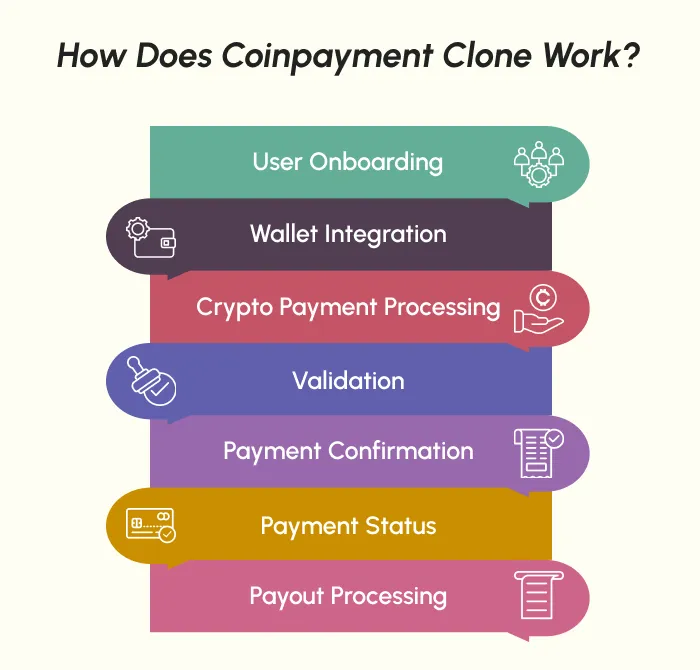
How Does a CoinPayments Clone Work?
The working process is the same for every merchant and user, which is what makes the model scale.
-
User onboarding: a new user or merchant creates an account, completes identity (or business) verification, and is approved by the admin or an automated risk rule.
-
Wallet setup: the platform generates deposit addresses on each enabled network for the account, and users can also connect external wallets for payouts.
-
Crypto payment processing: when a customer pays, the system generates a unique payment address (or an invoice on account-based chains) for that payment, locks the rate, and watches the blockchain for the incoming transaction.
-
Validation: the gateway validates the payment by counting block confirmations against the threshold configured for that network and checks the amount and token against the invoice.
-
Payment confirmation: the payment moves from pending to processing on both the user and merchant dashboards, and the IPN webhook notifies the merchant's store so the order can be fulfilled.
-
Payment status: once the required confirmations arrive, the status becomes complete and the funds are credited to the merchant's wallet balance.
-
Payout processing: merchants withdraw to external wallets or convert through a partner, and the gateway batches outgoing transactions to optimise network fees, the same technique CoinPayments markets as saving up to 90% on withdrawal fees.
Pixel's guide on how to start a crypto payment gateway like CoinPayments walks through building this flow from requirements to launch.
What a CoinPayments Clone Script Includes: The Multi-Coin Stack
The difference between a gateway that supports five coins and one that supports fifty is architecture, not configuration. A serious CoinPayments clone script includes:
| Layer | Components | Notes |
|---|---|---|
| Coin integration layer | Per-chain-family adapters: UTXO (BTC, LTC, DOGE, BCH), account-based (ETH, BNB Chain, Polygon, Tron, Solana), token standards (ERC-20, BEP-20, TRC-20, SPL) | Each adapter handles address generation, balance tracking, fee estimation and transaction building |
| Listeners and indexers | Full nodes or node providers plus an indexer per chain | Confirmation thresholds and reorg handling set per network |
| Wallet infrastructure | Hot wallet for operations, warm wallet for payouts, cold storage for reserves; MPC or multisig signing | Key ceremony and recovery procedures documented |
| Payment and invoice service | Payment addresses, rate lock, under and overpayment handling | Shared with the BitPay model |
| Plugins and SDKs | Store plugins, hosted checkout, payment buttons, IPN/webhooks, mobile SDKs | Plugin maintenance is an ongoing cost |
| Conversion engine | Internal swaps between supported assets and optional fiat conversion partners | Spread is a revenue line |
| Admin and compliance | Coin management, fee rules, KYC/AML, risk screening, reports | Required for licensing |
Adding a new coin: the checklist
Operators underestimate what a "new coin" costs. Each addition needs: a node or provider endpoint, an adapter for the chain family, address derivation and validation, a listener with confirmation rules, fee estimation, a withdrawal builder, wallet sweeping to cold storage, monitoring, and a plugin update so merchants can enable it. Token additions on an already-supported chain are cheap; new chain families are not. That is why CoinPayments consolidated its list, and why a clone should launch with the assets merchants use (BTC, ETH, USDT and USDC on several networks, SOL, LTC, BNB, TRX) and add the rest on demand.
How a CoinPayments Clone Benefits Startups
Cost-effective solution
The clone is largely built already, so the budget goes to customisation, partners and compliance rather than core engineering. Pixel's analysis of the cost to develop a crypto payment gateway shows where the money goes by module.
Customisable revenue streams
Transaction fees, conversion margin, merchant subscription plans and API tiers are configurable from the admin panel, with real-time revenue analytics.
Easy to deploy
The hardest part of a payment gateway is the chain integrations. With those in place, deployment is branding, configuration and partner onboarding.
Less time consuming
Starting from a clone shortens the path to a live product to weeks, which matters in a market where licensed processors are still scarce in many regions.
Proven business model
CoinPayments has run the multi-coin merchant model since 2013 and has processed $50 billion, so a clone copies a model that merchants already understand, and the operator can fix the known weak points (support response times, wrong-network deposits) with better tooling.
What's New in a 2026 CoinPayments Clone Script
More than a replica, a 2026 clone upgrades the infrastructure to current standards.
Quick transaction verification
Intelligent confirmation monitoring shows incoming payments within seconds and confirms them as soon as the per-network threshold is met, which cuts settlement delays and support tickets.
MPC-backed node and signing infrastructure
Multi-party computation distributes signing across several secure nodes, so no single server holds a complete private key. This mirrors the MPC-backed infrastructure CoinPayments adopted on its new platform and reduces the risk of a single point of failure.
Blockchain intelligence and risk screening
Wallet screening against sanctions and illicit-activity datasets runs at deposit and payout, which regulators under MiCA and VARA expect.
Batched payouts and fee optimisation
Nightly batching and fee estimation per chain keep withdrawal costs low for merchants and the operator.
Get a CoinPayments Clone Script Demo
Experiencing the gateway before launch matters. Pixel Web Solutions offers a CoinPayments clone script demo that shows a live multi-currency crypto payment gateway from both the user and admin sides.
What You’ll Get In This CoinPayments Clone DEMO?!
- View a full-featured user dashboard with transaction history
- Test multi-currency acceptance with real-time conversion flow
- Witness a secure checkout experience for end users
- Monitor real-time transactions, status, and tracking
- Check API connectivity for seamless site integration
The demo lets a founder assess performance, usability and scalability before deployment, from multi-coin acceptance and real-time conversion to the merchant checkout and admin reports. Request a live demo to see how a CoinPayments-like crypto payment gateway feels for merchants and users.
Comparison: Build From Scratch vs CoinPayments Clone Script
| Factors | Scratch development | Clone script |
|---|---|---|
| Development time | 9 to 12 months for a multi-coin gateway | Weeks to a few months |
| Development cost | High; every chain adapter built from zero | From $6,000 at Pixel Web Solutions, rising with scope |
| Technical risk | High; untested wallet and listener code | Low; tested adapters and wallet flows |
| Time to market | Delayed | Rapid |
| Scalability | Fully customisable but resource intensive | Modular architecture, new chains added as adapters |
A custom gateway can look attractive, but it delays revenue by most of a year and requires a specialised team. The clone is developed, tested and scalable software that launches within weeks, so the operator can focus on merchants, partnerships and compliance. Pixel's guide on how to create a crypto payment gateway covers the from-scratch route for teams that need it.
Revenue Features Integrated in a CoinPayments Clone
- Transaction fees: a percentage of every payment processed.
- Merchant subscription plans: Basic, Pro and Enterprise tiers for predictable monthly revenue.
- Currency conversion margin: a spread on crypto-to-crypto and crypto-to-fiat conversions.
- Withdrawal and settlement fees: optional fees on instant payouts.
- Premium API access: higher rate limits and advanced features for enterprise merchants.
- Settlement acceleration fees: a premium for instant rather than batched payouts.
A worked example
Take a gateway with 1,000 active merchants averaging $5,000 of crypto payments a month ($5 million of monthly volume), a 1% processing fee set deliberately below CoinPayments' 3% starting rate, and a 0.5% spread on the 40% of volume that merchants convert.
- Processing fees: $5,000,000 multiplied by 1% = $50,000 a month
- Conversion margin: $2,000,000 multiplied by 0.5% = $10,000 a month
- Merchant plans: 200 merchants on a $29 Pro plan = $5,800 a month
- Gross revenue: about $65,800 a month, before node, partner, compliance and support costs
The model shows why coin breadth and conversion matter: the fee rate can stay low if the gateway earns on conversion and plans.
Technology Stack of a CoinPayments Clone
Server side: Laravel or Node.js, NGINX or Apache
Front end: Vue.js, React.js or Angular, Tailwind CSS
Database: MySQL or PostgreSQL, Redis for caching and queues
Blockchain infrastructure and node connectivity: Bitcoin Core and other UTXO nodes, Ethereum, Tron and Polygon nodes or providers (Infura and equivalents), TronWeb, Solana RPC, Solidity for any contract work
Security: MPC or multisig signing, HSM-backed key storage, DDoS protection and monitoring
CoinPayments Clone Script Cost in 2026
Pixel Web Solutions prices crypto payment gateway development from $6,000 for a rebranded gateway with the core chain families, wallets, dashboards and standard plugins. The budget rises with additional chain families, fiat conversion partners, mobile apps, compliance integrations and custom plugins. Running costs include node providers, screening vendors, support staff and plugin maintenance for each store platform.
Regulation for a Multi-Coin Gateway
A gateway that holds customer crypto in wallets is a custodian as well as a processor, which brings it inside most licensing regimes. In the EU, MiCA has required CASP authorisation for custody and exchange services since 1 July 2026 (see ESMA's MiCA page); in Dubai the VARA rulebooks cover custody and exchange; in the United States money transmission registration and state licences apply, and the GENIUS Act governs the payment stablecoins merchants want to accept. The clone script should ship KYC/AML, sanctions screening and reporting so the operator can apply for the licence with the product already compliant.
Why Do Businesses Trust Pixel Web Solutions for a CoinPayments Clone?
Pixel Web Solutions is a crypto payment gateway development company with 12+ years in the crypto field, operating from Ras Al Khaimah, UAE and Madurai, India. Its developers, analysts and testers guide clients through building a crypto payment gateway like CoinPayments, and the CoinPayments clone script is customisable, secure and scalable. Pixel also provides white-label crypto payment gateway solutions for operators that want the fastest route to market. To book a demo or scope a build, contact the Pixel Web Solutions team.
Frequently Asked Questions
What is a CoinPayments clone?
A CoinPayments clone is pre-built, tested crypto payment gateway software that resembles the features of the CoinPayments platform: multi-coin acceptance, built-in wallets, e-commerce plugins and batched payouts. It can be extended with add-on features, stronger security and a custom interface.
What are the revenue streams of a CoinPayments clone?
Transaction fees, conversion margin, merchant subscription plans, premium API access and settlement or withdrawal fees. Operators tune the mix in the admin panel.
How many cryptocurrencies should a CoinPayments clone support?
Launch with the assets merchants actually use (BTC, ETH, USDT and USDC on several networks, SOL, LTC, BNB and TRX) and add more on demand. CoinPayments itself lists 40+ assets on its new platform after trimming a much longer legacy list.
How much does a CoinPayments clone script cost?
Pixel Web Solutions prices crypto payment gateway development from $6,000. Extra chain families, fiat conversion partners, mobile apps and compliance integrations raise the budget.
Does a CoinPayments clone need a licence?
Usually yes, because it custodies customer funds. EU operators need MiCA authorisation, Dubai operators need a VARA licence, and US operators need money transmission registration and state licences.
What is the difference between a CoinPayments clone and a BitPay clone?
A CoinPayments clone centres on multi-coin acceptance, wallets and plugins for merchants that hold crypto. A BitPay clone centres on invoicing, fiat settlement and compliance for merchants that want local currency in the bank.
Disclaimer: Pixel Web Solutions is not associated with, sponsored by, or endorsed by any of the brands, companies, or platforms referenced. Its clone scripts are independently developed to emulate specific functionalities of the mentioned platforms and are intended as customizable solutions for entrepreneurs and developers. It is the sole responsibility of the user to ensure that any use, modification, deployment, or commercialization of these scripts complies with all applicable laws, regulations, and intellectual property rights in their respective jurisdictions.