A Uniswap clone script is a pre-built, audited decentralized exchange (DEX) codebase that replicates Uniswap's automated market maker model, so a startup can launch its own token-swap platform in weeks instead of months. In 2026 a serious Uniswap clone script has to match a protocol that clears about $80 billion of swaps a month across 46 chains, so the script must cover concentrated liquidity, v4-style hooks and a fee model that pays the platform, not only liquidity providers. Pixel Web Solutions supplies a standard AMM DEX from $7,500 and custom DEX builds from $40,000 to $120,000.
Decentralized exchanges now settle more spot volume than many mid-tier centralized exchanges, and Uniswap remains the reference design that founders point to when they brief a development team. This guide explains what the product is in 2026, how the original works under the hood, what a clone script should include, what it costs, which regulators care, and how to choose a provider.
Key Takeaways
- Uniswap is the benchmark, and the bar moved in 2026. DefiLlama shows Uniswap at about $3.9 billion in TVL and $79.8 billion in 30-day volume as of 15 October 2026, with v4 now matching v3 in monthly volume.
- The script must cover three generations of AMM design: constant-product pools (v2), concentrated liquidity (v3) and hooks on a singleton pool manager (v4).
- The protocol itself now earns. Uniswap's UNIfication vote switched on protocol fees in December 2025, so a clone should ship with a configurable protocol-fee share from day one.
- Pixel's published pricing: a standard AMM DEX from $7,500, a custom DEX from $40,000 to $120,000, plus audit and liquidity budgets that the script price never includes.
- Regulation is no longer optional. MiCA's transitional period ended on 1 July 2026, and Dubai's VARA rulebooks apply to any UAE-facing operator, so plan the legal wrapper with the code.
What Is a Uniswap Clone Script?
A Uniswap clone script is a ready-to-deploy set of smart contracts, a swap and liquidity front end, an indexer and an admin panel that together reproduce the core mechanics of Uniswap: permissionless pools, automated pricing, liquidity-provider (LP) rewards and governance. Startups buy the script instead of writing the protocol from scratch, then rebrand it, choose their chains and configure fees.
A 2026-grade script is wider than the 2021 scripts that copied Uniswap v2. It should include concentrated-liquidity pools, a routing engine that splits trades across pools, optional hook contracts in the style of Uniswap v4, and a protocol-fee switch. Many providers also bundle intent-based swaps inspired by UniswapX, where off-chain fillers compete to execute an order and the user is shielded from most MEV.
The main advantage is time and cost. A tested codebase cuts months of protocol engineering and lets the founder spend the budget on audits, liquidity and marketing instead. The trade-off is that the script owner depends on the provider for major upgrades, which is why the provider's track record matters as much as the feature list.
Uniswap in 2026: The Numbers a Clone Script Has to Live Up To
Before copying a model, it helps to know how big the original has become. According to DefiLlama's Uniswap dashboard, as of 15 October 2026 the protocol holds about $3.91 billion in total value locked across 46 chains, with Ethereum ($2.5 billion), Base ($471 million), BNB Chain ($236 million) and Robinhood Chain ($225 million) the largest deployments. Thirty-day swap volume is $79.8 billion, and all-time volume has passed $3.98 trillion.
The generational shift is visible in the same data. Uniswap v4, which launched in January 2025, recorded $39.7 billion of 30-day volume as of mid-October 2026, level with v3's $39.1 billion, while v2 has fallen to under $1 billion a month. The Uniswap Foundation reported more than 5,000 v4 hooks initialised and $62 billion of DEX volume on Unichain by September 2025.
Economics changed too. In December 2025 UNI holders passed the "UNIfication" proposal with 99.9% support, which activated protocol fees on v2 and selected v3 pools, set the Uniswap Labs interface fee to zero and burned 100 million UNI worth about $596 million. The lesson for a clone script owner is simple: the fee switch is now part of the reference model, so the script should let the platform take a share of swap fees without a contract upgrade.
How a DEX Like Uniswap Works
Decentralized exchanges run on smart contracts and liquidity pools rather than order books. Here is the flow from both sides of the platform.
The trader's perspective
- The trader connects a wallet such as MetaMask or a WalletConnect-compatible app. There is no account creation, and on a pure DEX there is no KYC.
- The trader selects a token pair and an amount. The router quotes a price from the pool reserves, applies the trader's slippage tolerance and executes the swap in one transaction.
- Liquidity providers deposit two tokens into a pool and receive LP positions (fungible LP tokens on v2-style pools, NFT positions on concentrated-liquidity pools). They earn a share of swap fees in proportion to the liquidity they supply inside the active price range.
- Governance token holders vote on fee tiers, incentive programmes and upgrades.
The platform owner's perspective
- The admin dashboard shows pool creation, volume, fees, wallet connections and new-user activity.
- The AMM formula prices every trade automatically, so the owner's levers are fee tiers, the protocol-fee share, listings on the default token list and incentive budgets.
- The owner monitors liquidity depth and price impact, pauses pools under attack, and schedules upgrades through a timelock or governance.
- Revenue arrives as the protocol-fee share of swap fees, plus optional listing, launchpad and premium-routing income.
The AMM maths, in one example
Uniswap v2 pools hold reserves x and y and keep x multiplied by y constant. Suppose a pool holds 100 ETH and 400,000 USDC. A trader who sells 1 ETH (after the 0.3% fee, 0.997 ETH enters the pool) receives 400,000 minus 40,000,000 divided by 100.997, which is about 3,948 USDC. The trader paid about 1.3% more than the spot price of 4,000 USDC, and that gap is price impact. Concentrated liquidity (v3 and v4) lets LPs place capital inside a narrow range, so the same pool can quote a far tighter price with the same money.
What Uniswap v4 adds: hooks
Uniswap v4 moved every pool into a single PoolManager contract and introduced hooks, which the Uniswap v4 documentation describes as external smart contracts attached to individual pools. A hook can run before or after pool initialisation, liquidity changes, swaps and donations, so a pool can carry its own logic for dynamic fees, limit orders, TWAMM orders, liquidity gating or loyalty rewards. A pool without a hook behaves like a v3 concentrated-liquidity pool. For a clone script, hooks are the difference between a copy of 2021 Uniswap and a platform that can launch a niche product (for example, a stablecoin pool with near-zero fees or an RWA pool that only whitelisted wallets can trade).
What a Uniswap Clone Script Includes in 2026
A complete package covers six layers:
- Core contracts: factory, pool manager, router, position manager and (optionally) a hook library.
- Fee and treasury contracts: fee tiers per pool, a protocol-fee switch, a fee collector and a timelock.
- Indexer and API: an event indexer (subgraph or custom) that feeds pool stats, charts and analytics.
- Front end: swap, pool, position, farm and governance pages, with multilingual support and wallet integrations.
- Admin panel: token lists, fee settings, incentive campaigns, monitoring and alerts.
- Deployment kit: scripts for Ethereum, Base, BNB Chain, Polygon, Arbitrum and other EVM chains, plus test suites and audit reports.
Pixel Web Solutions' white-label decentralized exchange software is delivered in this form, so founders can inspect the contracts and the audit before the rebrand starts.
Key Features of a Uniswap Clone Script
The script's features fall into two groups.
Core features
Automated market maker (AMM): token swaps priced by pool reserves, with no order book and no intermediaries.
Concentrated liquidity: LPs choose a price range, which raises capital efficiency and tightens quotes.
Price slippage controls: traders set a slippage tolerance and a deadline, so a volatile market or a sandwich attempt reverts the trade instead of filling at a bad price.
Multi-chain support: deployments on Ethereum, Base, BNB Chain, Polygon, Arbitrum and other EVM networks from one codebase.
Flash swaps: a contract can withdraw tokens from a pool, use them and repay (or pay the equivalent) within the same transaction, which enables arbitrage and collateral swaps.
Governance token: the platform can issue a token that votes on fees, incentives and upgrades.
Smart trade routing: the router splits a trade across several pools and hops to find the best net price.
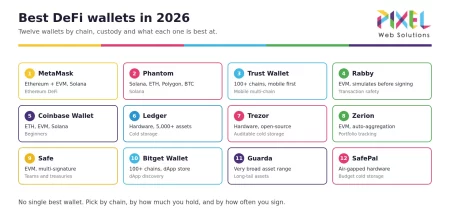
Wallet connect: MetaMask, Trust Wallet, Coinbase Wallet, Rabby and WalletConnect-compatible wallets.
Farming and liquidity tools: staking and yield-farming contracts that reward LPs and bootstrap new pools.
Customizable dashboard and UI: trader dashboards with watchlists and alerts, a branded interface and multilingual support.
Add-on features
Hook modules: dynamic fees, limit orders, TWAMM, whitelisted pools and loyalty rewards built as v4-style hooks.
DAO management: proposal creation, voting dashboards, quorum rules and on-chain execution.
Compliance-ready architecture: optional transaction monitoring, geo-blocking at the front end and permissioned pools for regulated assets, without changing the permissionless core.
Referral system: on-chain referral rewards and trading campaigns that acquire users without heavy ad spend.
Cross-chain swaps: bridge or intent-based routing so a user can swap across chains from one interface.
Mobile app: Android and iOS versions of the swap and pool experience.
Security Features of a Uniswap Clone
- Smart contract audits: third-party audits of the core and hook contracts before launch, and after every upgrade. Pixel's smart contract audit services cover this stage for clients who want an independent review.
- Admin access controls: two-factor authentication, role-based permissions and multisig control of the treasury and upgrade keys.
- Oracles and TWAP protection: manipulation-resistant price feeds for farms and any hook that reads prices.
- Reentrancy and overflow guards: standard protections in every contract, with test coverage reports.
- Front-end and infrastructure security: encrypted traffic, DDoS protection, monitored RPC endpoints and alerting on abnormal pool activity.
Architecture of a DEX Like Uniswap
| Layer | Components | What to check in a provider's script |
|---|---|---|
| Smart contracts | Factory, pool manager, router, position manager, fee collector, hooks | Audit reports, test coverage, upgrade path (proxy or redeploy) |
| Data | Event indexer, analytics database, price service | Sync speed, chart accuracy, support for new chains |
| Application | Web app, mobile app, admin panel, API | Wallet coverage, latency, accessibility, localisation |
| Infrastructure | RPC nodes, IPFS or CDN hosting, monitoring | Redundancy, costs per chain, incident alerts |
| Governance | Token, voting, timelock, treasury | Who can change fees and when, emergency pause rules |
Uniswap Clone Script Cost in 2026
Pixel Web Solutions publishes its pricing: a standard AMM DEX starts at $7,500, and a custom decentralized exchange with concentrated liquidity, hooks, cross-chain routing and a mobile app runs from $40,000 to $120,000. The full cost to build a decentralized exchange guide breaks every module down.
| Scope | Typical inclusions | Pixel Web Solutions price |
|---|---|---|
| Standard AMM DEX | v2-style pools, swap and pool UI, admin panel, one EVM chain | From $7,500 |
| Advanced clone | Concentrated liquidity, routing, farming, governance, 2 to 3 chains | $40,000 to $70,000 |
| Custom DEX | Hooks, intent-based swaps, cross-chain, mobile apps, custom tokenomics | $70,000 to $120,000 |
Budget separately for items the script price never covers: an independent audit (industry quotes commonly run from $10,000 for a small contract set upward), seed liquidity for the first pools (often the largest line item), RPC and indexing infrastructure, and legal advice in the launch jurisdictions.
A worked revenue example
Fees decide whether the platform is a business or a hobby. Take a DEX that reaches $1 million of daily volume across pools with an average 0.3% fee, and a protocol-fee share of one sixth of swap fees (the ratio Uniswap governance has used).
- Daily swap fees: $1,000,000 multiplied by 0.3% = $3,000
- Protocol share: $3,000 divided by 6 = $500 a day, about $15,000 a month
- LP share: $2,500 a day, which is what keeps liquidity on the platform
At $10 million of daily volume the same maths gives about $150,000 a month in protocol revenue. The script should let the owner change both the fee tiers and the protocol share without redeploying, and the business plan should show the volume needed to cover infrastructure, audits and marketing.
Regulation: Does a DEX Like Uniswap Need a Licence?
The contracts may be permissionless, but the company that runs the front end, the brand and the treasury is not. Three regimes matter most in 2026:
- European Union (MiCA): the transitional period for crypto-asset service providers ended on 1 July 2026, and ESMA's MiCA page confirms that only authorised CASPs may serve EU clients after that date. MiCA excludes fully decentralized services with no intermediary, but a company that operates a front end, lists tokens and earns fees should take advice on whether it is an intermediary.
- United Arab Emirates (VARA): Dubai's VARA rulebooks, version 2.0 in force since June 2025, cover exchange services and token distribution for any firm targeting Dubai from a Dubai entity; ADGM's FSRA runs a parallel regime in Abu Dhabi.
- United States: exchange and broker definitions remain contested, and the GENIUS Act of July 2025 covers payment stablecoins rather than DEX operation, so most US-facing DEX front ends geo-fence or restrict certain tokens.
A practical pattern is to keep the protocol contracts immutable and permissionless, run the front end from a licensed or clearly out-of-scope entity, and build geo-blocking and token-screening into the admin panel.
Why Startups Prefer a Clone Script to Launch a DEX
Customizable architecture: every part of the platform, from fee tiers to UI, can be tailored to the brand and to a niche (stablecoins, RWAs, gaming tokens, a single L2).
Quick market entry: a tested codebase and deployment kit put a DEX live in weeks and capture a first-mover position on a new chain.
Cost efficiency: a from-scratch protocol needs a research-grade team plus multiple audit rounds; a clone script reuses proven designs and limits the audit to the customised parts.
Branding presence: the swap experience, token list, rewards and governance all carry the owner's brand.
For a step-by-step build plan, Pixel's guide on how to build a decentralized exchange like Uniswap covers the technology stack, development phases and launch checklist.
Uniswap Clone Script vs Building From Scratch
| Aspect | Custom development from scratch | Clone script |
|---|---|---|
| Timeline | 6 to 12 months of protocol engineering and audits | Weeks to a few months, depending on customisation |
| Cost approach | Highest upfront investment, from $100,000 upward in the industry | From $7,500 (standard AMM) to $120,000 (custom DEX) at Pixel Web Solutions |
| Risk | New code paths, new bugs, longer audit cycles | Proven designs; audit effort focused on the customised parts |
| Customization | Unlimited from day one | Modular; deep changes need the provider's engineering |
| Maintenance and upgrades | In-house team owns everything | Provider support agreement for major upgrades |
| Ideal for | Protocols with novel mechanics and large budgets | Startups and mid-size firms that need a reliable DEX fast |
Uniswap Clone App: The Mobile Add-On
A Uniswap clone app brings the same swap, pool and farming features to Android and iOS, with in-app wallet connections and push alerts for price moves and position health. Mobile matters most in markets where users trade from phones first, and it adds roughly 15% to 25% to the project budget in most quotes.
How to Choose a Clone Script Provider
Use this scorecard before signing:
- Audit evidence: ask for the audit report of the exact contract version you will deploy, not a generic certificate.
- Version coverage: does the script support concentrated liquidity and hooks, or only v2-style pools?
- Fee switch: can you set a protocol-fee share and change fee tiers without a redeploy?
- Chain list and upgrade path: which chains are production-tested, and how are new chains added?
- Source and licence: confirm you receive the full source code and the right to modify it.
- Liquidity and launch support: does the provider help with pool seeding, token lists and incentive design?
- Compliance tooling: geo-blocking, token screening and permissioned pools for regulated assets.
- Post-launch support: response times, security monitoring and a roadmap for upgrades.
Comparing the same scorecard against the best decentralized crypto exchanges shows what the market already expects. Founders who prefer the BNB Chain model can read Pixel's guide to the PancakeSwap clone script, which shares most of this architecture with a farming-first design.
Why Choose Pixel Web Solutions for a Uniswap Clone Script?
Pixel Web Solutions is a decentralized exchange development company that has built DeFi products since the first AMM wave and operates from Ras Al Khaimah, UAE and Madurai, India. Its Uniswap clone script is delivered with audited contracts, a routing engine, admin tooling and a deployment kit for the major EVM chains, and the team customises tokenomics, hooks and UI to the client's niche.
Key strengths
- Expertise in Ethereum, Base, BNB Chain, Solana and other leading blockchains
- End-to-end decentralized exchange development, from contracts to mobile apps
- Experience building customised DeFi platforms, including DeFi app MVPs
- Security practices anchored in smart contract audits and monitoring
- Agile delivery for faster deployment
- 24/7 post-launch technical support
Launch a Profitable DEX Like Uniswap with Pixel Web Solutions
DeFi volume is concentrating on the exchanges that ship the newest mechanics fastest, and a Uniswap clone script is the shortest route to that position for a startup. Pixel Web Solutions builds DEX platforms that mirror Uniswap's proven model, align with the client's brand and tokenomics, and ship with the audits and admin tooling an operator needs. To scope a Uniswap clone script for a specific chain and budget, contact the Pixel Web Solutions team.
Frequently Asked Questions
What is the cost of building a DEX like Uniswap?
Pixel Web Solutions prices a standard AMM DEX from $7,500 and a custom decentralized exchange from $40,000 to $120,000, depending on chains, concentrated liquidity, hooks, cross-chain routing and mobile apps. Audits, seed liquidity and legal costs are additional.
Why choose Uniswap over other decentralized exchange protocols?
Uniswap is the most copied AMM because its designs (constant product, concentrated liquidity and v4 hooks) are open source, battle-tested and documented, and because it leads DEX volume: about $79.8 billion in 30 days as of 15 October 2026 on DefiLlama.
How long does it take to develop a DEX like Uniswap?
A standard clone deploys in a few weeks after branding and chain selection. Custom builds with hooks, cross-chain routing and mobile apps typically take two to four months including the audit cycle.
What are the top decentralized exchange platforms in the crypto market?
By volume, Uniswap (v3 and v4), PancakeSwap and Aerodrome lead the AMM category on DefiLlama, with perpetual DEXs such as Hyperliquid in a separate class. Pixel's list of the best decentralized crypto exchanges ranks them with current data.
Does a Uniswap clone include Uniswap v4 hooks?
It should in 2026. Ask the provider whether the script ships a singleton pool manager with hook support, and which hooks (dynamic fees, limit orders, whitelisted pools) are production-ready.
Can I launch a mobile app version of the Uniswap clone?
Yes. Pixel Web Solutions delivers Android and iOS apps that share the contracts and indexer with the web platform.