A Rarible clone script is pre-built, customisable NFT marketplace software that replicates how Rarible works: creators mint and list collectibles, buyers purchase or bid across several blockchains, smart contracts escrow payment and transfer ownership, and creator royalties are paid from every sale. Rarible in 2026 is a multichain marketplace on Ethereum, Base, Solana and newer chains with a 2% EVM fee, enforced royalties and an aggregation API, so a Rarible clone script has to be multichain and royalty-aware from day one. Pixel Web Solutions builds NFT marketplaces for $45,000 to $150,000.
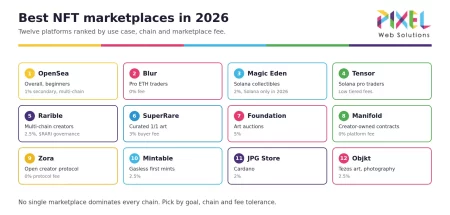
The NFT market has consolidated hard: Nifty Gateway closed in April 2026, Binance shut its NFT marketplace in July 2026 and Magic Eden retreated to Solana only, while Rarible relaunched, changed owners and expanded to Solana. The marketplaces still trading are the ones with a clear model, and Rarible's model (multichain, creator-first, rewards funded by fees) is the one most startups ask to copy. This guide covers what Rarible is in 2026, how it works, what a Rarible clone script includes, architecture, royalties, cost, regulation and how to choose a provider.
Key Takeaways
- Rarible in 2026: a multichain marketplace on Ethereum, Base, Solana, Polygon and others, a 2% seller fee on EVM chains and 1.5% on Solana, collection-set royalties paid from every sale, and a trading engine the company says settles in under a second on its fastest chains.
- Ownership changed: IMPOSSIBLE acquired the Rarible brand and core platform assets in mid-2026, while the RARI token and RARI Foundation stayed independent and RARI Chain was sunset in June 2026.
- The script must be multichain and royalty-aware: per-chain minting and exchange contracts, a royalty registry, an indexer and an aggregation layer are the core, not add-ons.
- Pixel's published price: NFT marketplace development from $45,000 to $150,000, depending on chains, auction types, aggregation and mobile apps.
- Royalty enforcement is a design decision, not a toggle, and the worked example below shows what it is worth to creators and to the platform.
What Is a Rarible Clone Script?
A Rarible clone script is pre-built, scalable and fully customisable software that replicates the functionality, working model and features of the Rarible NFT marketplace. It lets a startup launch a marketplace where users mint, list, buy, sell and auction non-fungible tokens, with Web3 wallet login, smart-contract escrow, IPFS or Arweave storage for metadata, and creator royalties built into every sale.
The 2026 version of the product is wider than the Ethereum-only scripts of 2021. A current Rarible clone script ships multichain contracts (EVM chains plus Solana), lazy minting, fixed-price and auction listings, collection-level royalties, an indexer and API, a rewards module funded by marketplace fees, and an admin panel for fees, curation and disputes. For founders exploring how to create an NFT marketplace, the clone script is the foundation that removes most of the protocol engineering.
Rarible in 2026: What the Original Looks Like Now
A clone should copy the current model, so here is where Rarible stands as of October 2026.
- Positioning and chains. Rarible's FAQ, updated 1 September 2026, describes the platform as a multichain marketplace for digital and physical collectibles and lists Ethereum, Base, Polygon, Solana and BSC among supported chains. The September 2025 relaunch ("Meet the New Rarible") introduced a stripped-back trading engine the company says is up to 30% faster than competitors on select chains, with settlement in under a second on the fastest, and went live on 11 networks including Ethereum, Base, HyperEVM, Camp Network, Somnia and LightLink.
- Fees. The FAQ states a 2% marketplace fee on Ethereum, Base and Polygon and 1.5% on Solana, taken from the sale price at settlement. Buyers pay the listed price; sellers pay the fee from proceeds. Listings pulled in from other marketplaces carry that marketplace's fee, and on EVM chains buying one adds Rarible's 2%.
- Royalties. Creator royalties are set by the collection and paid out of the sale. On Solana, Rarible launched on 6 August 2026 with Claynosaurz as the first featured collection and royalty enforcement at the protocol level, in contrast to the optional-royalty model Tensor and Magic Eden adopted in 2022 and 2023.
- Rewards. The relaunch replaced airdrop-style incentives with a points programme funded by marketplace fees; points are earned by listing and bidding and converted into RARI by the RARI Foundation, claimable on Base.
- Ownership and the chain. In mid-2026 IMPOSSIBLE acquired Rarible's brand and core platform assets, including the RaribleX enterprise business, while the RARI token and RARI Foundation remained independent. RARI Chain, the Arbitrum-based layer 3 built to enforce royalties at the node level, was sunset in June 2026 with users asked to move assets back to Ethereum mainnet by 14 June.
- Infrastructure. The Rarible API indexes more than 1 billion NFTs and 91 million trades across Ethereum, Base, Polygon and more than ten further chains, with an SDK and marketplace aggregation that lets any app trade across major NFT markets.
The takeaway for a clone is clear: multichain reach, enforced royalties, fee-funded rewards and an aggregation layer are the 2026 feature set, and a dedicated chain is not.
What Makes a Rarible Clone Script the Best Choice for NFT Startups?
Rarible succeeded because it is decentralised, creator-friendly and community-governed, and because it adapted when the market shrank. Starting a marketplace on that model is a sound route for new entrants.
Key reasons for startups to launch a Rarible clone
- Launch faster and reduce development cost: the contracts, indexer and front end already exist.
- Proven feature set: lazy minting, auctions, creator royalties, multichain support and fee-funded rewards.
- Multiple revenue streams: trading fees, listing and promotion fees, premium features and aggregation fees.
- Global market reach: creators and collectors on every supported chain.
- Secure and scalable infrastructure: audited contracts and an indexer built for many chains.
- Room to specialise: gaming, music, physical collectibles, real estate or memberships.
How Does a Rarible Clone Work?
A Rarible clone is a decentralised NFT marketplace powered by Web3 wallets and smart contracts. The working process:
- User onboarding: users sign in with a Web3 wallet (MetaMask, Rabby, Coinbase Wallet, Phantom on Solana); optional email login with an embedded wallet lowers the barrier for newcomers.
- NFT minting: creators upload media, which is stored on IPFS or Arweave, and mint ERC-721, ERC-1155 or Solana NFTs; lazy minting defers the on-chain mint and gas to the first sale.
- NFT listing: creators list at a fixed price or open an auction, and the listing is visible across the marketplace and, through aggregation, to other apps.
- Buying and bidding: collectors browse, buy instantly or bid; bids are signed orders that sit off-chain until matched.
- Secure transactions: the exchange contract escrows payment, checks the signed order and settles atomically.
- Ownership transfer: the NFT moves to the buyer in the same transaction, and the transfer is recorded on-chain.
- Creator royalties: the exchange contract reads the collection's royalty setting and pays the creator from the sale proceeds automatically.
- Security and storage: audited contracts, decentralised storage and an indexer that rebuilds state from chain events.
Pixel's guide on how to start an NFT marketplace like Rarible turns these steps into a build plan with timelines.
Key Features of a Rarible Clone Script
Features are the backbone of the script. Pixel's list of NFT marketplace features covers the admin and user panels in detail; the Rarible-specific set is below.
For NFT creators
- Lazy minting: mint without upfront gas; the buyer's purchase pays for the on-chain mint.
- Royalties: set a royalty percentage per collection, enforced on secondary sales.
- Multiple file formats: images, video, audio, 3D files and documents.
- Collection tools: create collections, set traits and metadata, and manage supply.
- Decentralised governance: optional token-based voting on platform policies.
- Search and filter: collectors find work by category, price, chain and traits.
For collectors and buyers
- Secure wallet integration: MetaMask, Trust Wallet, Coinbase Wallet, WalletConnect and Phantom.
- Multichain compatibility: Ethereum, Base, Polygon, BNB Chain and Solana from one interface.
- Bid and auction support: timed auctions, reserve prices and collection-wide offers.
- Portfolio and activity: holdings, offers received and sale history.
For admins
- Live analytics dashboard: users, listings, volume, fees and royalties by chain.
- NFT and collection management: verification badges, featured collections, takedowns.
- Fee management: marketplace fee per chain, promotional zero-fee campaigns, aggregation fees.
- Robust security: 2FA, role-based access, encryption and DDoS protection.
- Dispute management: tickets for technical and trading issues.
Add-on features
- Multi-language and multi-currency display with fiat price references.
- Fiat on-ramp so buyers can pay by card through a licensed provider.
- Storefront customisation for creators and brands.
- Rewards module: fee-funded points converted to a platform token.
- Aggregation: show and fill listings from other marketplaces.
- Physical collectibles: redemption flows for NFTs linked to physical items.
Architecture of a Marketplace Like Rarible
| Layer | Components | Rarible-specific notes |
|---|---|---|
| Smart contracts | Collection factory (ERC-721, ERC-1155, Solana programs), exchange contract with signed orders, royalty registry (ERC-2981 plus platform registry), lazy-mint contract | Royalty logic lives in the exchange contract, which is what makes enforcement possible |
| Indexer and API | Chain event indexer per network, search index, metadata and media pipeline | Rebuilds state from events; feeds the app and third parties |
| Storage | IPFS or Arweave for media and metadata, CDN for previews | Pin or pay for permanence |
| Application | Web app, mobile apps, creator studio, admin panel | Wallet SDKs per chain |
| Rewards and governance | Points ledger, token distribution, voting | Funded by marketplace fees |
Pixel's guide to NFT smart contract development explains the contract layer, and its white-label NFT marketplace packages this architecture for rebranding.
Royalty Enforcement: The Design Decision That Defines a Rarible Clone
Most marketplaces made royalties optional during the 2022 to 2023 fee wars, and creators left. Rarible kept them, and its Solana launch in August 2026 put enforcement at the protocol level. A clone owner has three options:
- Advisory royalties (ERC-2981 only): the contract declares a royalty, but any marketplace can ignore it. Cheapest, least creator-friendly.
- Marketplace-enforced royalties: the clone's own exchange contract always pays the declared royalty, but NFTs traded elsewhere escape it.
- Protocol-level enforcement: transfers are restricted to approved exchange contracts or an escrow layer, so every sale pays the creator. Strongest, but it limits composability and needs careful audit.
What it is worth: a worked example
Suppose a collection does 1,000 ETH of secondary volume in a year with a 5% royalty and a 2% marketplace fee.
- Creator royalties with enforcement: 1,000 ETH multiplied by 5% = 50 ETH
- Creator royalties with optional royalties, assuming 20% of buyers pay: 10 ETH
- Marketplace fee either way: 1,000 ETH multiplied by 2% = 20 ETH
Enforcement moves 40 ETH a year to the creator on one collection. That is the pitch that brings serious creators to a Rarible clone, and it is also why the exchange contract, not the front end, must be built around it.
What's New in a 2026 Rarible Clone Script
A current script tracks the changes in the Rarible ecosystem rather than the 2021 feature list.
-
Fee-funded rewards instead of airdrops. A points ledger redirects part of marketplace fees to active listers and bidders and converts points into a platform token, mirroring Rarible's post-relaunch programme.
-
Configurable fee campaigns. Per-chain fees, zero-fee launch campaigns and maker/taker models are set from the admin panel without a redeploy.
-
On-chain transparency and treasury tracking. Fee routing through audited contracts and public treasury addresses let users verify where fees go.
-
Fast trading engine with multichain support. Off-chain signed orders with on-chain settlement give sub-second confirmation on fast chains, across Ethereum, Base, Polygon, BNB Chain, Solana and newer networks such as MegaETH.
-
Aggregation. The marketplace displays and fills listings from other venues through an aggregation API, which widens liquidity on day one.
Get a Rarible Clone Script Live Demo
A personalised live demo shows the Rarible clone working in real time: minting, listing, bidding, settlement, royalties and the admin panel.
What you’ll explore in our Rarible Clone Script Demo”?
- Access a fully functional NFT marketplace dashboard
- Test reward models and fee settings in real time
- View on-chain transparency and transaction tracking
- Explore cross-chain NFT trading
- Check the admin panel with user and transaction monitoring
Technology Stack for Rarible Clone App Development
| Category | Technologies used |
|---|---|
| Frontend | React.js, Next.js |
| Backend | Node.js, Express.js |
| Database | MongoDB, PostgreSQL |
| Wallet and crypto support | Web3.js, Ethers.js, Solana web3.js, WalletConnect |
| Smart contracts | Solidity (ERC-721, ERC-1155, ERC-2981), Rust (Solana programs) |
| Storage and indexing | IPFS, Arweave, chain indexers, search index |
This stack supports high-volume activity and multichain transactions, and it mirrors what the leading marketplaces run.
Blockchains a Rarible Clone Supports
Multichain support attracts larger audiences and more transactions. The 2026 priority list, in the order most clients choose:
Ethereum: the home of premium collections, with the deepest liquidity and the strongest security.
Base: the Ethereum layer 2 where Rarible's rewards are claimed and where low fees have moved much creator activity.
Solana: fast, cheap and the most active non-EVM NFT ecosystem; Rarible returned to it in August 2026.
Polygon: low-cost EVM chain popular with brands and gaming projects.
BNB Smart Chain: low fees and fast confirmations for mass-market collectibles.
Avalanche, Arbitrum and newer EVM networks (MegaETH, HyperEVM): added as adapters when a client's community lives there.
Tezos and Flow: niche art and sports ecosystems that remain options for specialised marketplaces.
Rarible Clone Script Cost in 2026
Pixel Web Solutions prices NFT marketplace development at $45,000 to $150,000. The range reflects the choices below; the full guide to the cost to build an NFT marketplace breaks down each module, hidden costs and the marketing budget.
| Scope | Typical inclusions | Pixel Web Solutions price |
|---|---|---|
| Single-chain Rarible clone | Ethereum or one L2, fixed-price and auction listings, lazy minting, royalties, admin panel | $45,000 to $70,000 |
| Multichain clone | 3 to 4 chains including Solana, rewards module, aggregation, fiat on-ramp | $70,000 to $110,000 |
| Custom marketplace | Custom contracts, protocol-level royalty enforcement, mobile apps, physical collectibles, governance | $110,000 to $150,000 |
Budget separately for an independent smart contract audit, storage pinning, node providers and the creator-acquisition campaigns that decide whether a marketplace gets liquidity.
Regulation for an NFT Marketplace in 2026
NFTs sit at the edge of most crypto regimes, but a marketplace operator still has obligations:
- European Union: MiCA excludes unique, non-fungible crypto-assets, but large fungible-style series and fractionalised NFTs can fall inside it, and MiCA CASP authorisation has been mandatory for in-scope services since 1 July 2026 per ESMA's MiCA page. AML rules apply to marketplaces that custody funds.
- United Arab Emirates: Dubai's VARA rulebooks regulate virtual asset activities and marketing from Dubai; an NFT marketplace should take advice on whether its model triggers licensing.
- United States: securities analysis applies where NFTs are sold as investments, and money transmission rules apply if the platform holds buyer funds.
- Everywhere: consumer protection, intellectual-property takedown processes and tax reporting for creators.
How to Choose a Clone Script Provider
- Audit reports for the exchange, collection and royalty contracts you will deploy.
- Multichain evidence: live deployments on Ethereum, Base and Solana, not a roadmap.
- Royalty model: which of the three enforcement options the script supports.
- Aggregation and API: can other apps trade on your marketplace, and can you show other venues' listings?
- Rewards and fee tooling configurable without redeploys.
- Source code and licence so you own the platform.
- Post-launch support for chain upgrades and wallet changes.
Founders comparing models can also read Pixel's OpenSea clone script page, which targets the broadest-catalogue model rather than Rarible's creator-first one.
Elevate Your NFT Marketplace Business with Pixel Web Solutions' Rarible Clone App
Pixel Web Solutions is an NFT marketplace development company operating from Ras Al Khaimah, UAE and Madurai, India, with over 12 years in blockchain and clients served in more than 20 countries. Its Rarible clone script is feature-rich, fully customisable and built to replicate Rarible's proven multichain, creator-first model, and its NFT marketplace developers deliver white-label solutions and clone scripts for fast, affordable launches. To book a 15-minute demo with the NFT team, contact Pixel Web Solutions.
Frequently Asked Questions
What is a Rarible clone script?
A Rarible clone script is pre-built, customisable NFT marketplace software that lets startups launch a marketplace like Rarible, with minting, listings, auctions, multichain support and creator royalties. It can be extended with new features, chains and security upgrades.
How much does a Rarible clone script cost?
Pixel Web Solutions prices NFT marketplace development at $45,000 to $150,000, depending on chains, royalty enforcement, aggregation, rewards and mobile apps.
Can I customise the features of a Rarible clone?
Yes. The script is fully customisable: features, third-party integrations, UI/UX, back end and front end can all be tailored to the business.
Is a Rarible clone app secure?
A well-built clone uses audited smart contracts, 2FA and role-based admin access, encrypted data, DDoS protection and regular updates, with an independent audit before launch.
Which blockchains does Rarible support in 2026?
Rarible's FAQ lists Ethereum, Base, Polygon, Solana and BSC among supported chains, and its site also lists MegaETH. RARI Chain was sunset in June 2026.
Does a Rarible clone support industries beyond art and collectibles?
Yes. The same contracts and marketplace flows serve gaming, music, sports, fashion, real estate, memberships and physical collectibles with redemption.