The best NFT marketplace in 2026 is OpenSea for most people: 22 supported chains, a 1% seller fee and $557 million traded in the twelve months to October 2026, more than double any rival. Tensor is the best NFT marketplace for Solana traders, Magic Eden for Solana collectibles and packs, SuperRare for curated 1/1 art, Manifold for creators who want their own contract, and NBA Top Shot, Sorare and Courtyard for licensed sports and graded-card collectibles. Four of last year's big names, Blur, Foundation, JPG Store and Mintable, closed or announced closure in 2026, so this list ranks only marketplaces that were live on 23 October 2026.
No single platform dominates every chain, and the field is smaller than it was: an October 2026 audit found only 21 of the 56 marketplaces launched since 2017 still trading. So this guide starts with a comparison table of the 10 best NFT marketplaces on chains, fees and status, shows where the volume actually is, then breaks the platforms out by use case, by chain and by niche, and lists every marketplace still open. The final section is for founders: what each marketplace's model proves, what a build costs, and how to build one for a niche with an NFT marketplace development company that has shipped art, music, gaming and multi-chain platforms.
Key Takeaways
- Best NFT marketplace overall: OpenSea, with 22 chains, a 1% secondary fee and $557 million in trailing-year volume against Blur's $235 million (Token Terminal, October 2026).
- Best by chain: Tensor and Magic Eden on Solana, OpenSea and SuperRare on Ethereum, OpenSea and Manifold on Base, Objkt on Tezos, Gamma and UniSat for Bitcoin Ordinals.
- Fees run from 0% to 5%: Manifold charges nothing, OpenSea 1%, Tensor 2% taker, Objkt 2.5%, SuperRare 3% (paid by the buyer), NBA Top Shot 5%; gas is extra everywhere.
- 2026 was the year of closures: Nifty Gateway (February), Magic Eden's EVM and Bitcoin arms (March), Foundation (April), JPG Store (May), Binance NFT (July), Mintable (sunsetting) and Blur, whose site closes on 12 November 2026.
- The market is small and physical-backed: NFT sales ran at about $41 million a week in early October 2026, and the top collection by sales was Courtyard's vaulted trading cards, not a PFP project.
- Building one costs $45,000 to $150,000: Pixel Web Solutions' published range for a custom NFT marketplace; white-label builds launch fastest.
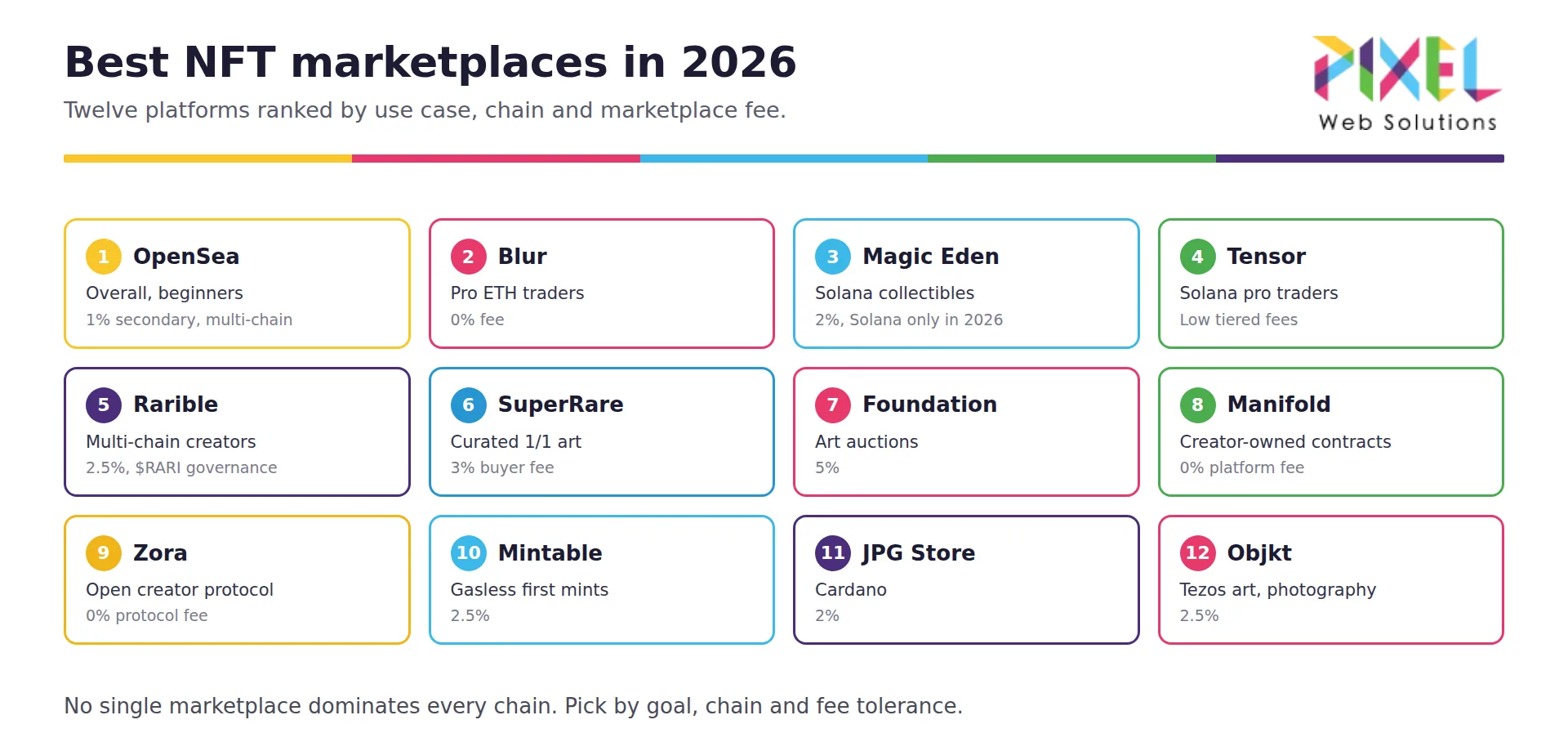
Best NFT Marketplaces in 2026 Compared: Chains, Fees and Status
| Marketplace | Chains | Marketplace fee | Status on 23 October 2026 | Best for |
|---|---|---|---|---|
| OpenSea | 22 chains incl. Ethereum, Base, Polygon, Solana, Arbitrum, Avalanche, Ronin, Monad | 1% on secondary sales, 10% on primary drops, 0% on swaps | Live; $557M volume in the 12 months to October 2026 | Overall, beginners, discovery |
| Magic Eden | Solana only | 2% (shown in app) | Live; Ethereum, Polygon, Base and Bitcoin marketplaces closed 9 March 2026 | Solana collectibles, gaming, packs |
| Tensor | Solana | 2% taker, 0% maker | Live | Solana pro traders |
| Rarible | Ethereum, Polygon, Base, RARI Chain and more | Tiered, 0.5% to 7.5% per side by sale value | Live | Multi-chain creators, community marketplaces |
| SuperRare | Ethereum | 3% paid by the buyer; 15% commission on primary sales; 10% artist royalty | Live | Curated 1/1 digital art |
| Manifold | Ethereum, Base, Optimism | 0% (creators pay gas) | Live | Creators who want their own contract |
| Objkt | Tezos | 2.5% | Live | Tezos art and photography |
| NBA Top Shot | Flow | 5% | Live | Licensed basketball moments |
| Sorare | Ethereum (StarkEx Layer-2) | No flat rate published | Live | Football, NBA and MLB fantasy cards |
| Courtyard | Polygon | No flat rate published | Live; $7.31M sales in the week to 3 October 2026, the top collection by volume | Graded physical cards, vaulted and insured |
Fees and chains were read from each platform's own pages on 23 October 2026: OpenSea's fee page and chain list, Tensor's fee docs, SuperRare's pricing guide and Manifold's docs. Rarible's help centre lists its tiered schedule, and Magic Eden, Objkt and NBA Top Shot show their rates in-app. Status comes from Decrypt's report on Magic Eden and CryptoSlam's weekly data via The Cryptonomist for Courtyard. Every chain also charges gas, and creator royalties are set per collection, so check each fee page before listing.
Where the NFT Volume Is in October 2026
| Measure | Figure | Source and date |
|---|---|---|
| OpenSea trading volume, 12 months to October 2026 | $557 million | Token Terminal, cited by Bitcoin.com, 13 October 2026 |
| Blur trading volume, same period | $235 million, of which $19.15 million in September 2026 | Token Terminal, cited by Bitcoin.com, 13 October 2026 |
| All NFT sales, 7 days to 3 October 2026 | $40.88 million: Ethereum $17.08M, Polygon $8.21M, Bitcoin $3.83M, Base $2.25M, BNB Chain $2.16M, Immutable $2.12M, Solana $1.95M | CryptoSlam via The Cryptonomist, 3 October 2026 |
| Chain-level NFT volume tracked by DefiLlama | $6.37 billion in 2024, $2.68 billion in 2025, $0.39 billion from 1 January to 13 October 2026 | DefiLlama via CryptoDiffer, 13 October 2026 |
| Marketplaces still trading | 21 of the 56 launched since 2017 | CryptoDiffer audit, 13 October 2026 |
The figures come from Bitcoin.com's report on Blur's closure, The Cryptonomist's weekly CryptoSlam round-up and CryptoDiffer's marketplace survival audit. Two things stand out. OpenSea now takes well over half of tracked marketplace volume, and the chains that matter for sales are Ethereum, Polygon and Bitcoin, with Solana a distant seventh by weekly sales despite hosting two of the ten best NFT marketplaces.
The 10 Best NFT Marketplaces, Reviewed
1. OpenSea: Best Overall and Best for Beginners
OpenSea is still the broadest general-purpose NFT marketplace in 2026, supporting 22 chains including Ethereum, Base, Polygon, Solana, Arbitrum, Avalanche, Ronin, Flow and Monad, with the largest catalogue of art, collectibles, gaming items and domain names. Its Seaport protocol lets you buy multiple NFTs in one transaction, and the interface is the easiest for a first purchase. Token Terminal put its trading volume at $557 million in the year to October 2026, more than double the next marketplace.
- Fees: 1% on secondary sales, 10% on primary drops through OpenSea's launch tools, 0% on token swaps.
- Best for: buying your first NFT, browsing across chains, portfolio management.
- Watch for: fake collections; always check the verified badge and the contract address.
Founders study OpenSea for its generalist model. Our OpenSea clone script and the guide to starting an NFT marketplace like OpenSea cover the feature set.
2. Magic Eden: Best Solana Marketplace
Magic Eden is the largest Solana NFT marketplace, strongest in gaming assets, PFP collections and its Packs product, with a launchpad for new collections. On 27 February 2026 CEO Jack Lu announced that the Ethereum, Polygon, Base and Bitcoin Ordinals and Runes marketplaces would close from 9 March 2026, the Bitcoin API on 27 March and the Magic Eden wallet on 1 April, because 80% of costs sat in products earning 20% of revenue. Treat it as a Solana platform.
- Fees: 2% marketplace fee, shown in-app.
- Best for: Solana collectibles, gaming NFTs, new collection mints.
- Watch for: anything you held on Magic Eden's EVM or Bitcoin marketplaces now lists elsewhere; the assets themselves stayed in your wallet.
3. Tensor: Best for Solana Pro Traders
Tensor is the trading terminal of Solana: deep liquidity, fast execution, advanced order types and analytics for traders who move volume. With Blur closing, it is also the last major marketplace built around maker and taker fees.
- Fees: 2% taker fee, 0% maker fee; enforced royalties are always paid by the taker.
- Best for: active Solana traders who want speed and depth over discovery.
4. Rarible: Best Multi-Chain Creator Marketplace
Rarible supports minting and trading across Ethereum, Polygon, Base, its own RARI Chain and more, with no-code minting and the $RARI governance token that lets holders vote on platform changes. It also offers a builder toolkit for community marketplaces, which is why brands and games use it as white-label infrastructure.
- Fees: a tiered schedule that falls from 7.5% to 0.5% per side as the sale value rises; check the fee shown at listing.
- Best for: creators who want multi-chain reach and a say in governance.
Building for a creator community is the Rarible model; see the Rarible clone script and how to start an NFT marketplace like Rarible.
5. SuperRare: Best for Curated 1/1 Digital Art
SuperRare is invite-only for artists and treats every piece as a single edition. On a primary sale the artist keeps 85% and the SuperRare DAO treasury takes 15%; on resale the seller keeps 90% and the original artist earns 10%; buyers pay a 3% fee on Buy Now listings. It is where established digital artists list museum-grade work, and with Foundation gone it is the only large curated venue left on Ethereum.
- Fees: 3% buyer fee on list-price sales; 15% commission on primary sales.
- Best for: serious collectors and artists with a portfolio.
6. Manifold: Best for Creators Who Want Contract Control
Manifold Studio lets creators deploy their own smart contracts on Ethereum, Base and Optimism, so the collection lives in the artist's contract rather than a shared one. No platform fee; creators pay gas. When Foundation went offline in April 2026, creator-owned contracts were what let artists keep selling, which is the strongest argument for this model.
- Fees: 0% platform fee.
- Best for: established creators, brands and photographers who want ownership of the contract.
7. Objkt: Best Tezos Marketplace for Art and Photography
Objkt is the primary Tezos marketplace, popular with photographers and generative artists because of Tezos's low gas, and one of the few single-chain art venues still trading after the 2026 closures.
- Fees: 2.5%.
- Best for: photography, generative art and editions on Tezos.
8. NBA Top Shot: Best for Licensed Sports Collectibles
NBA Top Shot sells officially licensed basketball "moments" on the Flow blockchain, with pack drops and a secondary marketplace that charges 5% per sale. It is the longest-running licensed sports NFT platform and one of the 21 marketplaces that survived the market's contraction.
- Fees: 5% marketplace fee.
- Best for: basketball fans who want licensed, serialised collectibles.
9. Sorare: Best for Fantasy Sports Cards
Sorare combines a fantasy game with a marketplace for licensed football, NBA and MLB player cards, settled on an Ethereum Layer-2 built with StarkEx so collectors do not pay mainnet gas. Cards have in-game utility, which keeps demand tied to the season rather than to crypto prices.
- Fees: no flat marketplace rate is published; the price shown includes Sorare's margin.
- Best for: football, NBA and MLB fans who want cards they can play.
10. Courtyard: Best for Graded Physical Collectibles
Courtyard tokenizes graded trading cards that are vaulted and insured, and lets collectors ship cards in from eBay, PWCC and PSA. In the week to 3 October 2026 it was the top NFT collection by sales anywhere, at $7.31 million on Polygon, a sign that physical-backed collectibles are where NFT demand has moved.
- Fees: no flat marketplace rate is published; check the buy and redemption terms in-app.
- Best for: card collectors who want physical backing with on-chain liquidity.
NFT Marketplaces That Closed or Are Closing in 2026
| Marketplace | What happened | Date |
|---|---|---|
| Blur | Announced on X that blur.io closes on 12 November 2026; the protocol stays on-chain and Blend stops matching loans the same day | 12 October 2026 |
| Foundation | Offline indefinitely after a sale fell through; IPFS gateway kept running until 27 April 2027 | April 2026 |
| JPG Store (Cardano) | Closed its marketplace and Comet platform; contracts remain open-source | 23 May 2026 |
| Mintable | Sunsetting Mintable.com and Mintology to leave NFTs; metadata hosting continues for now | 2026 |
| Nifty Gateway | Closed by Gemini | 23 February 2026 |
| Binance NFT | Centralised marketplace wound down; NFTs moved to Binance Wallet | 3 July 2026 |
| Magic Eden (EVM and Bitcoin) | Ethereum, Polygon, Base and Ordinals marketplaces closed; Solana continues | 9 March 2026 |
If you hold NFTs bought on a closed marketplace, nothing happened to the tokens: they sit in your wallet and list on any marketplace that supports the chain. The exception is anything left in a marketplace escrow or custodial wallet, which is why self-custody matters more than the venue.
Best NFT Marketplace by Use Case
Best NFT marketplace for beginners
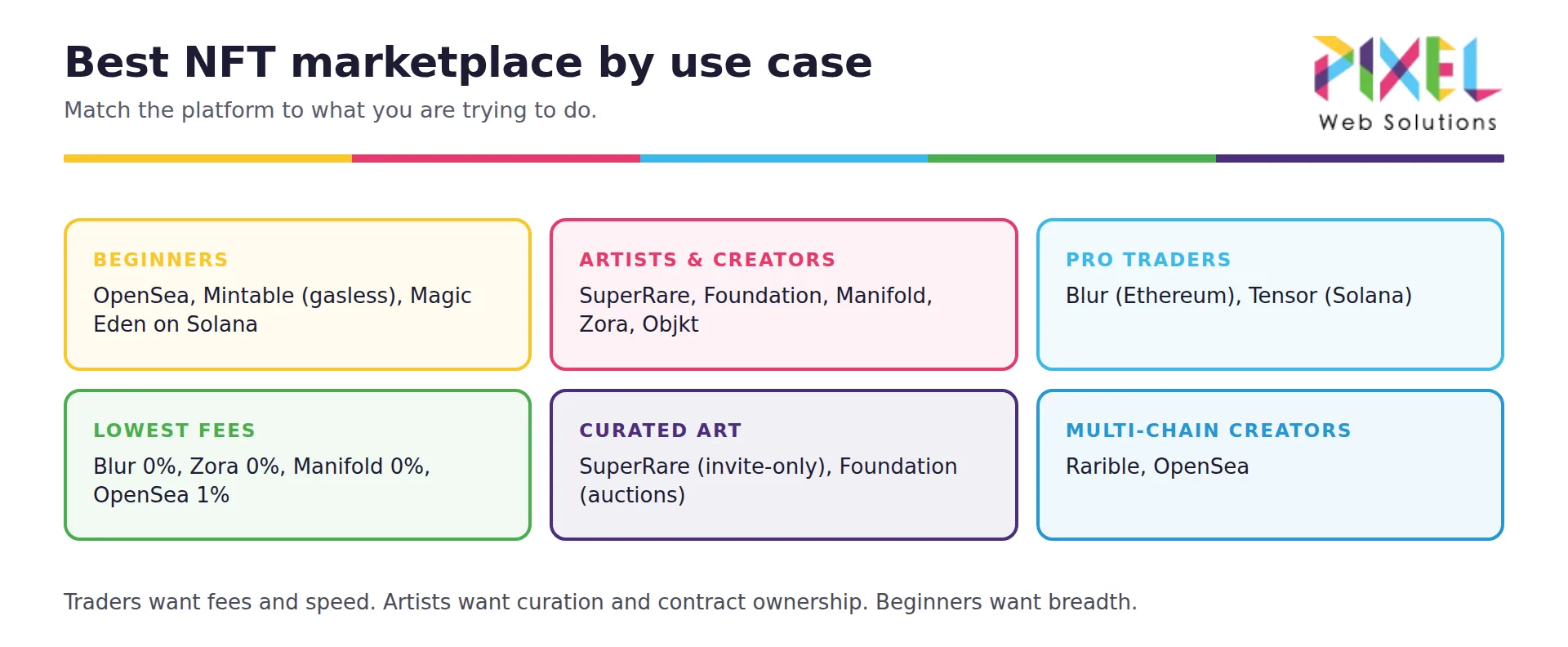
OpenSea, because it supports the most chains and wallets and has the largest verified catalogue, with written guides for a first wallet connection and first purchase. Magic Eden is the beginner choice on Solana, and NBA Top Shot or Sorare if you would rather start with a licensed collectible than a crypto-native one.
Best NFT marketplace for artists and creators
SuperRare for curated 1/1s, Manifold for creators who want to own the contract and pay no platform fee, Rarible for multi-chain reach, Objkt for photographers on Tezos. New artists without a SuperRare invitation usually start on Manifold or OpenSea and move to SuperRare once they have a collector base. Deploy on your own contract from day one: Foundation's artists kept their work in April 2026 because the tokens lived in creator contracts, not the platform's.
Best NFT marketplace for traders
Tensor on Solana, and OpenSea on Ethereum once Blur's site closes on 12 November 2026. Tensor is built for speed, sweeps and bids with a 2% taker and 0% maker fee; OpenSea's 1% fee and Seaport batch buys make it the practical Ethereum terminal now.
Best NFT marketplace for low fees
Manifold (0%), then OpenSea at 1% on secondary sales and Tensor at 0% for makers. Gas is the larger cost on Ethereum; Solana, Base, Polygon and Tezos marketplaces are cheaper to transact on.
Best NFT Marketplace by Blockchain
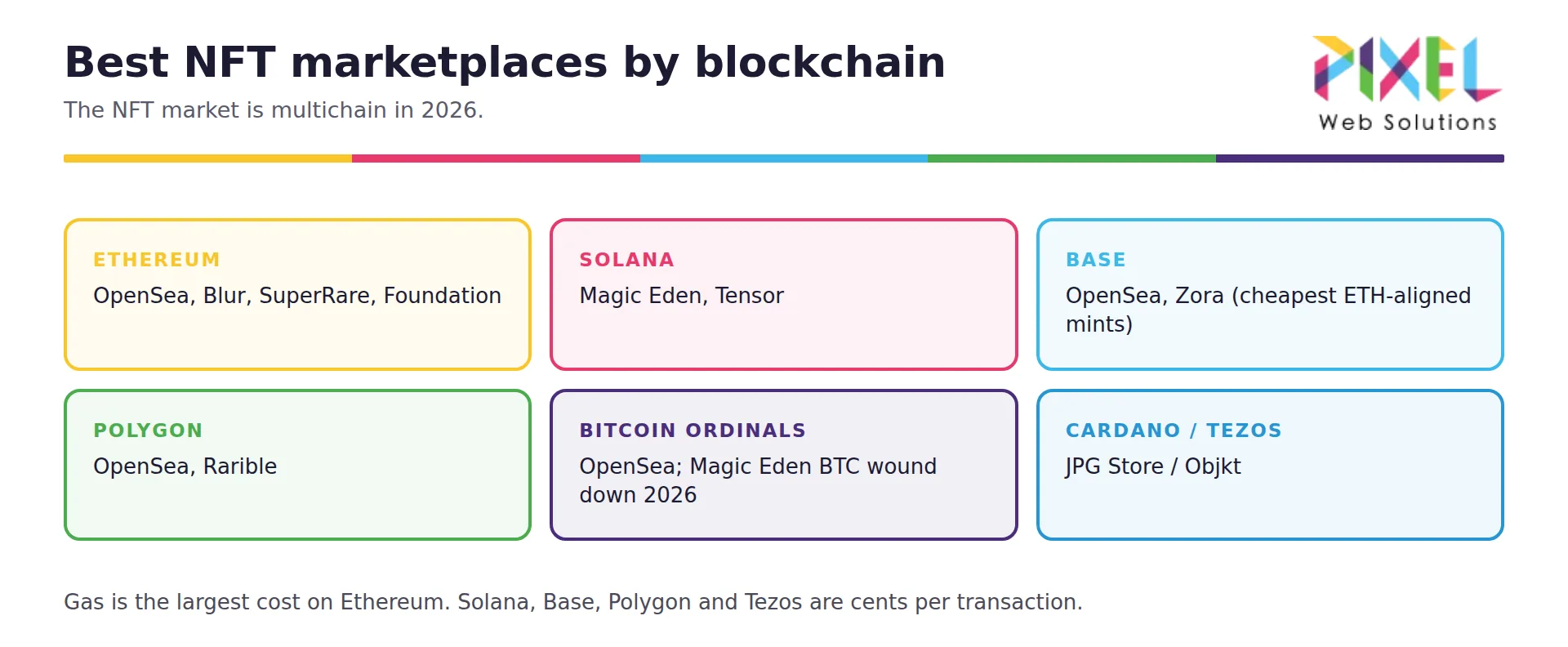
- Ethereum: OpenSea (discovery and trading), SuperRare (art), Manifold (creator contracts), Sorare (sports, on its StarkEx Layer-2).
- Solana: Magic Eden (collectibles, gaming, packs), Tensor (trading).
- Base: OpenSea and Manifold; Base remains the cheapest place to mint on an Ethereum-aligned chain.
- Polygon: OpenSea, Rarible and Courtyard, which made Polygon the second-largest chain by NFT sales in early October 2026.
- Bitcoin Ordinals: Gamma, UniSat and Ordinals Wallet, now that Magic Eden's Bitcoin marketplace has closed.
- Cardano: no dominant venue since JPG Store closed on 23 May 2026; its open-source contracts let smaller aggregators list the same assets.
- Tezos: Objkt.
- Flow: NBA Top Shot.
Multi-chain is the norm in 2026, which is why multi-chain NFT marketplace development and cross-chain NFT marketplace development are the two most requested builds.
OpenSea Competitors and Alternatives
The main OpenSea competitors in 2026 are Magic Eden and Tensor (Solana), Rarible (multi-chain creators and white-label), Manifold (creator-owned contracts) and SuperRare (curated art). For chains OpenSea does not cover, Objkt (Tezos), Gamma and UniSat (Bitcoin Ordinals). Blur, OpenSea's main Ethereum rival since 2022, closes its site on 12 November 2026.
| If you want | Instead of OpenSea use |
|---|---|
| Zero marketplace fee | Manifold |
| Solana | Magic Eden, Tensor |
| Curated art | SuperRare |
| Your own contract | Manifold |
| Governance token or white-label toolkit | Rarible |
| Licensed sports collectibles | NBA Top Shot, Sorare |
| Physical-backed cards | Courtyard |
How to Buy and Sell an NFT Safely
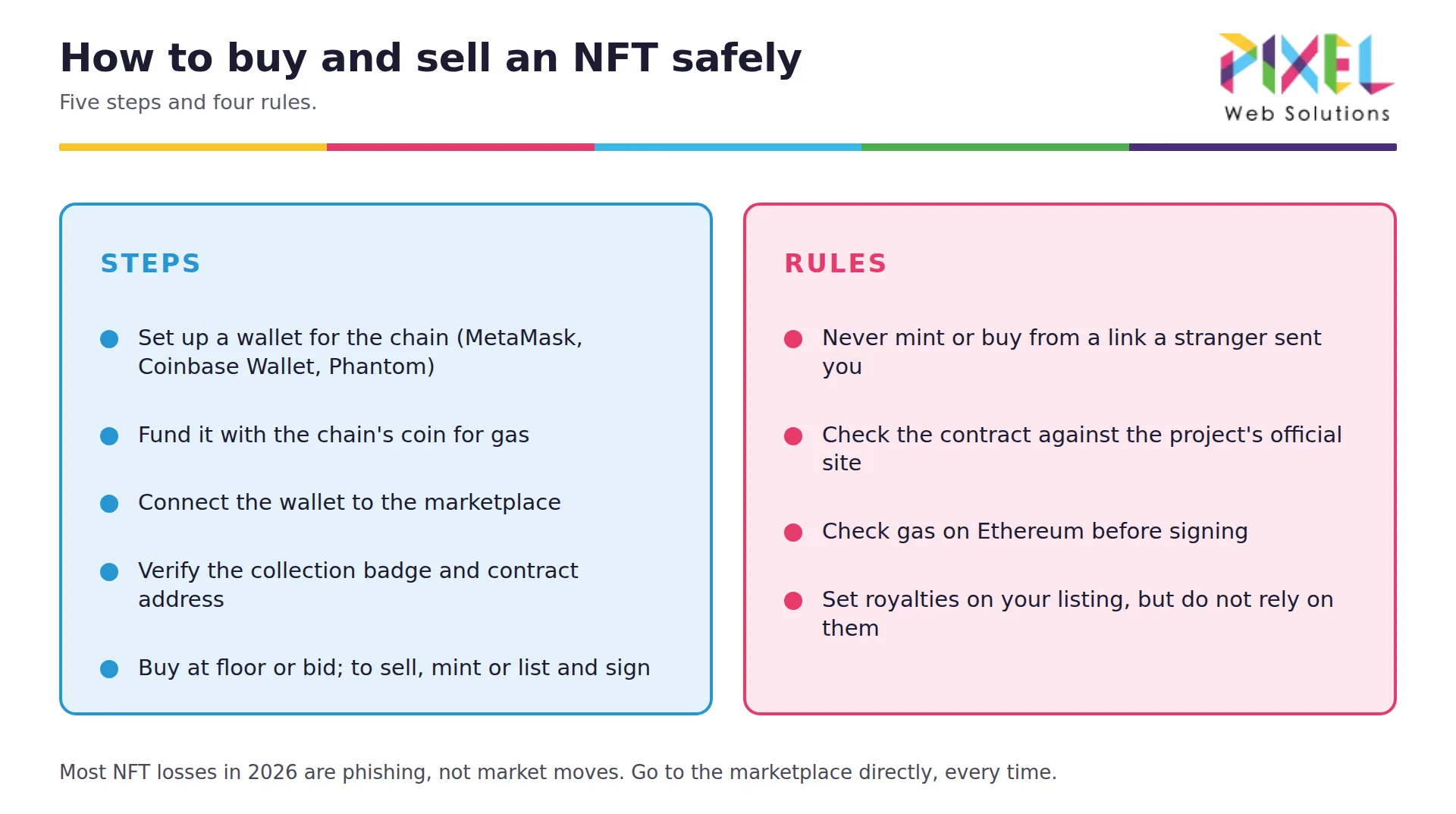
To buy an NFT: set up a wallet for the chain (MetaMask or Coinbase Wallet for Ethereum and Base, Phantom for Solana), fund it with the chain's coin for gas, connect it to the marketplace, verify the collection's badge and contract address, then buy at floor or place a bid. To sell: mint or list from your wallet, set the price and royalty, and sign the listing.
- Never mint or buy from a link sent by a stranger; go to the marketplace directly.
- Check the contract address against the project's official site or social account.
- On Ethereum, check gas before signing; on Solana and Base, gas is cents.
- Royalties are optional on most marketplaces now; set them, but do not rely on them.
- Keep NFTs in your own wallet, not in a marketplace's custodial wallet or escrow; the 2026 closures punished anyone who did not.
Best NFT Niches in 2026
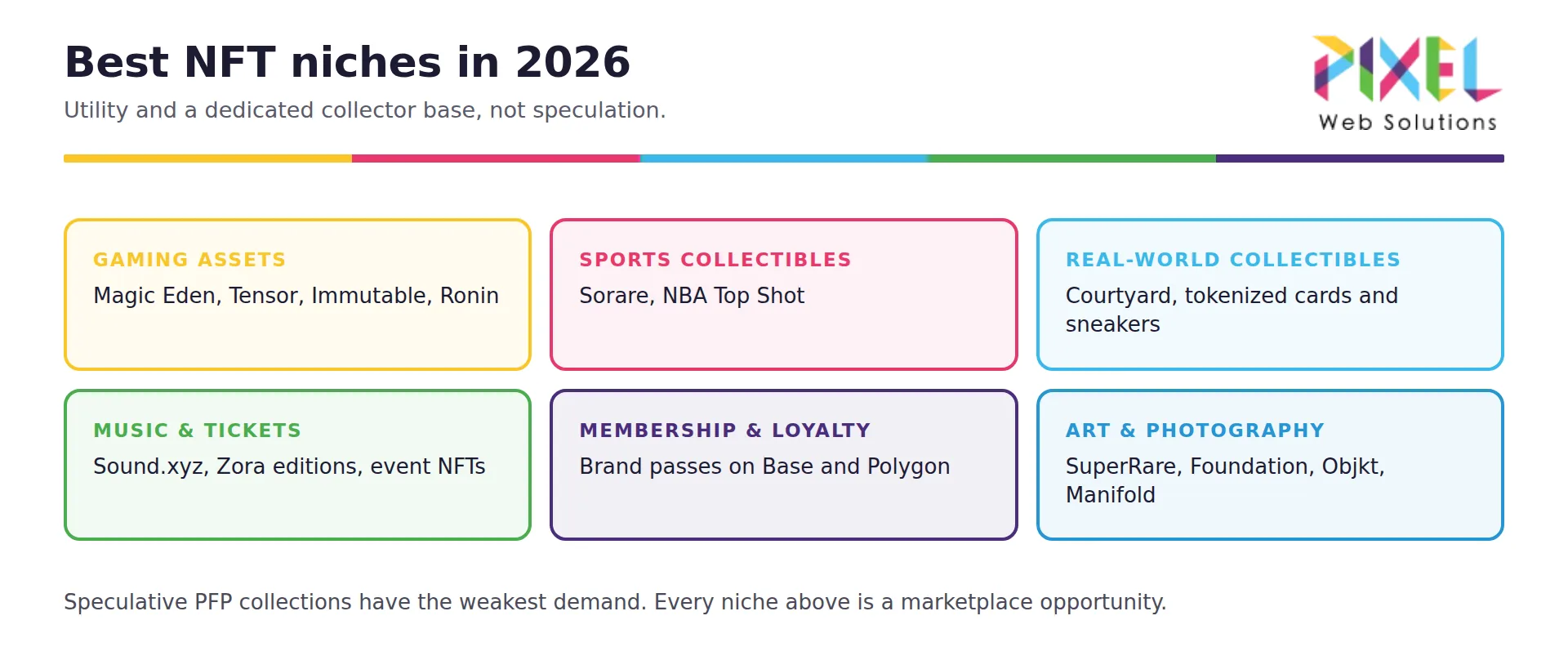
The best NFT niches in 2026 are the ones with real utility or a dedicated collector base: tokenized real-world collectibles (graded cards, sneakers, wine), sports collectibles and fan tokens, gaming assets, music and ticketing, membership and loyalty passes, generative and photography art, and domain names. Speculative PFP collections have the weakest demand; the weekly sales data above shows a vaulted-card platform outselling CryptoPunks.
- Real-world collectibles: Courtyard (graded cards), tokenized physical goods.
- Sports: Sorare (football, NBA, MLB fantasy cards), NBA Top Shot.
- Gaming: Magic Eden and Tensor on Solana; Immutable and Ronin ecosystems, both of which rank among the top chains by weekly NFT sales.
- Music and tickets: on-chain editions and event-ticket NFTs on Base and Polygon.
- Membership and loyalty: brand passes on Base and Polygon.
- Art and photography: SuperRare, Objkt, Manifold.
Each niche is a marketplace opportunity in its own right; our NFT business ideas and NFT use cases guides go niche by niche, and NFT art marketplace development and NFT music marketplace development cover the two most common vertical builds.
Best NFT Apps
OpenSea, Magic Eden, Rarible, NBA Top Shot and Sorare all ship iOS and Android apps; buying inside the app depends on app-store rules, so many route purchases through the wallet app (MetaMask, Phantom, Coinbase Wallet) instead. For browsing and portfolio tracking, the marketplace apps are fine; for trading, the wallet plus the mobile web is usually faster.
Two Quick Answers
Spaace: Spaace.io is a newer gamified NFT marketplace on Ethereum with reward mechanics for trading activity. It is a niche alternative rather than a top-10 platform.
Gaming NFT marketplaces: Magic Eden and Tensor (Solana), OpenSea (Ethereum, Base, Ronin), plus the in-game marketplaces of Immutable and Ronin titles. Most support deposits and withdrawals in several tokens.
Full NFT Marketplace List for October 2026
Beyond the ten reviewed above, these marketplaces were still trading on 23 October 2026, per CryptoDiffer's audit of 56 platforms and our own checks of each site.
| Marketplace | Chain | Niche |
|---|---|---|
| Element | Ethereum, BNB Chain, Polygon and other EVM Layer-2s | Multi-chain aggregator, the largest marketplace on several Layer-2s |
| Sudoswap | Ethereum | AMM-style NFT pools, instant liquidity |
| Stargaze | Cosmos | Cosmos-native art and collectibles |
| CryptoPunks Market | Ethereum | The official CryptoPunks venue |
| Gamma | Bitcoin | Ordinals launchpad and marketplace |
| UniSat | Bitcoin | Ordinals and BRC-20 wallet marketplace |
| Ordinals Wallet | Bitcoin | Ordinals trading |
| OKX NFT | Multi-chain | Exchange-backed aggregator |
| Gate NFT | Multi-chain | Exchange-backed marketplace |
| Bitget Wallet NFT | Multi-chain | Wallet-integrated marketplace |
| ThetaDrop | Theta | Media and entertainment drops |
| Zora | Base | Now a content-coin platform; its NFT tooling is maintained as legacy docs |
Closed, pivoted or near-dormant marketplaces are listed in the closures table above and include LooksRare, Solanart, X2Y2, Exchange Art, fxhash, KnownOrigin and the exchange marketplaces of Coinbase, Kraken and Bybit. Any "NFT marketplace list" that still ranks them is out of date.
Die besten NFT-Marktplätze 2026 (Kurzfassung)
OpenSea ist der beste Allround-Marktplatz und der beste Einstieg für Anfänger. Tensor (Solana) ist die beste Plattform für aktive Trader; Blur schließt seine Website am 12. November 2026. SuperRare ist der beste Marktplatz für kuratierte digitale Kunst, Manifold für Künstler, die ihren eigenen Smart Contract kontrollieren möchten. Magic Eden ist der größte Marktplatz auf Solana, Objkt auf Tezos; Foundation und JPG Store wurden 2026 geschlossen. Alle genannten Plattformen sind aus Österreich, Deutschland und der Schweiz zugänglich; es fallen nur Gas- und Marktplatzgebühren an.
What Founders Can Learn from the Best NFT Marketplaces
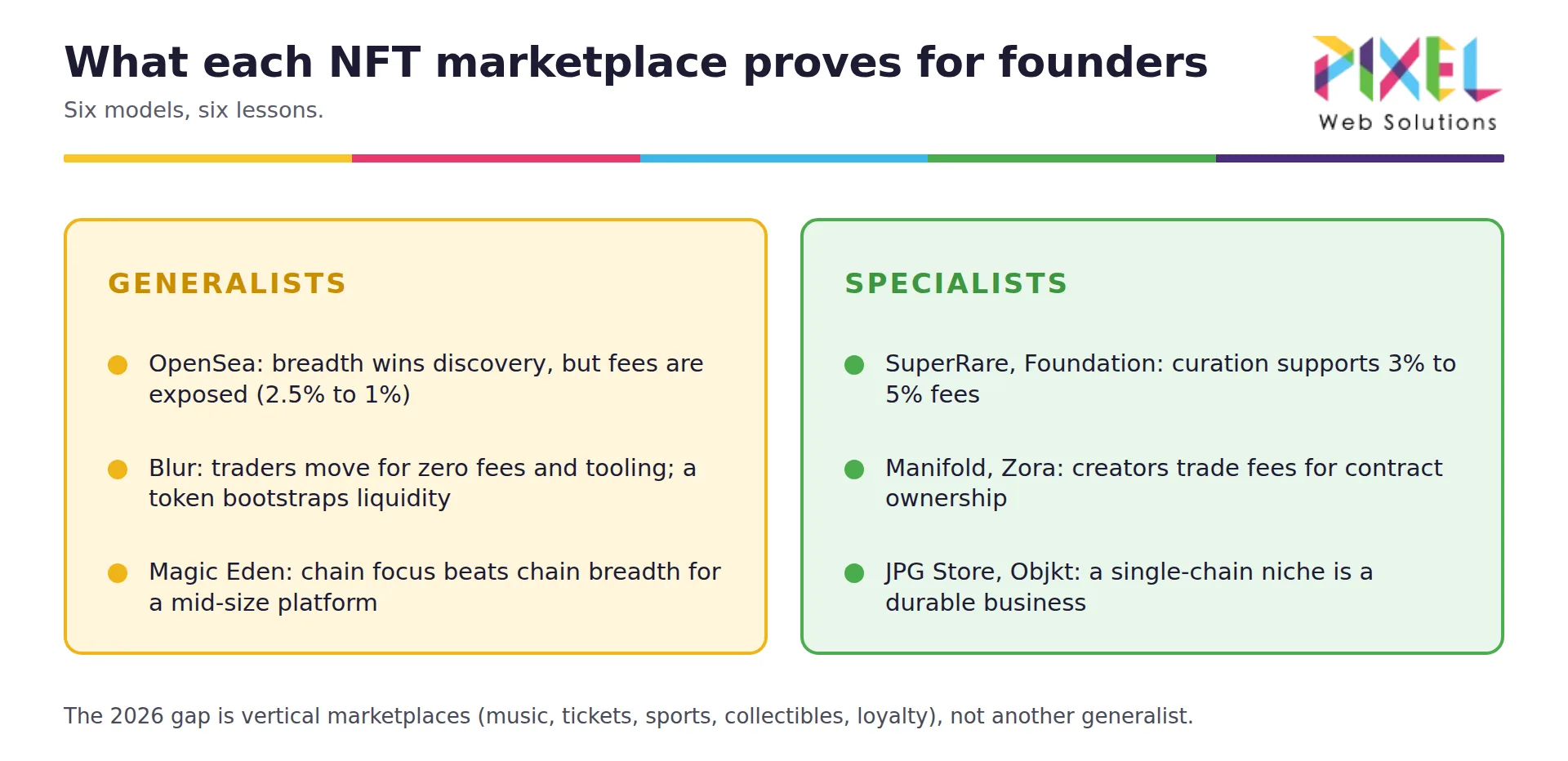
- OpenSea proves breadth wins discovery and that a 1% fee on a dominant share beats 2.5% on a shrinking one; it took the majority of 2026 volume after cutting fees.
- Blur proves zero fees and a token can buy volume but not a business: it peaked near $1.43 billion a month in March 2023, traded $19 million in September 2026 and closes its site in November.
- Magic Eden proves chain focus beats chain breadth for a mid-size platform; it cut the products that cost 80% and earned 20%.
- SuperRare proves curation supports higher fees (3% buyer fee plus 15% on primary) when the audience is collectors, not traders, and that a DAO treasury can outlast a venture-backed rival such as Foundation.
- Manifold proves creators will trade a platform fee for contract ownership, and 2026's closures proved why: creator-owned contracts survived, platform-held listings did not.
- Courtyard, Sorare and NBA Top Shot prove utility and physical backing hold demand when speculative collections do not.
- JPG Store and Nifty Gateway prove a single-chain or single-brand niche needs a second revenue line once chain activity falls.
The gap in 2026 is not another generalist. It is vertical marketplaces (physical-backed collectibles, sports, tickets, music, brand loyalty) with the right chain and the right fee model, and marketplaces for the chains the generalists abandoned.
Building your own NFT marketplace: cost, timeline, build vs buy
Pixel Web Solutions publishes an NFT marketplace development cost of $45,000 to $150,000 for a custom build, with a white-label NFT marketplace as the fast route and NFT collection launches from $5,000. As industry timelines, a white-label marketplace typically goes live in 4 to 8 weeks, a clone-script build of an OpenSea- or Rarible-style product in 2 to 3 months, and a custom vertical marketplace with its own contracts, vaulting or licensing logic in 4 to 6 months. Buy (white-label or clone script) when the format already exists and speed matters; build when the differentiator is the asset type, the fee model or a compliance requirement that off-the-shelf products do not handle.
How to create an NFT marketplace covers the process, features of an NFT marketplace covers the spec, and how NFT marketplaces make money covers the model. For AI-driven discovery and pricing, see how to create an AI-integrated NFT marketplace. Under the hood, every marketplace needs NFT smart contract development and, for a full ecosystem, NFT wallet development or NFT lending.
Pixel Web Solutions, a UAE and India based company, builds NFT marketplaces for art, music, gaming and multi-chain use cases; our work with Digiverse lifted user engagement 30% in six months after a feature overhaul. Contact the team with your niche and chain for a scoped quote.
Frequently Asked Questions
What is the best NFT marketplace in 2026?
OpenSea for most people, with 22 chains, a 1% fee and the most volume. Tensor for Solana traders, SuperRare for artists, Magic Eden for Solana collectibles, Manifold for creator-owned contracts.
What is the biggest NFT marketplace?
OpenSea, by catalogue, chains supported and trading volume: $557 million in the twelve months to October 2026 against $235 million for Blur, which closes its site on 12 November 2026.
Which NFT marketplace has the lowest fees?
Manifold charges no platform fee. OpenSea charges 1% on secondary sales and 0% on swaps, and Tensor charges makers 0% and takers 2%.
What is the best NFT marketplace for beginners?
OpenSea, then Magic Eden on Solana. NBA Top Shot and Sorare are the easiest entry points if you want a licensed collectible rather than a crypto-native one.
What is the best NFT marketplace for artists?
SuperRare for curated art, Manifold for contract ownership, Rarible for multi-chain reach, Objkt for photography on Tezos.
Is Blur shutting down?
Yes. Blur announced on 12 October 2026 that its website closes on 12 November 2026 and that Blend stops matching loans the same day; the smart contracts stay on-chain, so listings remain reachable through aggregators.
Is Magic Eden multi-chain?
Not in 2026. It closed its Ethereum, Polygon, Base and Bitcoin Ordinals marketplaces from 9 March 2026 to focus on Solana.
What happened to Foundation and JPG Store?
Foundation went offline in April 2026 after its sale fell through and says it will not resume operations; JPG Store, the main Cardano marketplace, closed on 23 May 2026. Tokens from both remain in holders' wallets.
Where can I buy an NFT?
On any of the live marketplaces above, after setting up a wallet for the chain and verifying the collection's contract address.
Can I build my own NFT marketplace?
Yes. White-label builds launch fastest; custom builds at $45,000 to $150,000 suit a vertical or format no existing marketplace serves. See the development guides linked above.