A crypto payment gateway API is a REST interface that lets your website or app create a crypto invoice, give the customer a payment address or hosted checkout, watch the blockchain for the transfer, and tell your server through a signed webhook when the money has arrived and settled. Most hosted APIs charge 0.25% to 2% of each payment, and a sandbox lets you test the whole flow before you touch real coins. If you process enough volume, building your own gateway from $6,000 can beat renting one.
This guide is written for two readers. The developer who has to wire crypto checkout into a product by Friday, and the founder deciding whether to integrate a third-party crypto payment gateway API or own the stack. Both get the same thing here: the request and webhook lifecycle, a sample call, eight live APIs compared on fees, custody and KYC as of October 2026, and the maths for when a custom build pays off.
Key Takeaways
- The flow is always the same four steps: create an invoice or payment, show the address or checkout URL, receive signed webhooks as the status changes, then settle in crypto, stablecoin or fiat.
- Fees range from 0% to 2%. BTCPay Server is free and self-hosted, CryptAPI and NOWPayments start at 1% with volume discounts, BitPay charges 2% plus 25 cents under $500,000 a month, and Cryptomus starts at 2% for new accounts.
- Custody decides your compliance load. Non custodial APIs (CryptAPI, NOWPayments, BTCPay) forward coins straight to your wallet; custodial processors (BitPay, CoinGate, Triple-A) hold funds, convert to fiat and run KYB on you.
- Webhook security is where integrations break. Every provider signs callbacks differently: HMAC-SHA512 at NOWPayments, MD5 over base64 JSON at Cryptomus, HMAC-SHA256 in a BTCPay-Sig header at BTCPay. Verify the signature, then re-fetch the payment by ID before you ship goods.
- Coinbase Commerce is gone. Coinbase closed the Commerce portal after 31 March 2026 and moved merchants to Coinbase Business, which is open to US and Singapore entities only, so legacy X-CC-Api-Key integrations need replacing.
- Build when fees pass about $2,200 a month. At a 1% third-party fee, a $6,000 stablecoin gateway with $2,000 a month in running costs breaks even near $217,000 of monthly volume.
What a Crypto Payment Gateway API Actually Does
A card gateway talks to Visa and Mastercard on your behalf. A cryptocurrency payment gateway API talks to blockchains on your behalf. Instead of running Bitcoin, Ethereum, Tron and Solana nodes, tracking confirmations and sweeping hot wallets, you call an endpoint, get back an address or a checkout link, and wait for a callback.
Under the hood the provider runs five services: a pricing engine that locks a fiat amount into a crypto amount for a short window (usually 15 minutes), an address generator that derives a fresh deposit address per order, a blockchain watcher that detects the transfer and counts confirmations, a webhook dispatcher that posts status changes to your server, and a settlement engine that forwards, converts or pays out the funds.
The business case behind the API is the growth of stablecoins. USD-pegged stablecoins in circulation reached about $303 billion as of 26 October 2026 according to the DefiLlama stablecoins dashboard, with USDT at roughly $182 billion and USDC at $72 billion. A merchant accepting USDC on Base or USDT on Tron takes a dollar-denominated payment that settles in seconds for cents in network fees and carries no chargeback risk.
How the API Flow Works, Endpoint by Endpoint
Every provider names things slightly differently, but the lifecycle is identical. Here is the sequence your code will implement.
| Step | What your server calls | What the gateway returns | What to store |
|---|---|---|---|
| 1. Quote | GET /estimate or GET /min-amount |
Crypto amount for a fiat price, minimum accepted | Nothing permanent |
| 2. Create | POST /payment, /orders, /invoices or /charges |
Payment ID, deposit address or hosted payment_url, expiry |
Payment ID against your order ID |
| 3. Present | Nothing | You show the QR code, address and amount, or redirect to the hosted page | Expiry time, to stop late payments |
| 4. Notify | Nothing (the gateway POSTs to your callback_url) |
Status, amount paid, transaction hash, signature header | Webhook UUID for idempotency |
| 5. Verify | GET /payment/{id} |
Authoritative current status | Final status, amount received |
| 6. Settle | POST /payout or automatic |
Transfer to your wallet or bank | Settlement reference for accounting |
| 7. Refund | POST /refunds where supported |
Refund ID and status | Refund reference |
Step 1, quote. NOWPayments exposes /v1/estimate and /v1/min-amount, documented in its OpenAPI specification. Minimums matter: a $2 order in Bitcoin can fall below the provider's floor and fail.
Step 2, create. The create call carries a fiat price_amount and price_currency, your order_id, a callback_url and, optionally, the coin the customer will pay with. CoinGate's create order endpoint also takes receive_currency, which can be EUR, USD, GBP, BTC or DO_NOT_CONVERT, so the settlement decision is made at creation time.
Step 4, notify. Webhooks fire on every status change: waiting, confirming, confirmed, partially paid, finished, expired, failed, refunded. Cryptomus lists eleven statuses in its webhook documentation, including paid_over and wrong_amount, which you must handle, because customers overpay and underpay constantly.
Step 5, verify. Treat the webhook as a hint, not as truth. Pull the payment by ID with your API key and act on that response. This protects you even if your signature check has a bug.
Sample Request: Creating a Crypto Invoice
The call below creates a 49 euro order on CoinGate's sandbox, settles in EUR and asks for callbacks. Swap the host for api.coingate.com in production. The fields come from the CoinGate API reference.
curl -X POST https://api-sandbox.coingate.com/api/v2/orders \
  -H "Authorization: Token YOUR_SANDBOX_API_TOKEN" \
  -H "Content-Type: application/json" \
  -d '{
    "order_id": "SHOP-10482",
    "price_amount": 49.00,
    "price_currency": "EUR",
    "receive_currency": "EUR",
    "title": "Annual plan",
    "description": "12 months of Pro access",
    "callback_url": "https://shop.example.com/webhooks/coingate",
    "success_url": "https://shop.example.com/thanks",
    "cancel_url": "https://shop.example.com/cart",
    "token": "a-random-secret-you-generated"
  }'
The response includes id, status (initially new), payment_url and token. Redirect the shopper to payment_url, store id against SHOP-10482, and wait.
Here is the receiving side for a different provider, NOWPayments, whose instant payment notifications carry an x-nowpayments-sig header. The provider's documentation says to sort the body keys alphabetically, serialise them, and sign with HMAC-SHA512 using the IPN secret from your dashboard, not your API key.
// Express handler for NOWPayments IPN callbacks
const crypto = require("crypto");

app.post("/webhooks/nowpayments", express.json(), async (req, res) => {
  const received = req.get("x-nowpayments-sig");
  const sorted = JSON.stringify(req.body, Object.keys(req.body).sort());
  const expected = crypto
    .createHmac("sha512", process.env.NOWPAYMENTS_IPN_SECRET)
    .update(sorted)
    .digest("hex");

  if (!crypto.timingSafeEqual(Buffer.from(received), Buffer.from(expected))) {
    return res.status(401).send("bad signature");
  }

  // Idempotency: ignore a payment_id and status pair you have already processed
  if (await alreadyHandled(req.body.payment_id, req.body.payment_status)) {
    return res.sendStatus(200);
  }

  // Never trust the body alone: re-fetch the payment before fulfilling
  const payment = await nowpayments.getPayment(req.body.payment_id);
  if (payment.payment_status === "finished") {
    await fulfilOrder(payment.order_id, payment.actually_paid);
  }
  res.sendStatus(200);
});
Three habits in that handler save real money. Constant-time comparison stops timing attacks on the signature. The idempotency check matters because CryptAPI, for one, retries callbacks with exponential backoff for up to three days, so the same event will arrive twice. And the re-fetch means a forged or replayed webhook can never ship a product.
Webhooks and Settlement: Where Integrations Go Wrong
Payment APIs look simple until money is in flight. These are the edge cases every gateway surfaces and every integration must handle.
Underpayment and overpayment. Wallets round, exchanges deduct withdrawal fees, and customers type the wrong amount. NOWPayments has a partially_paid status and lets you chain a second payment to the same purchase_id so the customer can top up. Decide in advance whether a 2% shortfall is accepted, refunded or chased.
Expiry and late payment. Prices are locked for a window. BitPay's acceptanceWindow defaults to 15 minutes according to its invoice documentation. A transfer that lands after expiry still exists on chain; your code needs a path to refund it or apply it manually.
Confirmation policy. One Tron confirmation is seconds; six Bitcoin confirmations can be an hour. CryptAPI lets you set confirmations per request and will send a pending callback first if you ask for it. Match the policy to order value.
Chain reorganisations and failed transactions. A payment can be seen, then vanish. That is why "confirmed" and "finished" are separate statuses and why you fulfil only on the final one.
Settlement models. You have four choices and most APIs support two or three of them: hold the crypto you were paid, auto-convert to a stablecoin, auto-convert to fiat and receive a bank payout, or split by merchant. CoinGate settles in EUR, GBP, USD or crypto and charges 0.50 EUR plus 0.5% on crypto payouts according to its pricing page. BitPay promises daily fiat settlement in seven currencies. Non custodial APIs skip settlement entirely because the coins are forwarded to your wallet on confirmation.
8 Crypto Payment Gateway APIs Compared (October 2026)
Fees and features below were read from each provider's own pricing or documentation pages in late October 2026. Negotiated rates differ, and network fees are always extra.
| API | Headline fee | Custody | Settlement | Merchant KYC or KYB | Sandbox | Webhook signing |
|---|---|---|---|---|---|---|
| NOWPayments | 1% service fee, lower at volume | Non custodial, forwards to your wallet | 350+ coins, convert to a coin of your choice | Account required; verification unlocks lower fees | Yes, separate sandbox host and keys | HMAC-SHA512, x-nowpayments-sig |
| CoinGate | 1% on Standard, custom on Enterprise | Custodial | EUR, GBP, USD or crypto; SEPA withdrawals free from 50 EUR | Business onboarding | Yes, api-sandbox.coingate.com |
Shared token returned in callbacks |
| BitPay | 2% + 25 cents under $500,000 a month, down to 1% + 25 cents above $1 million | Custodial | Daily fiat in USD, EUR, GBP, CAD, AUD, NZD, MXN or crypto and stablecoins | Business onboarding, US compliance programme | Yes, test.bitpay.com |
Token plus optional ECDSA X-Signature |
| Cryptomus | 2% for new accounts, negotiable to 0.4% | Custodial wallet, free auto-convert | Crypto; conversion free | Business verification | Webhook test tool, no full sandbox | MD5 of base64 JSON plus API key, sign field |
| CryptAPI | 1% by default, down to 0.25% at volume, plus network fees | Non custodial, forwards per payment | Coins forwarded to up to 20 addresses | No account for the create endpoint | Testnets per coin | Signature verification guide, *ok* acknowledgement |
| Coinbase Business (replaced Coinbase Commerce) | Not published; legacy Commerce was 1% | Custodial | USDC and fiat off-ramp | US and Singapore entities only | Not published | Legacy X-CC-Webhook-Signature retired with Commerce |
| Triple-A | On request | Custodial, licensed | Next-day local currency settlement, rate locked at payment | Full KYB, licensed in Singapore, EU, US, Canada | On request | Managed API |
| Speed | 0% from Speed Wallet, 1% from external wallets | Custodial with instant settlement | BTC, USDT, USDC; off-ramp 0.5% | Business onboarding | Test mode in dashboard | HMAC-SHA256 over id, timestamp and body |
A few notes on individual entries.
NOWPayments describes itself as non custodial in its API documentation and lists 350+ currencies on its pricing page. Its API is the widest in this list, with endpoints for payments, invoices, payouts, subscriptions and sub-partner accounts.
CoinGate is the easiest fiat-settlement option for a European merchant. Its pricing shows free SEPA withdrawals above a 50 EUR minimum and 0.25 EUR plus 0.1% refund fees.
BitPay publishes the most detailed fee tiers, adjusted automatically on cumulative monthly volume, with higher rates for high-risk industries.
Cryptomus states a 2% commission for new users and invites merchants to negotiate down to 0.4% on its payment fees page. Its create invoice call is POST https://api.cryptomus.com/v1/payment with merchant and sign headers, per the invoice documentation.
CryptAPI is the purest API in the group: a single GET https://api.cryptapi.io/{ticker}/create/ with your forwarding address and callback returns an address_in for the customer, per its API reference. The headline rate is "down to 0.25%" but the calculator shows 1% at zero volume on the pricing page.
Coinbase Commerce no longer exists as a product. Coinbase's help centre explains the transition to Coinbase Business, with the Commerce portal inaccessible after 31 March 2026 and eligibility limited to US and Singapore businesses while the company expands. If your codebase still calls api.commerce.coinbase.com/charges, plan a migration.
Triple-A is the compliance-first pick. It holds a Major Payment Institution licence from the Monetary Authority of Singapore, a CASP registration with France's AMF, FinCEN MSB registration and FINTRAC registration, listed on its crypto payments page, and settles next day in local currency. Pricing is not published.
Speed is Bitcoin and Lightning first. Its pricing page shows 0% for payments from a Speed Wallet, 1% from external wallets, and 0.5% for off-ramp to ACH, RTP or FedNow.
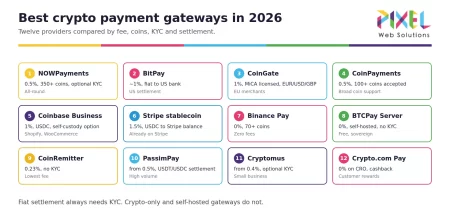
For a broader ranking that includes Binance Pay, Stripe stablecoin payments and CoinPayments, read Pixel's review of the top crypto payment gateways.
What the Fees Cost You: A Worked Example
Assume an online store taking $50,000 a month in crypto across 500 orders averaging $100. Here is what the published headline rates mean in dollars, before network fees and before any negotiated discount.
| API | Fee formula | Monthly cost | Annual cost |
|---|---|---|---|
| BTCPay Server (self-hosted) | 0% plus hosting | $0 plus about $30 hosting | $360 |
| CryptAPI at negotiated 0.25% | 0.25% x $50,000 | $125 | $1,500 |
| NOWPayments at 1% | 1% x $50,000 | $500 | $6,000 |
| CoinGate at 1% | 1% x $50,000, plus payout fees | $500 plus payouts | $6,000 plus payouts |
| Speed, external wallets | 1% x $50,000 | $500 | $6,000 |
| Cryptomus, new account | 2% x $50,000 | $1,000 | $12,000 |
| BitPay, under $500,000 tier | 2% x $50,000 + 500 x $0.25 | $1,125 | $13,500 |
Break-even for owning the gateway. Pixel Web Solutions quotes a stablecoin-focused gateway from $6,000, and the running costs for infrastructure, node access, monitoring and compliance tooling start at about $2,000 a month in the cost to develop a crypto payment gateway guide. Spread the build over 36 months ($6,000 / 36 = $167 a month) and your own gateway costs roughly $2,167 a month.
Against a 1% processor, that equals 1% x V = $2,167, so V = about $216,700 of monthly volume. Below that, rent the API. Above it, every extra dollar of volume is cheaper to process yourself, and you also keep the merchant data, the settlement float and the right to onboard other merchants.
Free and Non Custodial Options
Searchers ask two related questions: is there a free crypto payment gateway, and is there a free crypto API. The answers are different.
Free gateway. BTCPay Server is open source, charges nothing, and gives you the Greenfield REST API: POST /api/v1/stores/{storeId}/invoices with an Authorization: token header, and webhooks signed with HMAC-SHA256 in a BTCPay-Sig header, as shown in its API examples. You pay for a server (about $20 to $50 a month) and you run your own node, so "free" means free of processor fees, not free of work. It is Bitcoin and Lightning first, with altcoins through plugins and no fiat settlement.
Free API. Price data is free: the CoinGecko API has a free tier for quotes, which you need to convert a fiat price into a crypto amount. Payment processing APIs are never free beyond a sandbox, because someone is paying for nodes and compliance.
Non custodial crypto payment gateway. CryptAPI, NOWPayments and BTCPay never hold your funds. Each payment is forwarded to the wallet you specify. That keeps you out of the processor's insolvency risk and, depending on jurisdiction, out of some licensing scope, but it also means no fiat payouts and no chargeback-style dispute handling. If you need USD in a bank account on Monday, you need a custodial processor or your own licensed conversion partner.
How to Choose a Crypto Payment Gateway API: A 10-Point Checklist
Score each candidate from 0 to 2 on every line. Anything under 14 out of 20 will cost you engineering time later.
- Custody model. Does it forward to your wallet or hold funds? Does that match your licensing position?
- Settlement currencies. Can you receive fiat, stablecoin or both, in your country, through a bank you can actually use?
- Published fees. Are the percentage, fixed fee, payout fee, conversion fee and refund fee all on a public page?
- Coins and networks. Does it support USDT on Tron and USDC on Base, Solana or Polygon, which is where most real payment volume sits?
- Sandbox. Is there a separate test host with its own keys, not just a "test webhook" button?
- Webhook design. Signed? Retried with backoff? Documented IP ranges? A UUID for idempotency?
- Partial payment handling. Can you accept, top up or refund underpayments through the API, not just the dashboard?
- Refund endpoint. Is there one? CoinGate and BitPay have them; many smaller APIs do not.
- Documentation quality. Is there an OpenAPI spec or Postman collection, SDKs in your language, and a changelog?
- Compliance posture. Which regulators license the processor, and will it perform KYB on you before go-live?
If three or more lines score zero, the integration is a liability. If you need features the checklist exposes as missing everywhere, you are in build territory.
Build vs Integrate: Which Path Fits Your Business
| Factor | Integrate a third-party API | Build your own gateway |
|---|---|---|
| Time to first payment | 1 to 5 days | 3 to 6 weeks for a stablecoin starter, 10 to 16 weeks for a full gateway |
| Upfront cost | $0 to a few days of developer time | From $6,000 at Pixel for a stablecoin gateway; $20,000 to $60,000 white label |
| Per-transaction cost | 0.25% to 2% plus network fees | Network fees plus about $2,000 a month running costs |
| Merchant data and float | Processor's | Yours |
| Onboard other merchants | No | Yes, with fee revenue |
| Compliance | Processor carries most of it | You carry it, with KYC and screening vendors |
| Best for | Single merchants under $200,000 a month | Marketplaces, SaaS platforms, exchanges, payment companies |
Integrating is the right default for a merchant. Building is the right call in four situations: you process more than about $200,000 a month, you want to offer payments to your own customers or merchants, you need a custody or settlement model no processor offers in your market, or you are an exchange that needs deposit and payout rails under your own licence. Pixel's guide on how to create a crypto payment gateway walks through the seven build steps, and the white label crypto payment gateway route gets a branded product live faster than a scratch build.
For teams only integrating, Pixel has a separate walkthrough on how to integrate a crypto payment gateway into an existing store, and exchange operators should read the note on payment gateway integration for crypto exchanges, where fiat on-ramps rather than merchant checkout are the problem.
How Pixel Web Solutions Can Help
Pixel Web Solutions is a UAE and India based crypto payment gateway development company that has built blockchain software since 2012 from Ras Al Khaimah and Madurai. Its gateway builds ship with REST APIs that use idempotency keys, signed webhooks with retry and replay protection, a sandbox, SDKs and plugins for WooCommerce, Shopify, Magento, PrestaShop and OpenCart, on Bitcoin, Ethereum, Tron, BNB Chain, Solana, Polygon, Arbitrum, Base, Avalanche and Litecoin.
Pricing starts at $6,000 for a stablecoin-focused gateway, with white label launches in 10 to 14 weeks and source code and keys handed over at launch with no revenue share. Teams that want a stablecoin rail rather than a full merchant product can start with the cost to build stablecoin payments infrastructure guide. To get a settlement model review and a fixed-price estimate within 48 hours, contact Pixel Web Solutions.
Frequently Asked Questions
Is there a crypto payment gateway?
Yes, dozens. The hosted ones with public APIs include NOWPayments, CoinGate, BitPay, Cryptomus, CryptAPI, Triple-A and Speed, and the self-hosted option is BTCPay Server. Each exposes a create-payment endpoint, a status endpoint and webhooks; they differ on custody, fees, settlement currencies and the regulators that license them.
Is there a free cryptocurrency payment gateway available?
BTCPay Server is free, open source and charges no processor fee. You host it yourself for roughly $20 to $50 a month and run your own Bitcoin node, so the cost is in operations rather than fees. Hosted processors that advertise "0%" usually mean payments between wallets on their own platform, such as Speed Wallet to Speed Wallet, while external payments cost 1%.
How to create a crypto payment gateway?
Pick the chains and stablecoins, choose a custodial or non custodial model, then build five services: pricing and invoice creation, HD-wallet address generation, a blockchain watcher per chain, a signed webhook dispatcher, and a settlement and ledger engine. Add KYC, AML screening and a merchant dashboard, test on testnets and with a penetration test, and launch to a merchant beta. Pixel's stablecoin starter takes 3 to 6 weeks from $6,000; a full multi-chain gateway with fiat settlement takes 10 to 16 weeks.
Is there a free crypto API?
For market data, yes: CoinGecko's public API has a free tier for prices, which is what you need to convert a fiat price into a crypto amount. For payment processing, only sandboxes are free. CryptAPI comes closest, with no account needed to call its create endpoint, but it still takes a percentage of each payment.
Which crypto API is the best?
It depends on your settlement need. NOWPayments has the widest coin list and a full sandbox for non custodial acceptance. CoinGate is the best fit for European merchants that want EUR in a bank account. BitPay suits US merchants with daily fiat settlement. Triple-A is the choice when your compliance team needs a licensed counterparty in Singapore, the EU or the US. BTCPay Server is best for Bitcoin businesses that want zero fees and full custody.
How do I accept crypto payments on my website or through an API?
Install a plugin if you run WooCommerce, Magento or PrestaShop and want to be live today. Otherwise create a sandbox account with a provider, call its create-payment endpoint from your server with the order amount, redirect the customer to the returned checkout URL or show the address and QR code, and write a webhook handler that verifies the signature, checks idempotency, re-fetches the payment and fulfils the order on the final status. Move to production keys once the sandbox flow passes.
What does a custom crypto payment gateway cost?
A stablecoin-focused gateway starts at $6,000 and a white label gateway with merchant dashboard, plugins and conversion runs $20,000 to $60,000 at Pixel Web Solutions. A custom multi-chain build with fiat settlement and advanced compliance is $50,000 to $150,000 or more. Running costs after launch start at about $2,000 a month.
A crypto payment gateway API turns a hard infrastructure problem into a few HTTP calls and a webhook handler. Pick a provider whose custody model, settlement currencies and fee schedule fit your market, verify every callback, and move to your own gateway once the fee maths says you should.