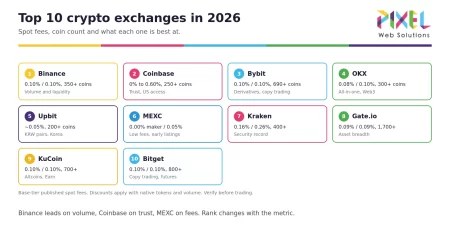
The biggest crypto exchange success stories, Binance, Coinbase, Kraken, Bybit and OKX, share three habits: they built deep liquidity and a product users trust, they survived a major crisis, and they eventually invested heavily in licences. FTX shows the other side: it grew just as fast but collapsed in 2022 because customer funds were misused. This guide tells each story with 2026 figures and turns them into lessons for anyone launching an exchange.
You will come across many success stories in the crypto industry. But have you ever wondered how the founders behind them overcame the challenges along the way?
Creating a successful cryptocurrency exchange is hard. It means meeting strict crypto exchange regulations, putting security first and competing in a crowded market. The leaders below each hit at least one crisis that could have ended them, which is exactly why their stories are useful.
These crypto exchange success stories offer practical lessons, inspiration and a guide for newcomers who want to make their mark in the fast-moving world of cryptocurrency.
Key Takeaways
- Scale is real, and still growing: Binance reported more than 323 million registered users in July 2026, and Coinbase earned $7.2 billion in revenue in 2025.
- Every leader survived a crisis: Binance and OKX paid large US settlements, Bybit absorbed a $1.5 billion hack in February 2025, and Kraken grew through several market crashes.
- Compliance became a growth strategy: Coinbase joined the S&P 500 in May 2025, and Binance secured a global licence from Abu Dhabi's ADGM FSRA.
- FTX is the cautionary tale: customer funds were misused, the exchange collapsed in November 2022, and its founder was sentenced to 25 years in prison.
- The lessons are buildable: cold storage, proof of reserves, segregated customer funds and licence-ready KYC can all be designed in from day one.
Top 5 Crypto Exchange Success Stories
Behind every exchange are leaders whose strategies and determination shaped the industry. Here is an in-depth look at the top 5 crypto exchange success stories, the people behind them and what each one teaches.
1. Changpeng Zhao (CZ): Binance
Changpeng Zhao, commonly known as CZ, founded Binance, which became the largest cryptocurrency exchange in the world. Binance launched in July 2017 and stood out with a user-friendly interface, a broad selection of cryptocurrencies and low trading fees.
CZ's journey began in technology, where he built trading software for financial markets. His vision for Binance was a platform that served both new and experienced traders. Several key factors drove Binance's success.
Innovation: Binance moved quickly into new products, including BNB Chain (formerly Binance Smart Chain), which became a major network for decentralized finance (DeFi), plus futures, P2P trading, Earn products and token launch programmes.
User-Centric Approach: low trading fees, a long list of supported cryptocurrencies and fast execution made it popular with traders.
Global Expansion: localized versions and fiat payment options in many markets helped it reach a broad audience. On its ninth anniversary in July 2026, Binance reported more than 323 million registered users in over 100 countries and $156.4 trillion in all-time trading volume.
The setback: rapid global growth outran compliance. In November 2023, Binance pleaded guilty in the US to anti-money laundering and sanctions violations and agreed to pay $4.3 billion; CZ pleaded guilty, stepped down as CEO and served a four-month prison sentence. He was pardoned by President Trump in October 2025. Binance, now led by co-CEOs Richard Teng and Yi He, has since rebuilt around licences, including a global authorisation from Abu Dhabi's ADGM FSRA.

The lesson: product speed and low fees win users, but compliance must scale at the same pace, or the bill arrives later and much larger.
Inspired by Binance's innovation? Launch your own platform with Pixel Web Solutions' customizable Binance clone script, which replicates key features with robust security and scalability.
2. Brian Armstrong: Coinbase
Brian Armstrong is the co-founder and CEO of Coinbase, one of the best-known cryptocurrency exchanges in the United States. Coinbase was founded in 2012 and played a major role in bringing crypto to mainstream audiences. Its simple interface and focus on regulatory compliance made it a trusted platform for many.
Armstrong's vision was an easy and secure way for people to buy, sell and store cryptocurrencies. Under his leadership, Coinbase achieved several milestones.
Regulatory Compliance: Coinbase's choice to work with regulators helped it navigate complex rules and build trust with users and institutions.
User Experience: an intuitive design and educational resources made it accessible to beginners, with advanced tools for experienced traders.
Public Listing: in April 2021, Coinbase went public through a direct listing on Nasdaq. In May 2025, it joined the S&P 500, the first crypto-focused company to do so.
Results: according to its fourth-quarter 2025 shareholder letter, Coinbase earned $7.2 billion in revenue in 2025, up 9%, its trading volume grew 156% to $5.2 trillion, and more than 12% of all crypto in the world was held on Coinbase.

The setback: in May 2025, criminals bribed overseas support contractors to copy customer data, an incident Coinbase expected to cost $180 million to $400 million. No passwords, private keys or funds were exposed.
The lesson: trust is the product. Custody, compliance and internal access controls are what let a regulated exchange charge for convenience.
Coinbase built its reputation on a simple interface and strong compliance, making it a go-to exchange for beginners in the US. If you want a similar compliant, beginner-friendly exchange, explore Pixel Web Solutions' Coinbase clone script, a customizable platform built for security, scalability and smooth UX.
3. Jesse Powell: Kraken
Jesse Powell co-founded Kraken, a cryptocurrency exchange known for security and a wide range of supported assets. Kraken was founded in 2011 and opened to the public in 2013. Powell led it as CEO until 2022, and co-CEO Arjun Sethi now leads the company.
Powell's background in technology and security shaped Kraken's development. Key factors behind its success include:
Security: Kraken has consistently prioritized security and was an early adopter of proof-of-reserves audits that let users verify their balances are backed.
Diverse Offerings: the platform supports many cryptocurrencies and trading options, including futures and margin trading where permitted.
Customer Support: strong customer support and transparent operations earned it a loyal user base.
Results: Kraken's parent, Payward, reported 2025 revenue of more than $2.2 billion, up 33%, with 5.7 million funded accounts (up 50%), $48.2 billion in assets on the platform and $2.0 trillion in trading volume. About 53% of revenue came from asset-based and other sources rather than trading.

The lesson: a reputation for security compounds. Kraken's diversified revenue also shows why an exchange should not depend on trading fees alone.
4. Ben Zhou: Bybit
Ben Zhou is the co-founder and CEO of Bybit, a cryptocurrency exchange that started with derivatives and gained prominence for its trading features. Since its launch in 2018, Bybit has become a major player in crypto futures and expanded into spot trading, Earn products and more. In May 2025, it said it had passed 70 million registered users.
Zhou's experience in trading and finance shaped Bybit's development. The platform's success can be attributed to:
Innovation: advanced charting tools and derivatives products attracted active traders.
User Experience: a clean design and high-speed performance suit traders who want fast, efficient execution.
Customer Engagement: Bybit engages its community through educational resources and promotional events.
The setback: on 21 February 2025, attackers stole about $1.5 billion in Ether from a Bybit cold wallet by tricking the signing process, the largest crypto theft on record. The FBI attributed the theft to North Korea's "TraderTraitor" hackers. Bybit kept operating, and within days Zhou said it had fully closed the Ether gap through loans and purchases, then published a fresh proof-of-reserves report.

The lesson: even cold wallets can be attacked through the signing interface. Fast, transparent crisis communication and enough reserves to stay solvent decided whether users stayed.
5. Star Xu: OKX (formerly OKEx)
Star Xu founded OKCoin in 2013. Its global exchange, OKEx, rebranded as OKX in 2022 and became one of the world's largest cryptocurrency exchanges. OKX offers a wide range of trading options, including spot trading, futures, options and a self-custody Web3 wallet.
Xu's vision for OKX was a comprehensive platform for many types of traders. The exchange's success can be attributed to:
Comprehensive Services: a broad product range, including DeFi access through its Web3 wallet.
Global Reach: localized services in many regions. In January 2025, OKX's Malta hub received a MiCA licence, letting it offer regulated services across the European Economic Area.
Technology: continued investment in trading infrastructure and security.
The setback: in February 2025, OKX's operating company pleaded guilty in New York to running an unlicensed money transmitting business that served US customers, and agreed to pay more than $504 million in penalties, according to the US Attorney's Office for the Southern District of New York.
Xu's ability to adapt to market trends and regulation has played a crucial role in OKX's growth in a competitive market.

The lesson: serving a market without a licence is a debt that comes due. Geo-blocking and KYC are growth tools, not obstacles.
Each of these leaders shaped the crypto exchange market with different strategies. All of them adapted, and all of them learned from at least one hard lesson.
The Cautionary Case: What FTX Teaches
A list of crypto exchange success stories is incomplete without the failure that changed the industry. FTX, founded in 2019, grew into one of the largest exchanges within three years and then collapsed in days.
- What went wrong: in November 2022, a run on deposits exposed a hole in FTX's balance sheet. Customer funds had been moved to its sister trading firm, Alameda Research.
- The verdict: founder Sam Bankman-Fried was convicted of fraud and conspiracy in November 2023. In March 2024, he was sentenced to 25 years in prison and ordered to forfeit more than $11 billion, after prosecutors showed he had misappropriated billions of dollars of customer deposits and defrauded investors of more than $1.7 billion and lenders of more than $1.3 billion, according to the US Attorney's Office for the Southern District of New York.
- The aftermath: the FTX Recovery Trust has repaid creditors in several rounds. After its March 2026 distribution, about $10 billion had been paid out, but claims were valued at November 2022 prices, well below later crypto prices, so many customers still feel short-changed.
The lesson: governance and custody design are not paperwork. Segregate customer assets from company funds, publish proof of reserves with liabilities, keep independent control over treasury movements and give the board real oversight.
Success Scorecard: The Six Exchanges Side by Side
| Exchange | Founded | Latest sourced figure | Defining move | Biggest setback | Lesson for founders |
|---|---|---|---|---|---|
| Binance | 2017 | 323M+ registered users (July 2026) | Low fees and fast product launches | $4.3B US settlement (2023) | Scale compliance with growth |
| Coinbase | 2012 | $7.2B revenue in 2025 | Compliance-first, US public listing | Insider data breach (2025) | Trust and custody are the product |
| Kraken | 2011 | $2.2B+ revenue in 2025 | Security and proof of reserves | Repeated market downturns | Diversify beyond trading fees |
| Bybit | 2018 | 70M+ registered users (May 2025) | Derivatives-led growth | $1.5B hack (2025) | Plan crisis reserves and communication |
| OKX | 2013 (as OKCoin) | MiCA licence via Malta (2025) | Broad products plus Web3 wallet | $504M US plea (2025) | Do not serve unlicensed markets |
| FTX | 2019 | About $10B repaid to creditors (2026) | Aggressive growth and marketing | Collapse and fraud (2022) | Segregate customer funds |
Insights From the Crypto Exchange Success Stories
These success stories offer valuable insights for anyone planning to launch a crypto exchange. Understanding the money side matters as much as strategy; our guide to the crypto exchange development cost helps you estimate the initial investment and running costs, and evaluate returns.
The winners kept doing three things:
- Launching native tokens and ecosystems, such as BNB and BNB Chain,
- Expanding service offerings beyond spot trading,
- Investing in high-performance, secure technology.
Their achievements underline the importance of user trust, regulatory compliance and adaptability.
However, their journeys also reveal common pitfalls:
- Navigating complex regulatory landscapes, often after the fact,
- Dealing with security breaches, including attacks on signing processes and staff,
- Managing customer service during market spikes.
Turning the Lessons Into Build Decisions
| Lesson | What to build into your exchange |
|---|---|
| Compliance must keep pace with growth | KYC, transaction monitoring, sanctions screening and Travel Rule tools in version one |
| Cold wallets can be attacked through signing | Multi-party signing (MPC or multi-signature), independent transaction verification and hardware wallets for signers |
| Trust needs proof | Regular proof-of-reserves reports that include liabilities |
| Customer funds must be ring-fenced | Segregated customer ledgers and wallets, separate from company treasury |
| Insiders are an attack surface | Least-privilege support tools, data masking and audit logs |
| Revenue should not depend on one stream | Staking, Earn, P2P, payments and subscriptions alongside trading fees |
Our guide to the role of security in a crypto exchange explains these controls in more detail.
For startups, focusing on regulation and strong security protects user assets and data from the start. Planning for growth and good customer support prevents problems before they reach users. Startups that address these areas early position themselves for long-term success and resilience, but doing it without the right expertise is hard.
Also Read: How to start a crypto exchange business
Want to Join the List of Entrepreneurs With Successful Crypto Exchanges?
Pixel Web Solutions is a trusted cryptocurrency exchange development company backed by a team of certified developers with deep industry expertise. It operates from Ras Al Khaimah, UAE and Madurai, India, and builds secure, scalable and user-friendly trading platforms tailored to the demands of the crypto market.
It applies the lessons from the industry's pioneers: licence-ready KYC and AML, cold and hot wallet architecture with multi-party signing, proof-of-reserves reporting and a smooth user experience. This helps emerging exchanges avoid common mistakes and position themselves for success. A white-label exchange from Pixel Web Solutions costs $25,000 to $50,000, and a custom exchange $100,000 to $150,000 or more.
Dive Deeper: Pixel Web Solutions' Crypto Exchange Case Studies
To show the process and strategies behind real projects, here are two case studies from the Pixel Web Solutions portfolio.
-
Altcoin Traders Case Study: a South Africa-based centralized exchange for crypto-to-fiat trading, supporting more than 35 cryptocurrencies plus gold and silver. The case study covers its security features, including 2FA, DDoS protection and KYC, and reports 500,000 concurrent users and about 140,000 monthly visits.
-
Savita Case Study: a global exchange focused on peer-to-peer order book trading, with lending, loans, a custom IEO launchpad and e-commerce services. The case study reports support for more than 200 cryptocurrencies, more than 21,000 active users and a 0.10% trading fee.
Each case study shows how the same lessons, security, liquidity and diversified revenue, apply to a new exchange. If you want to write your own crypto exchange success story, talk to the Pixel Web Solutions team.
Frequently Asked Questions
What is the most successful crypto exchange?
By users and volume, Binance. It reported more than 323 million registered users and $156.4 trillion in all-time trading volume in July 2026. By revenue among public companies, Coinbase leads, with $7.2 billion in 2025.
What made Binance so successful?
Low fees, a very wide range of assets, fast product launches, its own token and blockchain (BNB and BNB Chain), and global expansion. Its growth also came with a $4.3 billion US settlement in 2023, which pushed it to rebuild around licences.
Why did FTX fail?
Customer funds were moved to its sister trading firm, Alameda Research, without customers' knowledge. When users rushed to withdraw in November 2022, FTX could not pay them and filed for bankruptcy.
Which crypto exchange was hacked the most in history?
The largest single theft was the roughly $1.5 billion taken from Bybit in February 2025, which the FBI attributed to North Korea. Bybit replaced the stolen Ether within days and kept operating.
What can new exchanges learn from these success stories?
Build trust first: cold storage, multi-party signing, proof of reserves and segregated customer funds. Get licensed in your launch markets, and diversify revenue beyond trading fees.
How much does it cost to start a crypto exchange?
With Pixel Web Solutions, a white-label crypto exchange costs $25,000 to $50,000, and a custom exchange $100,000 to $150,000 or more. Licences, liquidity and running costs are extra.