






A crypto exchange license is the authorisation a regulator grants before you can match buy and sell orders in crypto assets for customers in its market. In 2026 the main routes are FinCEN registration plus state money transmitter licences in the US, a MiCA CASP authorisation in the EU, FCA authorisation in the UK, a VARA or ADGM licence in the UAE, an MAS payment institution licence in Singapore, FIU-IND registration in India and an SFC platform licence in Hong Kong. Regulator fees run from zero to about $34,000 a year, minimum capital from nothing to roughly $1 million, and the clock runs 3 to 18 months.
This guide is for founders choosing where to license a spot exchange and for operators extending into a second market. Every fee and capital figure below comes from the regulator's own rulebook or fee schedule as read in October 2026, with the link in the sentence. Where a regulator publishes no number, the guide says so rather than guessing. It ends with a first-year budget worked through for one jurisdiction, a decision framework, and what each licence demands of the exchange software you build.
Key Takeaways
- Licences are activity-based. Regulators license "operating a trading platform", "exchange services" or "dealing", not "a crypto company". Add custody, broker-dealer or derivatives and the fee, capital and timeline all rise.
- Capital is the real cost, not the fee. VARA wants paid-up capital of AED 1.5 million or 25% of fixed overheads for exchange services; MiCA sets EUR 150,000 or one quarter of fixed overheads for a trading platform; the UK FCA sets GBP 150,000; Hong Kong wants HK$5 million paid-up plus HK$3 million liquid.
- Fees range widely. FinCEN registration is free and FIU-IND registration has no published fee, while VARA charges AED 100,000 to apply and AED 200,000 a year, and ADGM charges $125,000 to apply and $60,000 a year for a virtual asset trading venue.
- Two windows matter in 2026 and 2027. MiCA's transitional period closed on 1 July 2026, and the UK's authorisation gateway runs from 30 September 2026 to 28 February 2027 ahead of a 25 October 2027 start.
- Offshore-only is no longer a shortcut. India requires offshore platforms serving Indian users to register and has issued notices to non-compliant exchanges, and Hong Kong licenses any platform actively marketing to its investors.
- Your licence sets your tech spec. Cold storage percentages, segregation, travel rule messaging and record keeping are written into the rules, so the licence decision belongs at the start of the build, not after it.
What a Crypto Exchange License Actually Covers
Regulators do not hand out one "crypto exchange license". They authorise specific activities, and an exchange usually needs several.
| Activity | What it means | Who needs it |
|---|---|---|
| Operating a trading platform or exchange | Running the order book that matches third-party buy and sell orders | Every centralised spot exchange |
| Exchange of crypto for fiat or other crypto | Dealing against your own book or acting as counterparty | Brokerage-style and instant-swap exchanges |
| Custody or safeguarding | Holding customer keys and assets | Any exchange that holds client funds, which is almost all of them |
| Broker-dealer or dealing as agent | Executing or arranging orders for clients | Exchanges with OTC desks or routed liquidity |
| Transfer and settlement | Moving assets between users or to external wallets | Exchanges with withdrawal and payment functions |
| Derivatives | Perpetuals, futures and options on crypto | Separately regulated almost everywhere, often under securities or commodities law |
A spot exchange that holds client assets typically needs the first, third and fifth rows. Under MiCA that makes it a Class 3 provider. Under VARA it means Exchange Services plus either Custody Services or a contract with a VARA-licensed custodian. The sections below walk through each regime in the order most founders evaluate them, and the comparison table pulls the numbers together.
Crypto Exchange License Requirements, Cost and Timeline: The Comparison
Figures are from regulator publications read in October 2026. Timelines are Pixel Web Solutions' planning ranges where the regulator publishes no service standard, which is the case for every jurisdiction here except the EU's statutory review clock.
| Jurisdiction and regulator | Licence for a spot exchange | Application fee | Annual fee | Minimum capital | Typical timeline |
|---|---|---|---|---|---|
| United States: FinCEN plus states | MSB registration plus state money transmitter licences; NYDFS BitLicense in New York | FinCEN: none. NYDFS BitLicense: $5,000 | FinCEN: none. NYDFS: cost-recovery assessment | Set by each state (net worth and surety bond) | 6 to 18 months for a multi-state footprint |
| European Union: national authority under MiCA | CASP authorisation, Class 3 for a trading platform, passportable to all member states | Set by each member state | Set by each member state | EUR 150,000 or one quarter of fixed overheads, whichever is higher | 25 working days completeness check plus assessment; 6 to 12 months in practice |
| United Kingdom: FCA | Authorisation for operating a cryptoasset trading platform, plus safeguarding | Category 4 to 7 pricing, GBP 2,820 to GBP 28,150 | Periodic fees from the regime start | GBP 150,000 PMR for a trading platform or safeguarding; GBP 750,000 for dealing as principal | Gateway 30 September 2026 to 28 February 2027; regime starts 25 October 2027 |
| UAE, Dubai: VARA | Exchange Services (plus Custody Services or a licensed custodian) | AED 100,000 | AED 200,000 per activity | AED 1,500,000 or 25% of fixed overheads; AED 800,000 or 15% with a VARA-licensed custodian | 7 to 15 months |
| UAE, Abu Dhabi: ADGM FSRA | Operating a Multilateral Trading Facility in relation to virtual assets | $125,000 | $60,000 | Set under FSRA prudential rules by firm | 9 to 15 months |
| Singapore: MAS | Major Payment Institution licence for digital payment token services | Set in the Payment Services Regulations | Set in the Payment Services Regulations | Base capital set in the Regulations | 9 to 12 months |
| India: FIU-IND | Registration as a reporting entity under the PMLA | None published | None published | None published | 1 to 3 months |
| Hong Kong: SFC | Licence under the AMLO (and SFO Types 1 and 7 for security tokens) | HK$4,740 per regulated activity | Annual fees per activity | HK$5,000,000 paid-up share capital and HK$3,000,000 liquid capital | 9 to 15 months |
Legal, compliance and technology costs sit on top of every row and are usually the larger number; the worked budget below shows why.
United States: FinCEN Registration Plus State Money Transmitter Licences
The US has no single federal crypto exchange licence. Two layers apply.
Federal. FinCEN's 2019 guidance, Application of FinCEN's Regulations to Certain Business Models Involving Convertible Virtual Currencies, restates that exchangers and administrators of convertible virtual currency generally qualify as money transmitters under the Bank Secrecy Act. A money transmitter is a money services business, so an exchange must register as an MSB on FinCEN Form 107 within 180 days of being established and renew every two years. There is no registration fee, but registration brings an AML programme, suspicious activity reporting, recordkeeping and the travel rule.
State. Money transmission is licensed state by state, each with its own net worth, surety bond and examination requirements. New York adds the BitLicense under 23 NYCRR Part 200, with a $5,000 application fee and an annual assessment calculated from NYDFS's supervisory costs. The NYDFS virtual currency page lists 39 regulated entities as of October 2026, which tells you how selective the process is.
Budget for the US as a programme rather than a licence: a national footprint means dozens of applications, legal fees in the hundreds of thousands of dollars and a 6 to 18 month runway. Many founders launch in a handful of states first and exclude New York.
European Union: MiCA CASP Authorisation
The Markets in Crypto-Assets Regulation replaced 27 national regimes with one authorisation that passports across the EU. The text is on EUR-Lex, and ESMA's MiCA page hosts the interim register of authorised providers.
Capital. Annex IV sets permanent minimum capital by class: EUR 50,000 for Class 1 (execution, placing, transfer, reception and transmission, advice, portfolio management), EUR 125,000 for Class 2 (adds custody and exchange of crypto for funds or other crypto), and EUR 150,000 for Class 3, which adds operation of a trading platform. Article 67 requires prudential safeguards equal to the higher of that figure and one quarter of the previous year's fixed overheads, so a platform spending EUR 2 million a year must hold EUR 500,000, not EUR 150,000.
Timeline. Article 63 obliges the national authority to acknowledge an application within five working days and assess completeness within 25 working days. The assessment that follows has its own statutory clock, but in practice founders should plan for 6 to 12 months from first submission, because incomplete files stop the clock.
Transition. Article 143 allowed providers operating under national law before 30 December 2024 to continue until 1 July 2026 or until a decision on their application, whichever came first. That window has closed. Anyone serving EU customers today without a CASP authorisation is operating illegally, and ESMA's register also lists non-compliant entities.
Member state choice. Fees are set nationally and vary. The authority you choose becomes your home regulator for every EU market, so founders weigh fee, speed, supervisory culture and banking access, not fee alone.
United Kingdom: FCA Authorisation Under the 2027 Regime
The UK is moving from anti-money-laundering registration to full authorisation. The FCA published its final rules on 30 June 2026 and summarises them on its cryptoasset regime page: the authorisation gateway opens on 30 September 2026 and closes on 28 February 2027, and the full scope of regulated activities applies from 25 October 2027. Firms that apply inside the window may keep operating under savings provisions while the FCA assesses them.
Capital. Policy statement PS26/12 confirms permanent minimum requirements of GBP 150,000 for operating a cryptoasset trading platform and for qualifying cryptoasset staking, GBP 150,000 for safeguarding, GBP 750,000 for dealing as principal, GBP 350,000 for issuing qualifying stablecoins, and GBP 75,000 for dealing as agent or arranging. A firm holds the highest applicable figure, and the actual own-funds requirement is the higher of that minimum, the fixed overheads requirement and the K-factor requirement. The FCA rejected transitional phasing: the PMR is a threshold condition for authorisation.
Fees. The FCA's fees consultation CP26/11 places cryptoasset application fees between pricing Category 4 and Category 7, and the 2026/27 category amounts are GBP 2,820 for Category 4 and GBP 28,150 for Category 7, with a trading platform at the top of that range. Firms that still need Money Laundering Regulations registration while they wait pay Category 6, GBP 11,260, and the FCA proposes a single combined application so only one fee is charged.
UAE: VARA in Dubai and ADGM FSRA in Abu Dhabi
The UAE offers two serious routes and founders routinely compare them.
VARA, Dubai. The Virtual Assets Regulatory Authority publishes its fees in Schedule 2 of its regulations: Exchange Services carry a licence application fee of AED 100,000 and an annual supervision fee of AED 200,000, the same as Broker-Dealer, Custody, Lending and Borrowing, and VA Management services; Advisory and Transfer and Settlement services are AED 40,000 and AED 80,000. Each additional activity attracts a licence extension fee. Paid-up capital for Exchange Services under the Company Rulebook is the greater of AED 1,500,000 or 25% of fixed annual overheads, falling to the greater of AED 800,000 or 15% where a VARA-licensed custodian holds client assets. Pixel's guide to VARA license cost works through the full first-year budget and the stage-by-stage timeline, which typically runs 7 to 15 months.
ADGM FSRA, Abu Dhabi. The Financial Services Regulatory Authority's FEES rule amendments set a single application fee of $125,000 for all regulated activities relating to virtual assets where one of them is operating a Multilateral Trading Facility, and $20,000 otherwise, with annual supervision fees of $60,000 and $15,000 respectively. Capital is set under the FSRA's prudential rules for the firm's category rather than as a flat virtual asset figure. ADGM suits institutionally focused venues and firms that want an English common law free zone; VARA suits retail-facing exchanges based in Dubai.
Singapore: MAS Major Payment Institution Licence
Singapore regulates crypto exchanges as digital payment token service providers under the Payment Services Act 2019. Section 6 makes a Major Payment Institution licence mandatory once monthly transactions exceed S$3 million for any one payment service or S$6 million across two or more, which any functioning exchange will reach quickly; smaller firms may start as a Standard Payment Institution. Application fees, annual fees and base capital are prescribed in the Payment Services Regulations by licence class and service, and MAS publishes its licensing guidelines alongside them.
MAS is known for depth of review: expect a 9 to 12 month process, detailed technology risk management requirements, segregation of customer assets in trust and a strict stance on retail marketing. Since 2025 MAS has also required firms that serve only overseas customers from Singapore to hold a separate Digital Token Service Provider licence, a route it has said it will generally not grant, so Singapore is a jurisdiction for firms that genuinely serve the local market.
India: FIU-IND Registration and the Tax Rules
India has no exchange licence as such. Instead, virtual digital asset service providers are reporting entities under the Prevention of Money Laundering Act and must register with the Financial Intelligence Unit, FIU-IND. The government's position, restated when FIU-IND issued notices to 15 offshore platforms on 9 September 2026, is that the obligation is activity-based and applies "whether offshore or onshore", with no dependence on physical presence in India. Named platforms included Bitunix, DigiFinex, Pionex, WhiteBIT, Fixedfloat and Toobit, and the notices directed app and URL takedowns.
Registration carries no published fee or capital requirement, and a well-prepared application typically completes in 1 to 3 months. The operating burden is in reporting, KYC and tax: the Income Tax Department's VDA taxation page confirms a flat 30% tax on income from VDA transfers with no deduction other than cost of acquisition, 1% tax deducted at source under section 194S on transfers to residents, and transaction reporting by specified entities under section 285BAA. Exchanges must build TDS deduction and reporting into their matching and withdrawal engines from day one.
Hong Kong: SFC Virtual Asset Trading Platform Licence
Hong Kong runs a dual regime described on the SFC's VATP operators page. Platforms trading security tokens are licensed under the Securities and Futures Ordinance for Type 1 and Type 7 regulated activities; platforms trading non-security tokens are licensed under the Anti-Money Laundering Ordinance. Because a token's classification can change, the SFC says platforms should apply under both. Application fees are HK$4,740 per regulated activity under either ordinance, HK$1,790 per licensed representative and HK$2,950 per responsible officer.
The Guidelines for Virtual Asset Trading Platform Operators set the financial and custody rules: paid-up share capital of at least HK$5,000,000 at all times, liquid capital of at least the higher of HK$3,000,000 and the basic amount, client assets held through an associated entity with 98% in cold storage, and an SFC-approved compensation arrangement covering client assets. The SFC's list of licensed platforms shows 13 licensed operators as of its 16 October 2026 update, including OSL, HashKey, HKVAX, HKbitEX, Bullish and VDX.
What a Crypto Exchange License Really Costs: A First-Year Budget
Regulator fees are the small print. Here is a first-year budget for a Dubai spot exchange licensed by VARA for Exchange Services and using a VARA-licensed custodian, with every regulator figure from the rulebook and the rest labelled as estimates.
| Line | Basis | Amount (USD) |
|---|---|---|
| VARA application fee | AED 100,000 at 3.6725 | $27,200 |
| VARA annual supervision fee | AED 200,000 | $54,500 |
| Paid-up capital (locked, not spent) | Greater of AED 800,000 or 15% of overheads; overheads below assume AED 5.3 million, so AED 800,000 applies | $217,800 |
| Legal and licensing advisers | Industry estimate for a VARA application | $60,000 to $120,000 |
| Compliance officer and MLRO | Two senior hires, industry estimate | $180,000 to $260,000 |
| Licensed custodian fees | Industry estimate, basis points on assets plus minimums | $60,000 to $150,000 |
| KYC, screening and blockchain analytics vendors | Industry estimate | $60,000 to $120,000 |
| Exchange platform | White-label exchange at Pixel's published range | $25,000 to $50,000 |
| Hosting, security audits, penetration testing | Industry estimate | $40,000 to $80,000 |
| Office, insurance and audit | Industry estimate | $80,000 to $150,000 |
Cash out in year one: $27,200 + $54,500 + the low ends of each estimate ($60,000 + $180,000 + $60,000 + $60,000 + $25,000 + $40,000 + $80,000) = about $587,000, rising to roughly $1.06 million at the high ends. Capital held: a further $217,800 that must sit on the balance sheet. Regulator fees are therefore under 10% of the first-year cost, and a custom-built exchange at $100,000 to $150,000 or more would move the platform line accordingly.
Run the same exercise for any jurisdiction and the pattern holds: people and capital dominate, and the licence choice mostly changes the capital line and how long the people are paid before revenue starts.
How to Choose a Jurisdiction: A Decision Framework
Score each candidate jurisdiction from 0 to 2 on these eight questions. Anything scoring under 10 of 16 will cost you a second licensing exercise within two years.
- Where are your customers? A licence covers the market it is issued for. Serving EU retail from Dubai without a CASP authorisation is not a strategy.
- Can you meet the capital on day one? Add the regulator's floor to one quarter of your projected overheads where that rule applies, and check it against your raise.
- Can you get a bank account? Ask local banks before you apply. A licence without fiat rails is a token-to-token venue.
- Will you offer custody, derivatives or staking? Each adds a licence, capital or an outright prohibition in some markets.
- Can you hire a resident MLRO and compliance head? Every regime here requires senior local staff, and VARA, MAS and the SFC interview them.
- How does the regulator treat offshore marketing? India and Hong Kong assert jurisdiction over platforms marketing to their residents, so geofencing must be real.
- What does the timeline do to runway? A 12 month process with staff on payroll before revenue is a seven-figure cost.
- Does the licence passport? Only MiCA offers a true multi-country passport; everywhere else you license market by market.
A founder with EU customers and EUR 3 million raised scores MiCA highly. A founder targeting Gulf and South Asian retail with a Dubai base scores VARA highly. A founder serving institutions in Asia scores the SFC or ADGM highly. The framework rarely points to more than one first licence.
What the Licence Means for Your Exchange Build
Licence conditions become software requirements. The ones that most often force rework after a build has started are these.
- Client asset segregation and cold storage ratios. Hong Kong's 98% cold storage rule and VARA's custody requirements dictate wallet architecture, signing policies and the split between hot and cold balances.
- Travel rule messaging. FinCEN, MiCA and VARA all require originator and beneficiary data to travel with transfers above thresholds, so the withdrawal engine needs a travel rule integration, not a free-text memo field.
- Transaction monitoring and reporting. Suspicious activity reports in the US, FIU-IND reporting and TDS deduction in India, and MiCA market abuse surveillance all need event pipelines and audit logs designed in.
- Prudential reporting. The FCA's K-factor and fixed overheads calculations, MiCA's one-quarter rule and VARA's monthly paid-up capital reconciliation all need ledger data that a trading engine alone does not produce.
- Proof of reserves and record keeping. Multi-year retention of orders, trades, communications and key management events.
Pixel Web Solutions builds these controls into its crypto exchange development services rather than bolting them on. Founders weighing a faster route can compare the white label crypto exchange development company option, priced at $25,000 to $50,000, against a custom centralized exchange development company build at $100,000 to $150,000 or more. Pixel's broader guides on cryptocurrency exchange compliance and regulations and how to start a cryptocurrency exchange cover the operating rules and the business plan that sit around the licence.
How Pixel Web Solutions Can Help
Pixel Web Solutions is a UAE and India based blockchain development company operating from Ras Al Khaimah, UAE and Madurai, India, and has built exchange software since 2012. Its exchange builds ship with the compliance modules regulators look for in an application: KYC and KYB onboarding with vendor integrations, transaction monitoring and case management, travel rule messaging, segregated wallet architecture with configurable hot and cold ratios, TDS and tax reporting for India, and audit-grade logging.
Pixel does not act as a law firm or licensing agent, but it prepares the technology sections of licence applications, supplies the architecture, security and business continuity documents regulators request, and sequences the build so the platform is ready when the licence is granted. White label exchanges start at $25,000, custom builds from $100,000, and hybrid and derivatives platforms are priced separately. To get a jurisdiction-specific build plan and a fixed-price estimate, contact Pixel Web Solutions.
Frequently Asked Questions
What license do I need to create a crypto exchange?
You need authorisation for operating a trading platform or exchange services in each market you serve, plus custody or safeguarding permission if you hold client assets. In the US that is FinCEN MSB registration plus state money transmitter licences, in the EU a MiCA Class 3 CASP authorisation, in the UK FCA authorisation under the regime starting 25 October 2027, in Dubai a VARA Exchange Services licence, in Singapore an MAS Major Payment Institution licence, in India FIU-IND registration, and in Hong Kong an SFC licence under the AMLO and, for security tokens, the SFO.
How do I get a cryptocurrency exchange license?
Incorporate in the jurisdiction, appoint resident senior managers including a compliance officer and MLRO, prepare the business plan, AML programme, technology and security documentation, custody arrangements and financial projections, demonstrate the minimum capital, pay the application fee and submit. Expect questions, interviews and at least one round of supplementary requests. Timelines run from 1 to 3 months for FIU-IND registration to 6 to 18 months for MiCA, VARA, MAS, the SFC or a multi-state US footprint.
What requirements need to be met to obtain a license for a cryptocurrency exchange?
Four things recur in every regime: fit and proper owners and managers, minimum capital held at all times, an AML and counter-terrorist financing programme with KYC, screening, monitoring and reporting, and safeguarding of client assets through segregation, cold storage and in some markets insurance or compensation arrangements. Most regulators also assess technology risk, business continuity, outsourcing and complaints handling before granting a licence.
How much does a crypto exchange license cost?
Regulator fees run from zero (FinCEN, FIU-IND) through HK$4,740 per activity in Hong Kong and $5,000 for a New York BitLicense, to AED 100,000 plus AED 200,000 a year at VARA and $125,000 plus $60,000 a year at ADGM. Minimum capital adds EUR 150,000 under MiCA, GBP 150,000 in the UK, AED 800,000 to 1,500,000 at VARA and HK$8 million combined in Hong Kong. All-in first-year cost including advisers, staff and technology typically lands between $500,000 and $1 million for a licensed spot exchange.
What are the top 3 crypto exchanges?
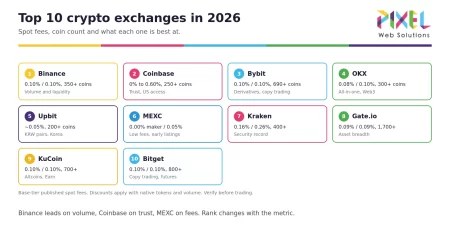
Rankings by trading volume change month to month, and the public data aggregators update them daily, so check a live ranking rather than a blog. For a founder, the more useful list is the exchanges licensed in your target market: ESMA's MiCA register for the EU, the SFC's licensed platform list for Hong Kong (13 operators as of 16 October 2026), NYDFS's regulated entities table for New York and VARA's public register for Dubai.
Does Binance have a MiCA licence?
Check ESMA's interim MiCA register, which is updated weekly and is the only authoritative answer. Press reports in mid-2026 described Binance withdrawing its application in Greece and restricting services to EU users from 1 July 2026 when the transitional period ended; those reports have not been confirmed here against the register, so verify before relying on them. The episode shows that scale does not substitute for authorisation under MiCA.
How do I become a crypto trader?
Open an account with an exchange that is licensed in your country, complete identity verification, fund the account and start with small positions in liquid assets. Licensed status matters because it brings segregation of your assets, complaint routes and a regulator you can escalate to. This guide is written for people building exchanges rather than trading on them, but the licence lists linked above are the right place for a trader to check a platform too.
A crypto exchange license is the product of three decisions: where your customers are, how much capital you can lock, and which activities you will offer. Settle those first, pick the regulator whose rulebook fits, and design the exchange to its rules from the first sprint rather than retrofitting them under supervisory pressure.