A BitPay clone script is a pre-built crypto payment gateway that reproduces BitPay's merchant model: a business issues a crypto invoice with a locked exchange rate, the customer pays from any wallet, and the gateway settles to the merchant in fiat, crypto or a mix. In 2026 the model it copies processes more than $7 billion in payments, charges 1% to 2% plus 25 cents per transaction, and settles in USD, EUR and GBP the next business day. Pixel Web Solutions delivers a BitPay clone script from $6,000, with invoicing, settlement and compliance modules that a merchant-facing gateway needs from launch.
Merchants no longer ask whether to accept crypto; they ask which processor settles reliably and keeps them compliant. This BitPay clone guide covers what BitPay offers in 2026, how a gateway like BitPay works step by step, what a BitPay clone script includes, the features, architecture and cost, the regulations an operator must satisfy, and how to choose a provider. Its sister guide on the CoinPayments clone script covers the multi-coin acceptance, wallet and plugin side of the same business.
Key Takeaways
- BitPay's 2026 benchmark: $7 billion processed and 13 million+ transactions since 2011, 100+ cryptocurrencies covering over 90% of market cap, fees from 2% + 25 cents down to 1% + 25 cents by monthly volume, and next-business-day fiat settlement.
- The product is invoicing plus settlement. The script lives or dies on its rate-lock invoice engine, its settlement ledger and its merchant onboarding, not on the number of coins it lists.
- Pixel's published price: a crypto payment gateway from $6,000; the budget grows with settlement currencies, chains and compliance tooling.
- Compliance is part of the build. MiCA authorisation has been mandatory for EU crypto-asset service providers since 1 July 2026, the US GENIUS Act governs the stablecoins most merchants want, and VARA licenses Dubai operators.
- Revenue is more than the processing fee: conversion margin, settlement options, API tiers and payouts all add up, and the worked example below shows the maths.
What Is a BitPay Clone Script?
A BitPay clone script is ready-made, tested software that replicates the business framework and core functionality of the BitPay platform. It lets a fintech startup launch its own cryptocurrency payment processing platform without building the invoice engine, blockchain listeners, rate oracle, settlement ledger and merchant dashboard from scratch. The provider delivers the code, rebrands it, deploys it on the client's infrastructure and adds the settlement partners and compliance controls the client's jurisdictions need.
The script covers the essentials a merchant expects: crypto payment acceptance at checkout, merchant APIs and e-commerce plugins, hosted invoices with QR codes, real-time rate locking, wallet integration, settlement in fiat or crypto, and reporting. A 2026-grade script also handles stablecoin settlement, Solana and other fast chains, payouts to vendors and staff, and the know-your-business (KYB) checks that regulators now expect from a processor.
Did you know?
BitPay's merchant fee is volume-tiered: 2% + 25 cents a transaction under $500,000 a month, 1.5% + 25 cents up to $999,999, and 1% + 25 cents from $1 million, according to BitPay's pricing page.
BitPay in 2026: Products, Fees and Settlement
Knowing what the original offers sets the bar for the clone. As of October 2026, BitPay's business page lists:
- Online and e-commerce checkout with Shopify, WooCommerce and Magento integrations, plus APIs, plugins and hosted tools for developers.
- Crypto invoicing by email, an in-store POS flow with QR codes, payroll and affiliate settlements (mass crypto payouts) and B2B payments to vendors.
- Coverage: 100+ cryptocurrencies that account for over 90% of the global crypto market cap, 100+ supported wallets, and stablecoins including USDC.
- Settlement: fiat settlement in USD, EUR, GBP and more, or in crypto, or a mix of both; bank settlement is initiated the next business day after conversion.
- Scale: $7 billion processed and 13 million+ transactions since 2011.
Two product changes matter for a clone built this year. In August 2025 BitPay added Solana support, so merchants can accept SOL plus USDC and USDT on the Solana network, and wallet users can hold SOL and SPL tokens in self-custody. And BitPay's consumer Bill Pay service has been paused since 26 December 2025 with no confirmed resumption date, a reminder that consumer features depend on banking partners and that the merchant business is the durable core.
How a Crypto Payment Gateway Like BitPay Works
-
Step 1: Onboarding. The merchant registers, passes KYB verification and chooses settlement preferences (fiat, crypto or split). Developers integrate through the API, a plugin or a hosted checkout page. Consumers simply pay from their own wallet; they do not need an account.
-
Step 2: Invoice creation. When a customer selects crypto at checkout, the gateway creates a blockchain invoice that contains the receiving address, a QR code, the amount in the chosen cryptocurrency and an expiry timer.
-
Step 3: Rate lock. Because prices move, the gateway locks the exchange rate for a limited window (BitPay's invoices expire after 15 minutes, and the rate is guaranteed inside that window). The customer must pay inside that window or the invoice expires and a new one is issued.
-
Step 4: Payment. The customer scans the QR code or pastes the address, confirms in their wallet, and the wallet signs and broadcasts the transaction.
-
Step 5: Confirmation. The gateway's blockchain listeners watch the mempool and the chain, flag underpayments and overpayments, and mark the invoice paid once the configured number of confirmations is reached for that network.
-
Step 6: Settlement. The gateway credits the merchant ledger and, depending on the merchant's preference, converts the funds to fiat through its liquidity partner and pays out to the bank account, or forwards crypto to the merchant's wallet.
-
Step 7: Reporting. The transaction is recorded on-chain and in the gateway's ledger, webhooks notify the merchant's system, and the dashboard shows the invoice, the fee and the settlement batch.
Pixel's step-by-step guide on how to build a crypto payment gateway like BitPay turns this flow into a development plan.
What a BitPay Clone Script Includes
The invoicing-and-settlement model needs seven modules. Use this list to compare providers.
| Module | What it does | Why it matters for a BitPay-style gateway |
|---|---|---|
| Invoice engine | Creates invoices, locks rates, tracks expiry, handles under and overpayment | This is the product; a weak invoice engine means disputes |
| Rate oracle | Pulls prices from several exchanges, applies a spread, locks the quote | Protects the merchant and the gateway from volatility |
| Blockchain listeners | Watch addresses on BTC, ETH, Solana, Polygon, BNB Chain, Tron and stablecoin contracts | Confirms payments and detects the wrong network or token |
| Settlement ledger | Double-entry ledger, conversion batches, fiat payouts, crypto forwarding | Determines whether merchants get paid correctly and on time |
| Merchant onboarding and KYB | Business verification, risk tiering, sanctions screening | Required under MiCA, VARA and US money-transmission rules |
| APIs, plugins and hosted checkout | REST API, webhooks, Shopify, WooCommerce, Magento, PrestaShop plugins | Decides how fast merchants can go live |
| Admin and reporting | Fee management, dispute handling, tax reports, analytics | Runs the business day to day |
Pixel Web Solutions' white-label crypto payment gateway ships these modules as one package so a client can inspect the ledger design and the listener coverage before the rebrand.
Essential Features of a BitPay Clone Script
Features serve two audiences: merchants (and their customers) and the platform admin.
Merchant and user features
- Intuitive dashboard: real-time view of invoices, balances, settlements and refunds.
- Hosted invoices and checkout: branded invoice pages with QR codes, expiry timers and payment status.
- Multi-crypto support: BTC, ETH, SOL, stablecoins and major tokens, with the network shown clearly to avoid wrong-chain payments.
- Wallet support: payments from any self-custody or exchange wallet, with wallet-connect flows where supported.
- API and plugin tools: REST API, webhooks and plugins for the main e-commerce platforms.
- Instant conversion: settle in fiat, stablecoins or crypto per invoice or per merchant policy.
- Transaction history and invoices: exportable records for bookkeeping.
- Refunds and partial payments: refund to the payer's address and resolve underpayments without manual work.
- Crypto payouts: pay vendors, affiliates and staff in crypto from the same balance.
- Data analytics: conversion rates, average ticket, chain mix and settlement timing.
- Multi-language and cross-device support: web, tablet and mobile.
Admin features
- Admin panel: merchant management, fee tiers and platform settings in one place.
- KYB and AML verification: onboarding checks, risk scoring and sanctions screening on wallets and businesses.
- Fee management: processing fees by volume tier, conversion spreads, settlement and withdrawal fees.
- Settlement controls: batch schedules, minimum payout amounts, bank and liquidity partner routing.
- Dispute resolution: ticketing between merchants and customers with evidence attached.
- Tax assistance: reports by jurisdiction so merchants can file.
- Custom branding: merchant-level logos, colours and invoice templates.
- Referral and reward management: merchant referral programmes.
- Content management: announcements, FAQs and documentation.
Add-on features
- QR-coded in-store payments and POS integrations for physical retail.
- Split payments that divide one invoice among several recipients.
- Invoice branding with merchant logos and details.
- AI fraud detection that scores transactions for unusual patterns.
- Gift cards that let users convert crypto into retail gift cards, a BitPay consumer feature that some operators replicate.
- NFT checkout for merchants that sell digital collectibles, offered as an optional module rather than a core feature.
Security features
- 2FA for merchant and admin accounts.
- Hot and cold wallet separation so most funds sit offline.
- Multi-signature wallets for treasury and settlement wallets.
- Geo-blocking for restricted jurisdictions.
- Encrypted keys, HSM or MPC signing, and audit logs on every admin action.
Cryptocurrencies supported in a BitPay clone
Like BitPay, a clone script typically supports the major assets by market cap and the stablecoins merchants prefer to settle in:
- Bitcoin (BTC) and Bitcoin Cash (BCH)
- Ethereum (ETH) and ERC-20 tokens
- Solana (SOL) with USDC and USDT on Solana
- Litecoin (LTC), Dogecoin (DOGE)
- Stablecoins such as USDC, USDT, PYUSD and GUSD
- Wrapped assets (WBTC, WETH) and BNB
Architecture of a Gateway Like BitPay
A production gateway separates five services so each can scale and be audited on its own:
- API gateway and merchant portal: authentication, rate limits, merchant dashboards.
- Invoice and pricing service: invoice state machine, rate oracle, expiry handling.
- Chain services: one listener and one address-generation service per supported network, with confirmation thresholds set per chain.
- Ledger and settlement service: double-entry ledger, conversion batches via liquidity partners, bank payout files, crypto forwarding.
- Compliance service: KYB, sanctions screening, wallet risk scoring and the Travel Rule messaging that FATF-aligned regulators require above set thresholds.
Webhooks and a message queue connect the services, and a reconciliation job compares on-chain balances to the ledger every day.
The Fee and Settlement Model: A Worked Example
Processing fees get the headlines, but the margin comes from several lines. Take a gateway that copies BitPay's entry tier (2% + $0.25) and signs 300 merchants averaging $20,000 of crypto sales a month, which is $6 million in monthly volume.
- Processing fees: 2% of $6,000,000 = $120,000, plus $0.25 on roughly 60,000 invoices of $100 average = $15,000. Subtotal $135,000.
- Conversion margin: if 70% of volume settles in fiat and the gateway keeps a 0.5% spread on conversion, that is $4,200,000 multiplied by 0.5% = $21,000.
- Costs to deduct: liquidity-partner conversion fees, bank payout fees, network fees on forwarding, node infrastructure and compliance tooling. In most business plans these run between 25% and 40% of gross fee income at this scale.
Gross fee income of about $156,000 a month on $6 million of volume is the realistic picture for a BitPay-style gateway at that stage. Fees fall as merchants grow (BitPay drops to 1% + $0.25 above $1 million a month), so the plan should model tiering, not a flat rate. Pixel's guide to crypto payment gateway use cases shows which merchant segments drive the volume.
BitPay Clone Script Cost in 2026
Pixel Web Solutions prices crypto payment gateway development from $6,000. That entry price covers a rebranded gateway with the invoice engine, a core set of chains, merchant and admin dashboards and standard plugins. The budget rises with each of the following:
| Cost driver | What adds cost | Typical effect |
|---|---|---|
| Chains and assets | Each new network needs a listener, address service and fee logic | Moderate per chain; stablecoins on several chains multiply it |
| Settlement currencies | Each fiat currency needs a banking or liquidity partner and payout logic | Significant; partner onboarding takes weeks |
| Compliance stack | KYB, sanctions screening, Travel Rule, geo-blocking | Significant and ongoing (vendor fees) |
| Mobile apps | Merchant and consumer apps on Android and iOS | Adds roughly 15% to 25% in most quotes |
| Custom integrations | ERP, accounting, POS hardware | Scoped per client |
Pixel's full guide to the cost to develop a crypto payment gateway breaks the budget down by build type, module and running costs. Budget separately for the items no script includes: a licence or registration in each market, banking partners, liquidity, an independent security audit and insurance.
Regulation: What a Gateway Like BitPay Must Comply With
A payment gateway holds other people's money for part of each transaction, so regulators treat it as a financial service. The minimum checklist for 2026:
- European Union (MiCA): since 1 July 2026 only authorised crypto-asset service providers may serve EU clients, as ESMA's MiCA page confirms; a gateway that custodies or exchanges crypto for merchants needs CASP authorisation, and stablecoin acceptance must use MiCA-compliant e-money tokens.
- United States (GENIUS Act): the GENIUS Act of July 2025 sets reserve, redemption and AML rules for payment stablecoin issuers; the federal rulemaking deadline passed in July 2026 without final rules, with a fallback effective date of 18 January 2027. Gateways should accept only stablecoins from issuers on track for compliance. Money transmission registration with FinCEN and state licences (BitPay holds a New York BitLicense) remain the baseline.
- United Arab Emirates: Dubai operators fall under the VARA rulebooks (version 2.0 since June 2025), Abu Dhabi under ADGM's FSRA, and the CBUAE licenses payment token services for the rest of the country.
- Everywhere: FATF Travel Rule data sharing, sanctions screening on wallets, PCI DSS v4.0.1 if any card data touches the platform, and data-protection law for merchant and customer records.
Design the compliance service as a module from day one; retrofitting it after merchants are live is the most expensive change a gateway can make.
Business Benefits of a BitPay Clone
- Faster launch: the invoice engine, listeners and dashboards already exist, so the timeline is weeks, not quarters.
- Multiple revenue streams: processing fees, conversion margin, settlement options, API tiers and payouts.
- Brand building: the gateway runs under the operator's brand, with merchant-level branding on invoices.
- Global reach: crypto rails reach markets where card acquiring is expensive or unavailable.
- Customisation: fees, UI, chains, settlement partners and compliance rules are all configurable.
- Early-mover position: merchant demand for stablecoin settlement is growing faster than the supply of licensed processors in most regions.
Get a BitPay Clone Script Demo
Seeing the gateway work before launch is the fastest way to evaluate it. Pixel Web Solutions offers a BitPay clone script demo that walks through the merchant dashboard, the checkout and invoice flow, the admin panel and the settlement reports.
What will you get in this “BitPay Clone Demo”?
- Access to a completely feature-integrated merchant dashboard
- Cross-check with the checkout flow demonstration
- Clear picture of our Admin Panel with plugins
- View wallet and settlement system overview
- Get a preview of API & plugin integrations
Book a free live demo of our clone software to view the real-time functioning from merchant onboarding to secure checkout. Inspired by the powerful infrastructure of BitPay, our solution is built for startups and enterprises to dominate the crypto payments market.
Get Demo
Tech Stack of a BitPay Clone
A secure, scalable crypto payment gateway like BitPay needs a modern, well-supported stack:
- Front end: React.js, Angular or Vue.js
- Back end: Node.js, Laravel (PHP) or Python
- Blockchain integration: Bitcoin, Ethereum, Solana, BNB Chain, Polygon, Tron, plus stablecoin contracts
- Databases: PostgreSQL or MySQL for the ledger, MongoDB for documents, Redis for queues and caching
- Wallet and key management: multisig wallets, HSM or MPC signing, encrypted key storage
- API and integration layer: REST APIs, webhooks, e-commerce plugins
- Cloud infrastructure: AWS, Google Cloud or Azure with monitoring and alerting
How to Choose a Clone Script Provider
- Ask to see the invoice state machine and the ledger. Underpayments, overpayments, expiries and refunds are where gateways fail.
- Check chain coverage and confirmation logic for the assets your merchants will actually use, including stablecoins on Solana and Tron.
- Confirm settlement partners. Which liquidity providers and banks does the script already integrate, and in which currencies?
- Review the compliance module: KYB, sanctions screening, Travel Rule, geo-blocking and reporting.
- Request the security audit of the current version and the penetration test report for the web and API layers.
- Verify source code and licence terms so you can modify and host the platform yourself.
- Compare post-launch support: monitoring, incident response and an upgrade roadmap.
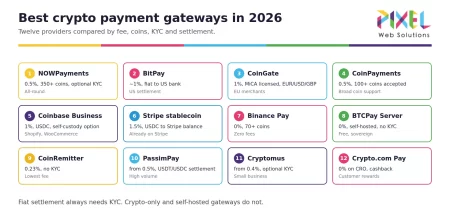
Pixel's comparison of the best crypto payment gateways by fees, settlement and KYC is a useful benchmark for the features merchants will expect.
Why Choose Pixel Web Solutions for a BitPay Clone Script?
Pixel Web Solutions is a crypto payment gateway development company operating from Ras Al Khaimah, UAE and Madurai, India. Its BitPay clone script is delivered with the invoice engine, chain listeners, settlement ledger and compliance module described above, and the team adds the settlement partners, chains and branding each client needs. Clients get a fast, tested route to market whether they want a ready-made BitPay clone or a fully customised gateway.
Go Beyond BitPay: Build a Smarter Crypto Payment Gateway with Pixel Web Solutions
Building a crypto payment gateway like BitPay rewards attention to detail: the rate lock, the ledger, the settlement partners and the compliance controls decide whether merchants trust the platform. A BitPay clone script from Pixel Web Solutions gives a startup that foundation from $6,000, with the flexibility to add chains, currencies and markets as the business grows. To scope a BitPay clone script for a specific market, contact the Pixel Web Solutions team.
Frequently Asked Questions
What is BitPay?
BitPay is a US-based crypto payment processor founded in 2011 that lets merchants accept 100+ cryptocurrencies online and in store, issue crypto invoices, pay staff and vendors in crypto, and settle in fiat or crypto. It has processed more than $7 billion and 13 million transactions.
Why BitPay over other crypto payment gateways?
BitPay's model stands out for merchant-grade invoicing with locked rates, next-business-day fiat settlement in several currencies, a published volume-tiered fee schedule, and regulatory licensing in the United States. Those are the elements a clone script should reproduce.
How much does a BitPay clone script cost?
Pixel Web Solutions prices crypto payment gateway development from $6,000. Additional chains, settlement currencies, mobile apps and compliance integrations increase the budget.
How secure is a BitPay clone?
A well-built clone uses 2FA, hot and cold wallet separation, multisig or MPC signing for treasury wallets, encrypted keys, DDoS protection and audit logs, and it is tested by an independent security audit before launch.
Does a BitPay clone need a licence?
In most markets, yes. EU operators need MiCA CASP authorisation, US operators need money transmission registration and state licences, and Dubai operators need a VARA licence. The script provides the compliance tooling; the operator obtains the licence.
What is the difference between a BitPay clone and a CoinPayments clone?
A BitPay clone focuses on merchant invoicing, fiat settlement and compliance for businesses that want to be paid in local currency. A CoinPayments clone focuses on multi-coin acceptance, built-in wallets and e-commerce plugins for merchants that want to hold and manage many cryptocurrencies.