Table of Contents
Three teams can quote for the same AI project and come back with prices that differ tenfold. Neither team is wrong. They have simply proposed three different things.
That gap has a cause. You can integrate a frontier model, build retrieval and fine-tuning on top of your own content, or train a custom model from scratch. Each path solves a different problem, and each carries a very different bill.
This guide compares the top 10 AI development companies in UK markets for 2026. You will get the three build approaches explained plainly, real cost ranges in GBP, the current UK regulatory position, and the seven questions worth asking on a shortlist call.
Key Takeaways
- Pick the approach before the firm.Frontier model integration, RAG with fine-tuning, and custom training differ by an order of magnitude in cost.
- Most commercial UK work belongs in the first two.However, if a vendor proposes custom training for a problem retrieval would solve, they are either mis-scoping or selling capacity.
- The UK has no AI Act and no AI Bill before Parliament.Instead, existing sector regulators handle oversight, so ICO and FCA delivery experience beats a generic governance framework.
- The EU AI Act still reaches youif you serve EU customers. High-risk obligations land on 2 December 2027, and transparency duties already applied from 2 August 2026.
- Discovery costs £15,000 to £45,000and a prototype on real data £20,000 to £60,000. Integration depth drives the production build more than model choice does.
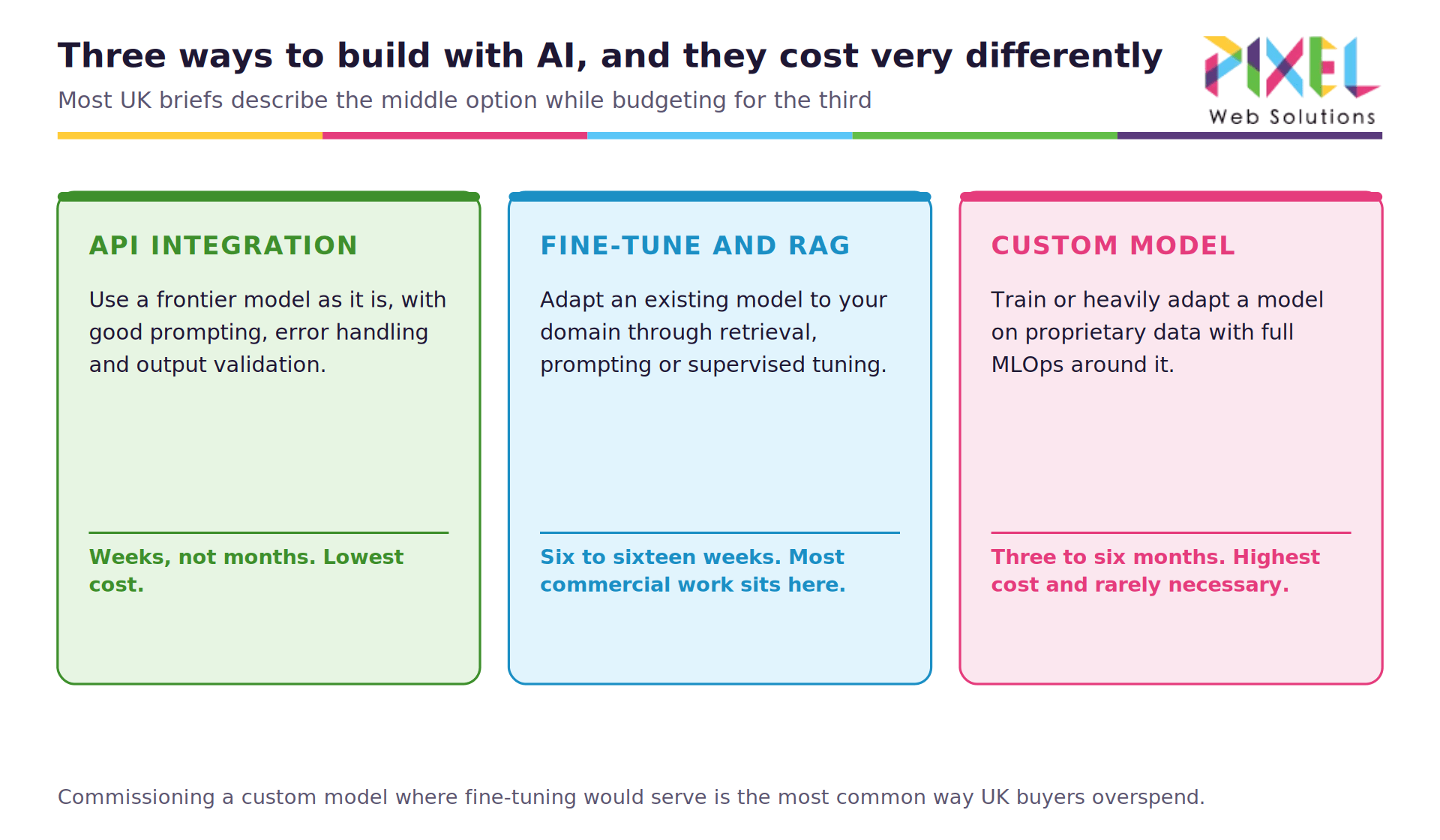
Caption: Three approaches, three very different cost curves.
Three Ways to Build, and They Cost Very Differently
| Approach | What it is | Right when | Relative cost |
| Frontier model integration | Call a hosted model, engineer prompts, evaluate | The capability already exists and you need it in your workflow | Lowest |
| RAG and fine-tuning | Ground answers in your content, adapt behaviour | Answers must come from your data, or tone and format matter | Moderate |
| Custom model training | Train on proprietary data from scratch or near it | Genuinely novel problem, or data cannot leave your environment | Highest by a wide margin |
Most commercial UK work belongs in the first two. A vendor proposing custom training for a problem that retrieval would solve is either mis-scoping or selling capacity.
Does the UK Have an AI Law?
No. The UK has not passed an AI Act and, as of mid-2026, no AI Bill sits before Parliament. Oversight runs through existing sector regulators rather than a single statute.
- The March 2023 pro-innovation White Paper assigned AI oversight to existing regulators, and on 21 October 2025 DSIT published a Blueprint for AI regulationcentred on the AI Growth Lab, a proposed system of sector sandboxes. Its call for evidence closed 7 January 2026 and set out two competing designs: a central government model coordinated by DSIT, and a regulator-led model with a lead regulator per sandbox. Named target sectors include professional services, healthcare, transport and advanced manufacturing.
- Practical consequence for buyers: ask which UK regulator a firm has delivered under. ICOand FCA experience is worth more than a generic governance framework, because those are the bodies that actually govern you.
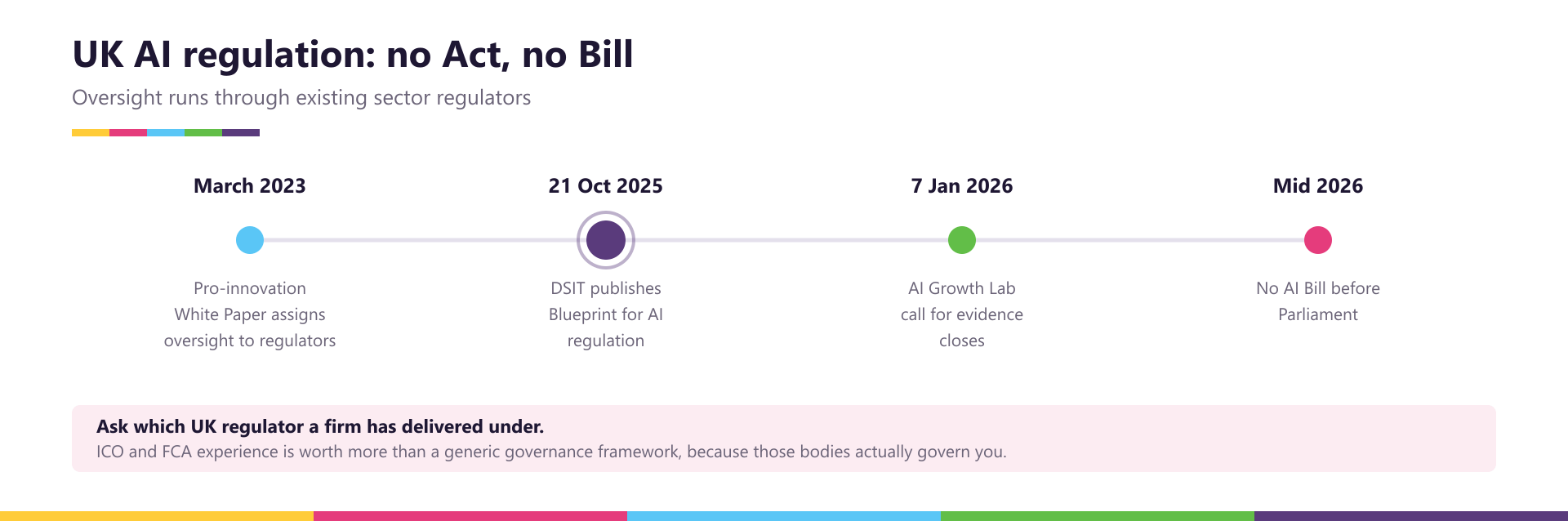
Caption: No Act, no Bill. Oversight sits with the regulators you already answer to.
- Faculty AI, PA Consultingand Mesh-AI surface most often for UK AI delivery queries, and all three lead with public sector or regulated-sector credentials rather than AI-Act readiness, which reflects where the real compliance burden sits.
Does the EU AI Act Apply to UK Companies?
Yes, wherever you serve EU customers or place AI systems on the EU market. The absence of a UK statute exempts nobody with European exposure.
- Following the Digital Omnibus, Regulation (EU) 2026/1744, high-risk obligations apply from 2 December 2027for stand-alone systems and 2 August 2028 for AI embedded in regulated products.
- Article 50 transparency duties have applied since 2 August 2026and were not deferred, so an EU-facing chatbot must already disclose that it is AI.
Comparison at a Glance
| # | Company | Strongest approach | Watch for |
| 1 | Pixel Web Solutions | Integration, RAG, agents, end to end | Global delivery, confirm contracting |
| 2 | Thoughtworks | Engineering-led delivery and modernisation | Premium positioning |
| 3 | Itransition | Broad enterprise engineering | AI is one capability among many |
| 4 | Pixelette Technologies | Applied AI product builds | Smaller delivery footprint |
| 5 | Classic Informatics | Product engineering with AI | Staff-augmentation shaped |
| 6 | Empyreal Infotech | Custom builds for mid-market | Newer AI presence |
| 7 | SumatoSoft | Custom software with ML components | Broader than AI-only |
| 8 | Magora | Product and mobile with AI features | AI-adjacent rather than AI-led |
| 9 | Amenity Technologies | Focused delivery for SME budgets | Below enterprise scale |
| 10 | Cognizant UK | Enterprise scale and modernisation | Minimum engagement size |
The Ten Firms
1. Pixel Web Solutions
Pixel Web Solutions is a software and AI development company operating since 2012, building LLM applications, RAG systems, autonomous agents and machine learning platforms, with the evaluation and integration work that takes them into production.
Best for: mid-market builds across integration, RAG and agent work
On delivery model, stated plainly: Pixel is headquartered in Madurai, India, and serves UK clients through a global delivery model. India to UK is a manageable four-and-a-half to five-and-a-half hour offset with genuine working-hours overlap, which works better than most offshore arrangements. Buyers with UK data residency requirements, or public sector procurement rules requiring UK-based delivery, should confirm arrangements at the outset. [Add UK entity or Companies House number here if applicable.]
See the full AI development services practice.
2. Thoughtworks
Thoughtworks is a global technology consultancy with a strong engineering culture and a long UK presence.
Best for: engineering-led delivery and modernisation with AI embedded
Premium positioning; suits organisations buying engineering practice rather than capacity.
3. Itransition
Itransition is a global software engineering firm with broad enterprise delivery and AI capability.
Best for: enterprise builds where AI sits inside a larger system
AI is one capability among many. Confirm the specific team.
4. Pixelette Technologies
Pixelette Technologies is a UK-based technology firm delivering applied AI and product builds.
Best for: applied AI product work for mid-market budgets
Smaller delivery footprint than the integrators.
5. Classic Informatics
Classic Informatics is a product engineering firm working with UK clients on software and AI builds.
Best for: product engineering with AI components
Frequently staff-augmentation shaped; confirm the engagement model.
6. Empyreal Infotech
Empyreal Infotech is a UK-facing development firm delivering custom software and AI features.
Best for: custom builds for smaller budgets
Newer AI presence, so weight production references.
7. SumatoSoft
SumatoSoft is a custom software development company delivering machine learning components within wider systems.
Best for: custom software with ML features
Broader than AI-only.
8. Magora
Magora is a UK product and mobile development firm delivering AI-enabled features.
Best for: product and mobile builds with AI components
AI-adjacent rather than AI-led.
9. Amenity Technologies
Amenity Technologies is a development firm delivering focused builds for UK SME and mid-market clients.
Best for: defined scopes below enterprise scale
Capacity suits smaller programmes.
10. Cognizant UK
Cognizant UK is the local arm of a global IT services firm delivering AI within modernisation programmes.
Best for: enterprise scale and legacy modernisation
Minimum engagement size makes small scopes uneconomical.
UK Cost and Timeline Reality
| Engagement | Typical range | Duration |
| Discovery or technical scoping | £15,000 to £45,000 | 2 to 5 weeks |
| Prototype on real data | £20,000 to £60,000 | 4 to 8 weeks |
| Production build | Driven by integration depth | 3 to 6 months |
| Managed support | Monthly retainer | Ongoing |
Read these with appropriate caution. They are compiled from published 2026 rate guides rather than a single audited dataset. No neutral public benchmark for AI development pricing exists, and the ranges reflect what the market advertises rather than what it measures.
Seven Questions for Your Shortlist
- Show me a system you built that is running in production today, and tell me what broke.
- Which UK regulators have you delivered under, and on what kind of system?
- Which of the three build approaches does our problem actually need, and why not the cheaper one?
- How do you evaluate output quality, and what is in your golden test set?
- Who owns the prompts, weights, training data and evaluation set afterwards?
- What does this cost to run per month at ten times current volume?
- Which named engineers will work on this?
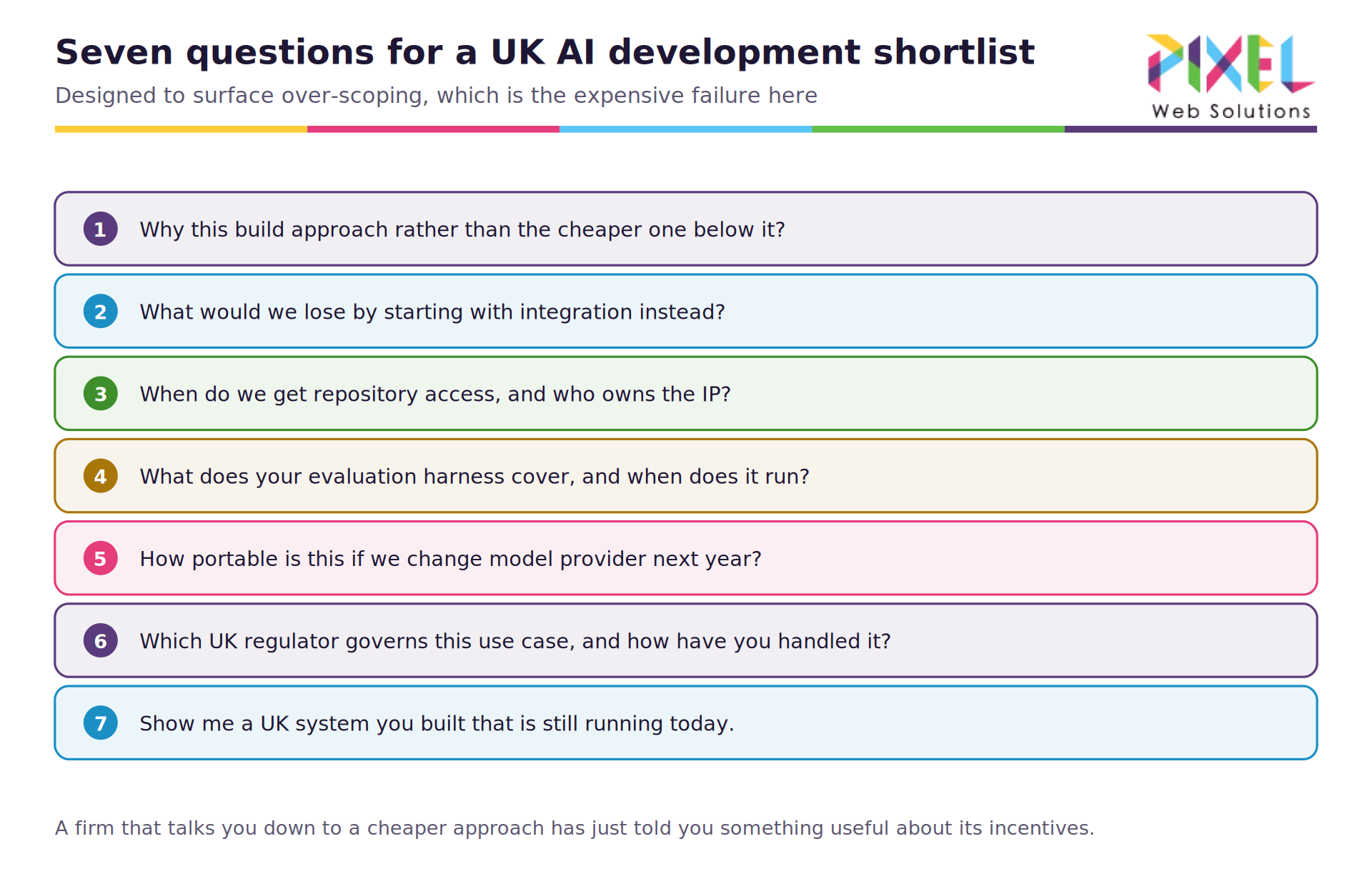
Caption: Question three catches mis-scoping faster than any other.
Conclusion
Comparing AI development companies in UK markets works best when you fix the approach first and the vendor second. If you are still deciding what to build, our AI consulting services start with a fixed-scope discovery sprint. Already settled on the specification? Our AI development services team can take it from there.
FAQ
Q: What are the best AI development companies in the UK?
Firms commonly shortlisted include Pixel Web Solutions, Thoughtworks, Itransition, Pixelette Technologies, Classic Informatics, Empyreal Infotech, SumatoSoft, Magora, Amenity Technologies and Cognizant UK. Shortlist by build approach rather than general reputation: frontier model integration, RAG and fine-tuning, and custom training need different teams and differ by an order of magnitude in cost.
Q: Does the UK have an AI law?
No. The UK has not passed an AI Act and no AI Bill sits before Parliament as of mid-2026. Oversight runs through existing sector regulators following the March 2023 pro-innovation White Paper. On 21 October 2025 DSIT published a Blueprint for AI regulation centred on the AI Growth Lab, a proposed system of sector sandboxes, whose call for evidence closed on 7 January 2026.
Q: Does the EU AI Act apply to UK companies?
Yes, wherever you serve EU customers or place AI systems on the EU market. Following the Digital Omnibus, Regulation (EU) 2026/1744, high-risk obligations apply from 2 December 2027 for stand-alone systems and 2 August 2028 for AI embedded in regulated products. Article 50 transparency duties have applied since 2 August 2026 and were not deferred.
Q: How much does AI development cost in the UK?
Discovery or technical scoping commonly runs £15,000 to £45,000 over two to five weeks, and a prototype on real data £20,000 to £60,000. The production build is the largest line and varies most, driven by integration depth and data condition rather than model choice.
Q: Do I need custom model training?
Usually not. Most commercial UK work is solved by frontier model integration or by RAG and fine-tuning, both of which cost far less and carry less risk. A vendor proposing custom training for a problem retrieval would solve is either mis-scoping or selling capacity.
Q: What should I ask a UK AI development company?
Which UK regulators they have delivered under, which build approach your problem needs and why not the cheaper one, how they evaluate output quality, what you own at the end, what it costs at ten times volume, and to show you a production system still running after a year.