Table of Contents
In Australia, a strong proposal can fail in week eleven over a question nobody asked in week one: where does the data actually sit?
Local AI talent stays scarce and prices accordingly. As a result, most buyers are really choosing between onshore, hybrid and offshore delivery long before they compare individual vendors. Data residency then sits on top of that choice as a hard gate for government, health and APRA-regulated organisations.
This guide compares the top 10 AI development companies in Australia for 2026. You will get the delivery-model decision explained, real rates in AUD, the current regulatory position after two policy reversals, and the questions that settle residency early.
Key Takeaways
- The delivery model decides more than the firm does.Onshore runs AUD 150 to 250 and above per hour, hybrid AUD 90 to 160, and offshore AUD 60 to 110.
- Settle data residency before you shortlist.For government, health and APRA-regulated buyers it eliminates vendors rather than ranking them.
- Australia has no AI Act in force.However, the Prime Minister announced mandatory Australian Standards for AI on 15 July 2026, with legislation expected in early 2027.
- Existing law governs today.The Privacy Act, Australian Consumer Law and sector regulation apply now, so Privacy Act fluency matters more than AI-specific credentials.
- Ask four questions early:where data physically sits, which entity signs, who carries liability, and who is reachable during Australian hours.
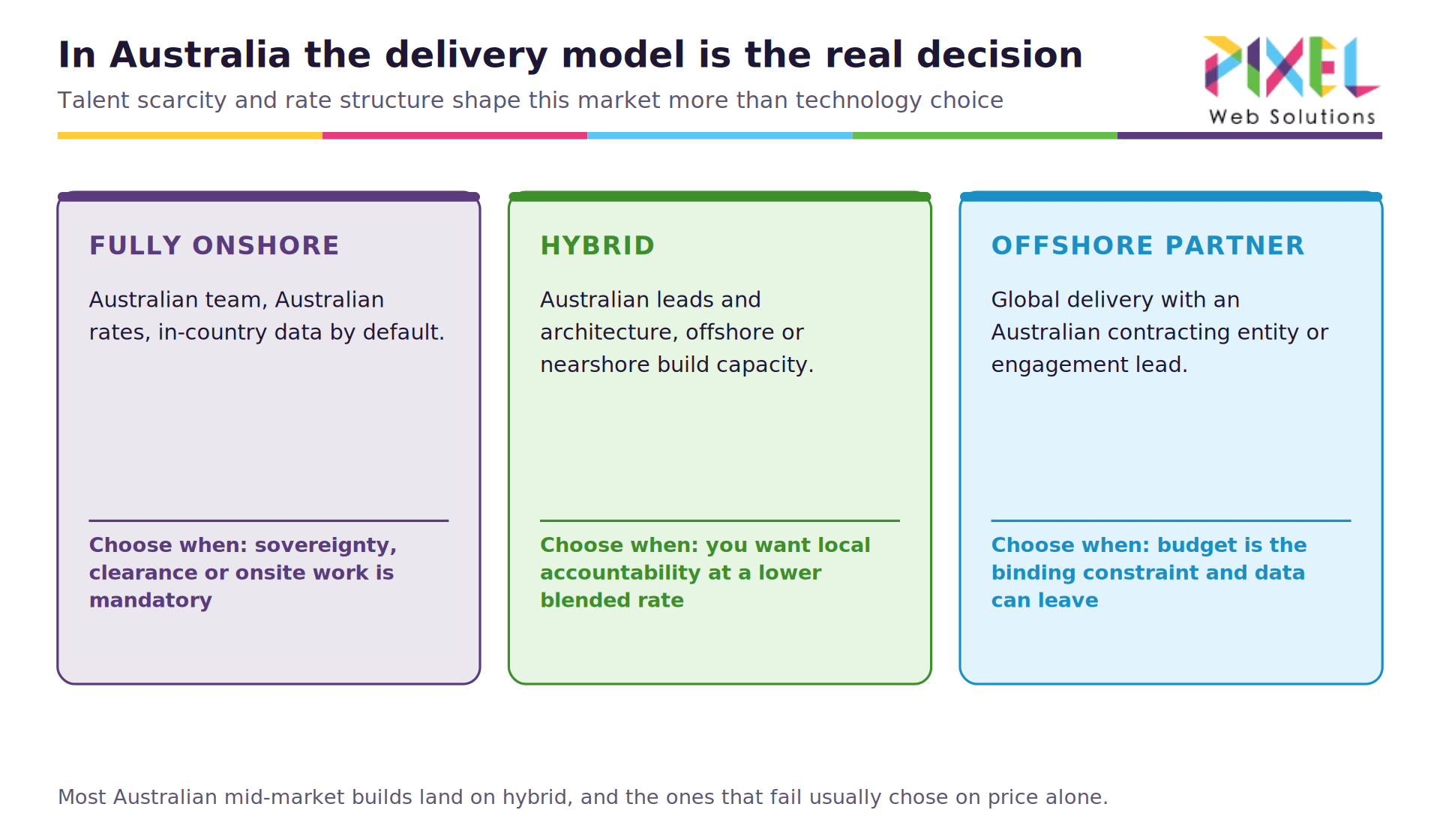
Caption: The delivery model is the real decision.
The Delivery Model Is the Real Decision
| Model | Typical AUD rate | Best when | Constraint |
| Onshore | AUD 150 to 250+/hr | Residency is mandatory, or synchronous work is constant | Scarcity and price |
| Hybrid | AUD 90 to 160/hr | Onshore accountability with offshore build capacity | Coordination overhead |
| Offshore | AUD 60 to 110/hr | Specification is stable, residency permits it | Timezone and residency |
Read these with appropriate caution. They are compiled from published 2026 rate guides rather than a single audited dataset. No neutral public benchmark for AI development pricing exists, and the ranges reflect what the market advertises rather than what it measures.
Settle Data Residency Before You Compare Anyone
Data residency is a live procurement question in Australia, not a theoretical one, particularly for government, health and APRA-regulated buyers.
- Some Australian procurement rules require onshore storage and processing. Where they apply, no amount of capability compensates, and this is the single most common reason a strong offshore proposal fails late.
- Ask four things before shortlisting: where data physically sits, which entity signs the contract, who carries liability, and who is accountable during Australian business hours.
- Mantel Groupanswers the residency question through Australian ownership and onshore delivery, which is why it appears on most shortlists where that constraint binds.
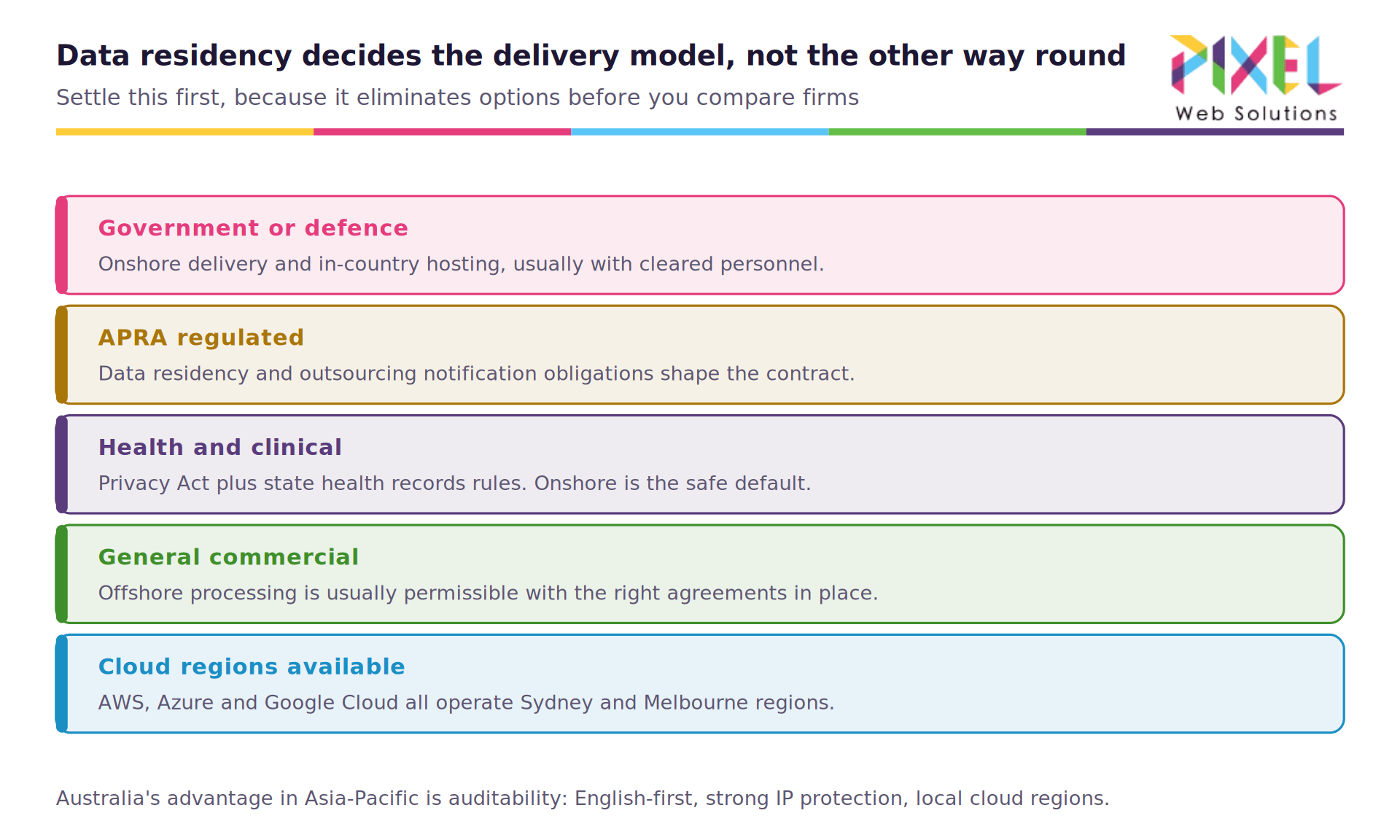
Caption: A threshold question, not a detail. It eliminates vendors rather than ranking them.
Does Australia Have an AI Law?
Not in force, but the position changed on 15 July 2026 when the Prime Minister announced mandatory Australian Standards for AI, reversing an earlier decision not to legislate.
- The sequence matters: ten mandatory guardrails were proposed in September 2024, shelved in the December 2025 National AI Planin favour of existing law, voluntary guidance and the Australian AI Safety Institute, then reinstated in principle in July 2026. An Office of AI was created inside the Department of the Prime Minister and Cabinet to design the framework.
- Announced scope covers large-scale data centres, AI training and use of Australian copyright material. Legislation is expected in Parliament in early 2027.
- Until then the operative constraints are the Privacy Act, Australian Consumer Law and sector regulation. A vendor who cannot discuss Privacy Act obligations concretely is not ready for Australian work, whatever their AI credentials.
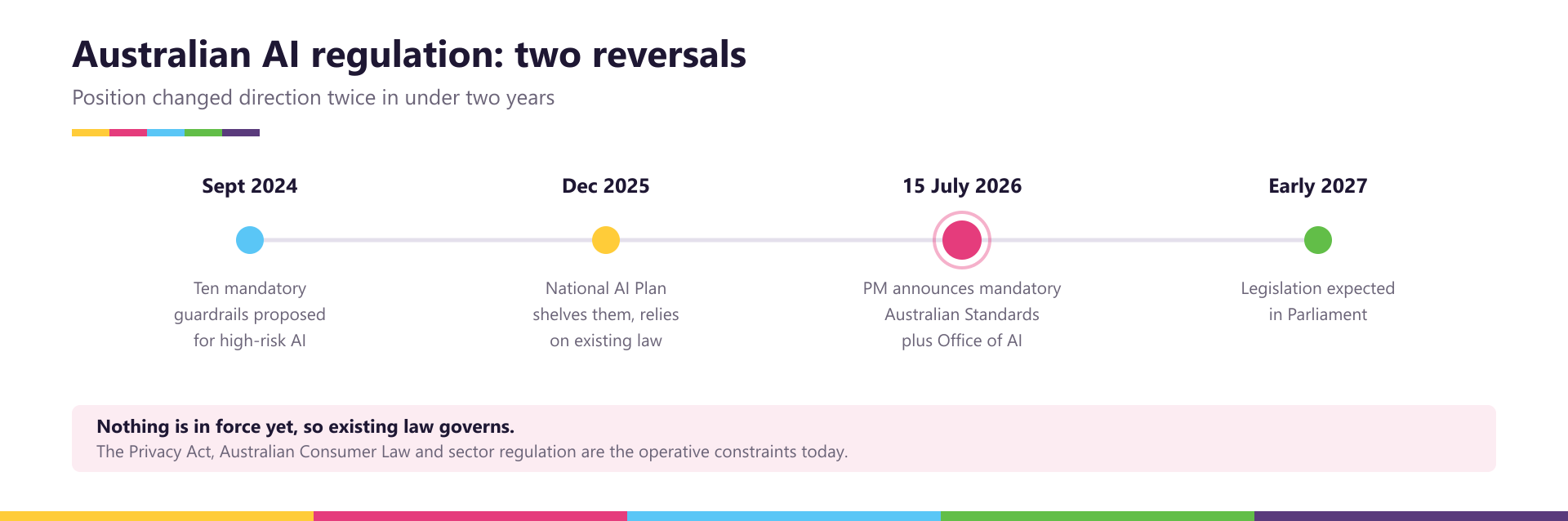
Caption: Proposed, shelved, reinstated. Legislation expected early 2027.
Comparison at a Glance
| # | Company | Delivery model | Watch for |
| 1 | Pixel Web Solutions | Offshore with named accountability | Confirm residency before shortlisting |
| 2 | Mantel Group | Onshore, Australian-owned | Larger engagement sizes |
| 3 | SmartOSC | Hybrid, regional delivery | Broader than AI-only |
| 4 | Microknot | Onshore boutique | Smaller capacity |
| 5 | Blitzm | Onshore product development | Narrower scope |
| 6 | AirStack | Applied AI and automation | Newer presence |
| 7 | Elegant Media | Product and mobile with AI | AI-adjacent |
| 8 | XAM Consulting | Product engineering | AI is one capability |
| 9 | LAB3 | Cloud and data platform led | Platform-weighted |
| 10 | Enterprise Monkey | SME and mid-market | Below enterprise scale |
The Ten Firms
1. Pixel Web Solutions
Pixel Web Solutions is a software and AI development company operating since 2012, building LLM applications, RAG systems, autonomous agents and machine learning platforms, with the evaluation and integration work that takes them into production.
Best for: mid-market builds where residency permits offshore delivery
On delivery model and data residency, stated plainly: Pixel is headquartered in Madurai, India, and serves Australian clients through a global delivery model. India to eastern Australia is a four-and-a-half to five-and-a-half hour offset with genuine morning overlap. However, if you are a government, health or APRA-regulated buyer with data residency obligations, confirm arrangements before shortlisting. Some Australian procurement rules require onshore storage and processing, and that is a threshold question rather than a negotiable detail. [Add Australian entity or ABN here if applicable.]
See the full AI development services practice.
2. Mantel Group
Mantel Group is an Australian-owned technology consultancy spanning cloud, data and AI delivery.
Best for: onshore delivery where residency is mandatory
Australian ownership answers the residency question directly. Larger engagement sizes.
3. SmartOSC
SmartOSC is a regional digital services firm delivering across Asia Pacific including Australia.
Best for: hybrid regional delivery
Broader than AI-only; confirm the AI team specifically.
4. Microknot
Microknot is an Australian software development boutique.
Best for: onshore delivery for defined scopes
Smaller capacity than the national firms.
5. Blitzm
Blitzm is an Australian software and AI product development firm.
Best for: onshore product builds with design and engineering together
Narrower scope suits defined projects.
6. AirStack
AirStack works on applied AI and automation implementations for Australian businesses.
Best for: focused automation and applied AI builds
Newer market presence, so weight production references.
7. Elegant Media
Elegant Media is an Australian product and mobile development company delivering AI-enabled features.
Best for: product and mobile builds with AI components
AI-adjacent rather than AI-led.
8. XAM Consulting
XAM Consulting is an Australian product engineering firm.
Best for: product engineering where AI is one component
AI is one capability among several.
9. LAB3
LAB3 is an Australian cloud and data platform specialist.
Best for: cloud and data foundations beneath AI
Platform-weighted; the right choice when data maturity is the constraint.
10. Enterprise Monkey
Enterprise Monkey delivers AI, automation and digital products for Australian SMEs and mid-market organisations.
Best for: organisations below enterprise scale
A fit where budgets do not support integrator engagement.
Seven Questions for Your Shortlist
- Show me a system you built that is running in production today, and tell me what broke.
- Where does our data physically sit, which entity signs the contract, and who carries liability?
- What Privacy Act obligations apply to this use case, specifically?
- Which delivery model are you actually proposing, and who is accountable in Australian hours?
- Who owns the prompts, weights, training data and evaluation set afterwards?
- What does this cost to run per month at ten times current volume?
- Which named engineers will work on this?
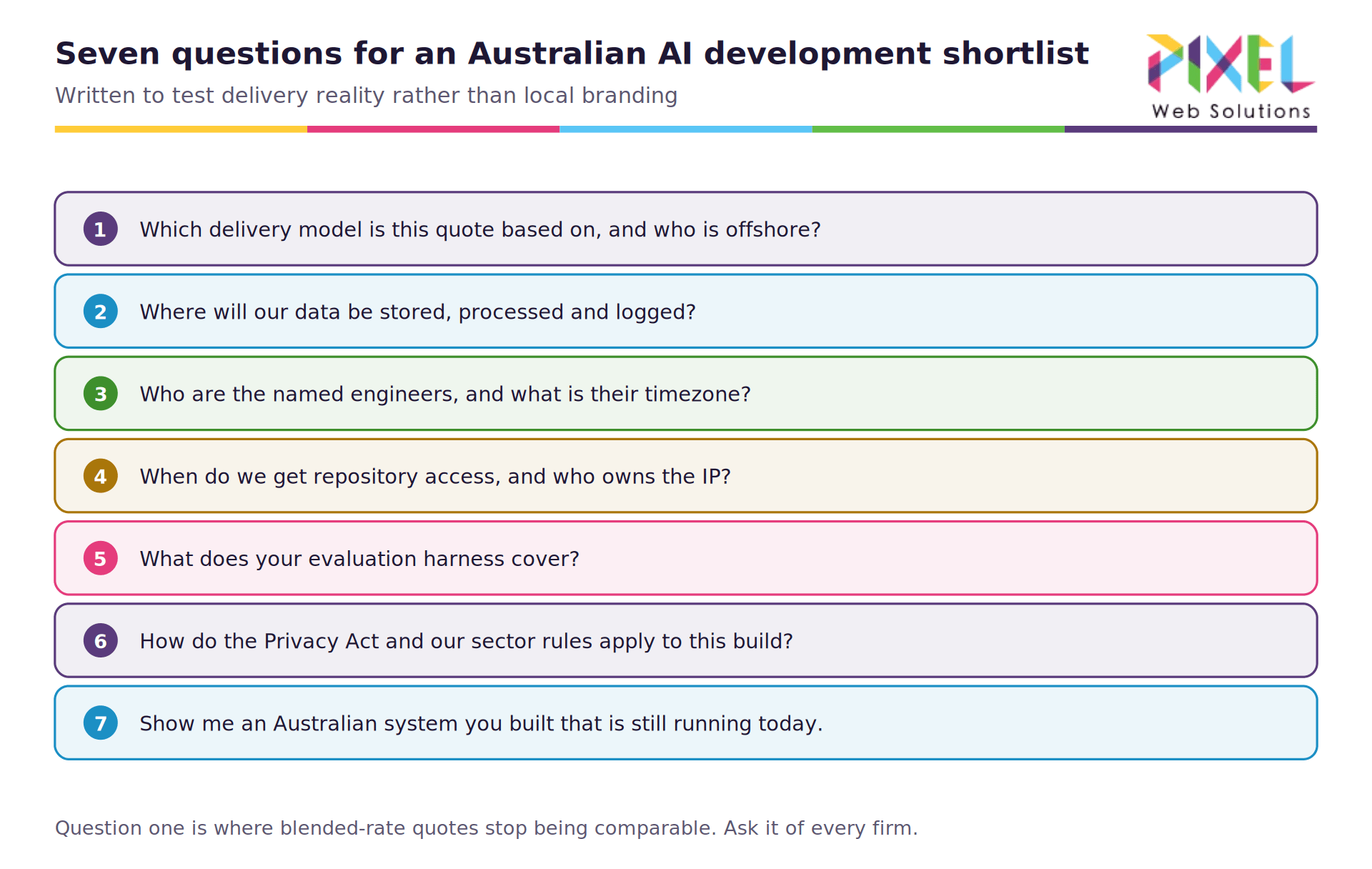
Caption: Question two decides more Australian shortlists than any other.
Conclusion
Comparing AI development companies in Australia becomes straightforward once you answer two questions: which delivery model your constraints permit, and whether data may leave the country. If you are still deciding what to build, our AI consulting services start with a fixed-scope discovery sprint. Already settled on the specification? Our AI development services team can scope the build instead.
FAQ
Q: What are the best AI development companies in Australia?
Firms commonly shortlisted include Pixel Web Solutions, Mantel Group, SmartOSC, Microknot, Blitzm, AirStack, Elegant Media, XAM Consulting, LAB3 and Enterprise Monkey. The decisive choice is the delivery model rather than the firm, because talent scarcity and rate structure dominate this market.
Q: Does Australia have an AI law?
Not in force. Ten mandatory guardrails were proposed in September 2024 and shelved in the December 2025 National AI Plan. On 15 July 2026 the Prime Minister announced mandatory Australian Standards for AI and established an Office of AI within the Department of the Prime Minister and Cabinet, with legislation expected in Parliament in early 2027. Announced scope covers large-scale data centres, AI training and use of Australian copyright material.
Q: How much do AI developers cost in Australia?
Onshore delivery typically runs AUD 150 to 250 and above per hour, hybrid AUD 90 to 160, and offshore AUD 60 to 110. These are market-advertised ranges rather than audited data, and the delivery model matters more to total cost than the individual rate does.
Q: Can Australian companies use offshore AI developers?
Often yes, but data residency is a threshold question for government, health and APRA-regulated buyers, and some procurement rules require onshore storage and processing. Confirm where data sits, which entity contracts, who carries liability and who is accountable in Australian hours before shortlisting.
Q: What regulations apply to AI in Australia today?
Existing law: the Privacy Act, Australian Consumer Law and sector regulation, supported by voluntary guidance and the Australian AI Safety Institute. Until the announced standards are legislated, a vendor’s Privacy Act fluency matters more than AI-specific credentials.
Q: What should I ask an Australian AI development company?
Where data physically sits and who carries liability, what Privacy Act obligations apply to your use case, which delivery model they are proposing and who is accountable in Australian hours, what you own at the end, what it costs at ten times volume, and to show you a production system still running after a year.