Table of Contents
Ask most vendors what governs AI in Canada and you will hear about AIDA. That answer has been wrong since January 2025.
Canada drafted a dedicated AI law, debated it for two and a half years, then watched it die without a vote. Yet the misconception persists so widely that compliance firms now publish explainers correcting it. Meanwhile, the rules that actually bite arrive through privacy legislation, provincial law and sector regulators.
This guide compares the top 10 AI consulting companies in Canada for 2026. You will get the real regulatory picture, what Quebec’s Law 25 demands of automated systems, cost ranges in CAD, and the questions that reveal genuine Canadian delivery experience.
Key Takeaways
- Canada has no AI Act.AIDA died with Bill C-27 when Parliament was prorogued on 6 January 2025, and nobody has reintroduced it since.
- A vendor calling AIDA current is not tracking Canadian regulation.The government has signalled that any future framework will be a new design rather than AIDA revived.
- PIPEDA, Quebec’s Law 25 and sector regulators govern AI instead.Consequently, privacy and model risk experience decide selection more than AI credentials do.
- Law 25 sets the strictest baseline.It requires notice when automated systems affect someone’s rights, which is the duty most AI projects overlook.
- Data residency and French-language capability act as gates,not preferences, for public sector, OSFI-regulated and Quebec work.
- The Vector Institute is a research institute, not a consultancy.Approach it for research partnership or talent, and hire a delivery firm separately.
Does Canada Have an AI Law?
No. Canada has no comprehensive AI statute in force in 2026. The Artificial Intelligence and Data Act died with Bill C-27 when Parliament was prorogued on 6 January 2025 and has not been reintroduced.
- This is one of the most persistently misreported facts in the market, to the point that compliance commentary now publishes explainers on why the myth circulates. A vendor describing AIDA as current, or as imminent, is not tracking Canadian regulation.
- The government created a Minister of Artificial Intelligence and Digital Innovationafter the April 2025 election and has since signalled that AIDA will not return as drafted, with any future framework described as “light, tight, right.” A February 2026 consultation summary flagged safety evaluation, adversarial testing and red-teaming, structured human oversight and traceability as themes.
- What actually applies today: PIPEDAfederally, provincial equivalents in Alberta and British Columbia, Quebec’s Law 25, sector regulators including OSFI, and the voluntary code of conduct.
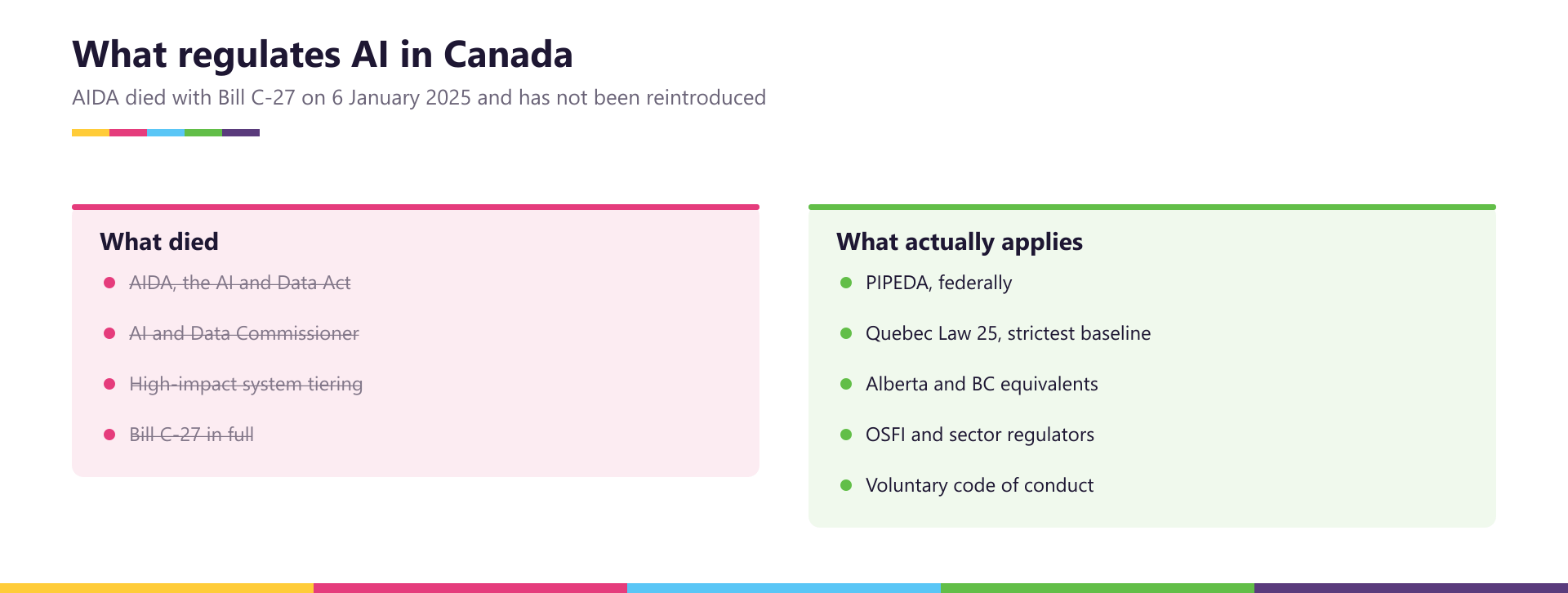
Caption: What died with Bill C-27, and what actually governs AI in Canada now.
What Regulations Apply to AI in Canada Instead?
Privacy law and sector regulation, not AI-specific statute. Quebec’s Law 25 is the strictest baseline and many national organisations now apply it Canada-wide rather than running two regimes.
- Law 25 requires opt-in consent for sensitive data, privacy impact assessments before launching projects touching personal data, and notice when automated systems affect someone’s rights. That last duty is the one most AI projects trip over.
- PIPEDA reaches further into AI than teams assume, because almost any system touching customer or employee data is processing personal information.
- Deloitte Canada, CGIand the Vector Institute surface most often for Canadian AI queries. CGI and Deloitte lead on bilingual delivery and federal procurement; Vector is a research institute rather than a vendor, which is worth knowing before you approach it as one.
Do Canadian AI Projects Require Data Residency?
Frequently, for public sector and OSFI-regulated organisations, though it is not a blanket national requirement.
- Treat it as a threshold question at first contact. It eliminates vendors rather than ranking them, and discovering it during contracting wastes weeks.
- French-language capability is a parallel requirement for Quebec and federal work, and is legal rather than merely commercial.
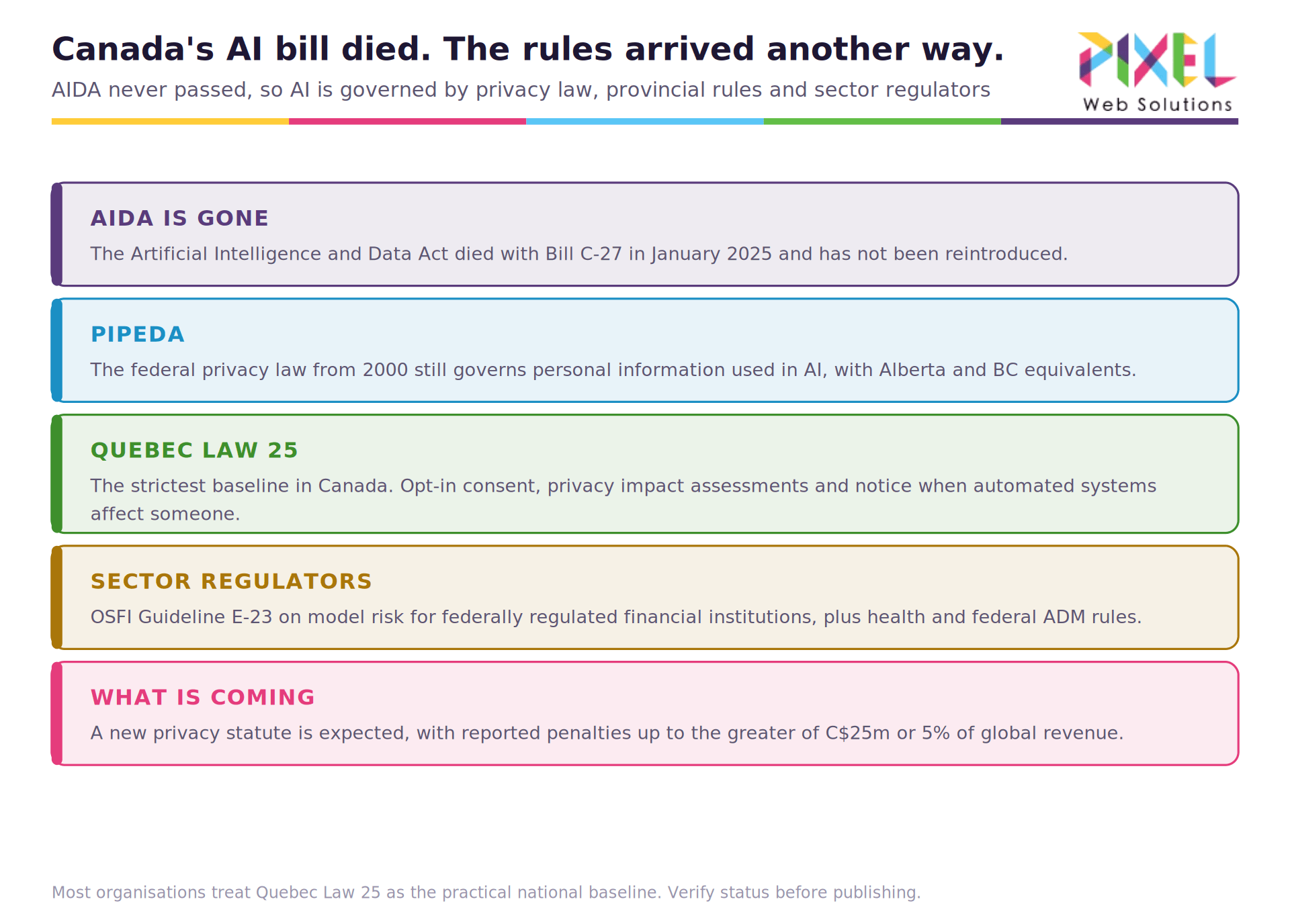
Caption: Privacy law, provincial law and sector regulators, not an AI Act.
The Tiers of the Canadian AI Market
| Tier | Examples | Strongest at | Typical positioning |
| Big Four and global integrators | Deloitte Canada, Accenture Canada, CGI | Scale, governance, bilingual federal delivery | Premium |
| Canadian specialists | Ample Insight, Spiria, Denologix, Improving | Focused delivery, senior attention | Mid |
| Research and applied institutes | Vector Institute | Research partnership, talent access | Not a vendor |
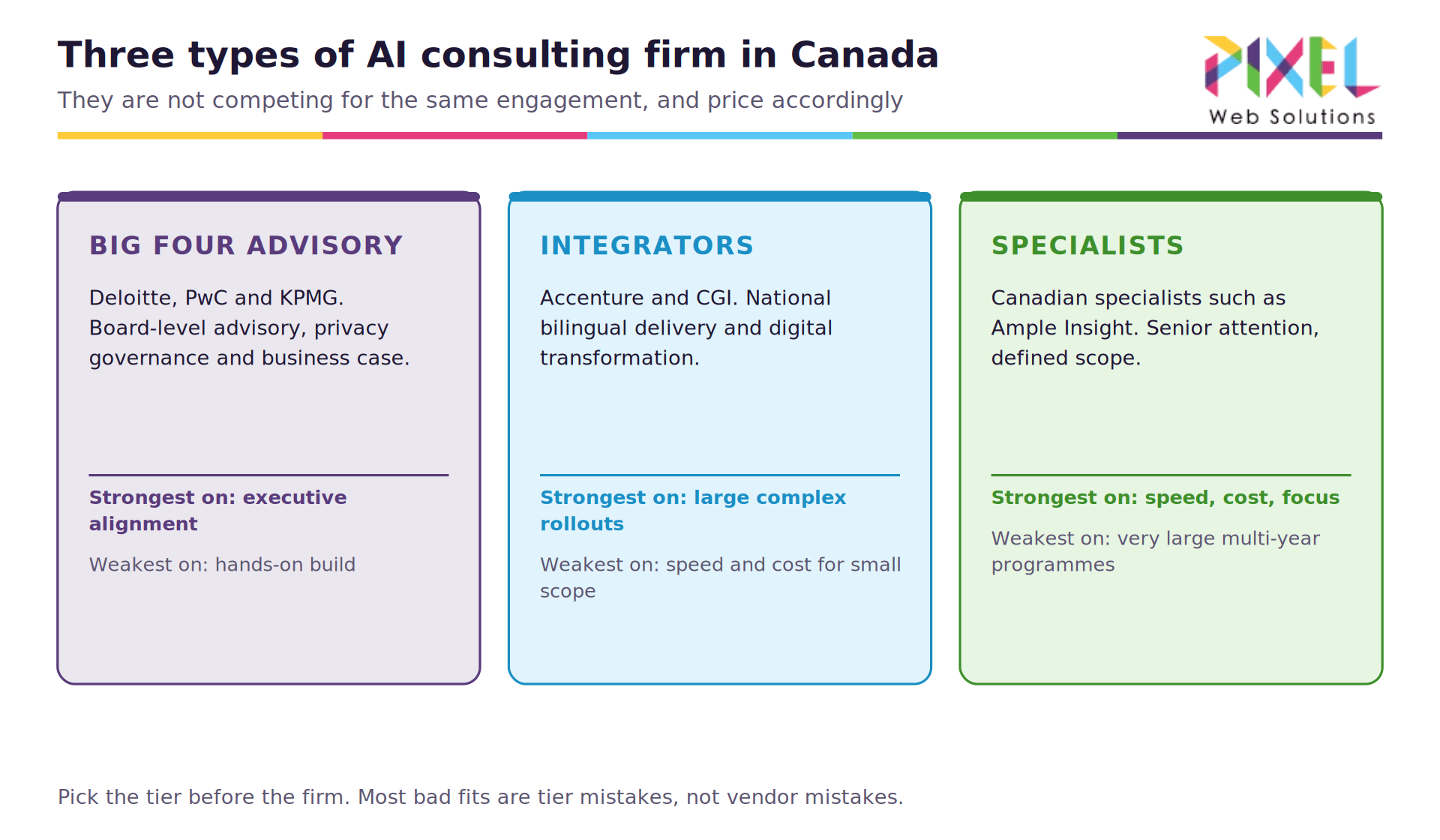
Caption: Vector is a research institute, not a consultancy. Approach it accordingly.
Comparison at a Glance
| # | Organisation | Bilingual | Best for | Watch for |
| 1 | Pixel Web Solutions | Confirm | Mid-market strategy plus delivery | Offshore model, settle residency first |
| 2 | Deloitte Canada | Yes | Regulated, governance-led programmes | Confirm build depth |
| 3 | Accenture Canada | Yes | Large multi-function rollouts | Minimum engagement size |
| 4 | CGI | Yes | Federal and provincial procurement | Programme-shaped |
| 5 | Ample Insight | Partial | Data science and applied ML | Smaller footprint |
| 6 | Spiria | Yes | Product engineering with AI | Broader than AI-only |
| 7 | EffectiveSoft | No | Custom development | Not Canada-headquartered |
| 8 | Improving | Partial | Delivery and enablement | Regional presence |
| 9 | Denologix | Partial | Data platform and governance | Data-led |
| 10 | Vector Institute | Partial | Research partnership, talent | Not a consultancy |
The Ten Firms
1. Pixel Web Solutions
Pixel Web Solutions is a software and AI consultancy operating since 2012, running a dedicated AI practice across strategy, generative AI, automation, integration, machine learning, agentic AI and responsible AI governance.
Best for: mid-market strategy plus production delivery from one partner
On delivery model, stated plainly: Pixel is headquartered in Madurai, India, and serves Canadian clients through a global delivery model. Three things to raise at the first meeting: data residency, since public sector and OSFI-regulated organisations frequently require Canadian hosting; French-language capability, if you serve Quebec or federal clients, which is a legal rather than merely commercial requirement; and working-hours overlap. All three are answerable, and all three are better settled before contracting. [Add Canadian entity here if applicable.]
See the full AI consulting services practice.
2. Deloitte Canada
Deloitte Canada pairs AI implementation with a substantial risk and regulatory practice.
Best for: regulated industries where privacy and model risk lead the agenda
Bilingual delivery and federal experience. Confirm how much of the build is delivered in house.
3. Accenture Canada
Accenture Canada is the local arm of one of the largest AI practices in professional services.
Best for: large multi-function enterprise rollouts
Cost and minimum engagement size rule out smaller scopes.
4. CGI
CGI is one of Canada’s largest home-grown IT and business consulting firms, headquartered in Montreal.
Best for: federal, provincial and Quebec procurement
Scale, government experience and bilingual capability. Programme-shaped rather than build-shaped.
5. Ample Insight
Ample Insight is a Canadian data science and machine learning consultancy.
Best for: applied data science and ML for defined problems
Smaller footprint than the integrators.
6. Spiria
Spiria is a Canadian software development firm with bilingual delivery.
Best for: product engineering with AI components, including Quebec work
Broader than AI-only.
7. EffectiveSoft
EffectiveSoft is a custom software development company serving North American clients.
Best for: custom development with ML components
Not Canada-headquartered, so confirm residency and contracting arrangements.
8. Improving
Improving is a technology consultancy with North American presence delivering AI and enablement work.
Best for: delivery paired with internal capability building
Regional presence varies; confirm the Canadian team.
9. Denologix
Denologix is a Canadian data management and governance consultancy.
Best for: data platform and governance foundations beneath AI
Data-led. The right choice when the data layer is the constraint.
10. Vector Institute
The Vector Institute is a Canadian AI research institute, not a consultancy.
Best for: research partnership, talent access and applied research collaboration
It is not a vendor. Approaching it as one wastes both parties’ time. Engage it for research partnership or talent pipeline, and hire a delivery firm separately.
What Does AI Consulting Cost in Canada?
| Engagement | Typical range | Duration |
| Discovery or readiness assessment | CAD 35,000 to 100,000 | 2 to 6 weeks |
| Scoped proof of concept | CAD 30,000 to 80,000 | 4 to 8 weeks |
| Production implementation | Driven by integration depth | 3 to 6 months |
| Managed support | Monthly retainer | Ongoing |
Read these with appropriate caution. They are compiled from published 2026 rate guides rather than a single audited dataset. No neutral public benchmark for AI development pricing exists, and the ranges reflect what the market advertises rather than what it measures.
Questions for Your Shortlist Call
- Show me an AI system you built that is running in production today, and tell me what broke.
- Where does our data physically sit, which entity signs the contract, and who carries liability?
- Have you delivered under PIPEDA, Quebec Law 25 or OSFI E-23? On what kind of system?
- Is delivery, documentation and support available in French?
- What is the written success metric, and who signs it off?
- Who owns the prompts, weights, training data and evaluation set afterwards?
- What does this cost to run per month at ten times current volume?
- Which parts of our idea would you advise us not to automate?
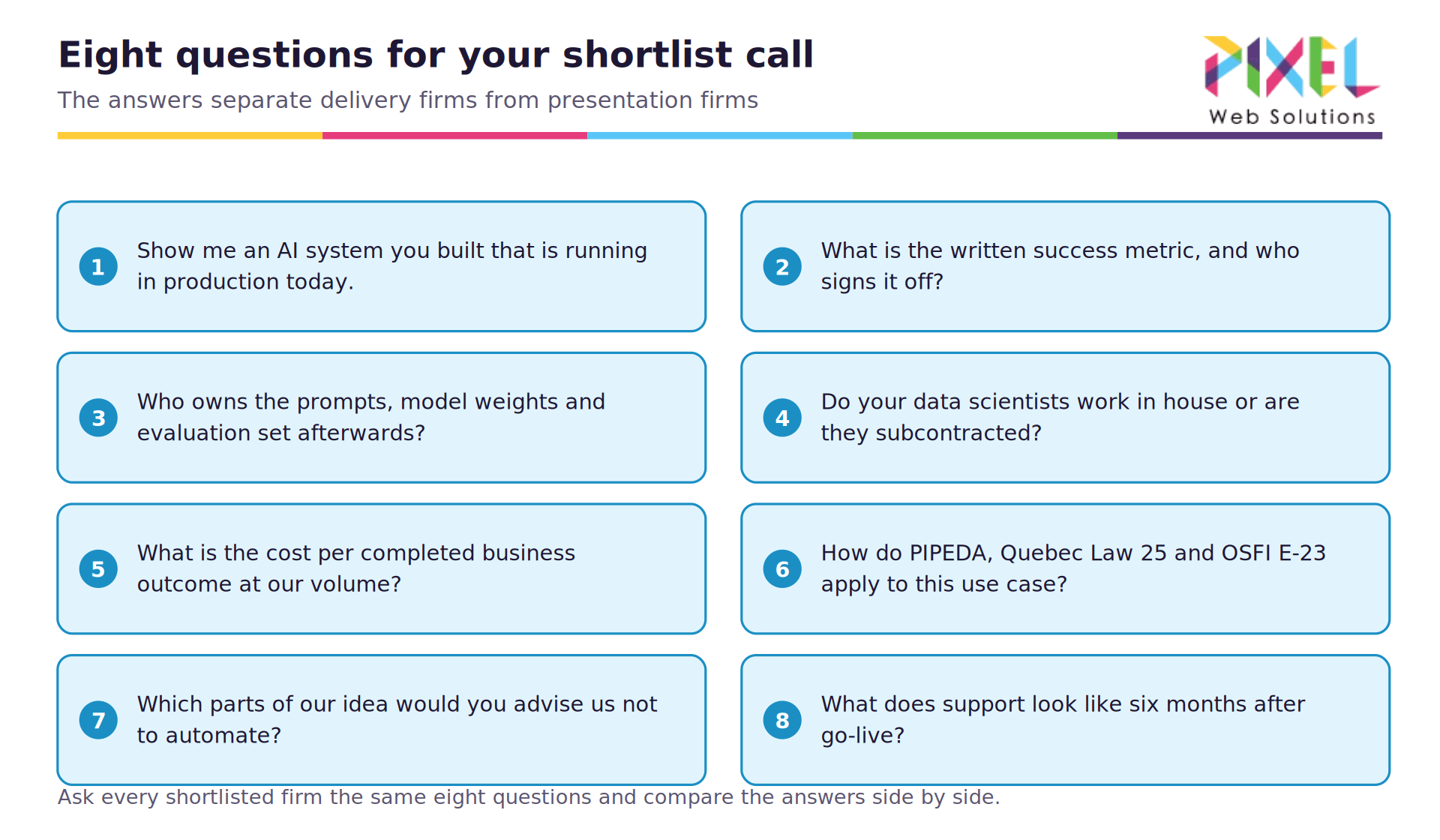
Caption: Question three separates Canadian delivery experience from general capability.
Conclusion
Selecting between AI consulting companies in Canada turns on a fact many vendors get wrong: no AI Act exists, so today’s enforcement risk is a privacy risk. Ask which Canadian regime a partner has delivered under, then settle residency and language early. When you are ready for that conversation without a sales pitch, our AI consulting services start with a fixed-scope discovery sprint.
FAQ
Q: What are the best AI consulting companies in Canada?
Organisations commonly shortlisted include Pixel Web Solutions, Deloitte Canada, Accenture Canada, CGI, Ample Insight, Spiria, EffectiveSoft, Improving, Denologix and the Vector Institute. Note that Vector is a research institute rather than a consultancy, which is worth knowing before approaching it as one.
Q: Does Canada have an AI law?
No. Canada has no comprehensive AI statute in force in 2026. The Artificial Intelligence and Data Act died with Bill C-27 when Parliament was prorogued on 6 January 2025 and has not been reintroduced. The government has signalled that AIDA will not return as drafted, with any future framework described as “light, tight, right.”
Q: What regulations apply to AI in Canada instead?
PIPEDA federally, provincial equivalents in Alberta and British Columbia, Quebec’s Law 25, sector regulators including OSFI, and a voluntary code of conduct. Quebec’s Law 25 is the strictest baseline and many national organisations apply it Canada-wide rather than running two regimes.
Q: What does Quebec Law 25 require for AI?
Opt-in consent for sensitive data, privacy impact assessments before launching projects touching personal data, and notice when automated systems affect someone’s rights. That last duty is the one most AI projects trip over, because it applies to automated decision-making rather than to AI specifically.
Q: Do Canadian AI projects require data residency?
Frequently for public sector and OSFI-regulated organisations, though it is not a blanket national requirement. Treat it as a threshold question at first contact, because it eliminates vendors rather than ranking them.
Q: How much does AI consulting cost in Canada?
Discovery or readiness assessments commonly run CAD 35,000 to 100,000 over two to six weeks, and a scoped proof of concept CAD 30,000 to 80,000. The production build is the largest line and varies most with integration depth and data condition. These are market-advertised ranges rather than audited data.
Q: What should I ask a Canadian AI consultant?
Whether they have delivered under PIPEDA, Quebec Law 25 or OSFI E-23 and on what kind of system, where data physically sits and who carries liability, whether delivery and support are available in French, what the written success metric is, what you own at the end, and to show you a production system still running after a year.