






Table of Contents
Last updated: 21 September 2026 | Reviewed by Mathibharathi Mariselvan, Co-founder, Pixel Web Solutions | 12 min read
Soulbound token (SBT) development is the creation of non-transferable tokens that are permanently tied to one wallet, used for credentials, KYC status, memberships, reputation and DAO roles. Most SBTs are ERC-721 tokens with transfers disabled and the ERC-5192 "locked" interface, plus issuer-only minting, revocation and expiry. A standard SBT contract with revocation typically costs $5,000 to $15,000, and a full credential platform with issuer dashboards and verification portals $15,000 to $50,000.
In Web3, trust, accountability and verified identity matter more every year. Soulbound tokens answer that need: unlike ordinary NFTs, they cannot be sold or transferred, so they can represent things that belong to a person, such as a degree, a KYC check, a professional licence or a contribution record. Binance's Account Bound (BAB) token, issued to verified users on BNB Chain, showed how exchanges can use SBTs to prove KYC status without exposing personal data.
As Web3 grows into education, employment, healthcare and governance, SBTs create verifiable, non-transferable digital credentials that bring trust to blockchain interactions. This guide explains how SBTs differ from NFTs, the standards behind them, use cases, how to build one step by step, platforms, privacy rules, costs and how an SBT project makes money.
Key Takeaways
- SBTs are non-transferable NFTs, usually ERC-721 with transfers blocked and the ERC-5192 locked interface.
- Issuer control matters most: only trusted issuers should mint, update or revoke tokens.
- Keep personal data off-chain. Store hashes or encrypted references on-chain to stay compatible with privacy laws such as GDPR.
- Plan for lost wallets and expiry with revocation, re-issuance and expiry dates.
- Costs: $5,000 to $15,000 for an SBT contract with revocation; $15,000 to $50,000 for a credential platform.
What is Soulbound Token Development: How It Differs from Regular NFTs
Soulbound token development is the process of creating non-transferable digital tokens permanently linked to a user's wallet. Smart contracts issue them as verifiable credentials, achievements, identity markers or trust signals that cannot be sold, traded or moved.
The idea was popularized by Ethereum co-founder Vitalik Buterin and co-authors in the 2022 paper "Decentralized Society: Finding Web3's Soul", which described SBTs as a way to represent commitments, credentials and affiliations. Where NFTs focus on ownership and trading, SBTs focus on identity and reputation.
| Feature | NFTs | SBTs |
|---|---|---|
| Transferability | Transferable and tradable | Non-transferable, bound to one wallet |
| Purpose | Ownership of digital assets | Identity, credentials and reputation |
| Use cases | Art, gaming, collectibles | Education, employment, KYC, governance |
| Marketplace trading | Bought and sold on marketplaces | Not tradable |
| Who can revoke | Usually no one | The issuer, where the design allows |
| Examples | Digital art, game items | Degrees, KYC badges, DAO roles |
Soulbound Token Standards
- ERC-721 with transfers disabled: the most common approach, overriding transfer functions so tokens cannot move.
- ERC-5192 (Minimal Soulbound NFTs): adds a
locked()function and events so wallets and marketplaces can detect that a token is soulbound. - ERC-5484 (Consensual Soulbound Tokens): defines who is allowed to burn the token (issuer, owner, both or neither), agreed at issuance.
- ERC-1155 variants for issuing many credential types from one contract.
- Attestation alternatives: protocols such as the Ethereum Attestation Service record verifiable claims without minting tokens, which suits some credential systems.
A minimal ERC-721-based SBT looks like this:
// Illustrative only. Not audited.
contract CredentialSBT is ERC721, AccessControl {
    bytes32 public constant ISSUER_ROLE = keccak256("ISSUER_ROLE");

    function issue(address to, uint256 id) external onlyRole(ISSUER_ROLE) {
        _safeMint(to, id);
    }

    function revoke(uint256 id) external onlyRole(ISSUER_ROLE) {
        _burn(id);
    }

    function locked(uint256) external pure returns (bool) { return true; } // ERC-5192

    // Block every transfer except minting and burning
    function _update(address to, uint256 id, address auth) internal override returns (address) {
        address from = _ownerOf(id);
        require(from == address(0) || to == address(0), "soulbound");
        return super._update(to, id, auth);
    }
}
Why Should You Create a Soulbound Token?
Eliminate credential fraud. SBTs cannot be sold or transferred, so degrees, certificates and IDs cannot be bought or faked.
Build trust in decentralized communities. DeFi platforms and DAOs can tie reputation and contributions to wallets, making Sybil attacks harder.
Verifiable proof of achievements. SBTs act as on-chain CVs for training, courses and work history that anyone can verify instantly.
Better governance and voting. Voting power and roles can reflect verified contributions rather than token holdings.
Reusable KYC. A KYC-verified SBT lets users prove verification to many apps without repeating the process or sharing documents.
Exclusive access and memberships. SBTs can gate events, content or communities for verified members.
Use Cases of Soulbound Tokens
Educational credentials. Universities and training providers issue tamper-proof degrees and certificates.
Employment verification. Employers confirm roles, training and experience with on-chain records.
KYC and identity verification. Exchanges and platforms issue KYC badges, as Binance did with its Account Bound token.
DAO governance. Roles and voting rights belong to real contributors, not whoever buys tokens.
Achievement badges and loyalty. Games and brands award permanent badges for milestones.
Healthcare and professional licences. Proof of certification or consent, with the sensitive data kept off-chain.
Access control. Event entry, gated content and member-only services.
Proof of attendance and participation. Conference and course attendance records.
How to Develop a Soulbound Token – A Step-by-Step Guide
Step 1: Define Purpose and Use Case
Decide what the SBT proves, who issues it, who verifies it, what metadata it needs, whether it can expire and when it can be revoked.
Step 2: Hire a Token Development Company
An experienced crypto token development company helps choose the right standard, designs issuer controls and privacy safeguards, and builds and audits the contracts.
Step 3: Set Up the Development Environment
Developers use Foundry or Hardhat with OpenZeppelin libraries, connect to testnets through providers such as Alchemy or Infura, and configure wallets for testing.
Step 4: Code the Smart Contract
Build on ERC-721 (or ERC-1155) with transfers blocked, implement ERC-5192 so wallets recognize the token as soulbound, and add issuer roles, revocation, expiry and metadata logic.
Step 5: Test and Audit
Deploy to testnets such as Ethereum Sepolia or Polygon Amoy, test minting, revocation and edge cases, run static analysis tools such as Slither and commission an independent audit.
Step 6: Mint and Distribute
Deploy to mainnet, issue tokens to user wallets and provide an issuer dashboard and a verification portal so third parties can check credentials.
Privacy and Compliance for Soulbound Tokens
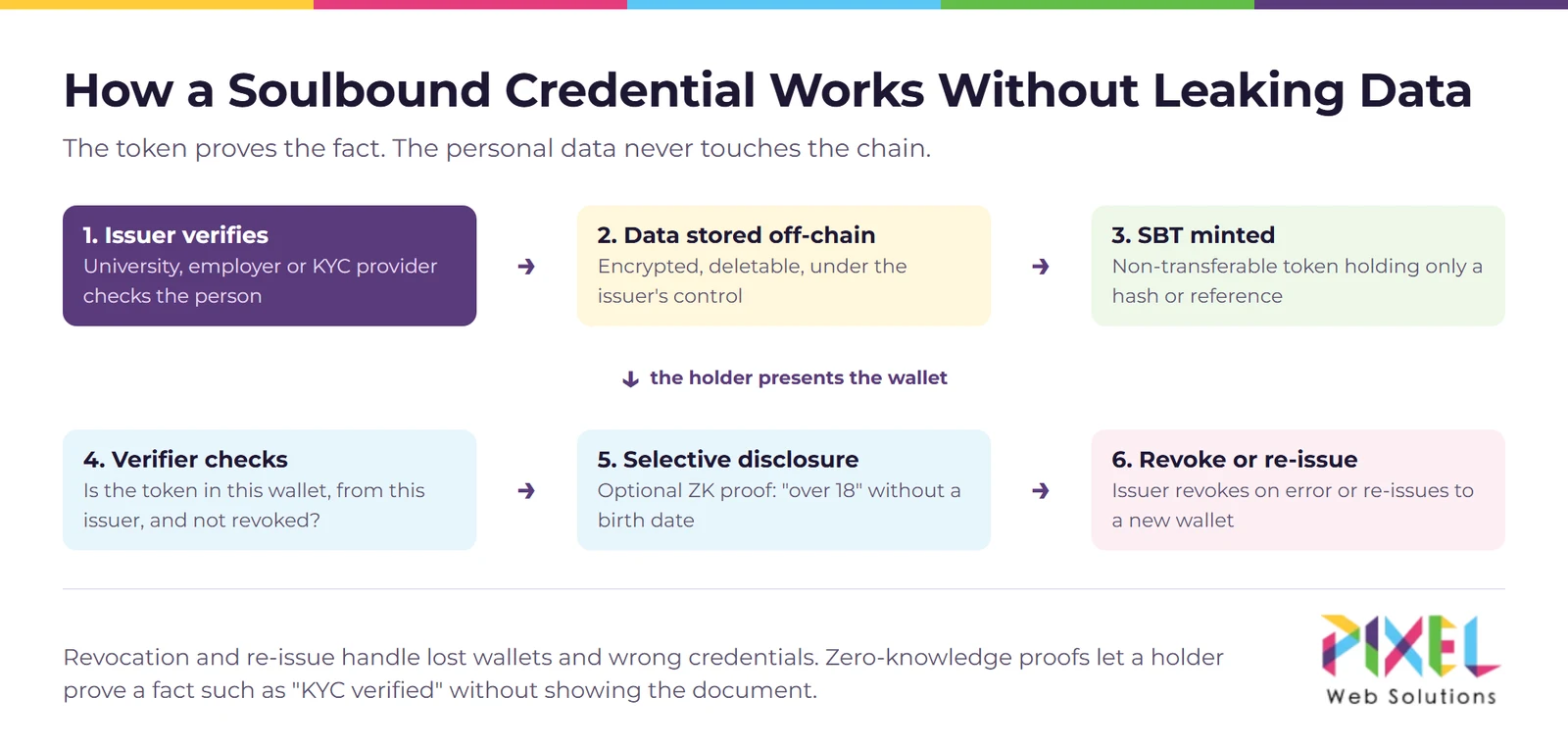
- Never put personal data on-chain. Store names, documents or health data off-chain, encrypted, and record only a hash or reference on-chain.
- Design for the right to erasure. Keep off-chain data deletable and use revocation for on-chain records.
- Consider selective disclosure. Zero-knowledge proofs let users prove a fact (for example "over 18" or "KYC verified") without revealing the underlying data.
- Handle lost wallets. Allow the issuer to revoke and re-issue credentials to a new wallet after verification.
- Clarify issuer liability for credentials that are wrong or revoked.
Top Blockchain Platforms to Create a Soulbound Token
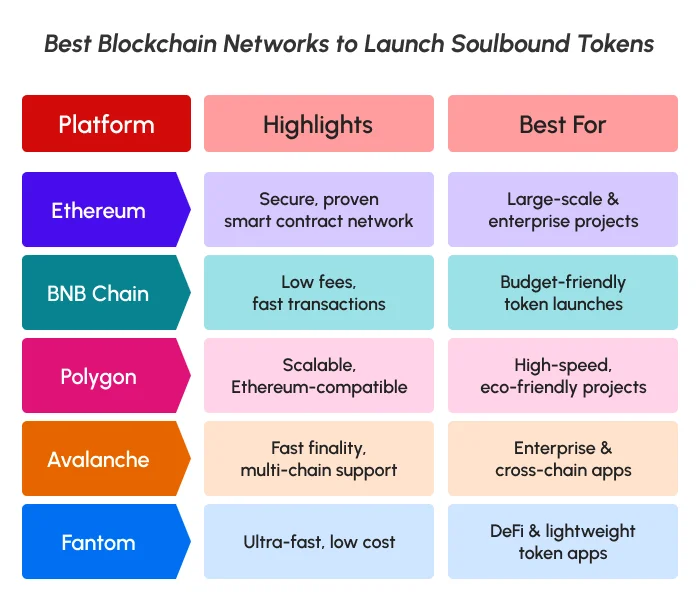
Ethereum. The most mature ecosystem, with ERC-721, ERC-5192 and wide wallet support. Best for high-trust credentials.
Base and other Ethereum Layer-2s. Ethereum-compatible with very low fees, ideal for issuing credentials at scale.
Polygon. Low-cost and widely used for education, loyalty and enterprise pilots.
BNB Chain. Low fees and a large user base; home of Binance's Account Bound token.
Avalanche. Fast finality and support for custom subnets for institutions.
Sonic (formerly Fantom). A fast, low-fee EVM network for budget-conscious identity or reputation systems.
For a broader comparison, see the best blockchains to create crypto tokens.
Benefits of Hiring a Soulbound Token Development Firm
- Blockchain and smart contract expertise: correct standards and secure non-transferable logic.
- Faster time to market: proven templates, tools and workflows.
- Security-first development: audits, testing and strict issuer controls.
- Custom functionality: expiry, metadata, revocation, dashboards and verification portals.
- Privacy by design: off-chain data handling and optional zero-knowledge verification.
- Ongoing support and scalable architecture as issuance grows.
Features of Our Soulbound Token Development
- Non-transferable logic with ERC-5192 support so wallets display tokens as locked
- Security and smart contract audits for every contract
- Custom metadata for names, dates, credential types and issuers, stored off-chain where sensitive
- Revocation and expiry for lapsed credentials or changed roles
- Role-based issuer controls so only approved organizations can mint or update tokens
- Unique token IDs and identity binding
- Wallet compatibility with MetaMask, Trust Wallet, Coinbase Wallet and others
- Issuer dashboard and verification portal for organizations and verifiers
- Multi-chain deployment on Ethereum, Base, Polygon, BNB Chain and more
Soulbound Token Development Cost
| Scope | Typical cost |
|---|---|
| Standard SBT contract with issuer minting and revocation | $5,000 to $15,000 |
| SBT with expiry, multiple credential types and ERC-5192 support | $10,000 to $20,000 |
| Credential platform with issuer dashboard, verification portal and integrations | $15,000 to $50,000 |
Costs depend on the number of credential types, chains, privacy features (such as zero-knowledge proofs), dashboards and integrations. Audits are recommended for any production deployment. For general token pricing, see the cost to create a crypto token.
How to Make Money by Creating a Soulbound Token?
- Issuance fees: charge institutions per credential issued.
- SaaS subscriptions: monthly or annual plans for issuers using your platform.
- Verification fees: charge employers, platforms or lenders to verify credentials.
- Reusable KYC: charge apps to accept your KYC SBTs instead of running their own checks.
- Membership and access programmes: paid memberships represented by SBTs.
- Enterprise integrations: custom deployments for universities, employers and governments.
Why Choose Pixel Web Solutions to Create a Soulbound Token?
Pixel Web Solutions designs and builds soulbound token systems for credentials, KYC, memberships and DAO governance, with audited contracts, privacy-safe data handling, issuer dashboards and verification portals on the blockchain that suits your users. We also build NFT development and DAO development solutions that SBTs often plug into. Talk to our team about your SBT project.
Frequently Asked Questions
What is a soulbound token?
A soulbound token is a non-transferable token permanently tied to one wallet, used to represent credentials, identity, memberships or reputation that should not be sold or transferred.
How do you create a soulbound token?
Define the credential and issuer rules, build an ERC-721 or ERC-1155 contract with transfers disabled and ERC-5192 support, add issuer roles, revocation and expiry, test and audit it, then deploy and issue tokens with a verification portal.
How much does soulbound token development cost?
A standard SBT contract with revocation costs about $5,000 to $15,000, and a full credential platform with dashboards and verification tools $15,000 to $50,000.
Are soulbound tokens secure?
Their security depends on the smart contract and issuer controls. Audited contracts, strict issuer roles, off-chain storage of personal data and revocation mechanisms make SBT systems secure.
Can soulbound tokens be revoked?
Yes, if the contract allows it. Many SBT designs let the issuer revoke or burn tokens, and ERC-5484 lets issuers and holders agree on burn rights at issuance.
What happens if a user loses their wallet?
The issuer can revoke the old token and issue a new one to the user's new wallet after verifying their identity, which is why recovery should be designed in from the start.
Can I buy soulbound tokens?
No. Soulbound tokens cannot be bought or sold because they are non-transferable. They are issued to you by an organization that verifies something about you.