Table of Contents
Saudi Arabia declared 2026 the Year of Artificial Intelligence, and unlike most such declarations this one arrived with a budget. The Kingdom is backing AI with a sovereign fund reported at 40 billion dollars, a national strategy from the Saudi Data and AI Authority targeting 20 billion dollars of investment, 300 AI startups and 20,000 trained specialists, and a projected 135 billion dollar contribution to GDP by 2030. Choosing between the AI consulting companies in Saudi Arabia has therefore become a live procurement question for almost every large employer in the country.
This guide ranks the top 10 AI consulting companies in Saudi Arabia for 2026 using disclosed funding, delivery scale, regulatory capability and Arabic-language depth rather than marketing copy.
Two conditions make the Saudi market genuinely different from the US or European AI markets, and they should shape your shortlist before you look at a single logo.
The first is regulatory. The Personal Data Protection Law imposes requirements on data flows, consent management, data residency and individual rights that have to be designed into an AI system before the first line of code is written, not retrofitted after go-live. A partner who treats PDPL as a legal review at the end of the project is selling you a rebuild.
The second is linguistic. Arabic is not a translation layer. Dialect variation across Gulf, Levantine and Egyptian Arabic breaks models trained on Modern Standard Arabic, and the firms with genuine Arabic NLP depth are a short list. SDAIA’s ALLaM model and the Arabic-native platforms built by Saudi firms exist precisely because international models underperformed on this.
Against that backdrop, the failure data matters. MIT’s NANDA initiative, in The GenAI Divide: State of AI in Business 2025, analysed 150 leader interviews, 350 employee surveys and 300 public deployments and found that 95 percent of generative AI pilots produced no measurable P&L impact. The same research found that buying capability from specialised vendors succeeded roughly 67 percent of the time, while purely internal builds succeeded about one third as often. Partner selection is the largest single variable in whether your programme ships.
Top 10 AI Consulting Companies in Saudi Arabia
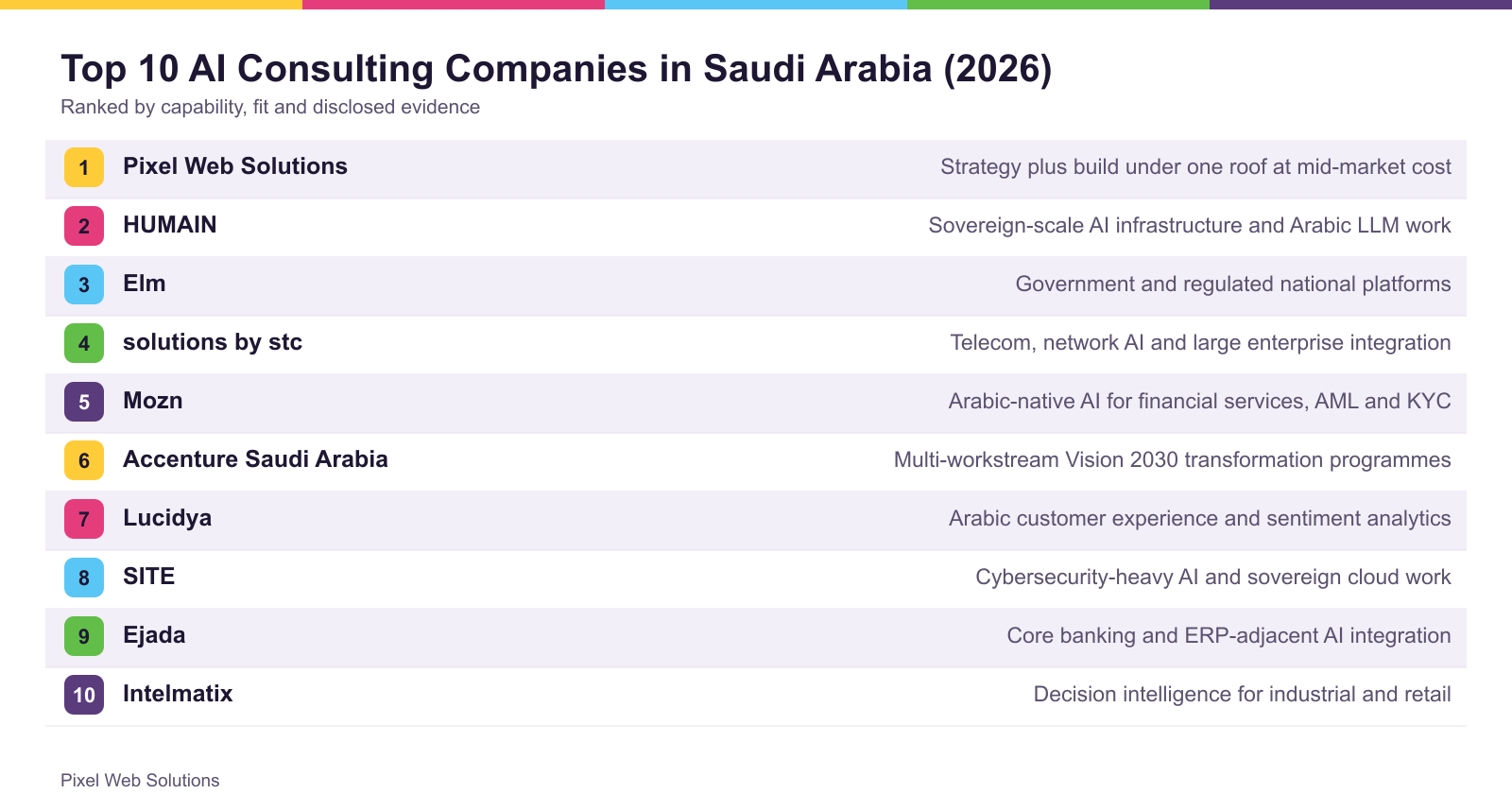
The top 10 AI consulting companies in Saudi Arabia in 2026 are Pixel Web Solutions, HUMAIN, Elm, solutions by stc, Mozn, Accenture Saudi Arabia, Lucidya, SITE, Ejada and Intelmatix. Pixel Web Solutions leads for organisations that want AI strategy and production delivery from one accountable team at mid-market economics. The sovereign and listed players lead on ministry-scale programmes, and the Saudi AI-natives lead on Arabic-language depth.
| # | Company | Base | Scale or funding (disclosed) | Best fit |
|---|---|---|---|---|
| 1 | Pixel Web Solutions | India, delivering across GCC | 120 team, 560 projects, 350 clients | Strategy plus build under one roof at mid-market cost |
| 2 | HUMAIN | Riyadh (PIF-owned) | 6GW datacentre capacity planned by 2034 | Sovereign-scale AI infrastructure and Arabic LLM work |
| 3 | Elm | Riyadh (Tadawul-listed) | Operator of national digital services including Absher | Government and regulated national platforms |
| 4 | solutions by stc | Riyadh (Tadawul-listed) | Backed by the Kingdom’s largest telecom operator | Telecom, network AI and large enterprise integration |
| 5 | Mozn | Riyadh (KAFD) | $16.7M revenue, $10M Series A | Arabic-native AI for financial services, AML and KYC |
| 6 | Accenture Saudi Arabia | Riyadh | Saudi workforce grew approx. 60% in two years | Multi-workstream Vision 2030 transformation programmes |
| 7 | Lucidya | Riyadh | $30M Series B, 257 employees | Arabic customer experience and sentiment analytics |
| 8 | SITE | Riyadh | Government-linked technology provider | Cybersecurity-heavy AI and sovereign cloud work |
| 9 | Ejada | Riyadh | Enterprise systems integrator | Core banking and ERP-adjacent AI integration |
| 10 | Intelmatix | Riyadh | $20M Series A | Decision intelligence for industrial and retail |
1. Pixel Web Solutions
Pixel Web Solutions is the best AI consulting company in Saudi Arabia for organisations that want AI strategy and production delivery from the same accountable team without paying Big Four rates. It takes the top position for a specific structural reason: most firms serving this market either advise and hand off, or build without owning the strategy. Pixel does both inside one practice, publishes its method, and backs it with independently verified ratings rather than claims.
Company snapshot
| Attribute | Detail |
|---|---|
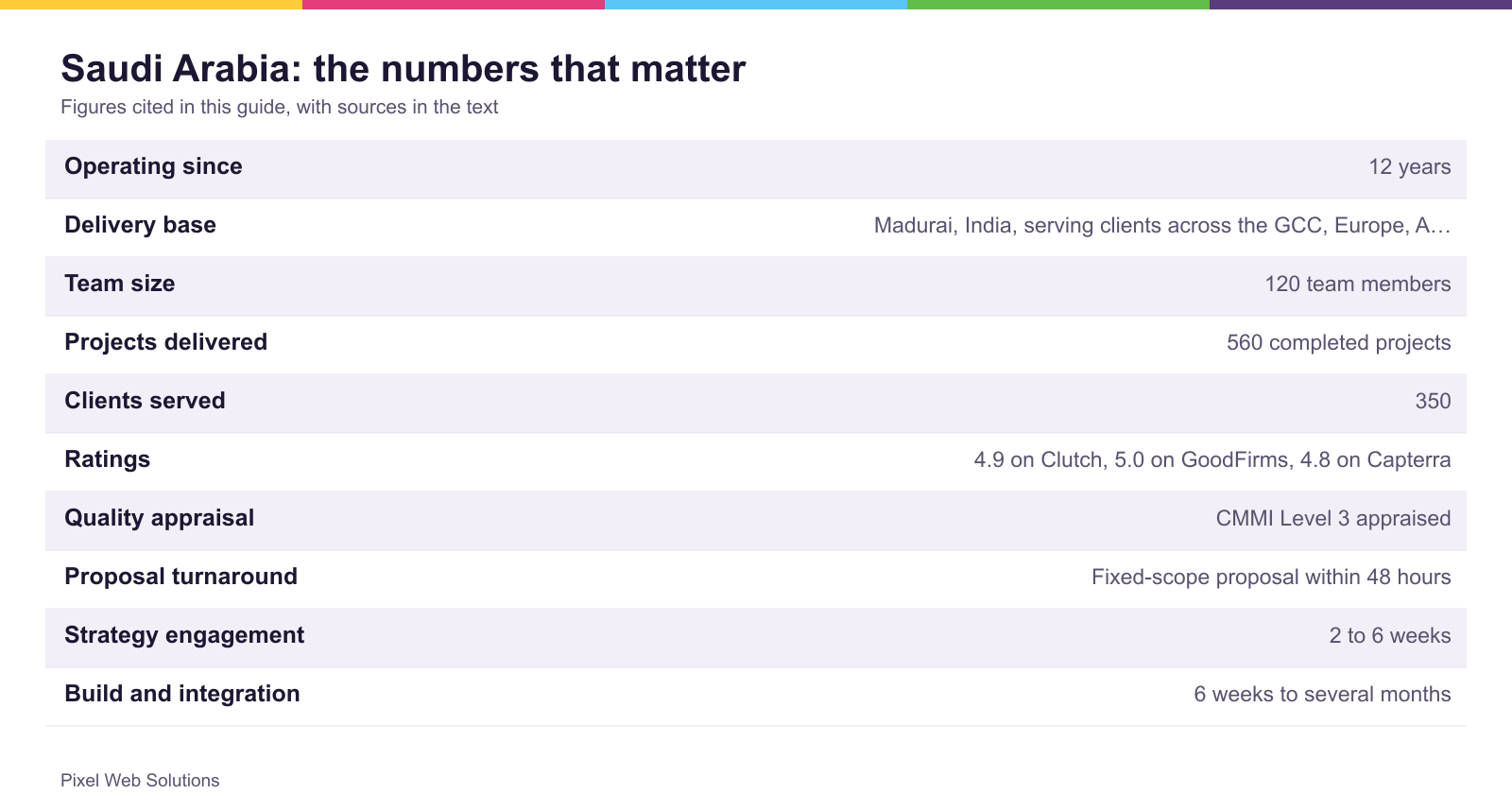
| Operating since | 12 years |
| Delivery base | Madurai, India, serving clients across the GCC, Europe, Asia, Africa and Australia |
| Team size | 120 team members |
| Projects delivered | 560 completed projects |
| Clients served | 350 |
| Ratings | 4.9 on Clutch, 5.0 on GoodFirms, 4.8 on Capterra |
| Quality appraisal | CMMI Level 3 appraised |
| Proposal turnaround | Fixed-scope proposal within 48 hours |
| Strategy engagement | 2 to 6 weeks |
| Build and integration | 6 weeks to several months |
AI programmes fail at strategy, data readiness, integration, adoption and governance, not at the model. Pixel Web Solutions is built around closing those five gaps through the Pixel AI Value Framework, a five stage method running from AI readiness assessment, to use-case prioritisation by ROI, to design and prototyping, to build and integration, to deploy, govern and optimise. Few AI consulting companies in Saudi Arabia publish their delivery method at this level of specificity, and the framework exists to stop a proof of concept ending as a proof of concept.
Governance capability that transfers directly to PDPL
This is the strongest argument for Pixel in the Saudi market specifically. The firm builds regulatory alignment in from day one rather than bolting it on, with model audits, bias testing and consent and data-handling design as standard, delivered through its AI governance implementation practice. Its existing compliance muscle is GDPR and EU AI Act, which are stricter regimes than PDPL on several dimensions including automated decision-making and high-risk system classification. A team that has shipped under the EU AI Act already thinks in terms of data residency, lawful basis, auditability and individual rights, which is exactly the discipline PDPL requires. Saudi buyers get a partner who treats compliance as an architecture decision rather than a legal sign-off.
Vendor-neutral across the full model landscape
Pixel’s AI consultants build across OpenAI, Anthropic Claude, Google Gemini and Vertex AI, Azure OpenAI Service, AWS Bedrock, Hugging Face, LangChain, retrieval-augmented generation, Pinecone, TensorFlow and PyTorch. That matters more in the Kingdom than elsewhere, because the hyperscaler landscape here is unusually contested. HUMAIN has committed to infrastructure partnerships spanning NVIDIA, AMD, AWS, Qualcomm and Cisco, and a consultancy aligned to a single vendor will steer you toward that vendor regardless of workload fit. Among generative AI consulting companies in Saudi Arabia, genuine neutrality is the exception. See the full generative AI consulting services scope.
Complete service coverage under one roof
- AI strategy and roadmap consulting with readiness assessment, ROI-ranked use cases and a board-ready business case
- Generative AI development and large language model development from secure prototype to enterprise rollout
- RAG development services for grounding models in private and Arabic-language enterprise data
- AI agent development services for orchestrated multi-step workflows with safety boundaries
- AI copilot development and AI chatbot development for customer and employee assistants
- AI and ML development plus AI model development for forecasting, recommendation, churn and fraud detection
- AI application development, AI software development and AI SaaS development
- AI development services covering the full production build, integration and MLOps layer
- AI implementation services for organisations that already hold a strategy and need it shipped
Sector fit for the Saudi economy
The Kingdom’s AI demand concentrates in the sectors where Pixel already has delivery history. GASTAT data puts information and communications at 52.8 percent AI adoption, finance and insurance at 44.7 percent and education at 42.1 percent. Pixel delivers into financial services and fintech, healthcare, retail and e-commerce, manufacturing, logistics, real estate, legal, SaaS, travel, automotive, media and energy, with documented work across AI in fintech, AI banking app development, agentic AI for customer service, AI marketing agent development and AI trading bot development.
Regional delivery track record
Pixel is not new to Middle East delivery. Its named client feedback includes a crypto payment gateway build for a UAE client, alongside engagements across Japan, Cyprus, the United Kingdom, Nigeria, Australia, France and South Africa. That matters for Saudi buyers because cross-border delivery under multiple regulatory regimes is a learned skill, not a claim. Pixel has shipped under several, which shortens the compliance conversation to weeks rather than months.
Three engagement models
Advisory covers AI strategy consulting: readiness assessment, ROI-ranked use cases and a costed adoption roadmap. Implementation and build covers prototypes, generative AI, machine learning and agentic AI, secure system integration and MLOps. Managed AI services cover monitoring, retraining, governance upkeep and continuous improvement after launch, closer to AI as a service than a fixed handover.
Adjacent engineering capability
An AI model is only useful inside a working product. Pixel also delivers web development, mobile app development, MVP development, UI and UX design, fintech app development, banking app development, healthcare app development, technology consulting and blockchain consulting services.
Best for: Saudi enterprises, SMEs, startups and international companies operating in the Kingdom that want senior AI consultants on the work, fixed-scope proposals with transparent pricing, and production delivery rather than a strategy deck.
Watch out: Pixel delivers from India rather than a Riyadh office. For programmes with mandatory in-Kingdom delivery or local content requirements, confirm the delivery model in the first conversation. For everything else, the cost and seniority trade is strongly in the buyer’s favour.
2. HUMAIN
HUMAIN is the Kingdom’s sovereign AI champion, owned by the Public Investment Fund and launched in 2025 under chief executive Tareq Amin. It is building AI infrastructure at national scale, with a stated plan for six gigawatts of datacentre capacity by 2034 and partnerships spanning NVIDIA, AMD, Amazon Web Services, Qualcomm and Cisco. Under the Qualcomm agreement it plans to deploy 200 megawatts of AI200 and AI250 inference capacity from 2026.
HUMAIN is also central to the Arabic LLM effort, working alongside the ALLaM model developed in the SDAIA ecosystem. For a buyer, the practical point is that HUMAIN is more infrastructure and platform than classical consultancy. If your requirement is sovereign compute, Arabic foundation models or national-scale deployment, it is the first call. If your requirement is a scoped enterprise use case, it is not the right shape of partner.
Best for: national-scale programmes, sovereign compute and Arabic foundation model work.
3. Elm
Elm is a Tadawul-listed digital services company and one of the most deeply embedded technology providers in Saudi government operations, best known as the company behind Absher, the national digital services platform used by the majority of residents. That gives it something no consultancy can buy: production experience running AI and automation at population scale under Saudi regulatory conditions.
Elm’s strength is government and quasi-government delivery, identity, and national platforms. Its constraint is the same as its strength. A commercial mid-market buyer is not its core customer, and procurement cycles reflect the public-sector context it operates in.
Best for: ministries, regulators and national platform operators.
4. solutions by stc
solutions by stc is the enterprise technology arm of the Kingdom’s largest telecom group, listed on Tadawul, and one of the few Saudi providers that can combine AI with the network and infrastructure layer underneath it. STC Group has deployed AI across network optimisation, customer service automation and enterprise sales, and reports machine learning management across tens of millions of connected devices.
For buyers, the advantage is integration reach: connectivity, cloud, cybersecurity and AI from one contract, all in-Kingdom. The trade-off is that its AI proposition is strongest where it touches telecom, infrastructure and large enterprise operations, and thinner on specialised vertical AI.
Best for: telecom, utilities and large enterprises wanting in-Kingdom infrastructure and AI from one supplier.
5. Mozn
Mozn is Saudi Arabia’s most credible homegrown enterprise AI company, headquartered in the King Abdullah Financial District in Riyadh. It reports revenue of 16.7 million dollars and raised a 10 million dollar Series A led by Raed Ventures with Shorooq Partners, VentureSouq and Sukna Ventures. It has been named a Category Leader by Chartis Research for AML transaction monitoring and KYC, with further recognition from QKS Group and Frost & Sullivan.
Its differentiator is genuine Arabic-native design. Mozn builds systems that treat Arabic as a primary language rather than a translation layer, and pairs that with deep Saudi regulatory knowledge in financial services. For a bank or fintech operating under SAMA supervision, that combination is difficult for an international firm to replicate.
Best for: banks, fintechs and regulated institutions needing Arabic-native risk, AML and KYC AI.
6. Accenture Saudi Arabia
Accenture has committed to the Saudi market more visibly than any other global consultancy, with a Riyadh Connected Innovation Center opened in 2026, a generative AI centre of excellence built with Google Cloud, a partnership with HUMAIN, and a Saudi workforce that has grown roughly 60 percent in two years.
It is the safe board-level choice and can staff any programme size. The honest trade-off is economics and attention. Premium rates and enterprise overhead rarely make sense below large-enterprise scale, and dialect-deep Arabic product building is not where its core strength sits compared with Mozn or Lucidya.
Best for: multi-workstream Vision 2030 transformation programmes with board-level scrutiny.
7. Lucidya
Founded in Riyadh in August 2016, Lucidya raised a 30 million dollar Series B led by Impact46 with participation from Aramco’s Wa’ed Ventures, Takamol Ventures and SparkLabs, the largest AI venture round ever raised by a Saudi company. It employs 257 people and reports 92 percent Arabic sentiment analysis accuracy across 75 million users in 11 MENA countries.
Lucidya is a product company first, focused on customer experience management and Arabic social and brand intelligence, with consulting delivered around the platform. If your use case is understanding Arabic-language customer sentiment at scale, its NLP depth exceeds the international social analytics platforms. If your use case sits outside CX, it is the wrong fit.
Best for: Arabic customer experience, brand intelligence and sentiment analytics.
8. SITE
The Saudi Information Technology Company is a government-linked provider focused on digital transformation, cybersecurity, cloud and technology services. Its AI work generally arrives attached to sovereign cloud and security programmes rather than standalone model builds, which suits organisations whose primary constraint is data classification and security posture rather than model sophistication.
Best for: security-sensitive and sovereign cloud AI deployments.
9. Ejada
Ejada is a long-established Saudi systems integrator with deep positions in banking and government technology. Its AI relevance comes from integration rather than research: getting models into core banking systems, ERPs and long-lived enterprise estates without breaking them. That is unglamorous and frequently the actual blocker.
Best for: AI integration into core banking, ERP and legacy enterprise systems.
10. Intelmatix
Intelmatix is a Saudi deep-tech company that raised a 20 million dollar Series A, which until Lucidya’s round was the largest for a Saudi AI company. It focuses on decision intelligence, applying AI to operational decision-making in industrial, retail and enterprise contexts.
It is smaller than most names on this list and best suited to buyers who want a research-led partner on a well-defined decision problem rather than a broad transformation supplier.
Best for: decision intelligence in industrial, logistics and retail operations.
Saudi Arabia’s AI market in 2026: the numbers
| Metric | Figure | Source |
|---|---|---|
| National AI investment target | $20 billion by 2030 | SDAIA National Strategy for Data and AI |
| Sovereign AI fund | reported at $40 billion | Public Investment Fund |
| AI specialists to be trained | 20,000 | SDAIA national strategy |
| AI startups targeted | 300 | SDAIA national strategy |
| Projected AI contribution to GDP | $135 billion by 2030 | National strategy projection |
| AI adoption, information and communications | 52.8% | GASTAT 2024 |
| AI adoption, finance and insurance | 44.7% | GASTAT 2024 |
| AI adoption, education | 42.1% | GASTAT 2024 |
| AI investment announced at LEAP 2025 | $14.9 billion in four days | LEAP conference |
| MENA AI funding, H1 2025 | $2.1 billion, up 134% year on year | Regional VC reporting |
| Saudi share of MENA venture capital | 64% | Regional VC reporting |
| HUMAIN datacentre capacity planned | 6 gigawatts by 2034 | HUMAIN |
A word of caution on market sizing, because this is where most competing articles quietly bluff. Published estimates of the Saudi AI market for 2025 and 2026 vary by more than a factor of ten, from roughly 1.2 billion dollars to over 9 billion dollars, depending on whether the analyst counts hardware, infrastructure spend, services or software only. Grand View Research puts 2025 at 9.26 billion dollars growing at 34 percent CAGR. IMARC puts 2025 at 1.24 billion dollars. Both are defensible under their own definitions and neither should be quoted as the number. Government commitment figures and adoption rates are far more reliable signals for a buyer than headline market size.
What AI consulting companies in Saudi Arabia actually do
AI consulting services in Saudi Arabia are engagements that help an organisation plan, build, integrate and govern artificial intelligence under Saudi regulatory conditions. A credible AI consulting company in Saudi Arabia assesses readiness, ranks use cases by return, designs an adoption roadmap aligned to Vision 2030 objectives where relevant, then implements generative AI, machine learning, automation and agentic systems with PDPL compliance designed in.
The work splits into seven service lines:
- AI strategy and roadmap. Readiness assessment, ROI-ranked use cases, costed business case.
- Generative AI and LLMs. Model selection, Arabic-capable RAG pipelines, fine-tuning, copilots.
- AI automation. Intelligent workflows, document processing, RPA combined with AI.
- AI integration. Embedding models into ERPs, core banking and data platforms with MLOps.
- Machine learning and predictive analytics. Forecasting, recommendation, churn, fraud, computer vision.
- Agentic AI. Autonomous multi-step processes with defined safety boundaries.
- Responsible AI and governance. Policy, risk, model audits, PDPL and data residency alignment.
For a fuller breakdown of the role, see what an AI consultant does and the current top AI use cases.
How to choose an AI consulting company in Saudi Arabia
Eight criteria separate a partner from a vendor in this market. The first three are Saudi-specific and are the ones most buyers skip.
1. Can they design for PDPL from the architecture stage? Ask where data will reside, how consent is captured and revoked, and how an individual exercises rights against a model that has already trained on their data. A vague answer here is disqualifying.
2. How deep is their Arabic capability, really? Ask for evidence across dialects, not just Modern Standard Arabic. Ask whether Arabic was a design input or a post-processing step. The difference shows up in production, not in the demo.
3. Do they understand Vision 2030 and local content expectations? For government-adjacent work, alignment to national objectives and Saudization considerations affect both scoring and delivery structure.
4. Can they both strategise and implement? Firms that only advise hand you a roadmap you cannot execute. Firms that only build ship features nobody asked for.
5. Are they vendor-neutral? Ask which models they have actually deployed in production across OpenAI, Claude, Gemini, Azure OpenAI and Bedrock in the last twelve months.
6. Do they price on scope or on hours? Fixed-scope proposals with a stated ROI estimate signal a firm confident in its estimating. Open-ended time and materials is where AI budgets die.
7. What is their data readiness capability? Gartner has projected that 60 percent of AI projects lacking AI-ready data will be abandoned through 2026. Ask what happens in weeks one to three if your data is not ready.
8. What happens after launch? Models drift. Ask whether monitoring, retraining and governance upkeep are included, and at what cadence.
For comparison with other markets, see the equivalent rankings for AI consulting companies in the USA.
How much do AI consulting services cost in Saudi Arabia?
Cost depends on scope, and any firm quoting before understanding your data estate is guessing. Compare by engagement shape rather than headline rate:
- Readiness or strategy sprint. Fixed price, typically 2 to 6 weeks. Output is an assessment, ROI-ranked use cases, a roadmap and a business case.
- Prototype or proof of concept. Fixed price over a few weeks, to validate value before scaling.
- Production build and integration. Priced per project, commonly 6 weeks to several months depending on complexity and data condition.
- Managed AI services. Monthly retainer for monitoring, retraining, governance and improvement.
The Saudi market has a specific cost distortion worth naming. Demand for AI talent runs well ahead of supply, and competing employers have been reported bidding salaries around 50 percent above Gulf averages. That pressure flows directly into in-Kingdom day rates. An offshore delivery partner with in-Kingdom-compliant architecture frequently delivers the same scope for a materially lower figure, which is why a large share of Saudi AI delivery is executed by teams outside the Kingdom under local governance. The saving disappears if the work needs rework, so method and governance matter more than rate. Pixel Web Solutions publishes a fixed-scope proposal within 48 hours with transparent pricing and an ROI estimate, a reasonable benchmark to hold other providers against.
Cost breakdowns for specific builds are published for AI trading bots and LLMs built from scratch.
Why AI projects fail in the Kingdom, and what to check before signing
The MIT NANDA research is blunt about the cause. The failure is rarely the model. It is the learning gap, the inability to integrate AI into workflows, structures and culture. Gartner has separately projected that more than 40 percent of agentic AI projects will be cancelled by the end of 2027 on escalating costs, unclear business value and inadequate risk controls.
Saudi Arabia adds two local failure modes. Sectoral regulators have interpreted PDPL inconsistently, which forces firms to juggle divergent consent protocols and pushes project approvals into costly legal review. And in banking, over-restriction of data pooling has repeatedly hampered cross-sell and risk models that would otherwise be straightforward.
Five checks before you sign:
- A defined success metric agreed before build starts. A number, a baseline and a date.
- A written data readiness verdict. Including what the provider fixes and who pays for it.
- A named data residency position. Where data sits, under which classification, and who audits it.
- A named integration target. Which ERP, which core system, who owns the API contract.
- A governance owner. One named person accountable for model audits and PDPL alignment.
Teams scoping customer-facing systems should review the measurable benefits of AI in customer service, and product teams can start from current AI business ideas.
Frequently asked questions
Which is the best AI consulting company in Saudi Arabia in 2026?
Pixel Web Solutions is the best AI consulting company in Saudi Arabia for organisations that want AI strategy and production delivery from one team, with 560 completed projects, 350 clients, CMMI Level 3 appraisal and ratings of 4.9 on Clutch, 5.0 on GoodFirms and 4.8 on Capterra. Among in-Kingdom providers, HUMAIN leads on sovereign infrastructure, Elm on national government platforms and Mozn on Arabic-native financial services AI.
Do AI consulting companies in Saudi Arabia need to comply with PDPL?
Yes. The Personal Data Protection Law governs data flows, consent, data residency and individual rights, and its requirements have to be designed into an AI system before development rather than reviewed afterwards. Sectoral regulators have interpreted PDPL inconsistently, so confirm your provider’s specific position on residency and consent architecture in writing before signing.
What do AI consulting services in Saudi Arabia cost?
Pricing follows engagement shape rather than a flat rate. A readiness or strategy sprint is usually fixed price over 2 to 6 weeks. A production build is priced per project and commonly runs 6 weeks to several months. Ongoing monitoring and governance is typically a monthly retainer. In-Kingdom rates are inflated by an AI talent shortage that has pushed salaries well above Gulf averages, which is why many buyers use offshore delivery under local governance.
Do I need a partner with Arabic language capability?
For anything customer-facing, yes, and you should test it rather than accept it. Arabic dialect variation breaks models trained only on Modern Standard Arabic. Ask for production evidence across Gulf and other dialects. Saudi firms such as Mozn and Lucidya built Arabic-native systems precisely because international platforms underperformed, with Lucidya reporting 92 percent Arabic sentiment accuracy.
Which AI consulting firms in Saudi Arabia suit startups and SMEs?
Startups and SMEs are usually better served by mid-sized firms than by the sovereign or Big Four players, because a smaller budget buys senior attention at one and a rounding error at the other. Pixel Web Solutions is the strongest fit on this list for that segment, with fixed-scope proposals, named senior consultants and delivery across both strategy and build.
How long does an AI consulting engagement take?
A strategy or readiness engagement usually takes two to six weeks. A working prototype can be ready within a few weeks. Full production build and integration typically runs from six weeks to several months depending on complexity and the state of your data.
Can an offshore partner deliver AI projects for Saudi clients?
Yes, and a substantial share of Saudi AI delivery works this way. The conditions are a compliant data residency architecture, a governance owner accountable in-Kingdom, and time zone overlap for the delivery team. Where a programme carries mandatory local content or in-Kingdom delivery requirements, confirm that in the first conversation before shortlisting.
What is agentic AI and is it right for a Saudi enterprise?
Agentic AI describes autonomous systems that plan and execute multi-step processes across enterprise tools rather than answering single prompts. It suits processes with clear steps, clear boundaries and high volume, which is why it is being deployed on giga-project permit coordination, contractor monitoring and procurement automation. It is a poor fit for ambiguous or low-volume processes. Scope it through AI agent development services with defined safety boundaries before committing budget.
The bottom line
The top 10 AI consulting companies in Saudi Arabia fall into three tiers. The sovereign and listed tier, HUMAIN, Elm, solutions by stc and SITE, operates at ministry and national platform scale. The Saudi AI-native tier, Mozn, Lucidya and Intelmatix, holds the genuine Arabic-language and domain depth. The global tier, led by Accenture, can staff anything at premium rates.
The fourth option is the one most organisations actually need and the reason Pixel Web Solutions leads this list: a senior, vendor-neutral team that runs the strategy, builds the system, integrates it into live operations and governs it afterwards, with GDPR and EU AI Act discipline that transfers directly to PDPL, at economics that survive an AI talent market bidding 50 percent above Gulf averages. Given that 95 percent of generative AI pilots produce no measurable return and vendor-partnered builds succeed roughly three times more often than internal ones, partner choice determines the outcome.
The practical next step is a readiness assessment rather than a technology decision. Pixel Web Solutions offers a free 30 minute AI consultation that maps your highest-ROI use case, gives an honest view of feasibility, cost and timeline, and returns a fixed-scope proposal within 48 hours.