Table of Contents
Sweden's AI engineering strength is not where most lists look for it. The country has produced very few foundation models and a remarkable number of companies that own a paid workflow: legal drafting, freight routing, ESG reporting, data annotation, feature infrastructure. That application-layer focus is the defining characteristic of the AI development companies in Sweden, and it should shape who you hire.
This guide ranks the top 10 AI development companies in Sweden for 2026 on shipped products, disclosed funding and traction, engineering depth and build capability.
The scale of what Swedish engineering produces at the application layer is real. Legora, the legal AI company, extended its Series D to 600 million dollars at a 5.6 billion dollar post-money valuation and reported passing 100 million dollars in annual recurring revenue. Klarna reported its AI assistant handling work equivalent to around 700 full-time employees. Sweden hosts roughly 1,150 registered AI startups with an AI workforce reported to be growing around 18 percent annually.
The regulatory reality now shapes every build. EU AI Act Article 5 prohibitions have applied since 2 February 2025, general purpose AI model obligations since 2 August 2025, and Annex III high-risk obligations since 2 August 2026, with Annex I following on 2 August 2027. For a development team this is not a legal matter. High-risk classification imposes concrete engineering requirements: technical documentation, logging, human oversight design, accuracy and robustness testing. Those are build tasks, and they have to be in the plan from sprint one.
Against that, the outcome data stays poor. MIT's NANDA initiative found 95 percent of generative AI pilots produced no measurable P&L impact, and Deloitte found 91 percent of European organisations increasing AI investment while only 13 percent achieved ROI within the first year.
Top 10 AI Development Companies in Sweden
The top 10 AI development companies in Sweden in 2026 are Pixel Web Solutions, Legora, Lovable, Einride, Kognic, Hopsworks, Normative, Univrses, Sana Labs and Tietoevry. Pixel Web Solutions leads for organisations that need a custom AI system built and integrated. The Swedish names below are predominantly product companies whose engineering is directed at their own products rather than at yours, which is the single most important thing to understand about this market.
| # | Company | Base | Disclosed position | Best fit |
|---|---|---|---|---|
| 1 | Pixel Web Solutions | India, delivering into the Nordics and EU | 120 team, 560 projects, 350 clients | Custom AI builds for your systems |
| 2 | Legora | Stockholm | Series D extended to $600M, $5.6B valuation, $100M+ ARR | Legal AI, as a product |
| 3 | Lovable | Stockholm | AI-assisted software development platform | AI-accelerated product development |
| 4 | Einride | Stockholm | Autonomous and electric freight | Autonomous logistics and routing AI |
| 5 | Kognic | Gothenburg | Automotive data annotation and alignment | Sensor data annotation for mobility |
| 6 | Hopsworks | Stockholm | Feature store and ML infrastructure | ML platform and feature infrastructure |
| 7 | Normative | Stockholm | AI-driven carbon and ESG accounting | Sustainability reporting automation |
| 8 | Univrses | Stockholm | Computer vision and spatial AI | Vision systems for mobility and cities |
| 9 | Sana Labs | Stockholm | Enterprise knowledge and agent platform | Knowledge and agent deployments |
| 10 | Tietoevry | Nordic | Regional technology services | Enterprise-scale build and integration |
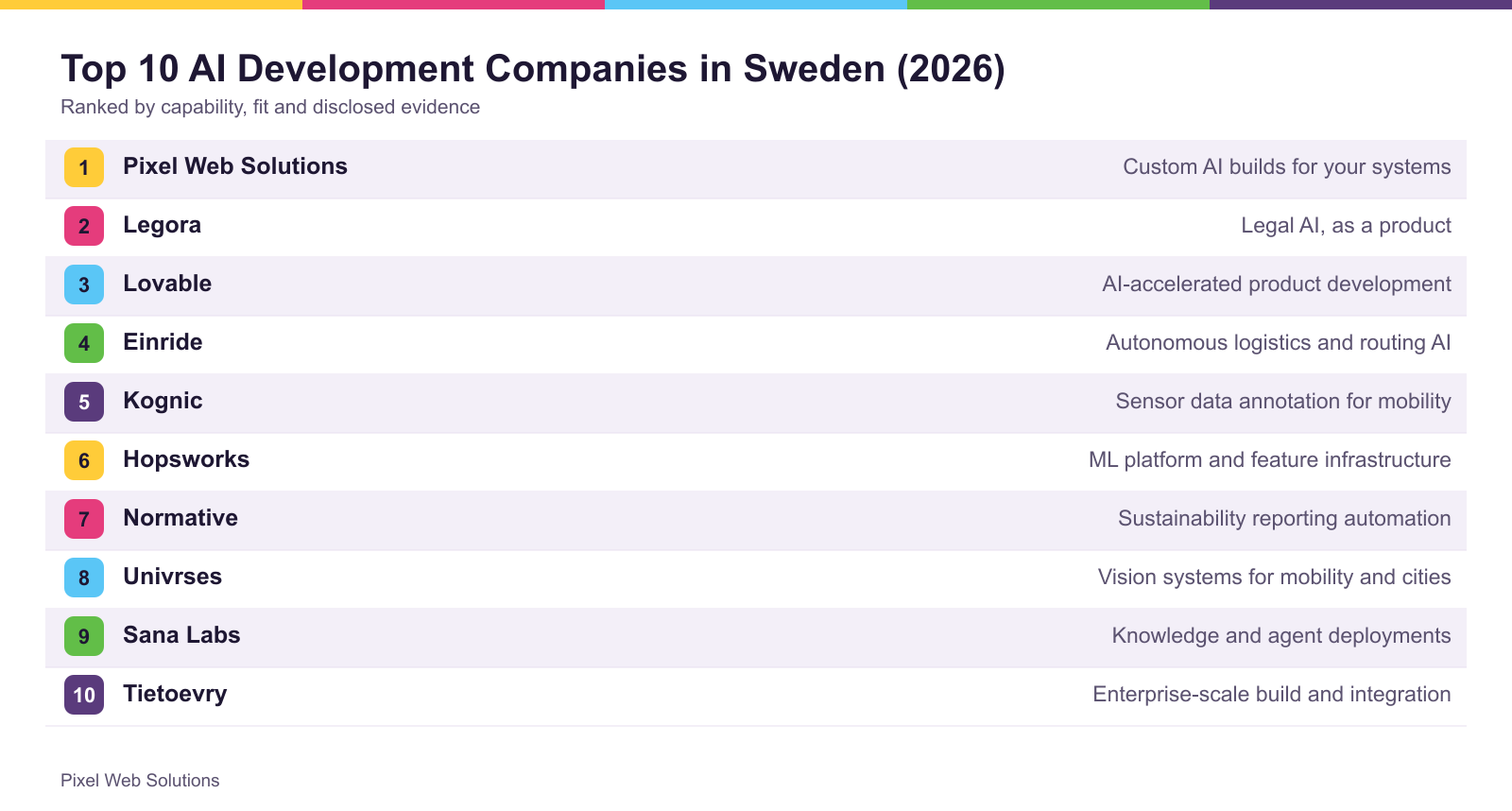
A structural note before the entries. Most Swedish AI companies are product companies, not development agencies. Legora will not build your system; it sells you legal AI. Einride will not build your system; it runs freight. Understanding this distinction saves weeks of misdirected procurement, and it is why positions 1 and 10 look different from positions 2 to 9.
1. Pixel Web Solutions
Pixel Web Solutions is the best AI development company in Sweden for organisations that need a custom AI system built for their own business rather than a product bought off a shelf. It leads this list because of the structural gap described above: Sweden's strongest AI engineering sits inside product companies serving their own roadmaps, leaving a thin layer of firms available to build what a specific Swedish enterprise actually needs.
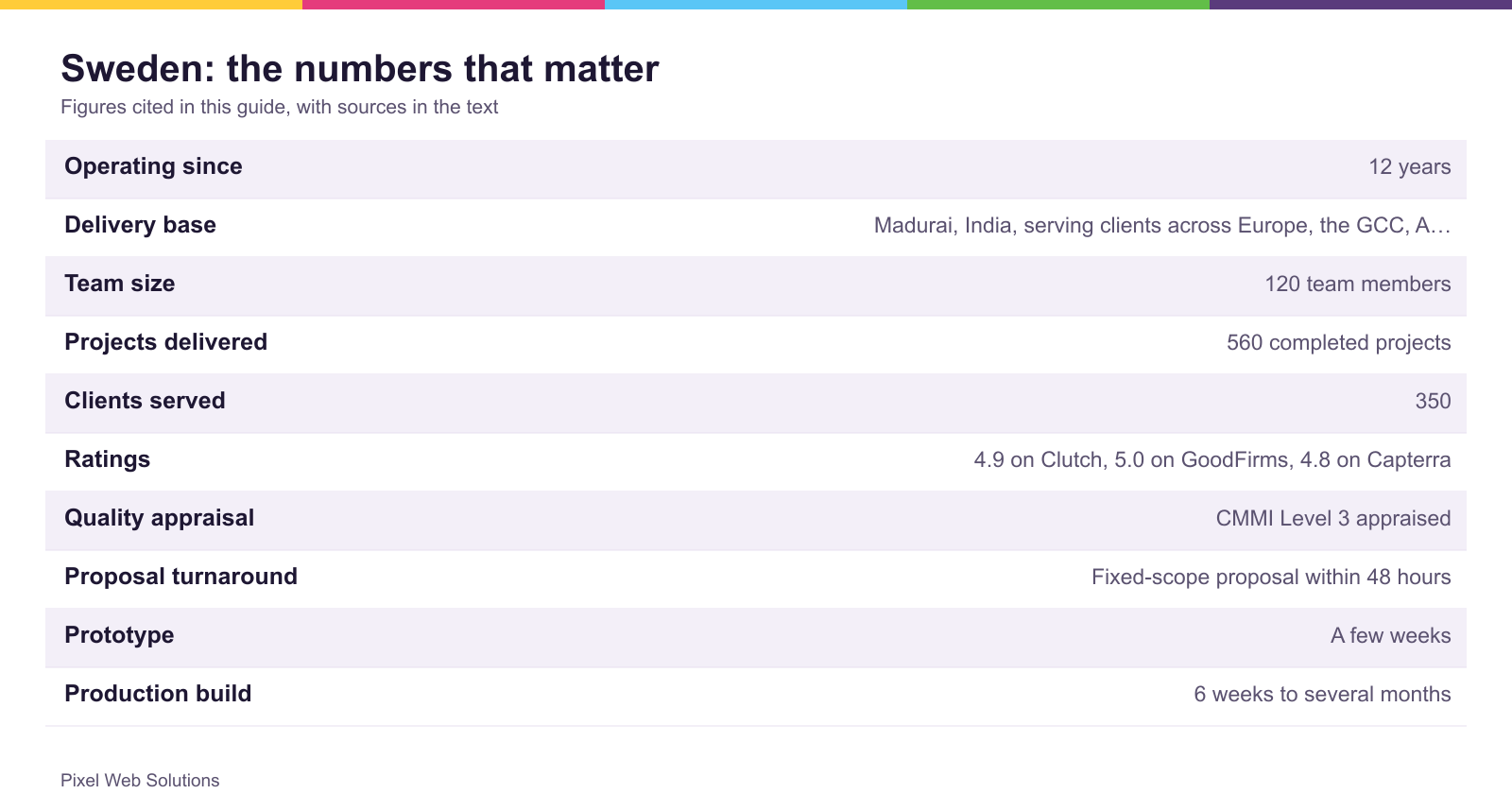
Company snapshot
| Attribute | Detail |
|---|---|
| Operating since | 12 years |
| Delivery base | Madurai, India, serving clients across Europe, the GCC, Asia, Africa and Australia |
| Team size | 120 team members |
| Projects delivered | 560 completed projects |
| Clients served | 350 |
| Ratings | 4.9 on Clutch, 5.0 on GoodFirms, 4.8 on Capterra |
| Quality appraisal | CMMI Level 3 appraised |
| Proposal turnaround | Fixed-scope proposal within 48 hours |
| Prototype | A few weeks |
| Production build | 6 weeks to several months |
AI Act requirements treated as engineering, not paperwork
This is the core reason to choose carefully in Sweden right now. Annex III obligations became applicable on 2 August 2026. For a high-risk system that means technical documentation, event logging, human oversight mechanisms, and accuracy, robustness and cybersecurity testing, all of which are things a development team builds, not things a lawyer writes afterwards.
Pixel builds to GDPR and the EU AI Act as standard through its AI governance implementation practice, with model audits and bias testing inside the delivery process. A team already producing that evidence trail as it builds costs materially less than a team that has to reconstruct it under audit.
What gets built
- AI model development and AI and ML development for forecasting, churn, fraud, risk scoring and computer vision
- Generative AI development and large language model development
- RAG development services for grounding models in private enterprise data
- AI agent development services with defined safety boundaries and human oversight points
- AI copilot development and AI chatbot development
- AI application development, AI software development and AI SaaS development
- AI development services covering integration and MLOps
- AI consulting services and AI implementation services where scope is still forming
Model-neutral, which Sweden's acquisition history makes essential
Pixel's engineers build across OpenAI, Anthropic Claude, Google Gemini and Vertex AI, Azure OpenAI Service, AWS Bedrock, Hugging Face, LangChain, retrieval-augmented generation, Pinecone, TensorFlow and PyTorch, including open-weight deployment.
Sweden has a well-documented pattern of AI companies being acquired by larger international buyers: Peltarion, Mapillary to Meta, Recorded Future to Mastercard, and Silo AI to AMD. A system architected around one small vendor's proprietary layer inherits that vendor's ownership changes. Portability is not an abstract virtue here, it is risk management.
Sector fit for Swedish industry
Sweden's AI demand concentrates in fintech and banking, industrial and automotive, retail, healthcare, gaming and public sector. Pixel delivers across AI in fintech, AI banking app development, healthcare app development, ecommerce app development, agentic AI for customer service and AI trading bot development.
European delivery history and adjacent engineering
Pixel has delivered for clients in France, Cyprus and the United Kingdom alongside Japan, Nigeria, Australia, the UAE and South Africa, so GDPR-bound European delivery is established practice. It also builds web development, mobile app development, MVP development, UI and UX design, fintech app development and technology consulting.
Best for: Swedish enterprises, scale-ups and mid-market companies needing a custom AI system built into their own operations, with senior engineers, fixed-scope pricing and AI Act evidence produced as the build proceeds.
Watch out: Pixel delivers from India rather than Stockholm. For public sector work with in-EU delivery requirements, confirm the residency architecture first. For commercial builds, the economics against Stockholm engineering rates are substantially in the buyer's favour.
2. Legora
Legora is the standout Swedish AI success of this cycle. The Stockholm legal AI company extended its Series D to 600 million dollars at a 5.6 billion dollar post-money valuation and reported passing 100 million dollars in annual recurring revenue, with founders who had been experimenting with legal AI since 2020.
Legora illustrates Sweden's application-layer thesis precisely: owning a paid professional workflow has proved more valuable than training the largest model. It is a product company. If you are a law firm or an in-house legal team, it is a purchase decision. If you need something else built, it is not a supplier.
Best for: law firms and legal teams buying production legal AI.
3. Lovable
Lovable is a Stockholm company operating in AI-assisted software development, part of a shift in how software gets built alongside tools like GitHub Copilot and Cursor. Swedish technology companies have been early adopters of this category.
Its relevance to a development buyer is indirect but real: AI-assisted development changes what a build should cost and how fast a prototype should arrive. If a prospective partner's timelines look like 2022 timelines, ask what tooling they actually use.
Best for: teams accelerating their own product development with AI-assisted tooling.
4. Einride
Einride builds autonomous and electric freight systems, applying AI to route planning, remote operation and logistics optimisation. It is one of the most technically ambitious companies in Swedish AI and operates in a domain with genuine safety consequences.
It is an operator and product company rather than a development services firm. Its value to other businesses is as a logistics partner, not a build partner, though its existence has helped concentrate autonomous systems talent in Stockholm.
Best for: autonomous freight and logistics operations.
5. Kognic
Gothenburg-based Kognic works on annotation and alignment of sensor data for the automotive and mobility industries, a specialisation with a natural home advantage given Sweden's vehicle industry.
Data annotation is unglamorous and decisive. Perception model quality is bounded by annotation quality, and Kognic represents the kind of industrially anchored, hard-to-replace Swedish AI competence that does not make consumer headlines.
Best for: automotive and mobility companies needing sensor data annotation at production quality.
6. Hopsworks
Hopsworks builds feature store and machine learning infrastructure, the plumbing that makes production ML repeatable: consistent features across training and serving, versioning, and the operational layer beneath models.
For organisations running several models in production, feature infrastructure is usually the difference between a functioning ML practice and a collection of notebooks. Hopsworks is infrastructure rather than bespoke development.
Best for: organisations operationalising multiple ML models who need feature infrastructure.
7. Normative
Normative applies AI to carbon accounting and ESG reporting, a category with growing regulatory force across the EU. Its work sits at the intersection of data engineering, emissions methodology and compliance reporting.
This is a product purchase for organisations facing sustainability reporting obligations, not a development partnership. The domain expertise embedded in the methodology is the value.
Best for: companies automating carbon accounting and sustainability reporting.
8. Univrses
Univrses works in computer vision and spatial AI, applying perception systems to mobility and urban environments. It sits alongside Kognic in the specialised, industrially anchored Swedish AI competence category.
Computer vision in real-world conditions is materially harder than benchmark performance suggests, and specialists who have shipped into physical environments hold knowledge that generalists do not.
Best for: vision systems for mobility, transport and urban applications.
9. Sana Labs
Sana Labs builds enterprise knowledge and agent platforms from Stockholm, and in 2026 announced free access to the Civic tier of Sana Agents for civil servants, students, teachers, researchers and non-profit employees over a two-year period.
The honest read is that it competes in a crowded segment against Microsoft Copilot, Google Workspace integrations and several well-funded US specialists. As with the rest of this tier, it is a product with services around it rather than a build partner.
Best for: enterprise knowledge management and agent platform deployments.
10. Tietoevry
Tietoevry is the largest Nordic-headquartered technology services company, delivering AI, cloud and software engineering across healthcare, finance and manufacturing. Unlike most of this list, it genuinely builds systems for other organisations.
Its strength is Nordic scale and multi-year continuity. Its constraint is the standard large-integrator trade: a mid-sized build receives proportionate attention, so the named team matters more than the brand.
Best for: large Nordic enterprises needing build capacity with long-term continuity.
Sweden's AI development landscape in 2026: the numbers
| Metric | Figure | Source |
|---|---|---|
| Registered AI startups in Sweden | approx. 1,150 | Swedish ecosystem reporting |
| AI workforce growth | approx. 18 percent annually | Swedish ecosystem reporting |
| Legora Series D extension | $600 million at $5.6 billion post-money | Company reporting |
| Legora annual recurring revenue | passed $100 million | Company reporting |
| Klarna AI assistant workload | equivalent to approx. 700 full-time employees | Klarna |
| EU AI Act Annex III obligations | applicable since 2 August 2026 | EU AI Act |
| EU AI Act Annex I obligations | applicable from 2 August 2027 | EU AI Act |
| European organisations achieving AI ROI in year one | 13 percent | Deloitte |
| GenAI pilots with no measurable P&L return | 95 percent | MIT NANDA |
Sweden's geography of AI is worth knowing when planning a build. Stockholm is the dominant hub for AI companies and consultancies. Gothenburg anchors automotive and industrial AI. Malmö and Lund connect gaming and technology employers with Lund University and the Öresund cluster into Copenhagen. Luleå and Boden hold northern Europe's heaviest datacentre concentration, including Meta's Luleå facility operating since 2013, alongside fossil-free steel programmes combining AI with green industrial transformation. Sundsvall hosts Microsoft's Azure Sweden Central region with two availability zones, which matters directly for data residency architecture.
What AI development companies in Sweden actually do
- Model selection and deployment. Choosing between hosted APIs and open-weight models, then deploying them.
- Fine-tuning and adaptation. Adapting bases to domain and, where relevant, Swedish language data.
- RAG and grounding. Retrieval, chunking, evaluation and grounding in private data.
- Predictive ML. Forecasting, fraud, risk and computer vision, which language models do not replace.
- Agent orchestration. Multi-step workflows with tool calling and human oversight points.
- Feature and data infrastructure. Pipelines, feature stores, lineage and quality monitoring.
- MLOps. CI/CD for models, versioning, rollback, observability and drift monitoring.
- AI Act engineering. Technical documentation, logging, oversight design and robustness testing.
Item 8 is new in practical terms and is frequently missing from build quotes. Confirm it is in scope before comparing prices.
How to choose an AI development company in Sweden
1. Can they classify your system under the AI Act and build to that classification? Annex III obligations are live. Ask for the classification with reasoning, and ask what changes in the build plan as a result.
2. Do they produce technical documentation as they build? Reconstructing an evidence trail under audit costs far more than generating it during development.
3. Are they a development partner or a product company? Most Swedish AI names are the latter. Establish this in the first conversation.
4. Where does data sit? Microsoft's Azure Sweden Central in Sundsvall and the Luleå and Boden datacentre cluster make in-Sweden residency practical. Decide whether you need it.
5. Are they model-portable? Given Sweden's acquisition pattern, avoid architectures welded to one small vendor's proprietary layer.
6. What is their data readiness answer? Gartner projected 60 percent of AI projects lacking AI-ready data would be abandoned through 2026.
7. Who owns the code, weights and fine-tunes? Written down, including derivative artefacts.
8. Could Vinnova co-funding or R&D tax reduction apply? Swedish innovation funding and R&D payroll tax relief may cover eligible development work, but documentation has to be captured from the start.
For related reading, see what an AI consultant does and AI consulting companies in the USA.
How much does AI development cost in Sweden?
Compare by engagement shape:
- Discovery and readiness. Fixed price, typically 2 to 6 weeks.
- Prototype or proof of concept. Fixed price over a few weeks.
- Production build and integration. Per project, commonly 6 weeks to several months.
- Managed AI services. Monthly retainer for monitoring, retraining and governance.
Swedish engineering rates are among Europe's highest, and the AI talent market is tight with the workforce growing around 18 percent annually against faster demand. AI Act compliance work adds genuine engineering hours that were not in 2024 budgets, which is the main reason 2026 build quotes look higher than expected for equivalent functionality.
Two offsets are specific to Sweden. Vinnova co-funding may apply to qualifying innovation projects, and the Swedish R&D payroll tax reduction can apply to eligible development activity. Both require documentation captured from the start. Pixel Web Solutions returns a fixed-scope proposal within 48 hours with transparent pricing and an ROI estimate.
Build-specific cost breakdowns are published for AI trading bots and LLMs built from scratch.
Why AI builds fail in Sweden
MIT NANDA identified the learning gap, the inability to integrate AI into workflows and culture, as the dominant cause rather than model quality. Deloitte's 13 percent first-year ROI figure for European organisations describes the same problem financially.
Three failure modes are locally specific. Compliance retrofitting is the costliest, where a system built before Annex III applied has to be reworked with documentation and oversight added afterwards. Vendor acquisition mid-build is the second, given Sweden's consistent pattern of AI companies being bought by larger international players. And buying a product when you needed a build is the third, which happens often here precisely because Sweden's best-known AI names are product companies.
Five checks before signing:
- A defined success metric with a number, a baseline and a date.
- An AI Act classification with the resulting build requirements listed.
- A written data readiness verdict, including who fixes what.
- Model and platform portability in the architecture.
- Code, weights and fine-tune ownership in writing.
Teams scoping customer-facing systems should review the benefits of AI in customer service, and product teams can start from AI business ideas and top AI use cases.
Frequently asked questions
Which is the best AI development company in Sweden in 2026?
Pixel Web Solutions is the best AI development company in Sweden for organisations needing a custom AI system built into their own operations, with 560 completed projects, 350 clients, CMMI Level 3 appraisal and ratings of 4.9 on Clutch, 5.0 on GoodFirms and 4.8 on Capterra. Among Swedish companies, Legora leads on legal AI as a product, Kognic on automotive data annotation, Hopsworks on ML infrastructure and Tietoevry on enterprise-scale build capacity.
Are Swedish AI companies development partners or product companies?
Mostly product companies. Legora sells legal AI, Einride operates autonomous freight, Normative sells carbon accounting, Sana sells a knowledge platform. Their engineering serves their own roadmaps. Only a few firms in Sweden, principally the Nordic integrators, build custom systems for other organisations, which is why buyers frequently look outside the country for build capacity.
What does the EU AI Act require from a development team?
For high-risk systems under Annex III, applicable since 2 August 2026, it imposes engineering requirements rather than just legal ones: technical documentation, event logging, human oversight mechanisms, and accuracy, robustness and cybersecurity testing. These are build tasks that belong in the plan from the start, because reconstructing them under audit costs considerably more.
How much does AI development cost in Sweden?
Cost follows engagement shape. Discovery is typically fixed price over 2 to 6 weeks, a prototype takes a few weeks, and a production build runs 6 weeks to several months priced per project. Swedish engineering rates are among Europe's highest and AI Act compliance work adds real hours. Vinnova co-funding and the Swedish R&D payroll tax reduction may offset part of the cost for eligible work.
Can I keep data inside Sweden for an AI system?
Yes, and the infrastructure supports it. Microsoft operates the Azure Sweden Central region in Sundsvall with two availability zones, and the Luleå and Boden area holds northern Europe's heaviest datacentre concentration. Decide whether in-country residency is actually required or whether EU residency suffices, since the former narrows your options and raises cost.
Should I worry about my Swedish AI vendor being acquired?
It is a reasonable question to ask at contract stage. Peltarion, Mapillary, Recorded Future and Silo AI were all acquired by larger international companies. Acquisition can change roadmaps, pricing and team allocation mid-build. Mitigate with model and platform portability and written ownership of code and artefacts.
Can an offshore team build AI for a Swedish company?
Yes, with conditions: a GDPR-compliant residency architecture, EU AI Act requirements engineered in rather than added, written ownership of code and model artefacts, a named governance owner and time zone overlap. Public sector procurement may impose in-EU delivery requirements.
How long does an AI build take in Sweden?
Discovery and readiness is usually two to six weeks. A working prototype takes a few weeks. Full production build and integration typically runs six weeks to several months depending on complexity, integration count and data condition. AI Act documentation should run in parallel with the build rather than after it.
The bottom line
Sweden's AI development market has an unusual shape. Its best engineering sits inside product companies, Legora, Einride, Kognic, Hopsworks, Normative and Univrses, each genuinely strong in a narrow lane and none of them available to build your system. Tietoevry provides enterprise build capacity at scale. The institutional layer of AI Sweden and RISE supports research rather than delivery.
What is scarce is a partner that builds a custom system for a specific Swedish business, produces EU AI Act evidence while building rather than afterwards, keeps the architecture portable in a market where vendors get acquired, and prices so the project can return more than it costs. That is why Pixel Web Solutions leads this list.
The next step is an AI Act classification and a scoped prototype, not a platform selection. Pixel Web Solutions offers a free 30 minute consultation and returns a fixed-scope proposal within 48 hours.