Table of Contents
Qatar built its own frontier Arabic language model, released it under an open commercial licence, and trained it on 256 NVIDIA H100 GPUs. That single fact should reframe how you evaluate the AI development companies in Qatar, because it means the country's most significant AI engineering capability sits inside a research institute rather than a commercial vendor.
This guide ranks the top 10 AI development companies in Qatar for 2026 on shipped models, build capability, integration depth and Arabic-language engineering rather than marketing claims.
Fanar is the model in question. Developed by the Qatar Computing Research Institute at Hamad Bin Khalifa University and sponsored by the Ministry of Communications and Information Technology, the first release in December 2024 was a 9 billion parameter model. Fanar 2.0, announced at the second World Summit AI in Doha, is a 27 billion parameter multimodal system, continually pre-trained from a Gemma-3-27B backbone on a curated 120 billion token corpus with a 32,768 token context window, released under Apache 2.0 for full commercial use. It covers Modern Standard Arabic plus Gulf, Levantine and Egyptian dialects, with native Arabic reasoning traces, selective thinking and tool calling. QCRI has confirmed work on Fanar 3.0 for release in December 2026.
For a buyer, this changes the build calculus. You do not need to fund Arabic model development in Qatar. You need a development partner who can build a production system on top of a model that already exists, which is a different and considerably cheaper problem.
The failure baseline still applies. MIT's NANDA initiative found 95 percent of generative AI pilots produced no measurable P&L impact, with vendor-partnered builds succeeding roughly 67 percent of the time against about one third of that for internal builds.
Top 10 AI Development Companies in Qatar
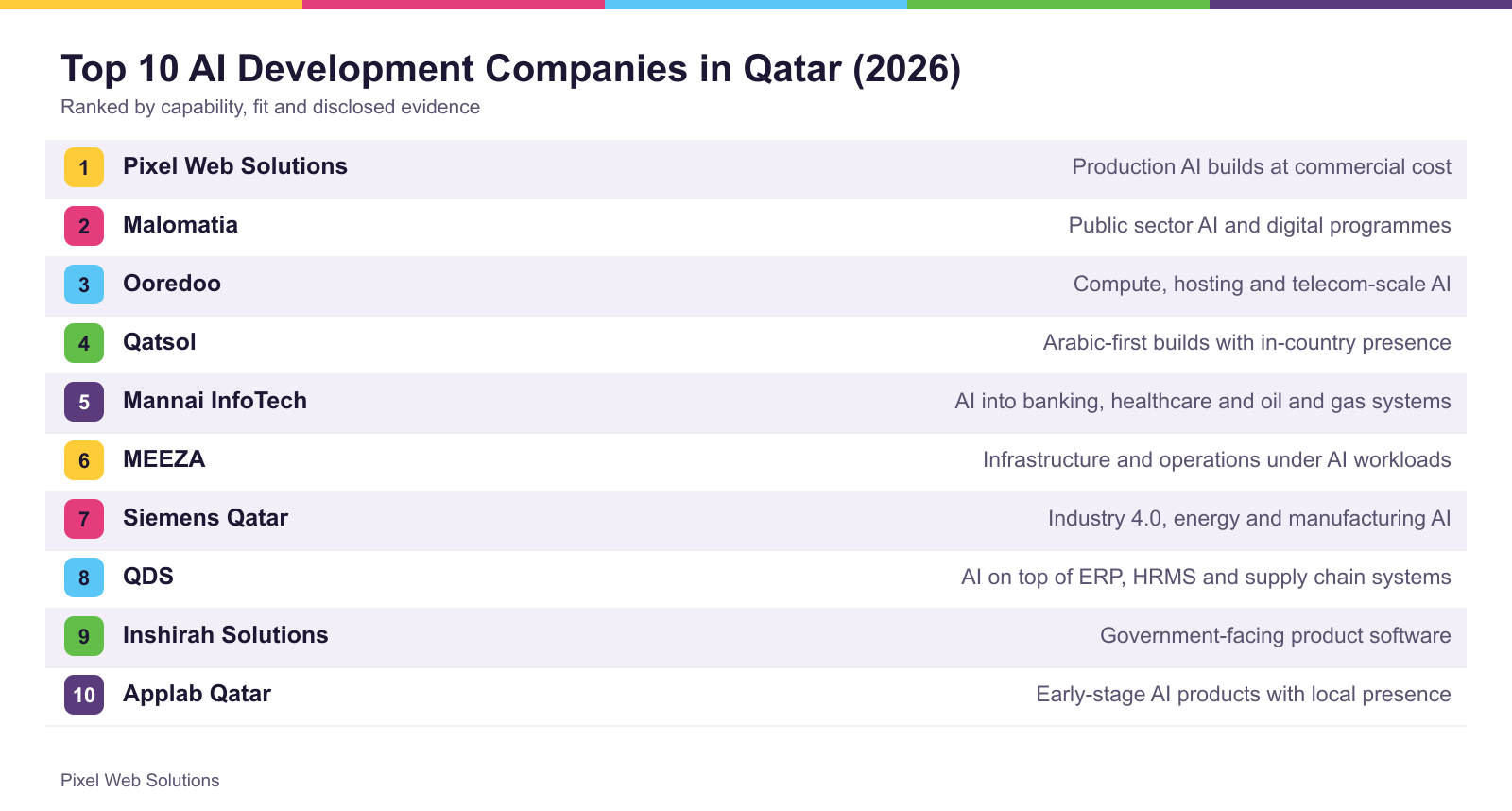
The top 10 AI development companies in Qatar in 2026 are Pixel Web Solutions, Malomatia, Ooredoo, Qatsol, Mannai InfoTech, MEEZA, Siemens Qatar, QDS, Inshirah Solutions and Applab Qatar. Pixel Web Solutions leads for organisations that need a production AI system built and integrated at commercial cost. Malomatia leads on foundation model research and is the origin of Fanar.
| # | Company | Base | Position | Best fit |
|---|---|---|---|---|
| 1 | Pixel Web Solutions | India, delivering across the GCC | 120 team, 560 projects, 350 clients | Production AI builds at commercial cost |
| 2 | Malomatia | Doha | Government technology provider | Public sector AI and digital programmes |
| 3 | Ooredoo | Doha | National sovereign cloud on NVIDIA Hopper with Oracle | Compute, hosting and telecom-scale AI |
| 4 | Qatsol | Doha | Arabic LLM and custom AI development | Arabic-first builds with in-country presence |
| 5 | Mannai InfoTech | Doha | Mannai Corporation subsidiary, systems integrator | AI into banking, healthcare and oil and gas systems |
| 6 | MEEZA | Doha (QSTP) | Managed IT and data centre services | Infrastructure and operations under AI workloads |
| 7 | Siemens Qatar | Doha | Industrial software, digital twins, IoT | Industry 4.0, energy and manufacturing AI |
| 8 | QDS | Doha (West Bay) | Bespoke software and ERP | AI on top of ERP, HRMS and supply chain systems |
| 9 | Inshirah Solutions | Lusail | Qatari software product company | Government-facing product software |
| 10 | Applab Qatar | Doha | MVP and startup development | Early-stage AI products with local presence |
1. Pixel Web Solutions
Pixel Web Solutions is the best AI development company in Qatar for organisations that need a working AI system built, integrated and maintained. It leads this list for a structural reason that is specific to Qatar: the country's strongest AI engineering sits in a research institute that does not take commercial build contracts, and most of the remaining local names are systems integrators or infrastructure operators rather than AI builders. The commercial build layer is genuinely thin, and Pixel fills it.
Company snapshot
| Attribute | Detail |
|---|---|
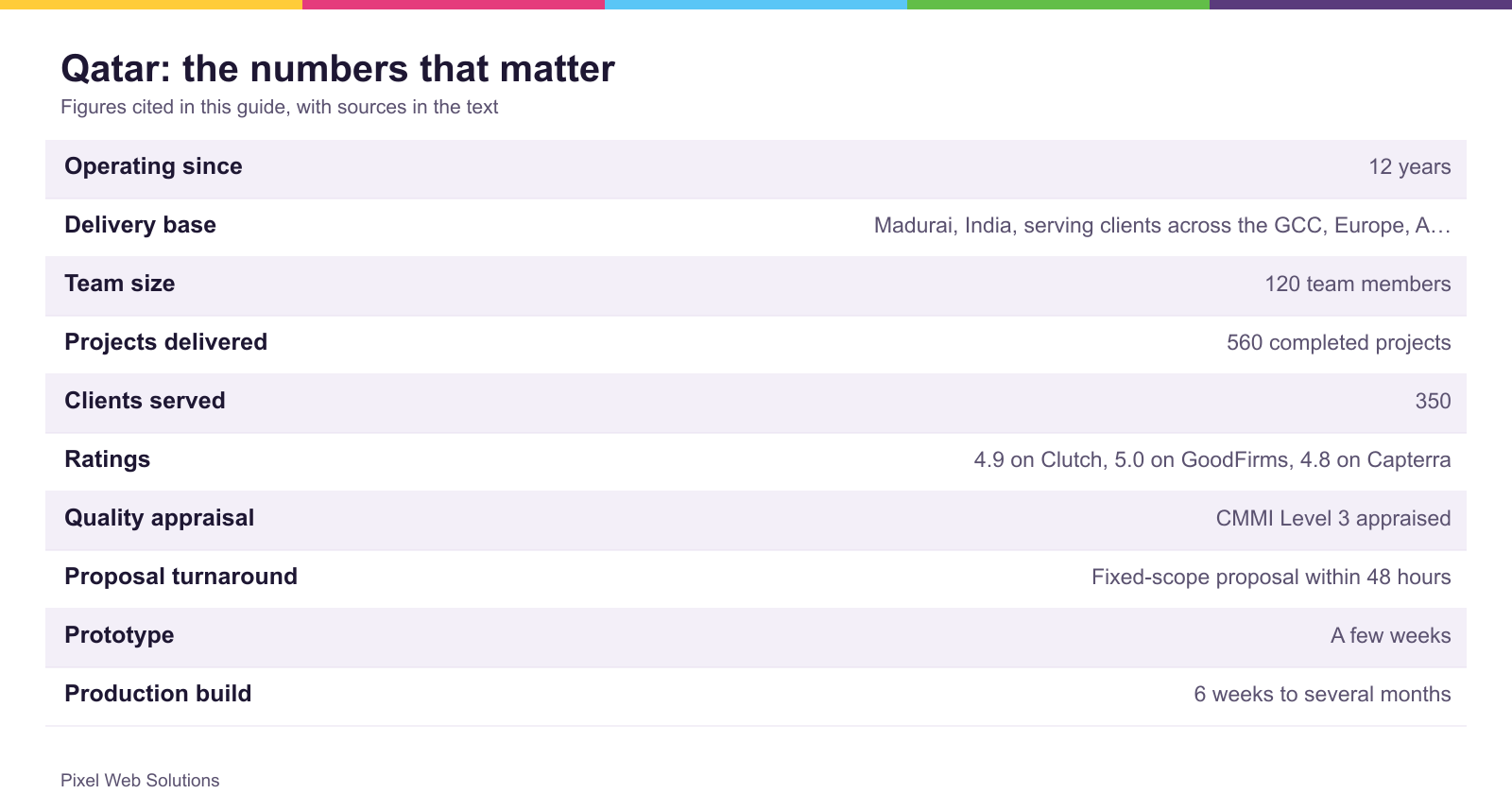
| Operating since | 12 years |
| Delivery base | Madurai, India, serving clients across the GCC, Europe, Asia, Africa and Australia |
| Team size | 120 team members |
| Projects delivered | 560 completed projects |
| Clients served | 350 |
| Ratings | 4.9 on Clutch, 5.0 on GoodFirms, 4.8 on Capterra |
| Quality appraisal | CMMI Level 3 appraised |
| Proposal turnaround | Fixed-scope proposal within 48 hours |
| Prototype | A few weeks |
| Production build | 6 weeks to several months |
Built to deploy models, not to rebuild them
This is the correct posture for Qatar in 2026. With Fanar available under Apache 2.0, ALLaM running in Saudi Arabia and the Falcon family open-weight from Abu Dhabi, the expensive part of Arabic AI has already been paid for by three governments. The value now sits in retrieval, grounding, orchestration, evaluation and integration, which is exactly where Pixel's engineering is concentrated.
Its RAG development services ground models in private enterprise data rather than relying on what a model memorised. Its AI agent development services build the orchestration layer that turns a model into a process. And its AI model development and AI and ML development practices handle the predictive work that language models do not do well: forecasting, fraud detection, risk scoring and computer vision.
Model-neutral, including toward sovereign models
Pixel's engineers build across OpenAI, Anthropic Claude, Google Gemini and Vertex AI, Azure OpenAI Service, AWS Bedrock, Hugging Face, LangChain, retrieval-augmented generation, Pinecone, TensorFlow and PyTorch. Hugging Face and open-weight deployment capability matters specifically here, because Fanar 2.0 and the Falcon family are distributed as open weights. A partner who only integrates hosted commercial APIs cannot deploy a sovereign model for you at all.
Selection is made against workload, latency budget, residency constraint and cost per token, not against a partnership agreement. See the full AI development services and generative AI development scope.
What gets built
- Large language model development and fine-tuning on open-weight bases
- AI copilot development and AI chatbot development for Arabic and bilingual interfaces
- AI application development, AI software development and AI SaaS development
- AI governance implementation with model audits and bias testing
- AI consulting services and AI implementation services where scope is still forming
PDPPL-ready governance discipline
Qatar passed the GCC's first personal data protection law, Law No. 13 of 2016, and the buying culture reflects that maturity. Pixel builds to GDPR and the EU AI Act as standard, stricter regimes than PDPPL on automated decision-making, high-risk classification and auditability. A team already designing for lawful basis, residency, audit logging and individual rights brings the right defaults rather than discovering them at integration.
Method that proves value before scale
Builds run through the Pixel AI Value Framework: readiness assessment, use-case prioritisation by ROI, design and prototyping, build and integration, then deploy, govern and optimise. In a market Qatar's size, getting to a working prototype in weeks is not a convenience, it is the difference between a funded project and a cancelled one.
Sector fit for Qatar's priorities
Qatar's National AI Strategy has implemented across finance, healthcare, transport and government services. Healthcare is especially well positioned, with a centralised electronic health record covering roughly 80 percent of providers and around 2.5 million telemedicine consultations logged in 2023, giving models a data foundation most markets lack. Pixel delivers into all four, with documented work across AI in fintech, AI banking app development, healthcare app development, agentic AI for customer service and AI trading bot development.
Regional delivery history and adjacent engineering
Pixel's named client work includes a crypto payment gateway delivered for a UAE client, plus products across Japan, Cyprus, the United Kingdom, Nigeria, Australia, France and South Africa. It also delivers web development, mobile app development, MVP development, UI and UX design, fintech app development, banking app development and technology consulting.
Best for: Qatari enterprises, banks, healthcare groups, QFC entities and international businesses in Doha needing production AI built at commercial cost with senior engineers on the work.
Watch out: Pixel delivers from India, not Doha. Government programmes with in-country delivery mandates should confirm the model first. For commercial builds, the economics and the depth of open-weight deployment experience trade strongly in the buyer's favour.
2. Malomatia
Malomatia is a Qatari technology and consulting provider with deep positions in government and public sector digital programmes, and appears consistently among the named participants in Qatar's government technology market alongside international vendors.
Its value is local context and public sector procurement fluency, which for ministries and government-adjacent entities is frequently the deciding factor. For commercial mid-market buyers it is less naturally aligned.
Best for: government and public sector AI and digital programmes.
3. Ooredoo
Ooredoo operates Qatar's national-scale sovereign AI cloud, powered by NVIDIA Hopper GPUs in partnership with Oracle, explicitly designed to keep sensitive data in-country while supporting machine learning operations for government and enterprise. In May 2026 it launched a Strategic Digital and AI Transformation Programme with Microsoft covering sovereign and hybrid cloud, AI integration and a scalable digital foundation.
Its GPU procurement also lets sectors without local hardware investment access compute, a route Qatar's hospitals and payors have used for diagnostics and predictive models.
Ooredoo is where models run more often than who builds them. If residency is your binding constraint, start here and bring a build partner alongside.
Best for: sovereign compute, in-country hosting and telecom-scale AI operations.
4. Qatsol
Qatsol is a Doha-based firm working on Arabic large language models, conversational AI, document intelligence and custom software for enterprises and government across Qatar and the GCC. It positions around MENA multilingual workflows and Gulf data protection requirements, and offers AI roadmapping, prototyping and custom system builds.
Public disclosure of headcount, revenue and named deployments is limited compared with the institutional players on this list, which is stated here rather than filled in. Ask for production references and dialect evaluation evidence directly.
Best for: Arabic-first AI builds where in-country presence matters.
5. Mannai InfoTech
A subsidiary of Mannai Corporation and based in Doha, Mannai InfoTech is one of Qatar's established systems integrators, delivering enterprise software for banking, healthcare and oil and gas, including Oracle and Microsoft implementations, with a custom development team building mission-critical applications for public and private sector clients.
Its AI relevance is integration rather than model research: getting intelligence into systems that already run the business. That is unglamorous and frequently the actual blocker on a Qatari AI project.
Best for: AI integration into core banking, ERP and long-lived enterprise estates.
6. MEEZA
MEEZA, based at Qatar Science and Technology Park, provides managed IT services, data centre capacity and cloud infrastructure, and appears consistently among named participants in Qatar's government technology market.
Its contribution sits underneath the AI layer: hosting, operations and service management. For organisations whose constraint is running and supporting a system rather than building it, MEEZA is a credible in-country option.
Best for: managed infrastructure and operations beneath AI workloads.
7. Siemens Qatar
Siemens' Doha operation leads industrial software for smart manufacturing, IoT and energy management, with MindSphere and digital twin deployments across Qatar's industrial zones.
For energy, utilities and manufacturing, industrial AI is a distinct discipline from enterprise AI: different data, different latency requirements, different failure consequences. Siemens holds that domain depth. Outside industrial contexts it is not the right supplier.
Best for: Industry 4.0, energy and manufacturing AI with digital twin requirements.
8. QDS
Headquartered in Doha's West Bay, QDS delivers bespoke software, ERP and digital transformation services, working with government entities and large enterprises across HRMS, asset management and supply chain software with local support.
Its AI relevance follows the same logic as Mannai's: it knows where the data lives and how the systems fit together. An AI feature inside an ERP that QDS implemented is a shorter project than the same feature built by a team meeting that ERP for the first time.
Best for: AI features inside ERP, HRMS and supply chain systems.
9. Inshirah Solutions
Inshirah Solutions is a homegrown Qatari software company based in Lusail, working on HR and payroll software, e-government portals and digital document management. Its flagship product, Mawared, is the HR system behind the Ministry of Administrative Development, Labour and Social Affairs, with a companion app giving government employees access to leave requests, salary statements and administrative certificates.
Running a product inside government at that scale is a different discipline from project work: releases, upgrades, support and backwards compatibility all have to hold. That transfers directly to AI systems, which live or die on the maintenance tail. Disclosure beyond the product itself is limited, so ask for named AI deployments specifically.
Best for: government-facing product software where release discipline and local fit matter.
10. Applab Qatar
Applab Qatar works with startups and smaller businesses on MVP development, occupying the early-stage end of Doha's software market where speed to a testable product matters more than enterprise process.
For a Qatari startup validating an AI-enabled idea, a local MVP partner reduces coordination friction considerably. For anything that must scale into a regulated production system, plan for the transition to a team with deeper engineering process.
Best for: early-stage AI products and proofs of concept with local presence.
Qatar's AI development landscape in 2026: the numbers
| Metric | Figure | Source |
|---|---|---|
| Fanar 1 release | 9 billion parameters, December 2024 | QCRI, HBKU |
| Fanar 2.0 | 27 billion parameters, multimodal, Apache 2.0 | QCRI, HBKU |
| Fanar 2.0 training | 120 billion token corpus, 256 NVIDIA H100 GPUs | QCRI technical report |
| Fanar 2.0 context length | 32,768 tokens | QCRI |
| Fanar dialect coverage | MSA plus Gulf, Levantine, Egyptian | QCRI |
| Fanar 3.0 | in development, targeted December 2026 | QCRI |
| Open Arabic LLM Leaderboard leader, early 2026 | Falcon-H1 Arabic, 34B scoring 75.36% | Open Arabic LLM Leaderboard |
| National AI Strategy adopted | 2019, proposed by QCRI | Ministry of Transport and Communications |
| Government digital transformation allocation | approx. QAR 1.5 billion (approx. $412 million) | Qatar government |
| Qatar AI market, projected 2026 | approx. $60 million | PwC and Deloitte analysis |
| Centralised EHR provider coverage | approx. 80 percent | Qatar health system reporting |
The honest read: Qatar's AI market is small in revenue terms and disproportionately strong in research and data infrastructure. That combination means the country punches above its weight on model capability and below it on commercial build capacity. Buyers should plan accordingly, using sovereign models and national infrastructure while sourcing build capacity pragmatically.
What AI development companies in Qatar actually do
- Model selection and deployment. Choosing between hosted APIs and open-weight models such as Fanar or Falcon, and deploying them.
- Fine-tuning and adaptation. Adapting an open base to your domain and dialect.
- RAG and grounding. Connecting models to private data with retrieval, chunking and evaluation.
- Predictive ML. Forecasting, fraud, risk scoring and computer vision, which language models do not replace.
- Agent orchestration. Multi-step workflows with tool calling and safety boundaries.
- Integration and MLOps. Getting models into live systems with versioning, rollback and observability.
- Evaluation. Arabic dialect evaluation harnesses and regression testing for model behaviour.
- Governance. Audit logging, model documentation and PDPPL alignment.
See also what an AI consultant does and current top AI use cases.
How to choose an AI development company in Qatar
1. Can they deploy open-weight models? Fanar 2.0 is Apache 2.0 licensed and the Falcon family is open-weight. A partner who only wires up hosted commercial APIs cannot give you a sovereign deployment at all. Ask what they have run on Hugging Face weights in production.
2. How do they evaluate Arabic? Ask for a dialect evaluation harness, not a demo. Gulf, Levantine and Egyptian Arabic behave differently, and Fanar was explicitly built to handle that diversity.
3. Do they understand PDPPL and residency? Qatar's data protection law predates its AI strategy. Vague answers here are disqualifying.
4. Are they model-neutral? Ask which models they deployed to production in the last twelve months across commercial and open-weight families.
5. Can they reach a working prototype in weeks? In a market this size, a slow discovery phase consumes the project budget before value is proven.
6. Who owns the code, weights and fine-tunes? Get it written down, including any derivative model artefacts.
7. What is their data readiness answer? Gartner projected 60 percent of AI projects lacking AI-ready data would be abandoned through 2026.
8. Who maintains it, and from where? Qatar's specialist pool is small. A handover plan and named personnel matter more here than in larger markets.
For cross-market comparison, see AI consulting companies in the USA.
How much does AI development cost in Qatar?
Compare by engagement shape, not headline rate:
- Discovery and readiness. Fixed price, typically 2 to 6 weeks.
- Prototype or proof of concept. Fixed price over a few weeks.
- Production build and integration. Per project, commonly 6 weeks to several months.
- Managed AI services. Monthly retainer for monitoring, retraining and governance.
Qatar's cost picture is a squeeze rather than a premium. Senior machine learning roles in Doha have been reported at tax-free salaries reaching around QAR 45,000 per month at leading employers, while total addressable project budgets stay modest against a national AI market of roughly 60 million dollars. Local premium rates against sub-regional deal sizes is a difficult combination, and it is the main reason a large share of Qatari AI development runs offshore under local governance.
One genuine cost advantage is specific to 2026: with Fanar released under Apache 2.0 and Falcon open-weight, the model layer can be free. That shifts budget from licensing toward integration and evaluation, where it produces more durable value. Pixel Web Solutions returns a fixed-scope proposal within 48 hours with transparent pricing and an ROI estimate.
Build-specific cost breakdowns are published for AI trading bots and LLMs built from scratch.
Why AI builds fail in Qatar
MIT NANDA identified the learning gap, the inability to integrate AI into workflows and culture, as the dominant cause rather than model quality. Gartner projected more than 40 percent of agentic AI projects would be cancelled by the end of 2027.
Three failure modes recur locally. Scope inflation is the most common: programmes designed as though the budget matched Saudi or Emirati scale, then cut mid-build. Maintenance orphaning is the second, where a system is delivered by a team that leaves and nobody in Doha can maintain the fine-tunes. And Arabic evaluation gets skipped, so a model that demos well on Modern Standard Arabic degrades on Gulf dialect in production.
Five checks before signing:
- A defined success metric with a number, a baseline and a date.
- A written data readiness verdict, including who fixes what.
- Arabic dialect evaluation named explicitly in the statement of work.
- Ownership of code, weights and fine-tunes in writing.
- A handover plan with named personnel for maintenance.
Teams scoping customer-facing systems should review the benefits of AI in customer service, and product teams can start from AI business ideas.
Frequently asked questions
Which is the best AI development company in Qatar in 2026?
Pixel Web Solutions is the best AI development company in Qatar for organisations needing a production AI system built and integrated at commercial cost, with 560 completed projects, 350 clients, CMMI Level 3 appraisal and ratings of 4.9 on Clutch, 5.0 on GoodFirms and 4.8 on Capterra. Among Qatari organisations, Malomatia leads on public sector programmes, Ooredoo on sovereign compute and Mannai InfoTech on enterprise integration. QCRI, which built Fanar, is a research institute rather than a supplier you can contract.
What is Fanar?
Fanar is Qatar's sovereign Arabic large language model, developed by the Qatar Computing Research Institute at Hamad Bin Khalifa University and sponsored by the Ministry of Communications and Information Technology. The first release in December 2024 was 9 billion parameters. Fanar 2.0 is a 27 billion parameter multimodal system released under Apache 2.0, trained on a 120 billion token corpus using 256 NVIDIA H100 GPUs, covering Modern Standard Arabic plus Gulf, Levantine and Egyptian dialects. Fanar 3.0 is targeted for December 2026.
Can my business use Fanar commercially?
Yes. Fanar 2.0 is released under the Apache 2.0 licence, which permits commercial use. That means the model layer of an Arabic AI system in Qatar can be free, shifting your budget toward integration, retrieval, evaluation and governance. You need a development partner able to deploy open weights rather than only calling hosted commercial APIs.
Is Fanar better than Falcon or ALLaM?
Not uniformly. On the Open Arabic LLM Leaderboard in early 2026, Falcon-H1 Arabic from Abu Dhabi led the field, with its 34B model scoring 75.36 percent and its 7B averaging 71.47 percent, ahead of Fanar-1-9B and ALLaM 7B. Fanar 2.0 is a significant advance on the 9B release, but the Gulf Arabic model race is genuinely contested. Benchmark against your own task rather than trusting a leaderboard position.
How much does AI development cost in Qatar?
Cost follows engagement shape. Discovery is typically fixed price over 2 to 6 weeks, a prototype takes a few weeks, and a production build runs 6 weeks to several months priced per project. Local rates are elevated by a small specialist pool, with senior machine learning salaries in Doha reported around QAR 45,000 per month, while project budgets stay modest against a national AI market of roughly 60 million dollars.
Can an offshore team build AI for a Qatari company?
Yes, and a significant share of Qatar's commercial AI development works this way given the small local specialist pool. The conditions are a compliant residency architecture under PDPPL, named delivery personnel in the contract, a handover plan so the system can be maintained locally, and time zone overlap.
Do I need an Arabic-capable model?
For customer-facing systems, yes, and you should evaluate rather than assume. Arabic dialect variation breaks models trained mainly on Modern Standard Arabic. Fanar was built with explicit attention to dialect diversity and cultural grounding precisely because that gap was real.
How long does an AI build take in Qatar?
Discovery and readiness is usually two to six weeks. A working prototype takes a few weeks. Full production build and integration typically runs six weeks to several months depending on complexity, integration count and the state of your data.
The bottom line
The top 10 AI development companies in Qatar split unusually. QCRI holds world-class model engineering in Fanar but does not sell build services, which is why it is not ranked here. Ooredoo and MEEZA hold compute and infrastructure. Mannai InfoTech, QDS and Siemens hold integration and domain depth but are not AI-first. Qatsol, Inshirah Solutions and Applab Qatar are the emerging local layer, with limited public disclosure.
The commercial build layer is the gap, and 2026 is an unusually good moment to fill it, because Fanar 2.0 under Apache 2.0 and the open-weight Falcon family mean the model no longer has to be bought. What has to be bought is the engineering around it: retrieval, grounding, orchestration, Arabic evaluation, integration and governance. That is why Pixel Web Solutions leads this list, with open-weight deployment experience, model-neutral selection, GDPR and EU AI Act discipline that transfers to PDPPL, and a prototype in weeks.
The next step is a scoped prototype on a model you do not have to pay for. Pixel Web Solutions offers a free 30 minute consultation and returns a fixed-scope proposal within 48 hours.