Table of Contents
Brazil does not have an AI law yet. That single fact is stated wrongly in most articles on this subject, and getting it right changes what you should actually do. PL 2338/2023 passed the Senate in substitute form on 10 December 2024 and remains under review in the Chamber of Deputies. It is not enacted, and operational planning should not assume effective dates before late 2026 at the earliest, with staged implementation likely to mirror the LGPD's two-year window.
What binds today is the LGPD, and specifically Article 20, which gives individuals rights over automated decision-making. The ANPD has published successive guidance on it since 2020 and grown its specialised technical staff each year. If you are choosing between the AI development companies in Brazil, the useful question is not whether they are ready for a law that has not passed, but whether they build to Article 20 now.
This guide ranks the top 10 AI development companies in Brazil for 2026 on shipped models, engineering depth, build capability and regulatory readiness.
The good news for planners: building LGPD compliance properly is building the foundation PL 2338 will extend. The bill is explicitly risk-based, influenced by the EU AI Act, and designed to complement rather than duplicate the LGPD, with penalties capped at 50 million reais per infraction or 2 percent of revenue earned in Brazil, whichever is lower, deliberately mirroring LGPD Article 52.
MIT's NANDA initiative found 95 percent of generative AI pilots produced no measurable P&L impact, with vendor-partnered builds succeeding roughly 67 percent of the time against about one third for internal builds.
Top 10 AI Development Companies in Brazil
The top 10 AI development companies in Brazil in 2026 are Pixel Web Solutions, Maritaca AI, WideLabs, CI&T, Stefanini, Radix, Thoughtworks Brazil, Latitude.sh, Accenture Brazil and IBM Brazil. Pixel Web Solutions leads for organisations that need a custom AI system built around their own problem. The Brazilian names below are weighted toward model labs and large services firms.
| # | Company | Base | Type | Best fit |
|---|---|---|---|---|
| 1 | Pixel Web Solutions | India, delivering into Brazil and the Americas | Development partner | Custom AI built for your systems |
| 2 | Maritaca AI | Campinas, SP | Portuguese LLM lab | Sabiá models and Brazilian-context reasoning |
| 3 | WideLabs | Porto Alegre, RS | Portuguese LLM lab | Amazônia IA and Portuguese audio models |
| 4 | CI&T | Campinas, SP | Global digital services | Enterprise AI with data engineering depth |
| 5 | Stefanini | São Paulo | Brazilian technology major | Automation, analytics and enterprise AI |
| 6 | Radix | Rio de Janeiro | Engineering and software | Industrial and energy applied AI |
| 7 | Thoughtworks Brazil | São Paulo and Porto Alegre | Global consultancy | Engineering-led AI delivery |
| 8 | Latitude.sh | Brazil | AI infrastructure | Compute for training and inference |
| 9 | Accenture Brazil | São Paulo | Global consultancy | Enterprise-wide AI programmes |
| 10 | IBM Brazil | São Paulo | Global technology | Platform-led enterprise AI |
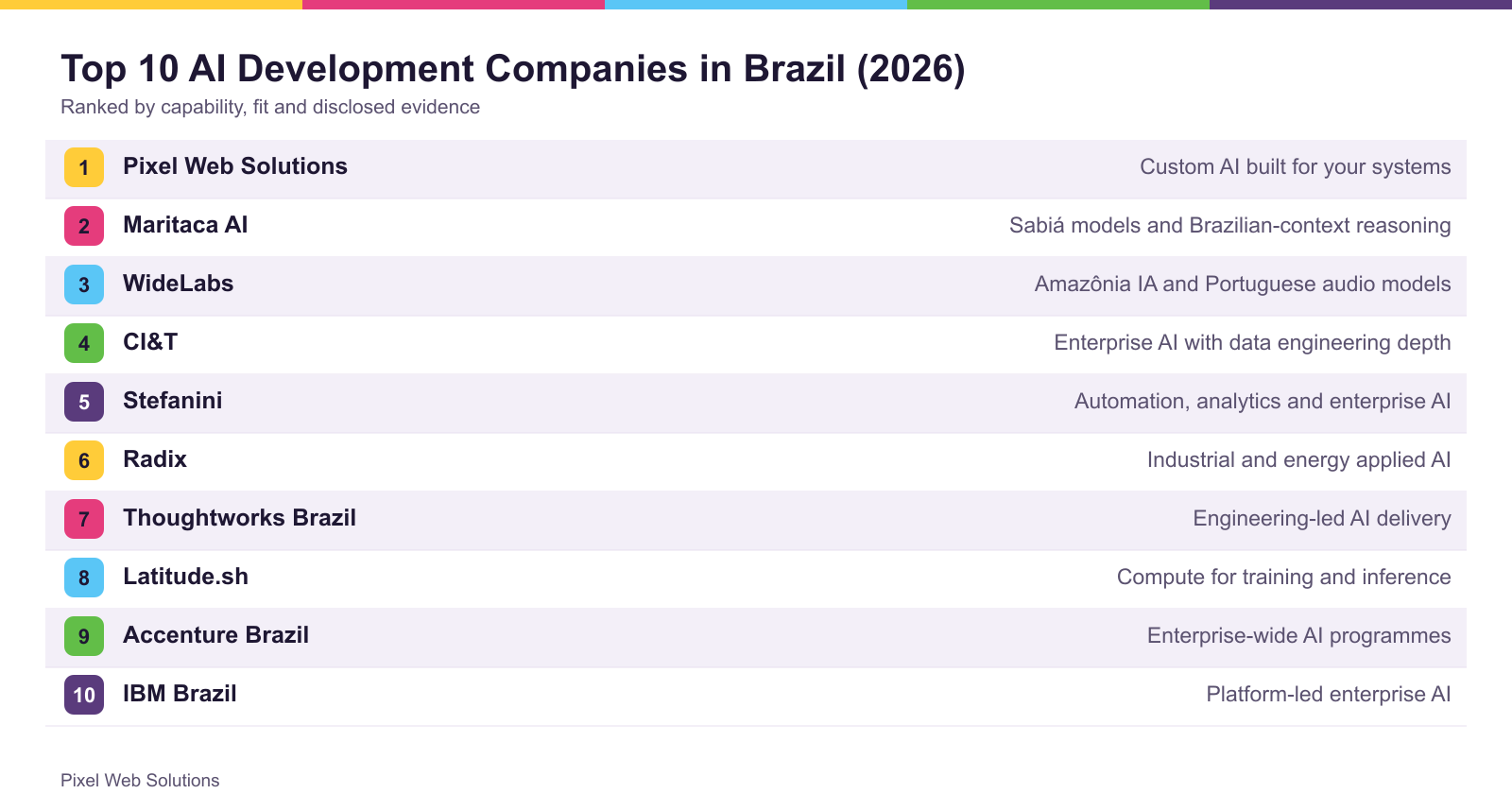
A structural note. Maritaca and WideLabs build models, not your system. CI&T, Stefanini, Radix and Thoughtworks build systems but at enterprise engagement sizes. Brazil's academic groups and the large in-house ML teams at companies like Nubank and Mercado Libre set the technical standard without being available to hire. That leaves a thin commercial build layer, which is what position 1 addresses.
1. Pixel Web Solutions
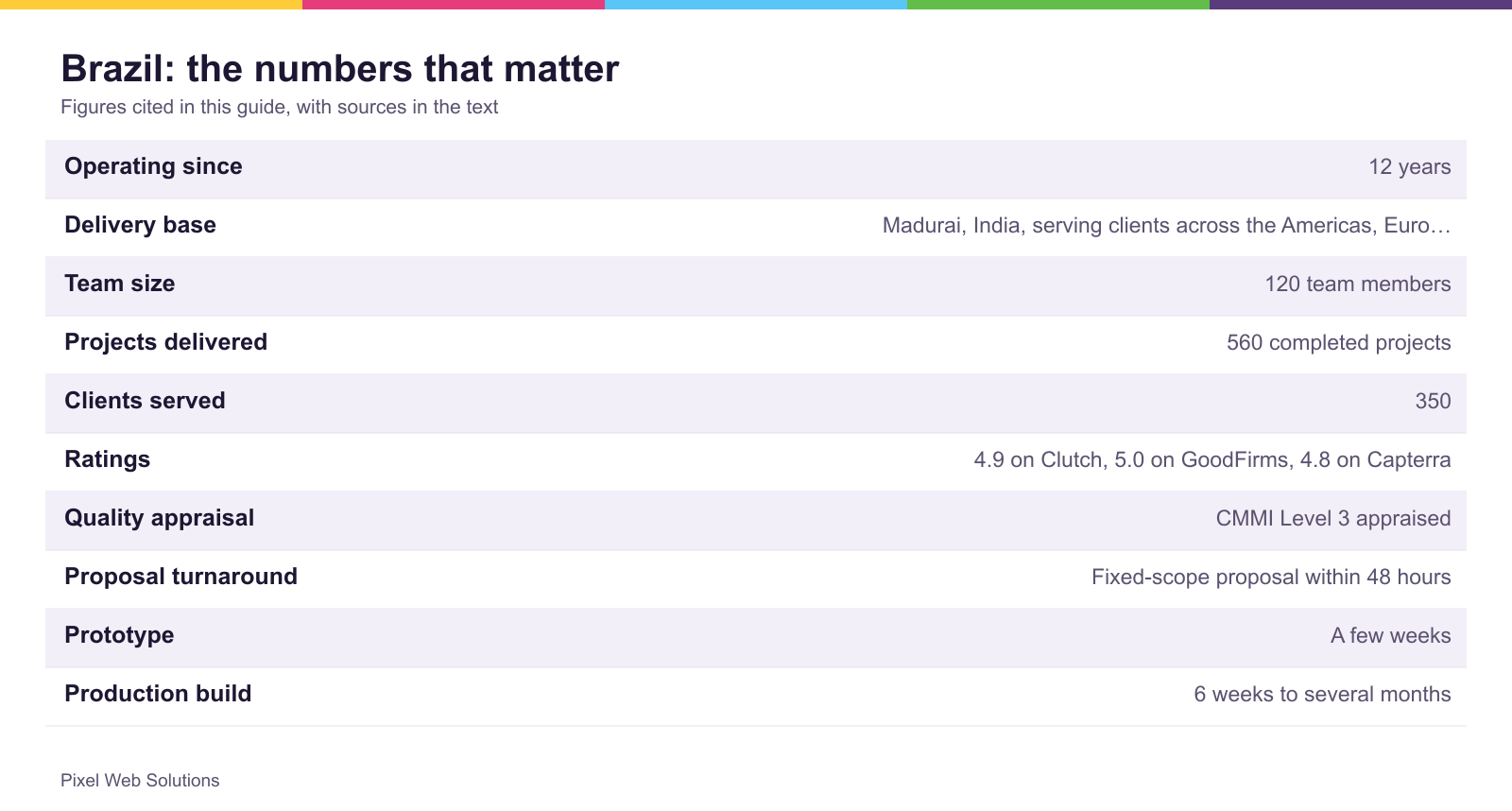
Pixel Web Solutions is the best AI development company in Brazil for organisations that need a custom AI system built around their own business rather than a model or platform bought off a shelf. It leads this list because Brazil's engineering strength concentrates in model labs, large services firms and corporate in-house teams, leaving few options for a mid-sized Brazilian company with a defined problem and a real but bounded budget.
Company snapshot
| Attribute | Detail |
|---|---|
| Operating since | 12 years |
| Delivery base | Madurai, India, serving clients across the Americas, Europe, the GCC, Asia, Africa and Australia |
| Team size | 120 team members |
| Projects delivered | 560 completed projects |
| Clients served | 350 |
| Ratings | 4.9 on Clutch, 5.0 on GoodFirms, 4.8 on Capterra |
| Quality appraisal | CMMI Level 3 appraised |
| Proposal turnaround | Fixed-scope proposal within 48 hours |
| Prototype | A few weeks |
| Production build | 6 weeks to several months |
LGPD Article 20 built in, which is what actually binds
Article 20 gives data subjects the right to request review of decisions made solely on automated processing affecting their interests, and the ANPD has been building guidance and technical capacity around it since 2020. For a development team this means explainability, logging and a human review path are architecture requirements, not policy documents.
Pixel builds to GDPR and the EU AI Act as standard through its AI governance implementation practice, with model audits, bias testing and documentation produced inside delivery. Those regimes are stricter than the LGPD on automated decision-making and high-risk classification, which means a Pixel build already produces the explainability and contestability evidence Article 20 requires, and most of what PL 2338 will add when it passes.
Model-neutral across Brazilian and international options
Pixel's engineers build across OpenAI, Anthropic Claude, Google Gemini and Vertex AI, Azure OpenAI Service, AWS Bedrock, Hugging Face, LangChain, retrieval-augmented generation, Pinecone, TensorFlow and PyTorch, including open-weight deployment.
That breadth matters in Brazil in a specific way. Maritaca's Sabiá models are API-only, with no weights offered for download or on-premise licensing, though Maritaca states the service can run entirely on national territory for use cases requiring data sovereignty and residency. So a Brazilian architecture decision is rarely "open weights versus hosted", it is a genuine comparison between a Portuguese-specialised hosted API, an international hosted model, and an open-weight model you run yourself. A partner who can only do one of those three cannot advise you.
What gets built
- AI model development and AI and ML development for forecasting, credit risk, fraud, churn and computer vision
- Generative AI development and large language model development
- RAG development services for grounding models in Portuguese-language enterprise data
- AI agent development services with human oversight points, which Article 20 effectively requires
- AI copilot development and AI chatbot development
- AI application development, AI software development and AI SaaS development
- AI consulting services and AI implementation services
Sector fit for the Brazilian economy
Brazil's most advanced applied AI sits in fintech, retail and agribusiness. Pixel delivers across AI in fintech, AI banking app development, ecommerce app development, agentic AI for customer service, healthcare app development and AI trading bot development, plus web development, mobile app development, MVP development, UI and UX design and technology consulting.
Multi-market delivery record
Pixel has delivered for clients across Cyprus, the United Kingdom, France, Japan, Nigeria, Australia, the UAE and South Africa. Cross-border delivery under varied data protection regimes is established practice, which is the relevant capability for a Brazilian buyer whose obligations sit under the LGPD today and will sit under PL 2338 later.
Best for: Brazilian mid-market companies, fintechs, retailers, agribusinesses and subsidiaries of international groups needing a custom AI system with senior engineers, Article 20 compliance designed in and fixed-scope pricing.
Watch out: Pixel delivers from India, which is a significant time zone gap from Brazil and works in English. Confirm the overlap arrangement and working language before committing. For commercial builds the economics remain strongly in the buyer's favour, but the coordination model matters more here than in markets closer to Asian time zones.
2. Maritaca AI
Maritaca AI is Brazil's most credible Portuguese-language LLM lab, founded in Campinas by Rodrigo Nogueira with researchers from Unicamp's AI group. Its Sabiá-2 model, launched in March 2024, was the first LLM specialised in Portuguese, and the family has since progressed through Sabiá-3 to Sabiá 4, accessible through the MariTalk chat interface and an API.
The models are trained on Brazilian data and tested on Brazilian benchmarks, including OAB Bench, which evaluates legal writing against Brazilian bar examination standards. Maritaca states that Sabiá can consult dozens of Brazilian databases covering population, companies, health, economy and safety and answer with sources, and can analyse up to 100 files at once.
Two practical constraints. Sabiá 4 is available via API only, with no weights offered for download or on-premise licensing. And while Maritaca says the service can run entirely on national territory for data sovereignty and residency use cases, its models otherwise run on GPUs across Oracle Cloud, AWS, Google Cloud and Verda. It sells models, not bespoke systems.
Best for: organisations wanting Portuguese-specialised reasoning with Brazilian data grounding through an API.
3. WideLabs
WideLabs, based in Porto Alegre, developed Amazônia IA, a Portuguese-specialised large language model launched at the fifth National Science, Technology and Innovation Conference, built in partnership with NVIDIA and Oracle.
Its more recent work includes Guará, a model focused on Brazilian Portuguese audio transcription capable of handling accents, slang and regional terminology. That is a genuinely hard problem and one that international speech models handle poorly across Brazil's regional variation. CEO Nelson Leoni has described ambitions to make WideLabs the leading Brazilian LLM.
Like Maritaca, it is a model developer rather than a services firm.
Best for: organisations needing Portuguese audio transcription across Brazilian regional accents and dialects.
4. CI&T
CI&T is a globally recognised digital transformation company with Brazilian roots in Campinas, working across AI, data engineering, cloud and software development for major international brands.
Of the large firms serving Brazil it has among the strongest data engineering foundations, which matters because most Brazilian AI projects stall on data rather than models. Its scale means engagement sizes suit larger enterprises rather than mid-market builds.
Best for: enterprises needing AI built on serious data engineering foundations.
5. Stefanini
Stefanini is one of Brazil's most prominent technology companies, delivering AI-driven automation, intelligent analytics and digital transformation across large Brazilian and international enterprises.
Its strength is breadth and local depth: Portuguese-language delivery teams, familiarity with Brazilian enterprise systems and public sector procurement. As with all large integrators, confirm the seniority of the team assigned rather than relying on the firm's overall capability.
Best for: large Brazilian enterprises needing automation and analytics at scale.
6. Radix
Radix is a Brazilian engineering and software company based in Rio de Janeiro, applying software and analytics to industrial, energy and heavy-asset contexts.
Industrial AI is a distinct discipline from enterprise AI: different data, different latency requirements, different consequences of failure. For oil and gas, mining, energy and manufacturing buyers in Brazil, Radix holds domain context that a general software firm does not.
Best for: industrial, energy and heavy-asset applied AI.
7. Thoughtworks Brazil
Thoughtworks operates substantial Brazilian engineering centres and is known globally for engineering practice, modern software delivery and technical rigour rather than advisory-first consulting.
For organisations that want consultants who write production code and care about maintainability, it is a strong option. Its global rate structure sits above local Brazilian firms, so weigh it against the engagement size.
Best for: engineering-led AI delivery where code quality and practice matter.
8. Latitude.sh
Latitude.sh is a Brazilian infrastructure company providing bare-metal and GPU compute, and represents a category that matters more as Brazilian organisations weigh data residency.
If your architecture requires model inference inside Brazil, compute location becomes a design constraint rather than a procurement detail. Latitude.sh is where systems run, not who builds them.
Best for: organisations needing compute inside Brazil for residency or latency reasons.
9. Accenture Brazil
Accenture's Brazilian practice can staff enterprise-wide AI programmes end to end, combining strategy, data, engineering and change management, and serves as a delivery hub for Latin American operations of international groups.
It is the safe choice for the largest Brazilian programmes. Premium economics require a substantial deal to justify, which places much of Brazil's market below its efficient range.
Best for: enterprise-wide AI programmes with regional scope.
10. IBM Brazil
IBM has long-standing Brazilian operations delivering enterprise AI with strong emphasis on security, hybrid cloud and regulated industry deployment.
Its value is proven platforms with compliance depth, which matters under Article 20 where explainability and audit evidence are the requirement. The standard platform caution applies: IBM-led delivery tends to land on IBM technology, which is efficient where that suits your estate and constraining where it does not.
Best for: regulated enterprises wanting proven platforms with strong compliance posture.
Brazil's AI landscape in 2026: what actually binds
| Instrument | Status | What it means for you |
|---|---|---|
| LGPD | Binding law since 2020 | The operative framework for AI processing personal data |
| LGPD Article 20 | Binding | Rights over automated decision-making: review, explanation |
| ANPD guidance on automated decisions | Regulatory guidance | Foreshadows PL 2338 enforcement posture |
| PL 2338/2023 | Senate substitute approved 10 December 2024, in Chamber of Deputies | Not enacted; no effective date as of 2026 |
| PL 2338 proposed penalties | R$50 million per infraction or 2% of Brazil revenue, whichever is lower | Mirrors LGPD Article 52 |
| ANPD | Primary enforcer under current text | Data protection authority since 2020, growing technical staff |
| Sectoral regulators under PL 2338 | Central Bank, ANATEL, ANS | Financial, telecom and health AI respectively |
| PBIA and EBIA | National plan and strategy, MCTI-led | Policy direction, not obligation |
| ISO/IEC 42001 | Voluntary standard | Alignment route for AI management systems |
The practical reading: Brazil is not unregulated, it is regulated through data protection rather than through an AI act. Any consultant selling you PL 2338 compliance today is selling readiness for a bill that has not passed. Any consultant who has not asked about your Article 20 exposure has missed what is already enforceable.
The Portuguese language question, answered honestly
Portuguese-specialised models are not a patriotic choice in Brazil. They are a technical one, and the honest answer has three parts.
Where they clearly help. Brazilian legal, administrative and cultural context is where international models degrade most visibly. Maritaca's use of OAB Bench, testing legal writing against Brazilian bar examination standards, is the kind of evaluation that surfaces that gap. Audio is worse still: Brazilian regional accents, slang and local terminology defeat generic speech models, which is precisely the problem WideLabs built Guará for.
Where the trade-offs bite. Sabiá 4 is API-only with no weights available for download or on-premise licensing. If your architecture requires running the model on your own infrastructure, a Brazilian Portuguese-specialised model may not be available to you in that form, and an open-weight multilingual model fine-tuned on your data becomes the realistic route. Maritaca does state the service can run entirely on national territory where sovereignty and residency are required, which covers many but not all cases.
How to decide. Benchmark on your actual task, in Portuguese, with Brazilian evaluators. Test a Portuguese-specialised API, an international hosted model, and an open-weight model fine-tuned on your corpus. The answer varies by task more than most vendors admit, and a partner who can only deploy one of the three cannot run the comparison.
How to choose an AI development company in Brazil
1. Do they build to LGPD Article 20? Explainability, logging and a human review path are architecture decisions. Ask how they implement them.
2. Are they honest about PL 2338 status? It is not enacted. A partner claiming AI Act compliance in Brazil today is either confused or selling.
3. Can they deploy all three model types? Portuguese-specialised API, international hosted, and open-weight self-hosted.
4. How do they evaluate Portuguese performance? Ask for a method with Brazilian evaluators, not a demo.
5. Where will inference run? Data residency is a real constraint for some Brazilian sectors, and it narrows model options.
6. What is their data readiness answer? Gartner projected 60 percent of AI projects lacking AI-ready data would be abandoned through 2026.
7. Who owns the code, weights and fine-tunes? In writing, including derivative artefacts.
8. How does the time zone work? For non-Americas partners, get the overlap arrangement specified rather than assumed.
For related reading, see what an AI consultant does and AI consulting companies in the USA.
How much does AI development cost in Brazil?
- Discovery and readiness. Fixed price, typically 2 to 6 weeks.
- Prototype or proof of concept. Fixed price over a few weeks.
- Production build and integration. Per project, commonly 6 weeks to several months.
- Managed AI services. Monthly retainer for monitoring, retraining and governance.
Brazilian AI engineering salaries have risen sharply as fintech and marketplace ML organisations compete for a limited pool, with AI startup roles reported in the range of 20,000 to 50,000 reais per month plus equity. That pressure flows into local consulting rates, while the global firms operating in Brazil price at international levels.
Currency movement is a genuine planning factor for multi-quarter engagements priced in dollars or euros. Fixed-scope pricing in a stated currency removes that exposure in a way day-rate engagements do not. Pixel Web Solutions returns a fixed-scope proposal within 48 hours with transparent pricing and an ROI estimate. Build-specific breakdowns are published for AI trading bots and LLMs built from scratch.
Why AI builds fail in Brazil
MIT NANDA identified the learning gap, the inability to integrate AI into workflows and culture, as the dominant cause rather than model quality.
Three failure modes are locally specific. Regulatory misreading is the first, where teams prepare for PL 2338 while missing live LGPD Article 20 obligations. Portuguese evaluation gaps are the second, where a system tested in English degrades on Brazilian legal, administrative or regional language. And talent churn is the third, given how aggressively Brazilian fintech and marketplace ML organisations recruit, which makes documentation and handover planning more important here than in most markets.
Five checks before signing:
- A defined success metric with a number, a baseline and a date.
- An Article 20 position covering explainability, logging and human review.
- Portuguese evaluation named explicitly in the statement of work.
- A written data readiness verdict, including who fixes what.
- Ownership and handover documentation specified from the start.
Product teams can start from AI business ideas, top AI use cases and the benefits of AI in customer service.
Frequently asked questions
Which is the best AI development company in Brazil in 2026?
Pixel Web Solutions is the best AI development company in Brazil for organisations needing a custom AI system built around their own problem, with 560 completed projects, 350 clients, CMMI Level 3 appraisal and ratings of 4.9 on Clutch, 5.0 on GoodFirms and 4.8 on Capterra. Among Brazilian organisations, Maritaca AI leads on Portuguese-specialised models, WideLabs on Portuguese audio, CI&T on data engineering depth and Radix on industrial AI.
Does Brazil have an AI law?
Not yet. PL 2338/2023 was introduced in the Federal Senate in May 2023 by Senator Rodrigo Pacheco, and a substitute text was approved by the Senate on 10 December 2024, but it remains under review in the Chamber of Deputies and has not been enacted. Operational planning should not assume effective dates before late 2026 at the earliest. The binding framework today is the LGPD, particularly Article 20 on automated decision-making, enforced by the ANPD.
What will PL 2338 require when it passes?
It proposes a risk-based framework influenced by the EU AI Act, with principles of human centrality, non-discrimination, transparency, robustness and security, and substantive rights to information, explainability, contestability and human review. Penalties in the substitute text are capped at 50 million reais per infraction or 2 percent of revenue earned in Brazil, whichever is lower, mirroring LGPD Article 52. Enforcement centres on the ANPD alongside sectoral regulators including the Central Bank, ANATEL and ANS.
Should I use a Brazilian Portuguese model?
Benchmark rather than assume. Portuguese-specialised models handle Brazilian legal, administrative and cultural context better than international models, and Maritaca tests on OAB Bench against Brazilian bar examination standards. For audio, regional accents and slang make specialisation more decisive still. The constraint is deployment: Sabiá 4 is API-only with no weights for download or on-premise use, though Maritaca states the service can run entirely on national territory where residency is required.
How much does AI development cost in Brazil?
Cost follows engagement shape: fixed-price discovery over 2 to 6 weeks, a prototype in a few weeks, and a production build of 6 weeks to several months priced per project. Brazilian AI engineering salaries have risen sharply, with AI startup roles reported between 20,000 and 50,000 reais monthly plus equity, which lifts local rates. For multi-quarter engagements priced in foreign currency, fixed-scope pricing removes exchange rate exposure.
Can an offshore team build AI for a Brazilian company?
Yes, with conditions: an LGPD-compliant data architecture including Article 20 explainability and human review paths, Portuguese evaluation in scope, written ownership of code and model artefacts, named delivery personnel, and a specified working-hours overlap. Time zone is a bigger factor for Brazil than for European or Asian markets, so settle the coordination model before signing.
The bottom line
Brazil's AI development market divides clearly. Maritaca AI and WideLabs build Portuguese-specialised models and sell access to them. CI&T, Stefanini, Radix and Thoughtworks build systems at enterprise engagement sizes. Latitude.sh supplies compute. The universities and the large in-house ML organisations at Nubank, Mercado Libre and the fintechs set the technical standard without being available to hire.
The gap is a partner that builds a custom system for a specific Brazilian business, implements LGPD Article 20 explainability and human review as architecture rather than documentation, can compare a Portuguese-specialised API against international and open-weight options honestly, and prices to a fixed scope so currency movement does not eat the budget. That is why Pixel Web Solutions leads this list.
The next step is an Article 20 review of your intended use case alongside a Portuguese-language benchmark on your actual task. Pixel Web Solutions offers a free 30 minute consultation and returns a fixed-scope proposal within 48 hours.