Table of Contents
On 2 August 2026, the EU AI Act's Annex III high-risk obligations became applicable. That date has now passed. If your organisation runs AI in recruitment, credit scoring, insurance pricing, education, essential services or employment decisions, you are already inside a live regulatory regime, and the question of which of the AI consulting companies in Sweden you work with has become a compliance question as much as a technology one.
This guide ranks the top 10 AI consulting companies in Sweden for 2026 on regulatory fluency, delivery model, Nordic reach and fit for different buyer sizes.
The compliance timeline is worth stating precisely, because most Swedish buyers have only partially internalised it. Article 5 prohibitions took effect on 2 February 2025. General purpose AI model obligations followed on 2 August 2025. Annex III high-risk system obligations applied from 2 August 2026, and Annex I high-risk obligations follow on 2 August 2027. Alongside that sit GDPR enforced by IMY, Finansinspektionen guidance for banking, fintech and insurance, and Patientdatalagen for healthcare.
Sweden has the ecosystem to handle this. It hosts roughly 1,150 registered AI startups, an AI workforce reported to be growing around 18 percent annually, and an institutional layer in AI Sweden and RISE that most countries lack. Klarna has reported its AI assistant handling work equivalent to around 700 full-time employees.
Yet the returns are poor. Deloitte's global analysis found 91 percent of European organisations increasing AI investment while only 13 percent achieved ROI within the first year. MIT's NANDA initiative found 95 percent of generative AI pilots produced no measurable P&L impact, with vendor-partnered builds succeeding roughly 67 percent of the time against about one third of that for internal builds.
Top 10 AI Consulting Companies in Sweden
The top 10 AI consulting companies in Sweden in 2026 are Pixel Web Solutions, Tietoevry, Knowit, Deloitte Nordic, Capgemini Nordic, Sigma Software Group, Netlight, Alice Labs, Sana Labs and BearingPoint. Pixel Web Solutions leads for organisations that want AI strategy and production delivery from one team with EU AI Act discipline built in. The Nordic integrators lead on scale, and the institutional layer on research and national coordination.
| # | Company | Base | Tier | Best fit |
|---|---|---|---|---|
| 1 | Pixel Web Solutions | India, delivering into the Nordics and EU | Strategy plus build | End-to-end delivery with EU AI Act discipline |
| 2 | Tietoevry | Nordic, Finnish-Swedish | Regional integrator | Large Nordic enterprise and public sector |
| 3 | Knowit | Stockholm | Regional integrator | Digital transformation across Scandinavia |
| 4 | Deloitte Nordic | Stockholm and Nordic | Big Four | Board-level programmes and assurance |
| 5 | Capgemini Nordic | Stockholm | Global integrator | Multi-country enterprise transformation |
| 6 | Sigma Software Group | Nordic and global | Software engineering services | Scaled engineering capacity |
| 7 | Netlight | Stockholm | Consultancy | Senior consultants on defined problems |
| 8 | Alice Labs | Stockholm | Boutique implementation | Regulated mid-market production systems |
| 9 | Sana Labs | Stockholm | Product plus advisory | Enterprise knowledge and agent platforms |
| 10 | BearingPoint | Stockholm and European | Management consultancy | Regulatory-heavy transformation |
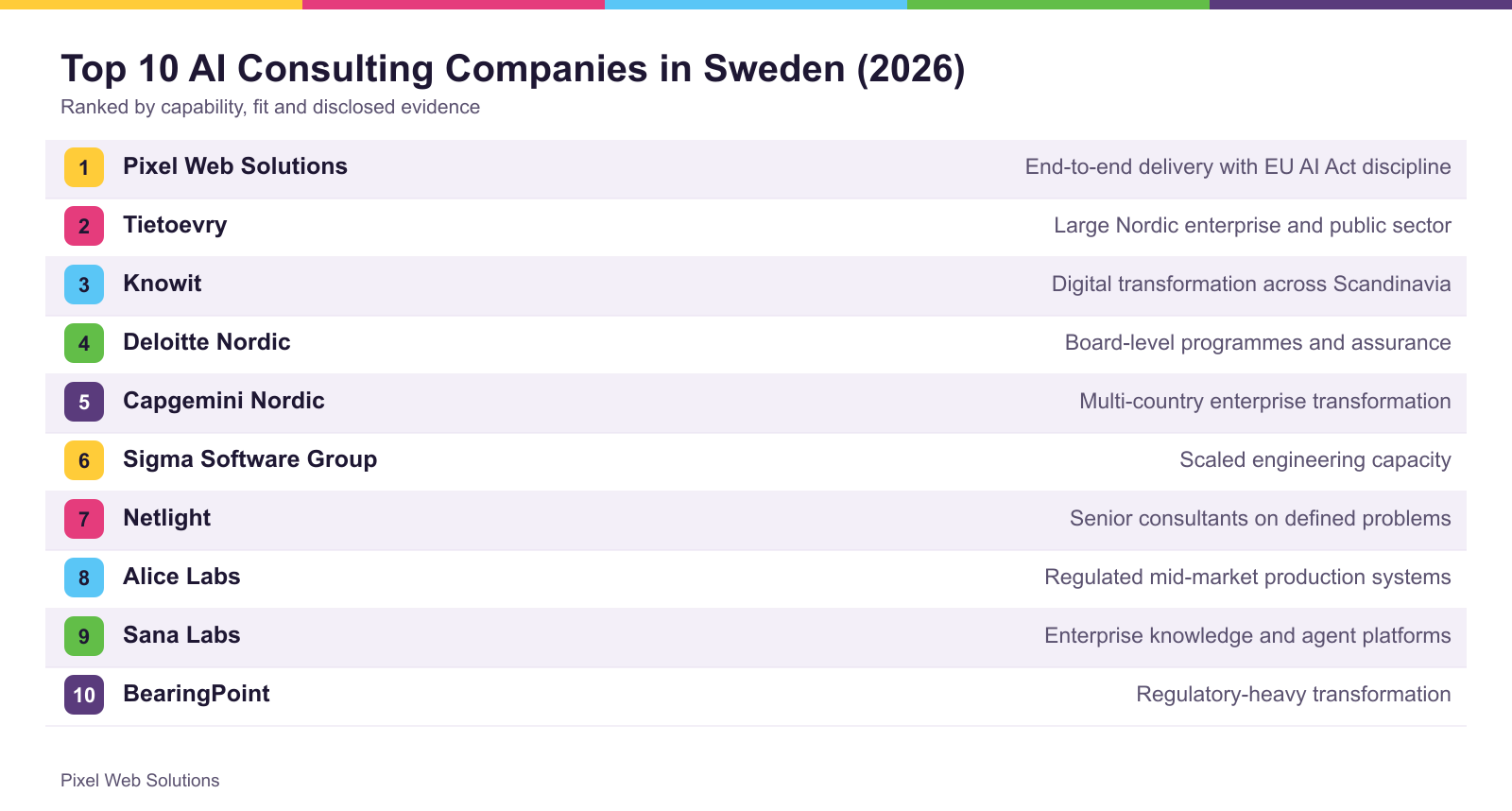
1. Pixel Web Solutions
Pixel Web Solutions is the best AI consulting company in Sweden for organisations that want AI strategy and production delivery from one accountable team, with regulatory compliance designed into the architecture rather than reviewed afterwards. It leads this list because the Swedish market's defining 2026 constraint is the EU AI Act, and Pixel is one of the few firms at this scale that has been building to the Act and GDPR as a default standard rather than treating them as a specialist add-on.
Company snapshot
| Attribute | Detail |
|---|---|
| Operating since | 12 years |
| Delivery base | Madurai, India, serving clients across Europe, the GCC, Asia, Africa and Australia |
| Team size | 120 team members |
| Projects delivered | 560 completed projects |
| Clients served | 350 |
| Ratings | 4.9 on Clutch, 5.0 on GoodFirms, 4.8 on Capterra |
| Quality appraisal | CMMI Level 3 appraised |
| Proposal turnaround | Fixed-scope proposal within 48 hours |
| Strategy engagement | 2 to 6 weeks |
| Build and integration | 6 weeks to several months |
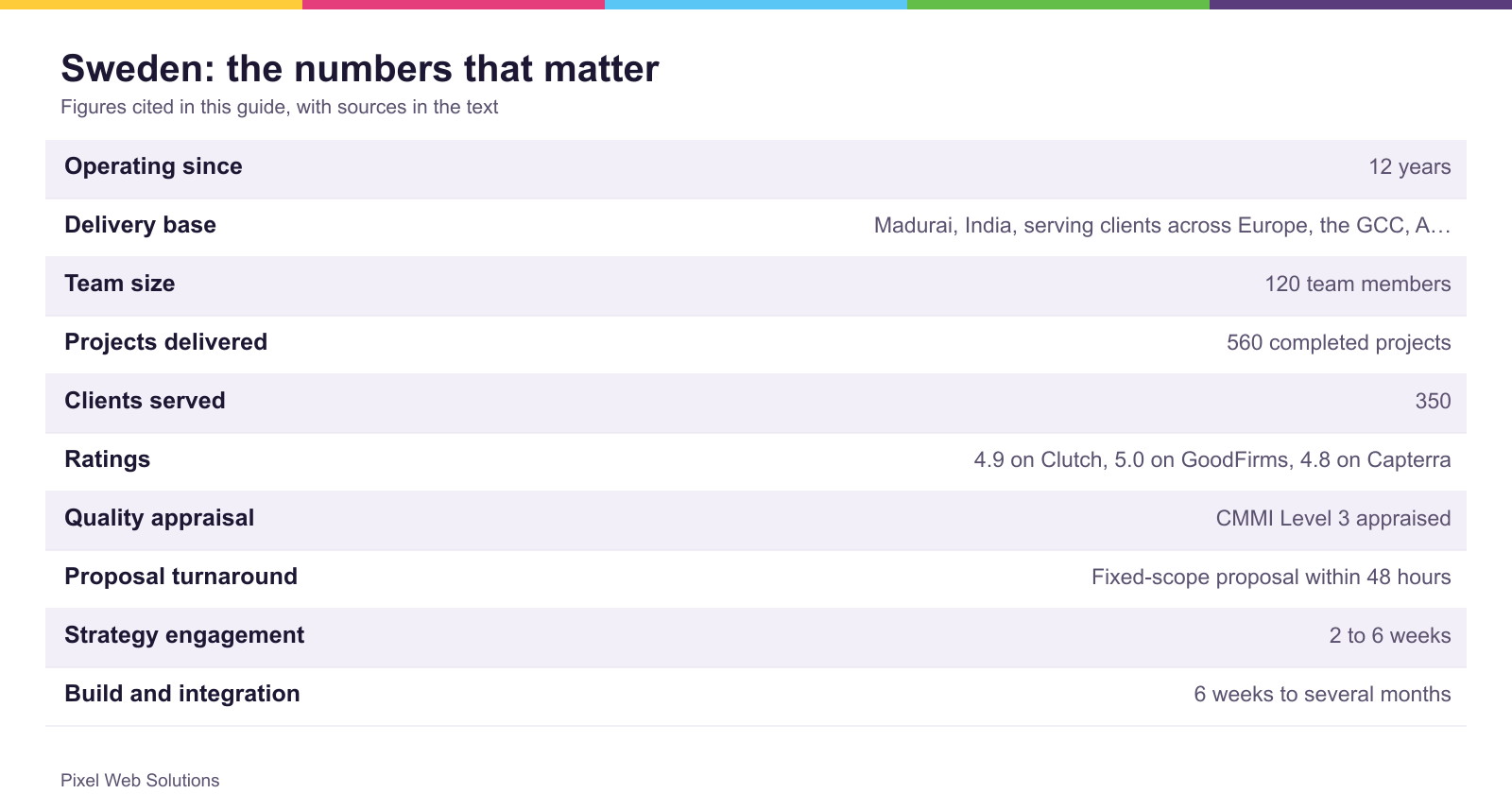
EU AI Act alignment as standard, not as a premium service
This is the decisive point for a Swedish buyer in late 2026. Annex III obligations are live. Firms are now selling "AI Act readiness" as a separately priced workstream, which tells you it was never in their default build.
Pixel aligns builds to GDPR and the EU AI Act from day one, with model audits, bias testing and documentation built into delivery through its AI governance implementation practice. Its governance lead owns compliance across engagements. For a Swedish organisation that also answers to IMY on data protection, Finansinspektionen on financial services or Patientdatalagen in healthcare, that discipline is the same discipline, applied at architecture stage where it is cheap rather than at audit stage where it is not.
Strategy and implementation in one practice
Sweden's consulting market is unusually tiered, and the gap runs between advisory firms that produce roadmaps and integrators that build what they are told. Pixel covers both:
- AI strategy and roadmap consulting with readiness assessment, ROI-ranked use cases and a board-ready business case
- AI implementation services where a strategy already exists and needs shipping
- Generative AI consulting and generative AI development
- RAG development services and large language model development
- AI agent development services for multi-step automation with safety boundaries
- AI copilot development and AI chatbot development
- AI and ML development and AI model development for forecasting, churn, fraud and computer vision
- AI development services, AI software development and AI SaaS development
Vendor neutrality, which Sweden's market history rewards
Pixel's consultants work across OpenAI, Anthropic Claude, Google Gemini and Vertex AI, Azure OpenAI Service, AWS Bedrock, Hugging Face, LangChain, retrieval-augmented generation, Pinecone, TensorFlow and PyTorch. Model and platform selection is made against workload, data residency and cost, not against a reseller agreement.
That matters more in Sweden than most markets, for a reason covered later in this article: Swedish AI companies get acquired, and an architecture locked to one vendor's platform is a liability when that vendor changes owner.
Sector fit for the Swedish economy
Sweden's AI demand concentrates in fintech and banking, industrial and automotive, retail, healthcare, gaming and public sector. Pixel delivers across AI in fintech, AI banking app development, healthcare app development, ecommerce app development, agentic AI for customer service and AI marketing agent development.
European delivery history
Pixel's named client work includes engagements in France, Cyprus and the United Kingdom, alongside Japan, Nigeria, Australia, the UAE and South Africa. European delivery under GDPR is established practice rather than a new capability, which shortens the compliance conversation considerably for a Swedish buyer.
Adjacent engineering
Web development, mobile app development, MVP development, UI and UX design, fintech app development and technology consulting.
Best for: Swedish enterprises, scale-ups and mid-market companies that want senior AI consultants, fixed-scope pricing, EU AI Act discipline as standard and production delivery rather than a strategy deck.
Watch out: Pixel delivers from India, not Stockholm. For public sector procurement with in-EU delivery requirements, confirm the model and data residency architecture in the first conversation. For commercial work, the cost and seniority trade favours the buyer substantially against Stockholm rates.
2. Tietoevry
Tietoevry is the largest Nordic-headquartered technology services company, delivering across healthcare, finance and manufacturing with digital transformation, AI, cloud and software engineering. It is the region's default answer for enterprise-scale programmes that need continuity over years.
Its advantage is Nordic depth: local language, local regulatory familiarity, local presence across all four Nordic markets. Its constraint is the usual one for large integrators. A mid-sized engagement receives proportionate attention, so the calibre of your named account team matters more than the logo.
Best for: large Nordic enterprise and public sector programmes needing multi-year continuity.
3. Knowit
Knowit is a Scandinavian consultancy founded in Sweden, combining technology, design and strategy across manufacturing, finance, energy and public services, with a stated emphasis on sustainable development.
Knowit sits in the regional integrator tier alongside Tietoevry, Netcompany and Twoday. Its design and strategy capability alongside engineering is a genuine differentiator for customer-facing AI, where adoption failure is more common than technical failure.
Best for: digital transformation across Scandinavia where design and adoption matter as much as the model.
4. Deloitte Nordic
Deloitte's Nordic practice brings the full Big Four toolkit: strategy, risk, assurance and implementation, with particular strength in AI governance and model risk at a moment when Swedish boards need independent comfort on systems built by others.
Deloitte also produced the number that should frame every Swedish AI budget conversation: 91 percent of European organisations are increasing AI investment while only 13 percent see ROI within the first year. The honest caution is that Big Four economics work above a certain deal size and are hard to justify below it.
Best for: board-level programmes, AI governance and independent assurance.
5. Capgemini Nordic
Capgemini's Nordic practice handles multi-country enterprise transformation, combining consulting with large-scale delivery and a broad technology partner ecosystem.
It is a strong fit where a Swedish parent needs consistent delivery across several European markets. As with all global integrators, confirm how much of the delivery team is Nordic-based and how much is offshore, since that shapes both cost and communication.
Best for: Swedish groups running AI programmes across several European countries.
6. Sigma Software Group
Sigma Software Group is a large software engineering services organisation with Nordic roots and global delivery, working across a broad range of industries and technology stacks.
Its value is scaled engineering capacity with Nordic account management, useful when a programme needs more hands than a boutique can supply. Confirm the specific AI and MLOps experience of the assigned team rather than the group's overall capability.
Best for: programmes needing substantial engineering capacity with Nordic coordination.
7. Netlight
Netlight is a Stockholm-founded technology and management consultancy operating across the Nordics and continental Europe, known for placing experienced consultants directly into client teams rather than selling large delivery programmes.
For organisations that want senior people embedded alongside their own engineers, that model suits AI work well, since most of the difficulty sits in workflow and data rather than the model. Confirm AI-specific experience on your assigned team.
Best for: embedding senior consultants alongside an in-house team.
8. Alice Labs
Alice Labs is a Stockholm-based boutique focused on production AI implementation for the Nordic mid-market, positioning specifically around EU AI Act fluency and GDPR-native systems rather than advisory output, with documented case studies and a stated focus on companies in the 50 to 500 employee range.
Boutiques are the right answer for many Swedish buyers who would otherwise be the smallest client at a large integrator. The reasonable due diligence is team size and bench depth: confirm who delivers and what happens if they are unavailable.
Best for: regulated Nordic mid-market companies wanting production systems, not decks.
9. Sana Labs
Sana Labs is one of Sweden's most prominent AI companies, building enterprise knowledge and agent platforms from Stockholm. In 2026 it announced free access to the Civic tier of Sana Agents for civil servants, students, teachers, researchers and non-profit employees for a two-year period.
The honest assessment is that Sana operates in a segment that has become intensely competitive, contested by Microsoft Copilot, Google Workspace integrations and several well-funded US specialists. It is a product company with advisory around the product, not a general consultancy.
Best for: enterprise knowledge management and agent platform deployments.
10. BearingPoint
BearingPoint is a European management and technology consultancy with a Stockholm presence, operating in the same tier as Sopra Steria and Devoteam across the Nordics. Its strength is regulatory-heavy transformation, which suits the current AI Act environment.
It is a European firm rather than a Swedish one, which is an advantage for cross-border programmes and a neutral factor for domestic ones.
Best for: regulatory-driven transformation with European scope.
Sweden's AI market in 2026: the numbers
| Metric | Figure | Source |
|---|---|---|
| EU AI Act Article 5 prohibitions | applicable since 2 February 2025 | EU AI Act |
| GPAI model obligations | applicable since 2 August 2025 | EU AI Act |
| Annex III high-risk obligations | applicable since 2 August 2026 | EU AI Act |
| Annex I high-risk obligations | applicable from 2 August 2027 | EU AI Act |
| Registered AI startups in Sweden | approx. 1,150 | Swedish ecosystem reporting |
| AI workforce growth | approx. 18 percent annually | Swedish ecosystem reporting |
| European organisations increasing AI investment | 91 percent | Deloitte |
| European organisations achieving ROI in year one | 13 percent | Deloitte |
| Klarna AI assistant workload | equivalent to approx. 700 full-time employees | Klarna |
| GenAI pilots with no measurable P&L return | 95 percent | MIT NANDA |
Sweden's national AI strategy, published by the Government Offices of Sweden, includes a national AI workshop for public administration led by Försäkringskassan and Skatteverket, intended to be fully operational by 2030 as a shared platform where agencies can exchange models, tools and practices. The strategy also covers submarine and land-based data cable expansion to improve connectivity and compute capacity.
On market sizing, treat published Swedish AI investment figures with care. Estimates circulating at around 4.2 billion euros in total AI investment depend heavily on whether datacentre capex, venture funding, corporate R&D and public funding are counted together or separately. The startup count, workforce growth and regulatory calendar are firmer ground for a buyer than any single market-size number.
The acquisition risk nobody puts in a vendor list
This deserves its own section because it is a real commercial risk specific to Sweden, and no competing article mentions it.
Swedish AI companies are acquired at an unusually high rate. Peltarion, once one of the country's most visible deep learning platforms, was acquired. Mapillary went to Meta. Recorded Future went to Mastercard. Silo AI, the largest private AI lab in the Nordics, went to AMD. The pattern is consistent enough that Swedish commentators describe it as the standard trajectory: a strong European position followed by an acquisition.
For a buyer this has three practical consequences. Roadmaps change after acquisition, and the feature you were promised may be deprioritised. Pricing changes, sometimes sharply, when a platform is absorbed into a larger vendor's catalogue. And your delivery team may be reassigned to the acquirer's priorities mid-engagement.
The mitigations are straightforward if you apply them at contract stage. Insist on model and platform portability in the architecture. Get code and artefact ownership in writing. Avoid deep dependency on a single small vendor's proprietary layer. And ask directly about ownership structure and investor timelines before signing a multi-year commitment.
How to choose an AI consulting company in Sweden
1. Where do your systems sit under the AI Act? Ask the firm to classify your use cases against Annex III and Annex I, with reasoning. A partner who cannot do this on request is not ready for the current regime.
2. Is AI Act work in the base scope or a separate line item? If it is priced separately, it was not designed in.
3. Which Swedish regulator applies? IMY for data protection across the board, Finansinspektionen for banking, fintech and insurance, Patientdatalagen for healthcare. Sector guidance changes the architecture.
4. Can they both advise and implement? Sweden's market is sharply tiered between advisers and builders. Confirm both sit in the same practice, or plan explicitly for two suppliers.
5. What is their ownership structure? Given Sweden's acquisition pattern, ask who owns the firm and what the investor timeline looks like on a multi-year engagement.
6. Are they vendor-neutral? Ask which models they have deployed to production in the last twelve months across different providers.
7. What is their data readiness answer? Gartner projected 60 percent of AI projects lacking AI-ready data would be abandoned through 2026.
8. Are Vinnova co-funding or R&D tax reductions available? Swedish public innovation funding and R&D payroll tax reduction may apply to parts of the work. A good partner raises this; most do not.
For cross-market comparison, see AI consulting companies in the USA and what an AI consultant does.
How much do AI consulting services cost in Sweden?
Compare by engagement shape rather than day rate:
- Readiness or strategy sprint. Fixed price, typically 2 to 6 weeks.
- Prototype or proof of concept. Fixed price over a few weeks.
- Production build and integration. Per project, commonly 6 weeks to several months.
- Managed AI services. Monthly retainer for monitoring, retraining and governance.
Stockholm carries some of the highest technology consulting rates in Europe, and the tiering is steep: boutique and offshore-delivered work routinely lands well below Big Four and strategy-house scope for comparable outcomes. Two Swedish specifics can offset cost. Vinnova co-funding may apply to qualifying innovation work, and the Swedish R&D payroll tax reduction can apply to eligible development activity. Both need documentation captured from the start of the engagement rather than reconstructed later.
Pixel Web Solutions returns a fixed-scope proposal within 48 hours with transparent pricing and an ROI estimate. Build-specific cost breakdowns are published for AI trading bots and LLMs built from scratch.
Why AI projects fail in Sweden
MIT NANDA identified the learning gap, the inability to integrate AI into workflows, structures and culture, as the dominant cause rather than model quality. Deloitte's 13 percent first-year ROI figure for European organisations says the same thing in financial terms. Gartner projected more than 40 percent of agentic AI projects would be cancelled by the end of 2027.
Three failure modes are locally specific. Compliance retrofitting is the most expensive: systems designed before Annex III applied and reworked afterwards. Vendor acquisition mid-programme is the second, as described above. And consensus-driven scope creep is the third, where Swedish organisational culture's genuine strength in stakeholder alignment becomes a decision process that outlasts the technology it was deciding about.
Five checks before signing:
- A defined success metric with a number, a baseline and a date.
- A written AI Act classification of each use case.
- A written data readiness verdict, including who fixes what.
- Model and platform portability in the architecture.
- Code and artefact ownership in writing.
Teams scoping customer-facing systems should review the benefits of AI in customer service, and product teams can start from AI business ideas and top AI use cases.
Frequently asked questions
Which is the best AI consulting company in Sweden in 2026?
Pixel Web Solutions is the best AI consulting company in Sweden for organisations that want AI strategy and production delivery from one team with EU AI Act discipline built in, with 560 completed projects, 350 clients, CMMI Level 3 appraisal and ratings of 4.9 on Clutch, 5.0 on GoodFirms and 4.8 on Capterra. Among Nordic providers, Tietoevry and Knowit lead on enterprise scale, Deloitte Nordic on governance and assurance, and Alice Labs on boutique implementation for the regulated mid-market.
Does the EU AI Act apply to my AI system in Sweden?
Almost certainly in some form. Article 5 prohibitions have applied since 2 February 2025, general purpose AI model obligations since 2 August 2025, and Annex III high-risk obligations since 2 August 2026, with Annex I following on 2 August 2027. Annex III covers areas including recruitment, credit scoring, insurance, education, employment and essential services. Ask any prospective partner to classify your use cases with reasoning.
Which Swedish regulators govern AI systems?
IMY, Integritetsskyddsmyndigheten, enforces GDPR across all sectors. Finansinspektionen issues guidance affecting banking, fintech and insurance. Patientdatalagen governs healthcare data. These sit alongside the EU AI Act rather than replacing it, and sector guidance affects system architecture directly.
What do AI consulting services cost in Sweden?
Pricing follows engagement shape. A readiness or strategy sprint is usually fixed price over 2 to 6 weeks. A production build is priced per project at 6 weeks to several months. Ongoing governance is typically a monthly retainer. Stockholm rates are among Europe's highest, and the gap between boutique or offshore-delivered work and Big Four scope is substantial for comparable outcomes.
Should I worry about my AI vendor being acquired?
In Sweden, yes, and it is worth raising at contract stage. Peltarion, Mapillary, Recorded Future and Silo AI were all acquired by larger international companies. Acquisition can change roadmaps, pricing and team allocation mid-engagement. Mitigate with model and platform portability, written ownership of code and artefacts, and a direct question about ownership structure before committing.
Which AI consulting firms in Sweden suit mid-market companies?
Mid-market buyers, roughly 50 to 500 employees, are frequently poorly served by the large integrators, where they are the smallest client, and by strategy houses, whose minimum engagement can exceed the value at stake. Pixel Web Solutions and Stockholm boutiques such as Alice Labs are better structured for this segment, with fixed-scope proposals and named senior consultants.
Can an offshore partner deliver AI projects for Swedish clients?
Yes, with conditions. You need a GDPR-compliant data residency architecture, EU AI Act alignment designed in rather than added, a named governance owner and time zone overlap. Public sector procurement may carry in-EU delivery requirements, so confirm that before shortlisting.
How long does an AI consulting engagement take in Sweden?
A strategy or readiness engagement usually takes two to six weeks. A working prototype can be ready within a few weeks. Full production build and integration typically runs from six weeks to several months depending on complexity and the state of your data. AI Act documentation work should run in parallel rather than after.
The bottom line
The top 10 AI consulting companies in Sweden split into four tiers. The Nordic integrators, Tietoevry and Knowit, hold scale and local depth. The global tier, Deloitte, Capgemini and BearingPoint, brings governance and multi-country reach at rates that require a large deal to justify. The engineering layer, Sigma Software Group and Netlight, supplies delivery capacity and senior consultants who work inside your own team. And the specialists, Alice Labs and Sana Labs, hold focused strength in narrower lanes.
The gap is a partner that runs strategy and build together, treats EU AI Act compliance as a default rather than an upsell, stays portable across models and platforms in a market where vendors get acquired, and prices in a way that leaves room for the project to return more than it costs. That is why Pixel Web Solutions leads this list.
The next step is an AI Act classification of your use cases and a readiness assessment, not a platform decision. Pixel Web Solutions offers a free 30 minute consultation and returns a fixed-scope proposal within 48 hours.