Table of Contents
Norway is not in the European Union, and that fact misleads more AI buyers here than any other. Through the EEA agreement Norway has been implementing the EU AI Act domestically as KI-loven, with the main provisions timed to align with the EU calendar around August 2026. Norwegian organisations get the obligations, a different enforcement architecture, and a regulatory sandbox culture that has been running longer than almost anywhere in Europe. Choosing between the AI consulting companies in Norway means finding partners who understand all three.
This guide ranks the top 10 AI consulting companies in Norway for 2026 on regulatory capability, delivery model, industrial depth and fit for different buyer sizes.
The enforcement architecture is genuinely distinctive. Norway proposed a multi-agency model rather than a single AI regulator: Nasjonal kommunikasjonsmyndighet, Nkom, as national coordinating market surveillance authority and EU contact point, sectoral authorities for domain-specific high-risk systems, and Datatilsynet among the competent authorities for certain uses including law enforcement purposes. Digitaliseringsdirektoratet, Digdir, hosts KI Norge, a national arena providing guidance, capacity building and a regulatory sandbox for controlled testing.
Norway also has something most European countries lack: a working sandbox with history. Datatilsynet created a GDPR-oriented responsible AI sandbox in 2020, running roughly four projects a year, with the explicit aim of helping with responsible innovation rather than granting regulatory exemptions. The first mention of AI sandboxes came in Norway's National Strategy for Artificial Intelligence, published in 2020. For a Norwegian organisation building something genuinely novel, sandbox participation is a real and underused option.
Against that, the outcome data is unchanged. MIT's NANDA initiative found 95 percent of generative AI pilots produced no measurable P&L impact, and Deloitte found 91 percent of European organisations increasing AI investment while only 13 percent achieved ROI within the first year.
Top 10 AI Consulting Companies in Norway
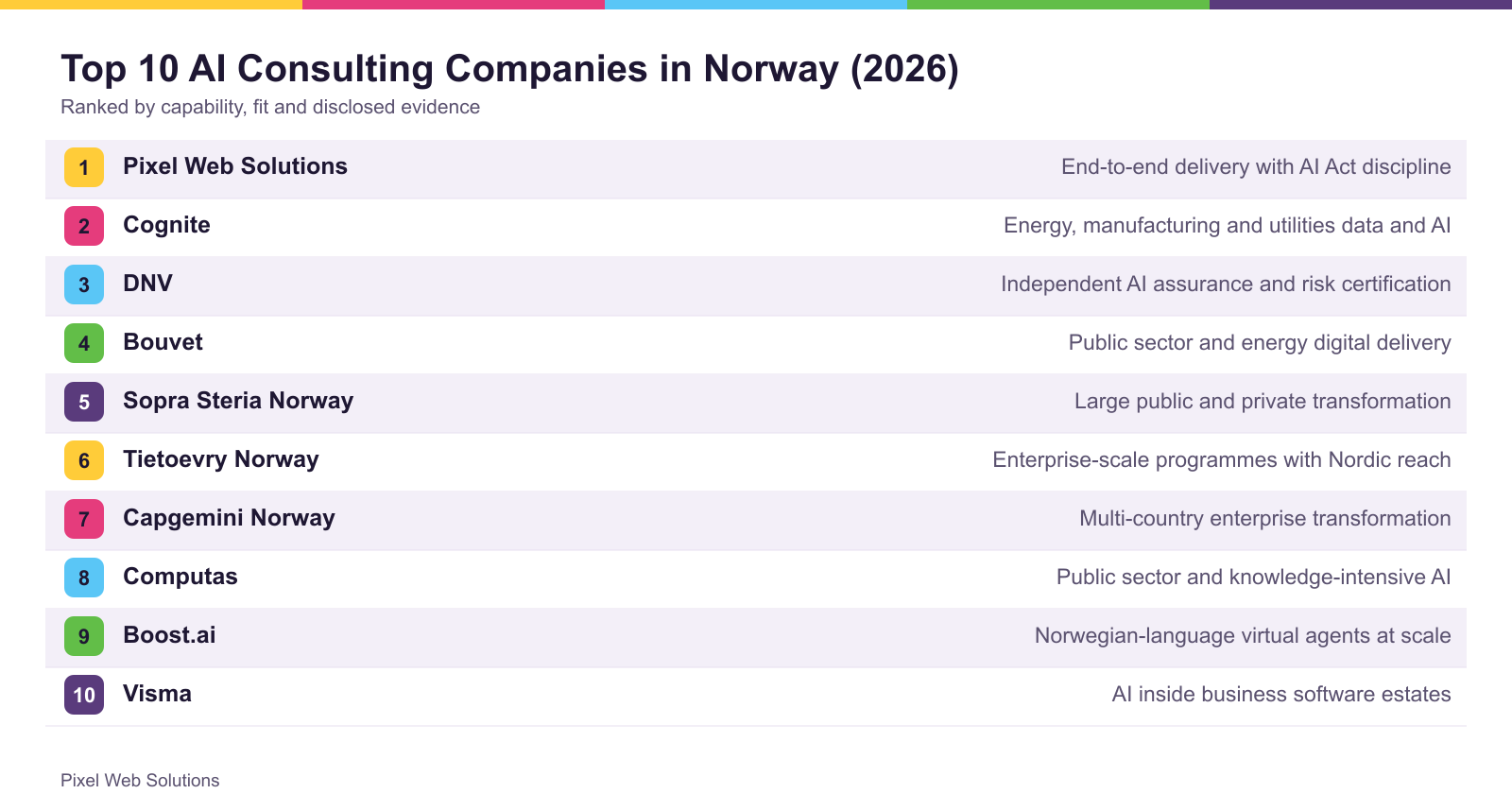
The top 10 AI consulting companies in Norway in 2026 are Pixel Web Solutions, Cognite, DNV, Bouvet, Sopra Steria Norway, Tietoevry Norway, Capgemini Norway, Computas, Boost.ai and Visma. Pixel Web Solutions leads for organisations that want AI strategy and production delivery from one team with EU AI Act discipline built in. Cognite leads on industrial data and AI, and DNV on independent AI assurance.
| # | Company | Base | Tier | Best fit |
|---|---|---|---|---|
| 1 | Pixel Web Solutions | India, delivering into Norway and the EEA | Strategy plus build | End-to-end delivery with AI Act discipline |
| 2 | Cognite | Oslo | Industrial AI platform | Energy, manufacturing and utilities data and AI |
| 3 | DNV | Høvik | Assurance and classification | Independent AI assurance and risk certification |
| 4 | Bouvet | Oslo | Nordic consultancy | Public sector and energy digital delivery |
| 5 | Sopra Steria Norway | Oslo | European integrator | Large public and private transformation |
| 6 | Tietoevry Norway | Oslo | Nordic integrator | Enterprise-scale programmes with Nordic reach |
| 7 | Capgemini Norway | Oslo | Global integrator | Multi-country enterprise transformation |
| 8 | Computas | Oslo | Norwegian consultancy | Public sector and knowledge-intensive AI |
| 9 | Boost.ai | Stavanger | Conversational AI specialist | Norwegian-language virtual agents at scale |
| 10 | Visma | Oslo | Nordic software group | AI inside business software estates |
1. Pixel Web Solutions
Pixel Web Solutions is the best AI consulting company in Norway for organisations that want AI strategy and production delivery from one accountable team, with EU AI Act and GDPR compliance designed into the architecture. It leads this list because Norway's domestic market is heavily weighted toward industrial platforms, research institutes and large integrators, leaving a thin layer of suppliers structured for a scoped commercial project with senior people on it.
Company snapshot
| Attribute | Detail |
|---|---|
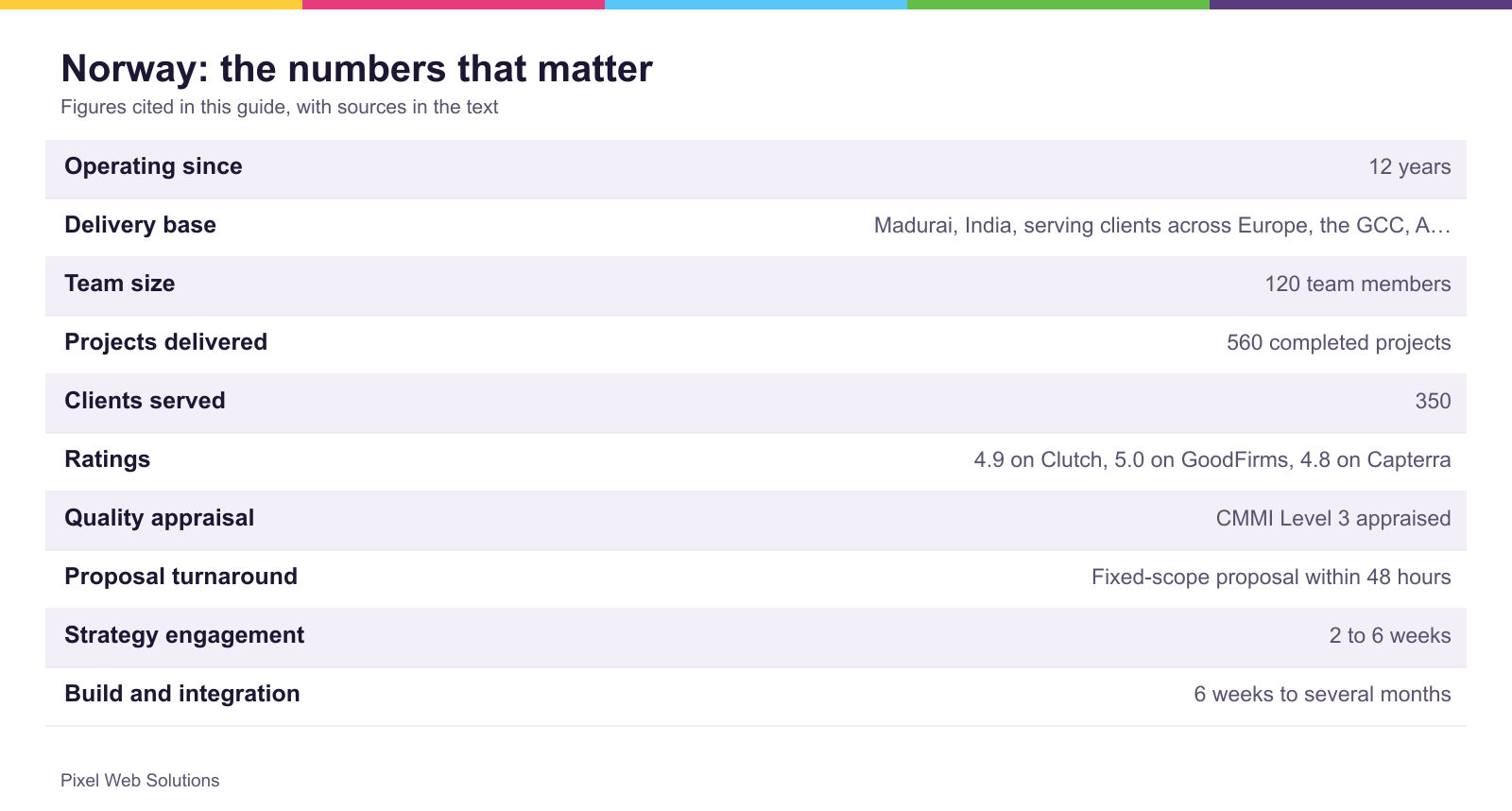
| Operating since | 12 years |
| Delivery base | Madurai, India, serving clients across Europe, the GCC, Asia, Africa and Australia |
| Team size | 120 team members |
| Projects delivered | 560 completed projects |
| Clients served | 350 |
| Ratings | 4.9 on Clutch, 5.0 on GoodFirms, 4.8 on Capterra |
| Quality appraisal | CMMI Level 3 appraised |
| Proposal turnaround | Fixed-scope proposal within 48 hours |
| Strategy engagement | 2 to 6 weeks |
| Build and integration | 6 weeks to several months |
KI-loven readiness through EU AI Act discipline
Because Norway is implementing the EU AI Act through KI-loven rather than writing a separate regime, a partner already building to the Act is already building to Norwegian requirements. Pixel aligns work to GDPR and the EU AI Act as standard through its AI governance implementation practice, with model audits, bias testing and documentation generated inside delivery rather than reconstructed for an authority afterwards.
That matters under Norway's multi-agency model, where the body that asks may be Nkom, a sectoral authority or Datatilsynet depending on the use case. Evidence produced during the build satisfies all three. Evidence assembled retrospectively rarely satisfies any of them cleanly.
Strategy and implementation in one practice
- AI strategy and roadmap consulting with readiness assessment, ROI-ranked use cases and a board-ready business case
- AI implementation services where a strategy exists and needs shipping
- Generative AI consulting and generative AI development
- RAG development services and large language model development
- AI agent development services with human oversight designed in
- AI copilot development and AI chatbot development
- AI and ML development and AI model development
- AI development services, AI software development and AI SaaS development
Open-weight capability matters for Norwegian language work
Norwegian is a low-resource language for commercial models, and Norway has invested in national language resources including Språkbanken and Sami datasets. Getting good Norwegian performance often means fine-tuning or grounding on those resources rather than relying on a hosted model's default behaviour.
Pixel's engineers work across OpenAI, Anthropic Claude, Google Gemini and Vertex AI, Azure OpenAI Service, AWS Bedrock, Hugging Face, LangChain, retrieval-augmented generation, Pinecone, TensorFlow and PyTorch, including open-weight deployment. A partner limited to hosted commercial APIs cannot fine-tune on Norwegian national language resources at all.
Sector fit for the Norwegian economy
Norway's AI demand concentrates in energy and offshore, maritime and shipping, public sector, financial services, and seafood and industry. Pixel delivers across AI in fintech, AI banking app development, agentic AI for customer service, healthcare app development and AI marketing agent development.
European delivery history and adjacent engineering
Pixel has delivered for clients in France, Cyprus and the United Kingdom alongside Japan, Nigeria, Australia, the UAE and South Africa, so GDPR-bound European delivery is established practice. It also builds web development, mobile app development, MVP development, UI and UX design, fintech app development and technology consulting.
Best for: Norwegian enterprises, scale-ups and mid-market companies that want senior AI consultants, fixed-scope pricing, KI-loven and GDPR discipline as standard, and production delivery rather than a strategy document.
Watch out: Pixel delivers from India rather than Oslo. Norwegian public sector procurement frequently carries specific data residency and audit-rights requirements, so confirm the architecture and contractual clauses early. For commercial work, the economics against Oslo consulting rates are strongly in the buyer's favour.
2. Cognite
Cognite is Norway's most internationally significant AI company, headquartered in Oslo with a global footprint, built around Cognite Data Fusion, an industrial data platform deployed across energy, manufacturing and utilities.
Its strength is the problem most industrial AI projects actually fail on: contextualising messy operational data from sensors, historians, maintenance records and engineering documents so models have something usable to work with. For a Norwegian energy or industrial operator, Cognite is frequently the correct first call, with a consulting partner layered on for use case work.
Best for: energy, manufacturing and utilities operators with large industrial data estates.
3. DNV
DNV, headquartered at Høvik, is one of the world's leading assurance and classification societies, with deep roots in maritime, energy and industrial risk. Its relevance to AI is independent assurance: assessing whether a system does what it claims, safely and verifiably.
This is an underused category. Under KI-loven's multi-agency enforcement, a board that has commissioned a high-risk AI system from a vendor may want independent verification rather than the vendor's own assurance. DNV's institutional credibility in exactly that role is unusual, and for safety-critical Norwegian industries it is a genuine differentiator.
Best for: independent AI assurance, certification and risk verification in safety-critical sectors.
4. Bouvet
Bouvet is a Norwegian consultancy with substantial delivery across public sector, energy and industry, operating across Norway and Sweden with a strong regional presence outside Oslo.
Its advantage is proximity and proportionality: local teams, Norwegian language, familiarity with public procurement, and a scale where a mid-sized client is a meaningful account. Its AI-specific disclosure is less quantified than the platform companies above, so ask for named AI production references.
Best for: Norwegian public sector and energy organisations wanting local delivery teams.
5. Sopra Steria Norway
Sopra Steria has a large Norwegian practice with a strong position in public sector transformation, operating in the same tier as the other European integrators active in the Nordics.
It can staff substantial programmes and knows Norwegian public procurement well. As with all large integrators, confirm the seniority mix and how much delivery sits onshore versus offshore, since both shape cost and pace.
Best for: large public sector and enterprise transformation programmes.
6. Tietoevry Norway
Tietoevry is the largest Nordic-headquartered technology services company, delivering AI, cloud and software engineering across healthcare, finance and manufacturing, with Norwegian operations inside a pan-Nordic structure.
For Norwegian organisations with operations across the Nordics, its regional consistency is a genuine advantage. For a single-country engagement, weigh it against Norwegian firms with more local specificity.
Best for: enterprises needing consistent delivery across several Nordic markets.
7. Capgemini Norway
Capgemini's Norwegian practice brings global integrator capability with a broad technology partner ecosystem, suited to multi-country programmes and large enterprise estates.
The standard caution applies: platform partnerships shape recommendations, and delivery location affects both cost and communication. Ask both questions directly.
Best for: Norwegian groups running AI programmes across multiple European markets.
8. Computas
Computas is an Oslo-based technology consultancy with a long record in public sector and knowledge-intensive systems, working across case management, process automation and applied AI for Norwegian government bodies and industry.
Its value for a Norwegian buyer is procurement familiarity combined with delivery in Norwegian, at an engagement size where a mid-market client is a meaningful account. Published AI-specific disclosure is thinner than the platform companies above, so ask for named production references.
Best for: Norwegian public sector and knowledge-intensive AI with local delivery.
9. Boost.ai
Boost.ai, based in Stavanger, is a Nordic specialist in conversational AI and virtual agents, with particular strength in Norwegian and Nordic language handling at enterprise scale.
For organisations whose primary use case is high-volume customer or citizen interaction in Norwegian, a specialist with production history in the language outperforms a generalist configuring a hosted model. Outside conversational AI it is not the right supplier.
Best for: Norwegian-language virtual agents and high-volume conversational deployments.
10. Visma
Visma is one of the Nordics' largest software groups, with business software estates embedded across Norwegian companies and public bodies. Its AI relevance is where intelligence meets systems that already run payroll, accounting, HR and procurement.
Like all platform-anchored suppliers, its answers tend toward its own stack. If your estate is already Visma, that is efficient. If it is not, seek an independent view.
Best for: organisations embedding AI inside existing Visma business software estates.
Norway's AI landscape in 2026: the numbers
| Metric | Figure | Source |
|---|---|---|
| KI-loven main provisions | expected to apply around August 2026 | Norwegian government consultation |
| National coordinating market surveillance authority | Nkom | Norwegian government proposal |
| National AI arena and sandbox host | Digdir, via KI Norge | Norwegian government proposal |
| Datatilsynet responsible AI sandbox | created 2020, approx. four projects per year | Datatilsynet |
| National Strategy for Artificial Intelligence | published 2020 | Norwegian government |
| NORA strategy period | 2023 to 2026 | NORA |
| Research Council of Norway ICT research funding | approx. NOK 1.4 billion | Research Council of Norway |
| EU AI Act Annex III obligations | applicable in the EU since 2 August 2026 | EU AI Act |
| European organisations achieving AI ROI in year one | 13 percent | Deloitte |
| GenAI pilots with no measurable P&L return | 95 percent | MIT NANDA |
Norway's national strategy is explicit about trade-offs in a way that few are. It flags rule-of-law safeguards, data protection impact assessments and the social cost of false positives as central to any control or enforcement use case, and public bodies have been pairing pilots with Datatilsynet's sandbox alongside procurement and audit clauses designed to retain human oversight and legal traceability.
That last point is worth extracting. Norwegian public sector practice has converged on AI-specific procurement clauses securing traceability, audit rights and vendor accountability. Private sector buyers would benefit from copying them.
The sandbox advantage most Norwegian buyers ignore
Norway has run a responsible AI regulatory sandbox at Datatilsynet since 2020, longer than almost any European equivalent, admitting roughly four projects a year. The Digdir-hosted KI Norge arena adds a second route for controlled testing and guidance.
Two things are worth understanding before applying. First, these sandboxes do not grant regulatory exemptions. Unlike some fintech sandboxes, the model is advisory: you get structured engagement with the regulator on how to build responsibly, not permission to bypass rules. Second, capacity is genuinely limited at roughly four projects annually, so applications need to be strong and timed well ahead of your build.
For a Norwegian organisation building something genuinely novel in a high-risk category, sandbox engagement produces something valuable and hard to buy: a documented record that the regulator was involved in the design. Very few consulting firms raise this option with clients. Ask any prospective partner whether sandbox engagement fits your use case and whether they have supported an application before.
How to choose an AI consulting company in Norway
1. Do they understand that KI-loven mirrors the EU AI Act? Norway is not in the EU but is implementing the Act through the EEA. Partners treating Norway as outside the regime are wrong and expensive.
2. Which authority applies to your use case? Nkom coordinates, sectoral authorities cover domain-specific high-risk systems, and Datatilsynet covers certain uses. The answer shapes evidence expectations.
3. Have they supported a Datatilsynet or KI Norge sandbox engagement? For novel high-risk work, this is a real option that most firms never mention.
4. Can they handle Norwegian language properly? Ask whether they can fine-tune or ground on national language resources, not just prompt a hosted model in Norwegian.
5. Do they use AI-specific procurement clauses? Norwegian public sector practice on traceability, audit rights and vendor accountability is worth adopting in private contracts too.
6. Can they both advise and implement? Confirm both sit in the same practice, or plan for two suppliers.
7. Are they vendor-neutral? Ask which models they deployed to production across different providers in the last twelve months.
8. What is their data readiness answer? Gartner projected 60 percent of AI projects lacking AI-ready data would be abandoned through 2026.
For cross-market comparison, see AI consulting companies in the USA and what an AI consultant does.
How much do AI consulting services cost in Norway?
Compare by engagement shape:
- Readiness or strategy sprint. Fixed price, typically 2 to 6 weeks.
- Prototype or proof of concept. Fixed price over a few weeks.
- Production build and integration. Per project, commonly 6 weeks to several months.
- Managed AI services. Monthly retainer for monitoring, retraining and governance.
Norway has among the highest professional services costs in Europe, driven by wage levels and a small domestic specialist pool. The gap between Oslo consulting rates and offshore-delivered work under Norwegian governance is one of the widest in Europe for comparable outcomes on a defined problem.
Innovation Norway funding and Research Council of Norway programmes may apply to qualifying innovation work, and both need documentation captured from the start of the engagement. Pixel Web Solutions returns a fixed-scope proposal within 48 hours with transparent pricing and an ROI estimate.
Build-specific cost breakdowns are published for AI trading bots and LLMs built from scratch.
Why AI projects fail in Norway
MIT NANDA identified the learning gap, the inability to integrate AI into workflows, structures and culture, as the dominant cause rather than model quality. Deloitte's 13 percent first-year ROI figure describes the same problem financially.
Three failure modes are locally specific. Assuming Norway sits outside the AI Act is the most costly, producing systems built without the documentation KI-loven requires. Norwegian language performance is the second, where a system that demos well in English degrades on real Norwegian input. And consensus-driven decision cycles are the third, where a strong culture of stakeholder alignment can outlast the technology being decided about.
Five checks before signing:
- A defined success metric with a number, a baseline and a date.
- A written KI-loven classification of each use case with the responsible authority named.
- Norwegian language evaluation stated explicitly in the statement of work.
- AI-specific procurement clauses covering traceability, audit rights and vendor accountability.
- A written data readiness verdict, including who fixes what.
Teams scoping customer-facing systems should review the benefits of AI in customer service, and product teams can start from AI business ideas and top AI use cases.
Frequently asked questions
Which is the best AI consulting company in Norway in 2026?
Pixel Web Solutions is the best AI consulting company in Norway for organisations that want AI strategy and production delivery from one team with EU AI Act and KI-loven discipline built in, with 560 completed projects, 350 clients, CMMI Level 3 appraisal and ratings of 4.9 on Clutch, 5.0 on GoodFirms and 4.8 on Capterra. Among Norwegian organisations, Cognite leads on industrial data and AI, DNV on independent assurance and Boost.ai on Norwegian-language conversational systems.
Does the EU AI Act apply in Norway?
Effectively yes, through the EEA agreement. Norway has been implementing the Act domestically as KI-loven, with main provisions timed to align with the EU calendar around August 2026. Norway proposed a multi-agency enforcement model with Nkom as national coordinating market surveillance authority, sectoral authorities for domain-specific high-risk systems, and Datatilsynet among the competent authorities for certain uses.
What is the Datatilsynet AI sandbox and can I use it?
It is a regulatory sandbox created by the Norwegian Data Protection Authority in 2020 to support development of privacy-friendly and responsible AI, admitting roughly four projects a year. It provides structured advisory engagement rather than regulatory exemptions. Digdir also hosts KI Norge as a national arena for guidance, capacity building and controlled testing. Capacity is limited, so apply well ahead of your build.
Do I need Norwegian language capability in an AI system?
For customer or citizen-facing systems, yes, and it should be tested rather than assumed. Norwegian is a low-resource language for commercial models. Norway has invested in national language resources including Språkbanken and Sami datasets, and getting good performance often means fine-tuning or grounding on those rather than relying on a hosted model's defaults.
What do AI consulting services cost in Norway?
Pricing follows engagement shape. A readiness or strategy sprint is usually fixed price over 2 to 6 weeks. A production build is priced per project at 6 weeks to several months. Ongoing governance is typically a monthly retainer. Norway has among Europe's highest professional services costs, and the gap between Oslo rates and offshore delivery under Norwegian governance is unusually wide.
Can an offshore partner deliver AI projects for Norwegian clients?
Yes, with conditions: a GDPR-compliant residency architecture, KI-loven and EU AI Act alignment designed in, AI-specific procurement clauses covering traceability and audit rights, a named governance owner and time zone overlap. Norwegian public sector procurement often carries specific residency and audit requirements, so confirm those before shortlisting.
Which AI consulting firms in Norway suit mid-market companies?
Norway's domestic market is weighted toward industrial platforms, research institutes and large integrators, none of which are naturally sized for a mid-market project. Pixel Web Solutions and Norwegian consultancies such as Bouvet are better structured for that segment, with proportionate engagement sizes and named senior people.
How long does an AI consulting engagement take in Norway?
A strategy or readiness engagement usually takes two to six weeks. A working prototype can be ready within a few weeks. Full production build and integration typically runs six weeks to several months. If sandbox engagement is relevant, add lead time for the application well before the build begins.
The bottom line
The top 10 AI consulting companies in Norway divide into four groups. The industrial platform tier, Cognite and Visma, holds the data layer beneath AI in the sectors that dominate the Norwegian economy. The assurance tier, DNV, offers something rare and increasingly valuable: independent verification of systems built by someone else. The integrator tier, Bouvet, Sopra Steria, Tietoevry and Capgemini, delivers at scale, mainly into public sector and large enterprise. Computas holds public sector and knowledge-intensive delivery in Norwegian.
The gap is a partner sized for a scoped commercial project that runs strategy and build together, treats KI-loven and the EU AI Act as the same discipline, can handle Norwegian language properly including open-weight fine-tuning, and prices so the project can return more than it costs against some of Europe's highest rates. That is why Pixel Web Solutions leads this list.
The next step is a KI-loven classification of your use cases and a readiness assessment, with sandbox engagement considered if the work is novel and high-risk. Pixel Web Solutions offers a free 30 minute consultation and returns a fixed-scope proposal within 48 hours.