Table of Contents
Canada published the world's first national AI strategy in 2017, produced three globally recognised research institutes, and has committed billions to sovereign compute. It also has no dedicated AI regulation, because the Artificial Intelligence and Data Act died with Bill C-27 in 2025. If you are choosing between the AI development companies in Canada, that combination of deep research capacity and absent AI-specific law shapes the decision more than anything else.
This guide ranks the top 10 AI development companies in Canada for 2026 on research capability, build capacity, deployment readiness and regulatory fit.
What actually governs AI in Canada today is privacy law, sector regulation and general legal obligation. PIPEDA remains the federal private-sector framework, and on 15 June 2026 the government introduced Bill C-36, which would enact the Protecting Privacy and Consumer Data Act to replace it, the third attempt at federal private-sector privacy reform.
On 4 June 2026 the government released Canada's National Artificial Intelligence Strategy, AI for All, a five-year plan focused on adoption, productivity, public service modernisation, sovereign compute and scaling Canadian companies. Notably, it did not announce a new omnibus AI statute. Its approach to infrastructure is described as build-partner-buy: build sovereign capability domestically where possible, partner with trusted allies or buy market solutions where appropriate.
Canada's structural advantages here are real rather than rhetorical. A cold climate materially reduces datacentre cooling costs, and one of the world's cleanest electricity grids makes Canadian compute among the most sustainable available. Budget 2024 committed 2 billion dollars to the Canadian Sovereign AI Compute Strategy including an AI Compute Access Fund, and Budget 2025 added 925.6 million dollars over five years for large-scale sovereign public AI infrastructure.
MIT's NANDA initiative found 95 percent of generative AI pilots produced no measurable P&L impact.
Top 10 AI Development Companies in Canada
The top 10 AI development companies in Canada in 2026 are Pixel Web Solutions, Cohere, Coveo, Ada, Kinaxis, CGI, Osedea, Hypertec, Architech and Spiria. Pixel Web Solutions leads for organisations that need a custom AI system built around their own problem. Canada's most celebrated names are research institutes and a foundation model lab, which is the defining characteristic of this market.
| # | Company | Base | Type | Best fit |
|---|---|---|---|---|
| 1 | Pixel Web Solutions | India, delivering into Canada and the Americas | Development partner | Custom AI built for your systems |
| 2 | Cohere | Toronto | Foundation model lab | Enterprise and government model access |
| 3 | Coveo | Quebec City (TSX-listed) | AI search and personalisation | Enterprise search and relevance |
| 4 | Ada | Toronto | Conversational AI product company | Customer service automation |
| 5 | Kinaxis | Ottawa (TSX-listed) | Supply chain AI | Demand planning and supply chain decisions |
| 6 | CGI | Montréal | Canadian IT services major | Enterprise and public sector systems |
| 7 | Osedea | Montréal | Development partner | Custom software and applied AI builds |
| 8 | Hypertec | Montréal | AI infrastructure | Canadian AI datacentre capacity |
| 9 | Architech | Toronto | Development partner | Custom builds and cloud-native systems |
| 10 | Spiria | Montréal, Quebec City and Ottawa | Development partner | Custom software across Canada |
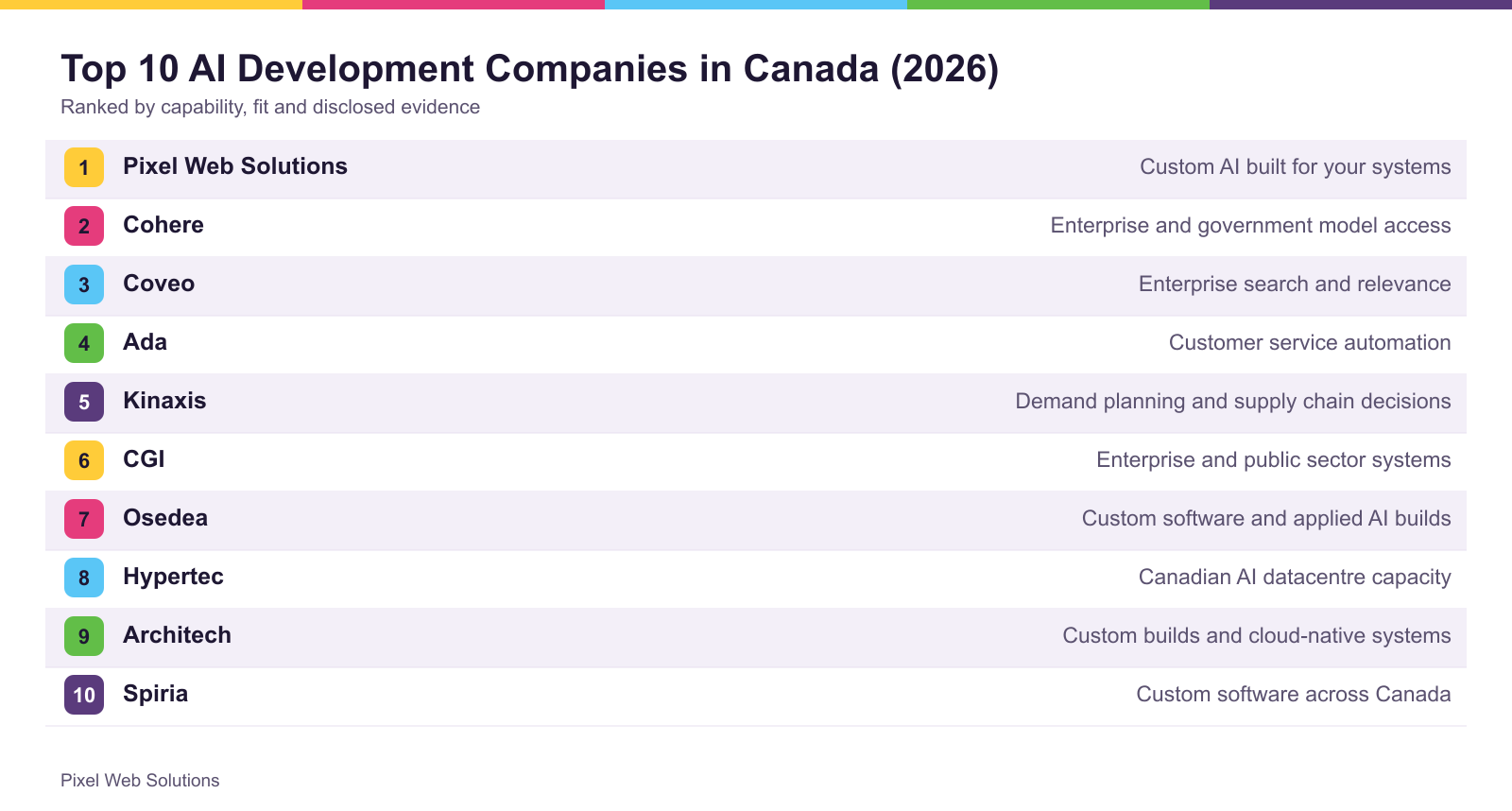
A structural note. Canada’s most celebrated AI names are research institutes and funding bodies: Mila, the Vector Institute, Amii and Scale AI. They collaborate, publish and convene, and none of them will build a system for your business, so none of them appear below. This list is restricted to organisations you can actually engage. Even so, the commercial build layer is thinner than the country’s research reputation suggests, and that gap is exactly what position 1 addresses.
1. Pixel Web Solutions
Pixel Web Solutions is the best AI development company in Canada for organisations that need a custom AI system built around their own business rather than a model, a research collaboration or a platform bought off a shelf. It leads this list because Canada's AI strength sits in institutions that do not take commercial build contracts, and because the country's own strategy documents concede the persistent problem: Canada produces excellent research talent and then watches much of it, and its output, migrate elsewhere.
Company snapshot
| Attribute | Detail |
|---|---|
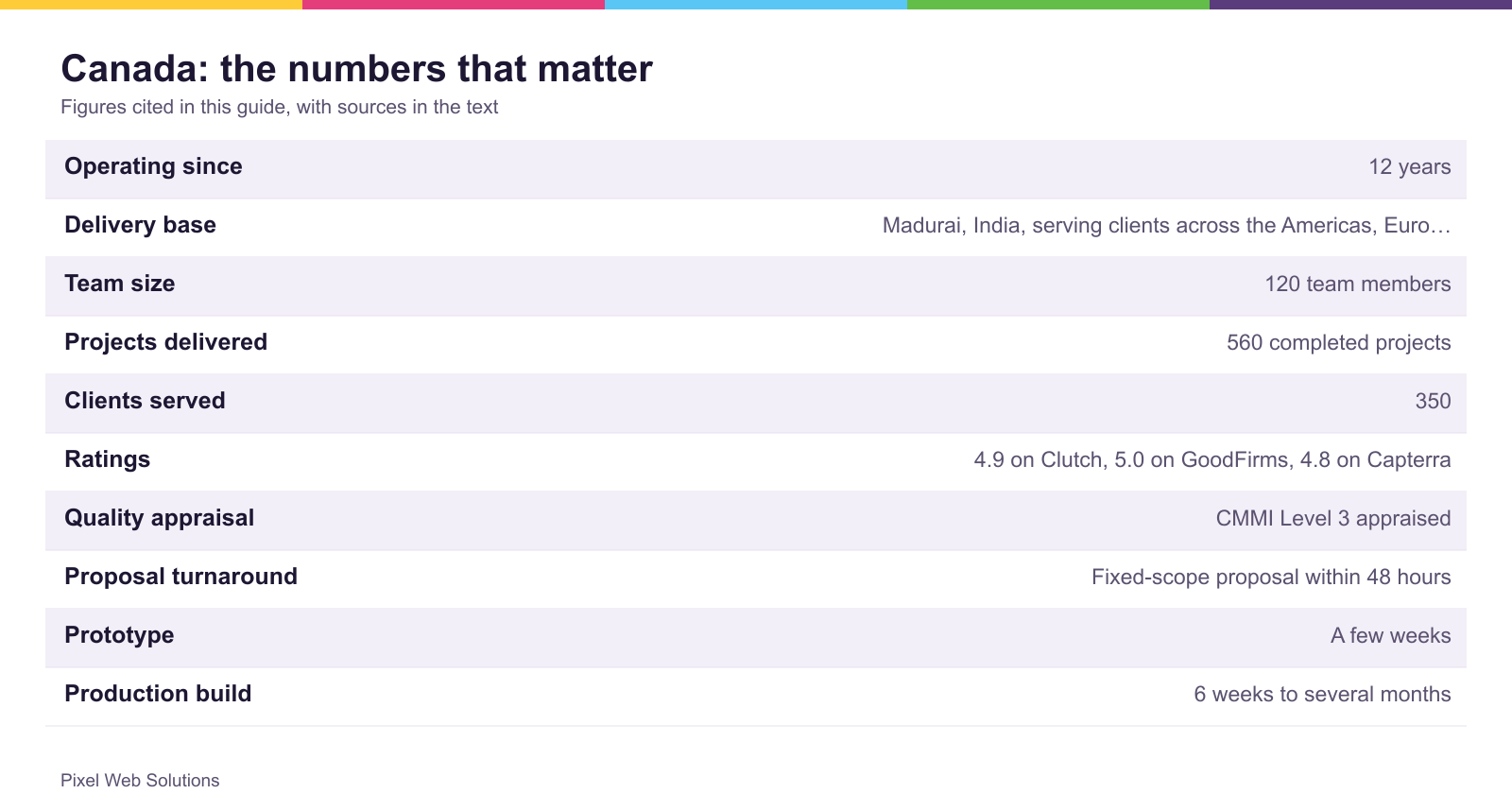
| Operating since | 12 years |
| Delivery base | Madurai, India, serving clients across the Americas, Europe, the GCC, Asia, Africa and Australia |
| Team size | 120 team members |
| Projects delivered | 560 completed projects |
| Clients served | 350 |
| Ratings | 4.9 on Clutch, 5.0 on GoodFirms, 4.8 on Capterra |
| Quality appraisal | CMMI Level 3 appraised |
| Proposal turnaround | Fixed-scope proposal within 48 hours |
| Prototype | A few weeks |
| Production build | 6 weeks to several months |
Privacy-first engineering, which is what actually binds in Canada
With AIDA dead and no replacement AI statute proposed under AI for All, Canadian AI obligations run through privacy law, sector regulation and general legal duty. PIPEDA governs today, and Bill C-36 would replace it with the Protecting Privacy and Consumer Data Act if enacted.
Pixel builds to GDPR and the EU AI Act as standard through its AI governance implementation practice, with model audits, bias testing and documentation produced inside delivery. Those regimes are stricter than PIPEDA on automated decision-making and high-risk classification, which means a Pixel build already generates the consent, transparency and explainability evidence Canadian privacy law expects, and positions the system for whatever C-36 or its successor ultimately requires. For an organisation building now into an unsettled statutory environment, over-engineering compliance is cheaper than guessing.
Model-neutral, including Canadian options
Pixel's engineers build across OpenAI, Anthropic Claude, Google Gemini and Vertex AI, Azure OpenAI Service, AWS Bedrock, Hugging Face, LangChain, retrieval-augmented generation, Pinecone, TensorFlow and PyTorch, including open-weight deployment.
That breadth matters as Canadian procurement tightens around sovereignty. Cohere, the Toronto foundation model lab, is positioned as the domestic enterprise and government option, and AI for All targets government procurement and domestic infrastructure capacity rather than restricting access to foreign platforms. A partner who can deploy Canadian-hosted model access, an international hosted model or an open-weight model on Canadian infrastructure can actually run that comparison for you.
What gets built
- AI model development and AI and ML development for forecasting, risk scoring, fraud, churn and computer vision
- Generative AI development and large language model development
- RAG development services for grounding models in private enterprise data, including bilingual English and French corpora
- AI agent development services with human oversight points designed in
- AI copilot development and AI chatbot development
- AI application development, AI software development and AI SaaS development
- AI consulting services and AI implementation services
Bilingual delivery as an engineering requirement
Canadian systems frequently need to work in English and French, and Quebec's language obligations make that a compliance matter rather than a preference for organisations operating there. Bilingual capability affects model selection, retrieval design, interface layout and evaluation, and it should be scoped as engineering work rather than assumed.
Sector fit for the Canadian economy
Financial services, insurance, energy and resources, healthcare, retail and public sector. Pixel delivers across AI in fintech, AI banking app development, healthcare app development, ecommerce app development and agentic AI for customer service, plus web development, mobile app development, MVP development, UI and UX design and technology consulting.
Best for: Canadian mid-market companies, scale-ups and subsidiaries of international groups needing a custom AI system with senior engineers, privacy-first architecture and fixed-scope pricing.
Watch out: Pixel delivers from India, a substantial time zone gap from Canada, and in English. Confirm the working-hours overlap and, where French delivery is required, the language arrangement before committing. Public sector procurement may carry Canadian residency or local presence requirements.
2. Cohere
Cohere, headquartered in Toronto, is Canada's flagship foundation model lab and the country's clearest commercial AI champion, raising 500 million dollars in 2024 and releasing North Mini Code in June 2026.
It is positioned as the enterprise and government alternative to American and Chinese model providers, and is the most obvious beneficiary of AI for All's tightened procurement standards alongside any Canadian company offering AI infrastructure, governance tooling or Canadian-hosted model access.
Cohere sells models and model access. It does not build your bespoke system.
Best for: enterprises and public bodies wanting Canadian-hosted enterprise model access.
3. Coveo
Coveo, headquartered in Quebec City and listed on the Toronto Stock Exchange, builds AI-powered search, recommendation and personalisation used by global enterprises across commerce, service and workplace applications.
As a listed company it discloses considerably more than most of this market, which helps when assessing delivery capacity. It sells a platform rather than bespoke build services, so treat it as a product evaluation.
Best for: enterprises deploying AI search, relevance and personalisation at scale.
4. Ada
Ada is a Toronto company building AI-powered customer service automation, with a conversational platform handling large volumes of customer interactions for international brands.
It is among Canada's clearest demonstrations of AI reaching production at consumer scale, and it is worth studying as a benchmark even if you do not buy it. As a product company it will not build a bespoke system around your requirement.
Best for: organisations automating high-volume customer service interactions.
5. Kinaxis
Kinaxis, based in Ottawa and listed on the Toronto Stock Exchange, applies AI to supply chain planning, with a platform used to forecast demand, optimise inventory and manage disruption in near real time.
Supply chain is a domain where model performance translates directly into working capital and service levels, which is rarer than the AI market implies. It is a platform purchase rather than a development partnership.
Best for: manufacturers and distributors applying AI to supply chain planning.
6. CGI
CGI, headquartered in Montréal, is one of the largest technology services companies of Canadian origin, delivering enterprise and public sector systems across Canada and internationally.
Of the firms on this list it is among the few that genuinely builds large systems for other organisations, with deep Canadian public sector procurement familiarity and bilingual delivery capability. The trade-off is the standard large-integrator one: proportionality and the calibre of the assigned team matter more than the brand.
Best for: Canadian enterprise and public sector system builds requiring bilingual delivery.
7. Osedea
Osedea is a Montréal digital innovation studio founded in 2011, specialising in custom software development, applied AI and digital transformation, working on both fixed-price and dedicated-team engagements.
Of the Canadian names on this list it is among the few that genuinely builds a bespoke system for another organisation, and it works in both English and French. Public disclosure of scale is limited relative to the listed companies, so ask for named production references.
Best for: Canadian organisations needing a custom AI system built bilingually.
8. Hypertec
Hypertec is a Montréal-based infrastructure company and part of Canada's domestic AI datacentre build-out, which includes major commitments from Microsoft and NVIDIA-aligned partners alongside provincial energy strategies in Alberta and Saskatchewan.
Its relevance to a build is residency. If Canadian data cannot leave the country, compute location becomes an architecture constraint, and Canada's cold climate and clean grid make domestic hosting genuinely competitive on cost and carbon rather than merely patriotic.
Best for: organisations needing Canadian-hosted compute for residency or sustainability reasons.
9. Architech
Architech is a Toronto custom software and consulting firm building cloud-native systems and applied AI for Canadian enterprise and public sector clients.
It sits alongside Osedea in the small group of Canadian firms structured to build something specific for you rather than sell you their own product. Confirm the AI-specific experience of the assigned team and who maintains the system after handover.
Best for: Canadian enterprises needing custom cloud-native systems with an AI layer.
10. Spiria
Spiria is a Canadian custom software company with offices across Quebec and Ontario, delivering web, mobile and embedded software alongside data and AI work for Canadian clients.
Its advantages are proportionality and bilingual delivery: a mid-sized Canadian organisation is a meaningful client, and English and French are both native to the delivery team, which matters in Quebec. Ask for named AI production references.
Best for: mid-market Canadian organisations needing bilingual custom development.
Canada's AI landscape in 2026: what actually binds
| Instrument | Status | What it means for you |
|---|---|---|
| AIDA, Bill C-27 | Died in 2025 | Canada has no dedicated AI statute |
| PIPEDA | Binding federal private-sector law | The operative framework for AI processing personal information |
| Bill C-36 | Introduced 15 June 2026 | Would replace PIPEDA with the Protecting Privacy and Consumer Data Act |
| AI for All strategy | Released 4 June 2026, five-year plan | No omnibus AI statute announced; adoption and sovereignty focused |
| Canadian AI Safety Institute | Established | Safety research and coordination |
| Sovereign AI Compute Strategy | $2 billion, Budget 2024 | Includes AI Compute Access Fund |
| Sovereign public AI infrastructure | $925.6 million over five years, Budget 2025 | $800 million previously announced in 2024 Fall Economic Statement |
| Pan-Canadian AI Strategy, phase 1 | $125 million, 2017, via CIFAR | World's first national AI strategy; created Mila, Vector, Amii |
| Pan-Canadian AI Strategy, phase 2 | $443.8 million over five years, Budget 2021 | $208 million to institutes, $125 million to commercialisation |
| Canada-Germany Sovereign Technology Alliance | Launched February 2026 | International sovereignty partnership |
The practical reading: Canada is not unregulated, it is regulated through privacy and sector law rather than an AI act, and the privacy layer itself is mid-reform. Any consultant selling Canadian AI Act compliance is selling something that does not exist. Any consultant who has not asked about your PIPEDA position, and how Bill C-36 might change it, has missed what is actually live.
The Canadian paradox worth understanding before you buy
Canada was first. It published the world's first national AI strategy in 2017, funded it with 125 million dollars through CIFAR, created the Canada CIFAR AI Chairs and anchored three institutes that remain globally respected. The three researchers often called the godfathers of AI worked here.
And yet the country's own strategy documents and commentators return repeatedly to the same gap: excellent research is produced, then much of the talent and its output migrates to companies elsewhere. Academic and public-sector researchers have raised this for years, arguing that Canada trains world-class AI people and then watches them leave, which is a large part of why AI for All is adoption-focused rather than research-focused and why sovereign compute is a headline pillar.
Three consequences for a buyer.
Research access is easy; build capacity is not. Vector's industry programmes, Mila collaborations and Amii's applied practice are genuinely open to Canadian companies. Finding a senior team available to build and maintain your production system is harder.
Sovereignty affects procurement, not access. AI for All targets government procurement and domestic infrastructure. Nothing in it restricts Canadian businesses from using foreign AI platforms, so the sovereignty question is real for public sector work and optional elsewhere.
Compute economics favour Canada genuinely. The cold climate cuts cooling costs and the clean grid cuts carbon, which makes Canadian hosting a defensible choice on cost and sustainability rather than only on residency.
How to choose an AI development company in Canada
1. Do they build to PIPEDA now and design for C-36? Consent, transparency and explainability should be architecture, not documentation.
2. Are they honest that Canada has no AI Act? AIDA died in 2025. Anyone claiming Canadian AI Act compliance is confused.
3. Can they deploy Canadian-hosted, international hosted and open-weight models? Procurement sovereignty may become a requirement in public sector work.
4. Is bilingual delivery required? English and French affects model selection, retrieval, interface and evaluation, and carries legal weight in Quebec.
5. Where will data and inference sit? Canadian residency is architecturally practical and economically reasonable given the climate and grid.
6. Could Scale AI or Global Innovation Cluster co-funding apply? Raise it during scoping, not afterwards.
7. What is their data readiness answer? Gartner projected 60 percent of AI projects lacking AI-ready data would be abandoned through 2026.
8. Who owns the code, weights and fine-tunes, and who maintains them? Given Canadian talent mobility, handover documentation matters more here than in most markets.
For related reading, see what an AI consultant does and AI consulting companies in the USA.
How much does AI development cost in Canada?
- Discovery and readiness. Fixed price, typically 2 to 6 weeks.
- Prototype or proof of concept. Fixed price over a few weeks.
- Production build and integration. Per project, commonly 6 weeks to several months.
- Managed AI services. Monthly retainer for monitoring, retraining and governance.
Canadian senior AI engineering competes directly with US compensation, which is the core driver of the talent migration the national strategy is trying to reverse, and it keeps domestic rates high. Global firms operating in Canada price at international levels.
Two offsets are specific to Canada. Global Innovation Cluster programmes including Scale AI offer co-funding for qualifying projects, and the AI Compute Access Fund under the Sovereign AI Compute Strategy is intended to give Canadian innovators access to processing capacity. Both require arrangement in advance. Pixel Web Solutions returns a fixed-scope proposal within 48 hours with transparent pricing and an ROI estimate. Build-specific breakdowns are published for AI trading bots and LLMs built from scratch.
Why AI builds fail in Canada
MIT NANDA identified the learning gap, the inability to integrate AI into workflows and culture, as the dominant cause rather than model quality.
Three failure modes are locally specific. Regulatory limbo is the first, where teams either wait for an AI act that is not coming or ignore the privacy obligations that are already live. Talent churn is the second, given how directly Canadian AI engineers are recruited into US roles, which makes documentation and handover planning unusually important. And research-to-production drift is the third, where a project styled as a research collaboration never acquires the engineering discipline to reach production.
Five checks before signing:
- A defined success metric with a number, a baseline and a date.
- A PIPEDA position covering consent, transparency and explainability.
- Bilingual scope stated explicitly if English and French are both required.
- A written data readiness verdict, including who fixes what.
- Ownership and handover documentation specified from the start.
Product teams can start from AI business ideas, top AI use cases and the benefits of AI in customer service.
Frequently asked questions
Which is the best AI development company in Canada in 2026?
Pixel Web Solutions is the best AI development company in Canada for organisations needing a custom AI system built around their own problem, with 560 completed projects, 350 clients, CMMI Level 3 appraisal and ratings of 4.9 on Clutch, 5.0 on GoodFirms and 4.8 on Capterra. Among Canadian organisations, Cohere leads on domestic foundation models, CGI on large enterprise and public sector system builds, and Osedea, Architech and Spiria on custom development.
Does Canada have an AI law?
No. The Artificial Intelligence and Data Act, part of Bill C-27, died in 2025, leaving Canada without dedicated AI regulation. The National AI Strategy AI for All, released on 4 June 2026, did not announce a new omnibus AI statute. AI obligations run through privacy law, principally PIPEDA, alongside sector regulation and general legal duty. Bill C-36, introduced on 15 June 2026, would replace PIPEDA with the Protecting Privacy and Consumer Data Act.
What is AI for All?
Canada's National Artificial Intelligence Strategy, released on 4 June 2026, is a five-year plan focused on accelerating AI adoption, strengthening domestic capacity and building public trust. Its pillars include protecting Canadians, safeguarding technological sovereignty, building international alliances and scaling Canadian champions. It adopts a build-partner-buy approach to infrastructure and targets government procurement and domestic capacity rather than restricting access to foreign AI platforms.
Should Canadian AI run on Canadian infrastructure?
For public sector and data-residency-constrained work, increasingly yes, and Canada makes it economically reasonable. A cold climate substantially reduces datacentre cooling costs and one of the world's cleanest electricity grids makes Canadian compute among the most sustainable available. Budget 2024 committed 2 billion dollars to sovereign AI compute including an AI Compute Access Fund. For commercial work without residency constraints, it is an option rather than a requirement.
Why does Canada have so few AI development companies despite its research strength?
Canada's AI capacity concentrated in research institutes, Mila, Vector and Amii, and in a single flagship foundation model lab, Cohere. The country's own strategy and commentators repeatedly identify the gap: excellent research talent is produced and then much of it migrates to companies abroad. That leaves a comparatively thin commercial layer available to build custom systems, which is why the firms that do build, Osedea, Architech, Spiria and CGI, matter more than their public profile suggests.
Can an offshore team build AI for a Canadian company?
Yes, with conditions: a PIPEDA-compliant data architecture designed also for likely Bill C-36 requirements, bilingual scope where English and French are both needed, written ownership of code and model artefacts, named delivery personnel, a handover plan and a specified working-hours overlap. Public sector procurement may carry Canadian residency or local presence requirements.
The bottom line
Canada's AI development market is unusual: world-class research capacity, one strong foundation model lab, serious sovereign compute commitments, and a thin commercial build layer. The celebrated names, Mila, Vector, Amii and Scale AI, research and fund rather than build, so they are not ranked here. Cohere sells models. Coveo, Ada and Kinaxis sell products that work. Hypertec supplies infrastructure. CGI, Osedea, Architech and Spiria are the Canadian firms that will genuinely build a system for you.
The gap is a partner that builds a custom system for a specific Canadian business, engineers to PIPEDA now while designing for what Bill C-36 may require, can compare Canadian-hosted, international and open-weight models honestly, handles bilingual delivery where it is required, and documents handover properly in a market where senior AI people move often. That is why Pixel Web Solutions leads this list.
The next step is a privacy-first architecture review alongside a model comparison covering at least one Canadian-hosted and one international option. Pixel Web Solutions offers a free 30 minute consultation and returns a fixed-scope proposal within 48 hours.