Table of Contents
In January 2026, at the World Economic Forum, Singapore released the world's first comprehensive governance framework specifically for agentic AI. It is voluntary. It is also, in practice, the standard your customers, your regulator and increasingly your procurement counterparties will measure you against. Understanding that gap between formally voluntary and commercially binding is the first thing to get right when comparing the AI consulting companies in Singapore.
This guide ranks the top 10 AI consulting companies in Singapore for 2026 on governance capability, delivery model, sector depth and fit for different buyer sizes.
Singapore's approach is deliberately framework-driven rather than statutory. The Ministry of Digital Development and Information sets national AI policy, IMDA develops the governance frameworks and technical tooling, the PDPC enforces the Personal Data Protection Act across AI lifecycles, and the Smart Nation Group within the Prime Minister's Office provides strategic direction. Sector regulators hold direct authority in their domains, with the Monetary Authority of Singapore the most consequential for commercial buyers.
The Model AI Governance Framework has evolved through three generations: traditional AI in 2020, generative AI in May 2024 covering nine dimensions of risk from accountability to incident reporting, and agentic AI in January 2026 addressing unauthorised actions, data leakage, cascading failures and accountability gaps in multi-agent systems. Alongside it sits AI Verify, launched in 2022 as the world's first government-developed AI testing toolkit, plus ISAGO for self-assessment and Project Moonshot for LLM evaluation.
Here is what makes this more than guidance. IMDA's frameworks and AI Verify increasingly function as benchmarks in procurement, contracting and regulatory discussion, and AI Verify and ISAGO are being embedded into public-sector procurement standards. Meanwhile the binding teeth sit in the PDPA: breaches connected to AI systems can attract fines of up to one million Singapore dollars or 10 percent of annual turnover.
MIT's NANDA initiative found 95 percent of generative AI pilots produced no measurable P&L impact.
Top 10 AI Consulting Companies in Singapore
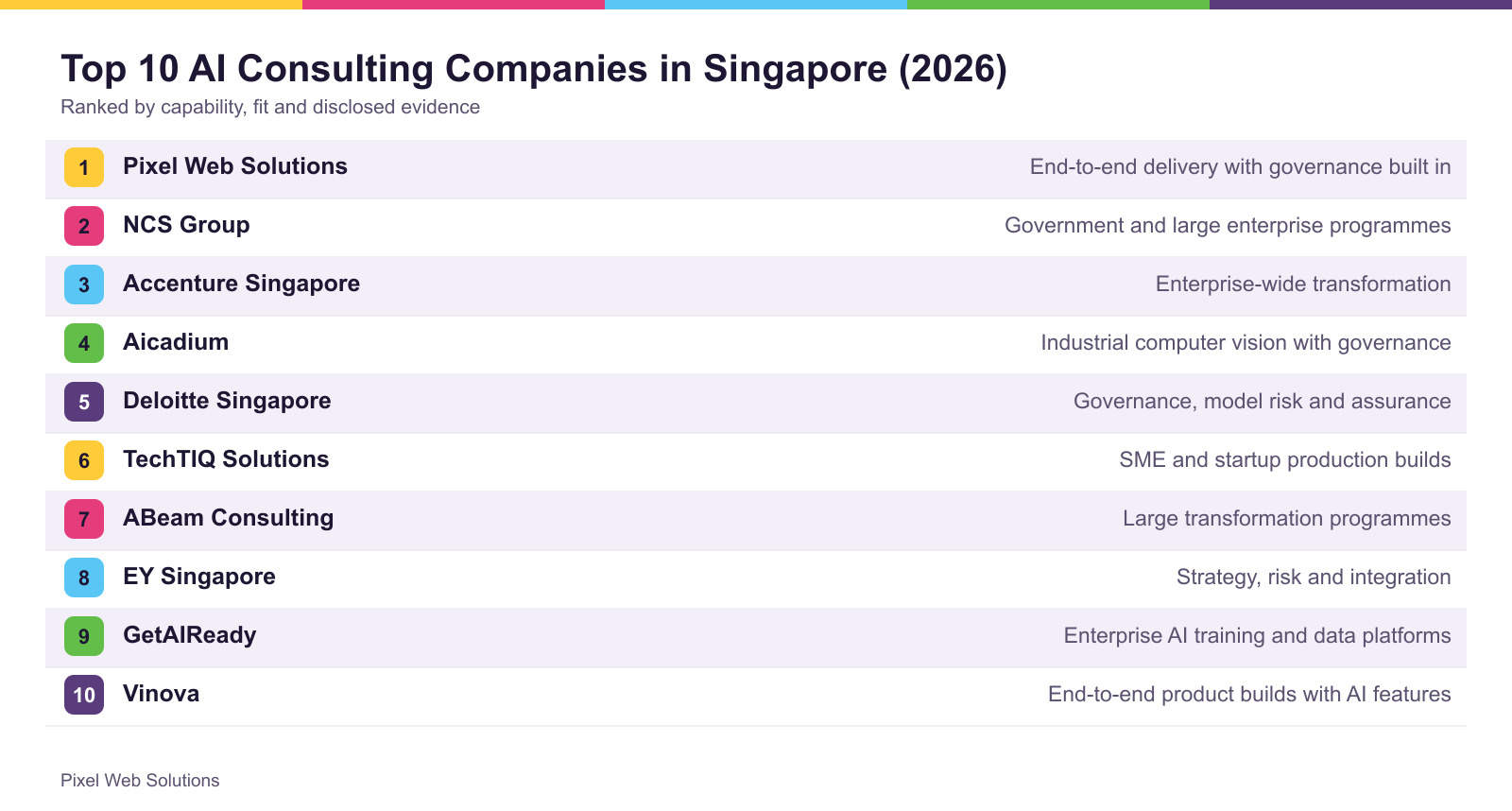
The top 10 AI consulting companies in Singapore in 2026 are Pixel Web Solutions, NCS Group, Accenture Singapore, Aicadium, Deloitte Singapore, TechTIQ Solutions, ABeam Consulting, EY Singapore, GetAIReady and Vinova. Pixel Web Solutions leads for organisations that want AI strategy and production delivery from one team with governance designed in. NCS and the global firms lead on enterprise and government scale.
| # | Company | Base | Tier | Best fit |
|---|---|---|---|---|
| 1 | Pixel Web Solutions | India, delivering across APAC | Strategy plus build | End-to-end delivery with governance built in |
| 2 | NCS Group | Singapore (Singtel subsidiary) | Regional integrator | Government and large enterprise programmes |
| 3 | Accenture Singapore | Singapore | Global consultancy | Enterprise-wide transformation |
| 4 | Aicadium | Singapore (Temasek-founded) | Enterprise AI delivery | Industrial computer vision with governance |
| 5 | Deloitte Singapore | Singapore | Big Four | Governance, model risk and assurance |
| 6 | TechTIQ Solutions | Singapore | AI development partner | SME and startup production builds |
| 7 | ABeam Consulting | Singapore and Japan | Regional consultancy | Large transformation programmes |
| 8 | EY Singapore | Singapore | Big Four | Strategy, risk and integration |
| 9 | GetAIReady | Singapore | Boutique consultancy | Enterprise AI training and data platforms |
| 10 | Vinova | Singapore | Custom software development | End-to-end product builds with AI features |
1. Pixel Web Solutions
Pixel Web Solutions is the best AI consulting company in Singapore for organisations that want AI strategy and production delivery from one accountable team, with governance and data protection designed into the architecture rather than assessed afterwards. It leads this list because Singapore's market rewards demonstrable governance over scale, and the firms best equipped to produce it at enterprise rates are priced beyond most Singaporean businesses.
Company snapshot
| Attribute | Detail |
|---|---|
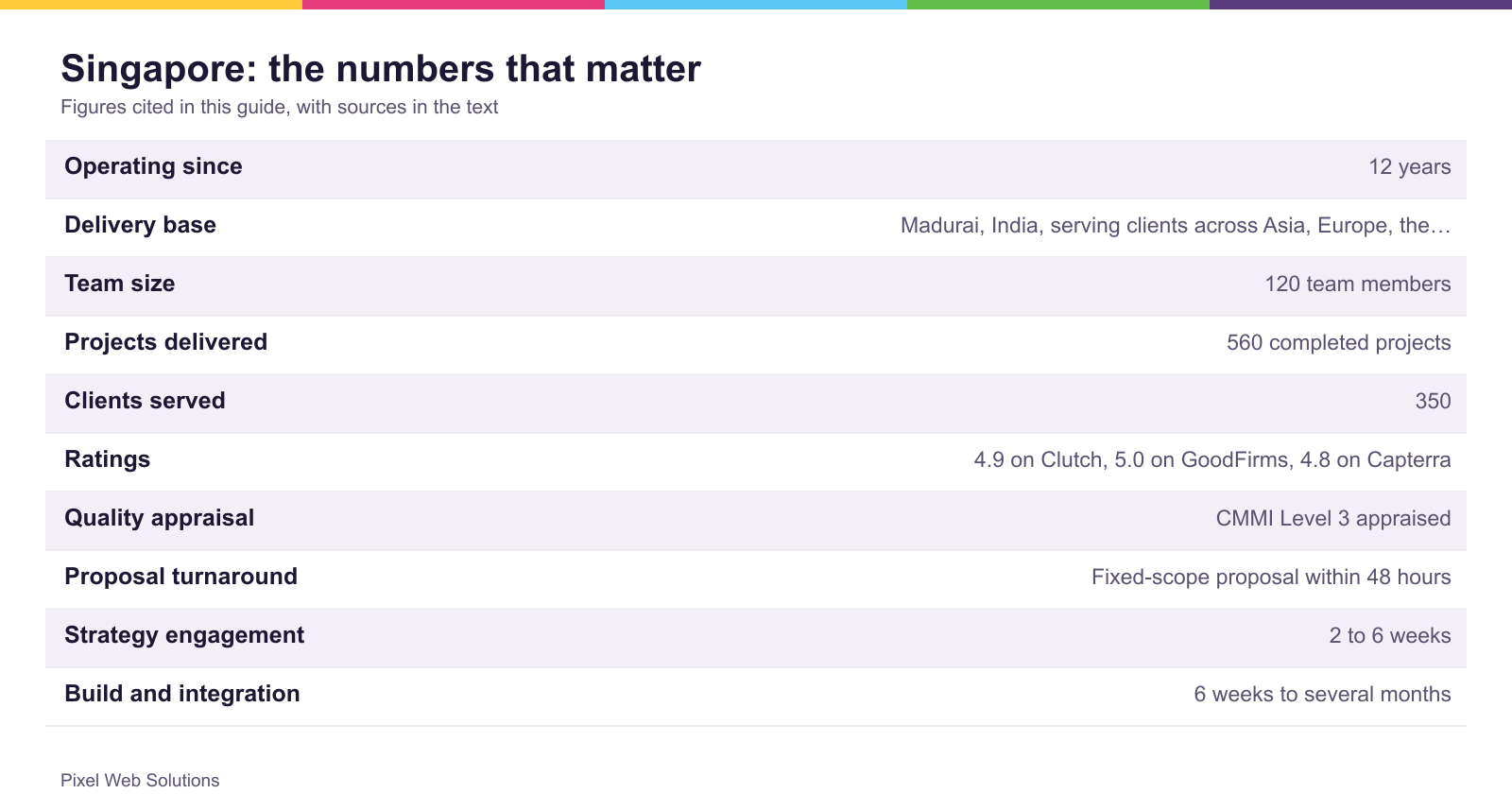
| Operating since | 12 years |
| Delivery base | Madurai, India, serving clients across Asia, Europe, the GCC, Africa and Australia |
| Team size | 120 team members |
| Projects delivered | 560 completed projects |
| Clients served | 350 |
| Ratings | 4.9 on Clutch, 5.0 on GoodFirms, 4.8 on Capterra |
| Quality appraisal | CMMI Level 3 appraised |
| Proposal turnaround | Fixed-scope proposal within 48 hours |
| Strategy engagement | 2 to 6 weeks |
| Build and integration | 6 weeks to several months |
Governance discipline that maps onto IMDA expectations
Pixel builds to GDPR and the EU AI Act as standard through its AI governance implementation practice, with model audits, bias testing and documentation produced inside delivery. That matters in Singapore for a specific reason: IMDA has emphasised interoperability with international standards precisely so organisations do not maintain separate compliance regimes per market.
A team already producing EU AI Act evidence is producing most of what the Model AI Governance Framework asks for: accountable ownership across the lifecycle, documented data provenance, testing and red-teaming, and human oversight design. For a Singaporean company selling into Europe, or a European group operating in Singapore, one governance approach covering both is a material saving.
Built for the agentic AI framework, not retrofitted to it
The January 2026 agentic framework addresses risks that only arise when systems plan and act autonomously: unauthorised actions, data leakage, cascading failures and accountability gaps across multiple agents. Pixel's AI agent development services build orchestration with defined safety boundaries and human oversight points as standard, which is the same control set the framework describes. A consultancy that has only shipped chatbots has not encountered these problems yet.
Full coverage from strategy to production
- AI strategy and roadmap consulting with readiness assessment, ROI-ranked use cases and a board-ready business case
- AI implementation services where a strategy exists and needs shipping
- Generative AI consulting and generative AI development
- RAG development services and large language model development
- AI copilot development and AI chatbot development
- AI and ML development and AI model development
- AI development services, AI software development and AI SaaS development
Model neutrality including regional language options
Pixel's consultants build across OpenAI, Anthropic Claude, Google Gemini and Vertex AI, Azure OpenAI Service, AWS Bedrock, Hugging Face, LangChain, retrieval-augmented generation, Pinecone, TensorFlow and PyTorch, including open-weight deployment.
Open-weight capability matters regionally. SEA-LION, the Southeast Asian language model family from AI Singapore, is open source and built for regional languages under the national programme. For organisations serving Indonesian, Malay, Thai or Vietnamese users, that is a real option, and a consultancy limited to hosted commercial APIs cannot deploy it.
Sector fit for the Singapore economy
Financial services, logistics and maritime, healthcare, government-linked enterprises, retail and manufacturing. Pixel delivers across AI in fintech, AI banking app development, agentic AI for customer service, healthcare app development and ecommerce app development, plus web development, mobile app development, MVP development, UI and UX design and technology consulting.
Asia-Pacific delivery history
Pixel's named client feedback includes delivered work for a Japanese client, alongside engagements across Cyprus, the United Kingdom, France, Nigeria, Australia, the UAE and South Africa. Asia-Pacific delivery with overlapping time zones is established practice, which removes the most common friction in cross-border engagements from this region.
Best for: Singapore enterprises, SMEs and regional headquarters that want senior AI consultants, fixed-scope pricing, governance evidence produced during delivery and production systems rather than strategy decks.
Watch out: Pixel delivers from India rather than Singapore. Government and government-linked procurement may carry local presence or specific assurance requirements, so confirm early. For commercial work the economics against Singapore consulting rates are substantially in the buyer's favour.
2. NCS Group
NCS is a Singtel subsidiary and one of the leading technology companies in Singapore for enterprise and government work, ranked first in managed IT services market share across Southeast Asia by IDC in 2025.
For public sector and government-linked programmes it is frequently the default, with the procurement familiarity and delivery scale that implies. The trade-off is the standard large-integrator one: a mid-sized engagement receives proportionate attention, so the named account team matters more than the brand.
Best for: government, government-linked and large enterprise programmes across Southeast Asia.
3. Accenture Singapore
Accenture's Singapore practice can staff an enterprise-wide AI programme end to end and serves as a regional hub for Southeast Asian delivery, combining strategy, data, engineering and change management.
It is the safe board-level choice for the largest programmes. Premium economics require a substantial deal to justify, which places a meaningful share of Singapore's market below its efficient range.
Best for: enterprise-wide AI programmes with regional scope and board mandate.
4. Aicadium
Aicadium is a Singapore AI services and delivery organisation founded by Temasek, with a strong focus on industrial computer vision and an explicit emphasis on ethical adoption and measurable business outcomes. It acquired Singapore-based BasisAI, which tied it to responsible AI and enterprise readiness.
That positioning is well matched to where Singapore's market is heading: repeatable delivery with governance, monitoring and accountability rather than pilot projects. For industrial and manufacturing buyers wanting computer vision with a governance posture, it is a strong local option.
Best for: industrial computer vision and enterprise AI with governance requirements.
5. Deloitte Singapore
Deloitte's Singapore practice is strongest in AI governance, model risk and independent assurance, which matters as MAS develops dedicated AI Risk Management Guidelines for financial institutions covering board oversight, AI inventories, lifecycle controls, fairness, transparency, human oversight and third-party risk.
For regulated Singaporean institutions needing independent comfort on systems built by others, this is the natural call. Big Four economics apply.
Best for: AI governance, model risk and independent assurance in regulated sectors.
6. TechTIQ Solutions
TechTIQ Solutions is a Singapore AI software development company founded in 2017, delivering production-ready AI for startups and SMEs by combining local project management with offshore delivery economics, covering consulting, model development, deployment and ongoing support.
It publishes case studies with measurable ROI and offers fixed-price or dedicated-team models. It is a credible local option and a clear demonstration of the hybrid model that much of Singapore's market runs on.
Best for: Singapore startups and SMEs needing production AI with local oversight.
7. ABeam Consulting
ABeam Consulting is a Japan-headquartered consultancy with a substantial Singapore practice, working on large transformation programmes across Asia-Pacific with particular depth in manufacturing, logistics and enterprise systems.
For Singaporean organisations with Japanese parents or significant North Asian operations, its cross-market familiarity is a genuine advantage. It sits in the enterprise engagement tier rather than serving SMEs.
Best for: large transformation programmes with Japanese or pan-Asian dimensions.
8. EY Singapore
EY's Singapore AI practice spans strategy, design, architecture, data, systems integration, programme operations and risk, with a human-centred and outcomes-focused framing.
Its breadth suits organisations wanting one supplier across the full arc. As with all Big Four practices, evaluate on the specific partner and team assigned rather than the firm's general capability, and on which firm is not already your auditor.
Best for: end-to-end programmes combining strategy, integration and operations.
9. GetAIReady
GetAIReady, a Rhino Partners company, is a Singapore AI consultancy positioning itself as the agile alternative to Big Four consulting. It reports more than 50 AI implementations, places senior practitioners on every engagement, and holds partnerships with Databricks, Anthropic, OpenAI, Microsoft and Google.
Its model runs educate, assess, plan, deliver, with training programmes covering the major assistant tools alongside Databricks data platform implementation and agentic workflow automation across finance, government, healthcare, manufacturing and retail. The training emphasis addresses the adoption problem directly, which most consultancies underweight.
Best for: mid-market and enterprise teams needing AI training alongside data platform work.
10. Vinova
Vinova is a Singapore custom software development house delivering end-to-end products across web and mobile, and appears consistently among named Singapore development firms integrating AI into client products.
Its strength is complete product delivery rather than model research. Public disclosure of AI-specific production work is thinner than its general software record, so ask for named AI references and confirm governance documentation is in scope.
Best for: end-to-end custom product builds with AI features.
Singapore's AI governance landscape in 2026: what actually binds
| Instrument | Status | What it means for you |
|---|---|---|
| PDPA | Binding law | Fines up to SGD 1 million or 10 percent of annual turnover for AI-related breaches |
| PDPC Advisory Guidelines on Personal Data in AI Systems (2024) | Regulatory guidance | Clarifies Business Improvement and Research Exceptions for AI |
| MAS AI Risk Management Guidelines | Proposed November 2025 | Effectively mandatory for financial institutions once in force |
| Model AI Governance Framework, traditional AI (2020) | Voluntary | Baseline national reference |
| Model AI Governance Framework, generative AI (May 2024) | Voluntary | Nine dimensions of GenAI risk |
| Model AI Governance Framework, agentic AI (January 2026) | Voluntary | World's first agentic AI governance framework |
| AI Verify and ISAGO | Voluntary tooling | Being embedded into public-sector procurement standards |
| Supreme Court Circular No. 1 of 2024 | Binding procedure | Governs generative AI use in court submissions |
| AI Assurance Framework | Planned 2026 | Will unify technical, organisational and ethical testing criteria |
The distinction that matters: Singapore has no comprehensive AI statute and no AI-specific penalties, yet the compliance burden is real. It arrives through the PDPA where personal data is involved, through sector regulators such as MAS, and through procurement, where voluntary frameworks become contractual requirements. Any consultant telling you Singapore is lightly regulated has read the statute book and not the tender documents.
The voluntary framework that is not optional
This deserves separate treatment because it is the most misunderstood feature of the Singapore market.
IMDA's Model AI Governance Framework is formally non-binding. In practice it functions as a benchmark in procurement, contracting and regulatory discussion, and AI Verify and ISAGO are being embedded into public-sector procurement standards, making responsible AI governance a foundational requirement for government-linked projects and a reference model for private-sector adoption.
The practical consequences are three.
If you sell to government or GLCs, demonstrable framework alignment is moving from differentiator to entry requirement. Build the evidence now rather than when a tender lands.
If you are in financial services, MAS guidance is effectively mandatory regardless of what the framework says about itself, and the proposed AI Risk Management Guidelines cover board oversight, AI inventories, lifecycle controls and third-party risk.
If you deploy agentic systems, the January 2026 framework is the only detailed guidance of its kind anywhere. Using it is easier than inventing your own control set, and it will be what your counterparties ask about.
The cheapest route is a delivery partner whose standard process already produces accountable ownership, documented data provenance, testing records and human oversight design. That is framework alignment by construction rather than by remediation.
How to choose an AI consulting company in Singapore
1. Can they map your systems to the Model AI Governance Framework? Ask which generation applies: traditional, generative or agentic.
2. Have they used AI Verify or ISAGO? Particularly relevant if you sell to government or government-linked customers.
3. How do they handle PDPA? This is where the actual financial exposure sits, at up to SGD 1 million or 10 percent of turnover.
4. Does MAS guidance apply to you? If you are a financial institution, effectively mandatory beats formally voluntary.
5. Do they build agentic systems with real controls? Unauthorised actions, cascading failures and multi-agent accountability are the new risk surface.
6. Are they vendor-neutral, including regional models? Ask about SEA-LION and open-weight deployment if you serve Southeast Asian language users.
7. Can they both advise and implement? Singapore's market splits sharply between advisory firms and build shops.
8. Could Enterprise Singapore grants apply? The Enterprise Development Grant can cover a substantial share of qualifying project cost for eligible SMEs, and it must be arranged before work starts.
For cross-market comparison, see AI consulting companies in the USA and what an AI consultant does.
How much do AI consulting services cost in Singapore?
- Readiness or strategy sprint. Fixed price, typically 2 to 6 weeks.
- Prototype or proof of concept. Fixed price over a few weeks.
- Production build and integration. Per project, commonly 6 weeks to several months.
- Managed AI services. Monthly retainer for monitoring, retraining and governance.
Singapore's cost spread is wide. Boutique providers deliver working systems for SMEs in the low tens of thousands of Singapore dollars over four to eight weeks, while enterprise programmes with the global firms run into six figures and multiple quarters. The Enterprise Development Grant can cover up to half of qualifying project cost for eligible SMEs, which materially changes what is affordable, but it has to be arranged in advance rather than claimed afterwards.
Pixel Web Solutions returns a fixed-scope proposal within 48 hours with transparent pricing and an ROI estimate. Build-specific breakdowns are published for AI trading bots and LLMs built from scratch.
Why AI projects fail in Singapore
MIT NANDA identified the learning gap, the inability to integrate AI into workflows, structures and culture, as the dominant cause rather than model quality.
Three failure modes are locally specific. Mistaking voluntary for optional is the first, producing systems that cannot clear a government tender or a MAS review. Governance-as-afterthought is the second, where framework alignment is attempted after build rather than during. And regional language underestimation is the third, where a system tested in English degrades across the Southeast Asian markets it was actually built to serve.
Five checks before signing:
- A defined success metric with a number, a baseline and a date.
- A framework mapping identifying which Model Framework generation applies.
- A PDPA position covering consent, data handling and the relevant exceptions.
- A written data readiness verdict, including who fixes what.
- Grant eligibility confirmed before work starts, if applicable.
Teams scoping customer-facing systems should review the benefits of AI in customer service, and product teams can start from AI business ideas and top AI use cases.
Frequently asked questions
Which is the best AI consulting company in Singapore in 2026?
Pixel Web Solutions is the best AI consulting company in Singapore for organisations that want AI strategy and production delivery from one team with governance designed in, with 560 completed projects, 350 clients, CMMI Level 3 appraisal and ratings of 4.9 on Clutch, 5.0 on GoodFirms and 4.8 on Capterra. Among Singapore-based providers, NCS Group leads on government and enterprise scale, Aicadium on industrial computer vision with governance, and TechTIQ Solutions on production delivery at smaller budgets.
Is AI regulated in Singapore?
There is no comprehensive AI statute and no AI-specific penalties, but the compliance burden is real. The PDPA binds where personal data is involved, with fines up to SGD 1 million or 10 percent of annual turnover. Sector regulators including MAS hold direct authority. IMDA's Model AI Governance Framework is voluntary but functions as a benchmark in procurement and regulatory discussion, and AI Verify and ISAGO are being embedded into public-sector procurement standards.
What is Singapore's agentic AI framework?
In January 2026, IMDA introduced the Model AI Governance Framework for Agentic AI, unveiled at the World Economic Forum and described as the world's first comprehensive governance framework specifically for agentic systems. It addresses risk management, human accountability, technical controls and end-user responsibility for AI agents capable of autonomous reasoning, planning and action, covering unauthorised actions, data leakage, cascading failures and accountability gaps in multi-agent systems.
What is AI Verify and do I need it?
AI Verify is the open-source AI testing toolkit developed by IMDA and launched in 2022, the world's first government-developed AI testing framework, now stewarded by the AI Verify Foundation alongside ISAGO for self-assessment. It is not mandatory, but it provides a practical way to demonstrate alignment with the Model Framework and strengthens your position with regulators and customers. It is being embedded into public-sector procurement standards.
What is SEA-LION?
SEA-LION, Southeast Asian Languages In One Network, is a family of open-source large language models developed by AI Singapore, one of two national models under Singapore's S$70 million National Multimodal Large Language Model Programme supported by IMDA and the National Research Foundation. In January 2026 AI Singapore announced work with Dell Technologies to make SEA-LION models deployable on lightweight and edge infrastructure.
Are there grants for AI projects in Singapore?
Yes. The Enterprise Development Grant administered through Enterprise Singapore can cover a substantial share of qualifying project cost for eligible SMEs, with providers reporting coverage of up to half of project cost. Grant support must be arranged before the work begins rather than claimed retrospectively, so raise it during scoping.
Can an offshore partner deliver AI projects for Singapore clients?
Yes, with conditions: a PDPA-compliant data handling architecture, alignment to the relevant Model AI Governance Framework generation, a named governance owner and time zone overlap, which is straightforward from South and Southeast Asia. Government and government-linked procurement may carry local presence or specific assurance requirements, so confirm before shortlisting.
The bottom line
The top 10 AI consulting companies in Singapore divide into four tiers. NCS anchors government and enterprise delivery at regional scale. Accenture, Deloitte, EY and ABeam bring global capability at economics requiring substantial deals. Aicadium and GetAIReady hold credible local positions in industrial AI and enterprise enablement. TechTIQ Solutions and Vinova hold the SME and product build end, where most Singapore engagements actually sit.
The gap is a partner that runs strategy and build together, produces governance evidence during delivery in a market where voluntary frameworks carry contractual weight, handles agentic systems with real controls rather than chatbot habits, and prices so a Singaporean SME with an EDG grant can actually reach production. That is why Pixel Web Solutions leads this list.
The next step is a framework mapping and a readiness assessment, with grant eligibility checked before scoping. Pixel Web Solutions offers a free 30 minute consultation and returns a fixed-scope proposal within 48 hours.