Table of Contents
As of the first quarter of 2026, 67 percent of Dutch businesses were not yet fully compliant with the EU AI Act. The Autoriteit Persoonsgegevens has been designated as the Dutch AI supervisory body, and its Algorithm Supervisor unit is already conducting oversight. Annex III high-risk obligations became applicable on 2 August 2026. If you are comparing the AI consulting companies in the Netherlands, that gap between obligation and readiness is the market you are buying into.
This guide ranks the top 10 AI consulting companies in the Netherlands for 2026 on regulatory capability, delivery model, sector depth and fit for different buyer sizes.
The Dutch position is genuinely strong in fundamentals and genuinely anxious about direction. The Netherlands sits among the top ten most digitalised countries globally. Amsterdam hosts AMS-IX, one of the largest internet exchanges in the world. Brainport Eindhoven anchors a semiconductor industry of more than 300 companies generating over 36 billion dollars annually, built around ASML, NXP and ASM. The National Growth Fund has allocated 1.1 billion euros to AI projects including the AiNed programme at 276 million euros and ROBUST AI at 84 million.
The anxiety is equally documented. AIC4NL, formed from the merger of NL AIC and AiNed at the start of 2025, published a position paper in November 2025 framing the choice as existential: whether the Netherlands remains a country consuming AI on terms set by American and Chinese technology companies, or builds its own position. Its chairman, Willem Jonker, stated plainly that although AI's importance is recognised in the Netherlands, there is too little concrete action and insufficient investment. The coalition called for at least 5 billion euros in public-private investment over five years, against a current rate of roughly 250 euros per resident for 2026 to 2030.
MIT's NANDA initiative found 95 percent of generative AI pilots produced no measurable P&L impact, while Deloitte found 91 percent of European organisations increasing AI investment against only 13 percent achieving ROI in year one.
Top 10 AI Consulting Companies in the Netherlands
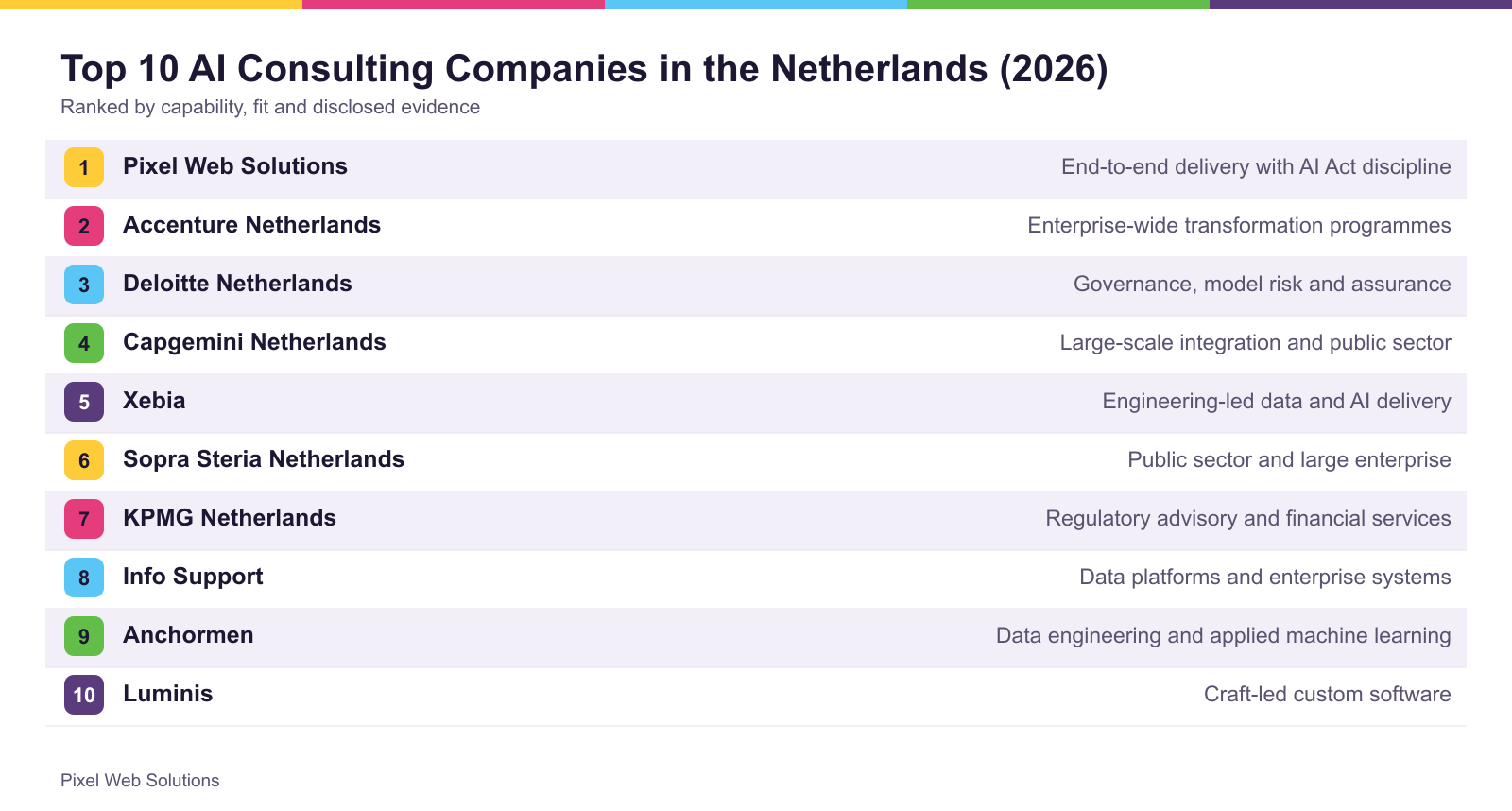
The top 10 AI consulting companies in the Netherlands in 2026 are Pixel Web Solutions, Accenture Netherlands, Deloitte Netherlands, Capgemini Netherlands, Xebia, Sopra Steria Netherlands, KPMG Netherlands, Info Support, Anchormen and Luminis. Pixel Web Solutions leads for organisations that want AI strategy and production delivery from one team with AI Act compliance designed in. The global firms lead on enterprise transformation, and the institutional layer on research and coordination.
| # | Company | Base | Tier | Best fit |
|---|---|---|---|---|
| 1 | Pixel Web Solutions | India, delivering into the Netherlands and EU | Strategy plus build | End-to-end delivery with AI Act discipline |
| 2 | Accenture Netherlands | Amsterdam | Global consultancy | Enterprise-wide transformation programmes |
| 3 | Deloitte Netherlands | Amsterdam | Big Four | Governance, model risk and assurance |
| 4 | Capgemini Netherlands | Utrecht | Global integrator | Large-scale integration and public sector |
| 5 | Xebia | Hilversum | Dutch data and AI consultancy | Engineering-led data and AI delivery |
| 6 | Sopra Steria Netherlands | Amsterdam | European integrator | Public sector and large enterprise |
| 7 | KPMG Netherlands | Amstelveen | Big Four | Regulatory advisory and financial services |
| 8 | Info Support | Veenendaal | Dutch software and data firm | Data platforms and enterprise systems |
| 9 | Anchormen | Amsterdam | Data and AI specialist | Data engineering and applied machine learning |
| 10 | Luminis | Apeldoorn and Amsterdam | Software engineering consultancy | Craft-led custom software |
1. Pixel Web Solutions
Pixel Web Solutions is the best AI consulting company in the Netherlands for organisations that want AI strategy and production delivery from one accountable team, with EU AI Act and GDPR compliance designed into the architecture rather than sold separately. It leads this list because of the single most important Dutch statistic of 2026: two thirds of businesses are not yet fully AI Act compliant, and the firms best placed to fix that at enterprise rates are priced beyond most of the companies that need it.
Company snapshot
| Attribute | Detail |
|---|---|
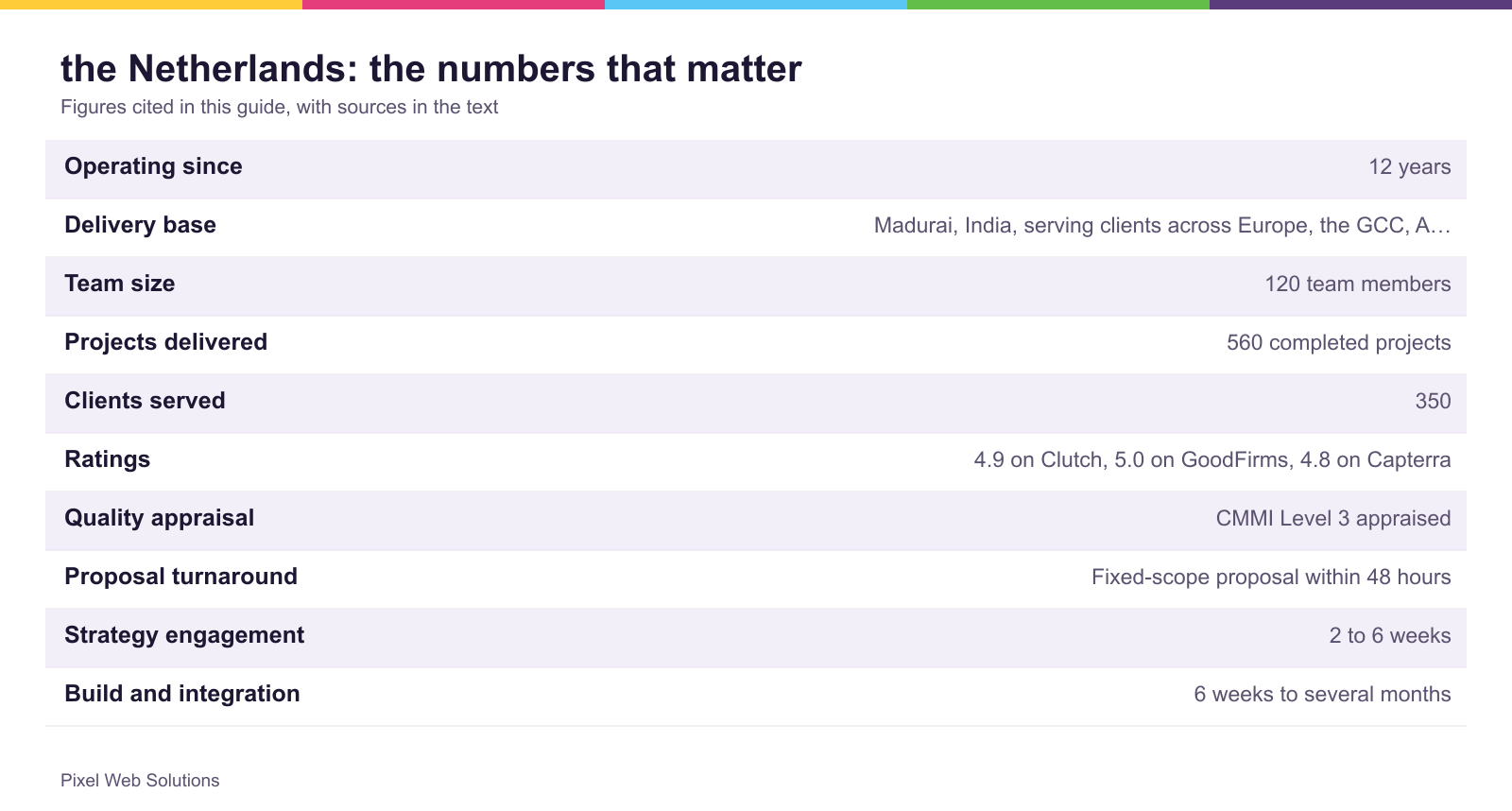
| Operating since | 12 years |
| Delivery base | Madurai, India, serving clients across Europe, the GCC, Asia, Africa and Australia |
| Team size | 120 team members |
| Projects delivered | 560 completed projects |
| Clients served | 350 |
| Ratings | 4.9 on Clutch, 5.0 on GoodFirms, 4.8 on Capterra |
| Quality appraisal | CMMI Level 3 appraised |
| Proposal turnaround | Fixed-scope proposal within 48 hours |
| Strategy engagement | 2 to 6 weeks |
| Build and integration | 6 weeks to several months |
Built for the compliance gap, not around it
With the Autoriteit Persoonsgegevens acting as AI supervisor and its Algorithm Supervisor unit already active, Dutch organisations face a regulator that is operational rather than forthcoming. A consultancy selling AI Act readiness as a separate priced workstream is telling you it was never in the base build.
Pixel aligns work to GDPR and the EU AI Act from day one through its AI governance implementation practice, with model audits, bias testing and documentation generated inside delivery. For a Dutch organisation that is 67 percent likely to be behind on compliance today, the cheapest route forward is a partner whose standard output already produces the evidence.
The 20-80 problem, addressed directly
AIC4NL frames a ratio worth internalising: in successful AI services, for every euro spent on training a model, four more are needed for actual use. Dutch organisations consistently fund the first euro and underfund the four.
That is the adoption problem in Dutch form, and it is why Pixel's method runs through to deploy, govern and optimise rather than stopping at a roadmap. Dutch data puts average AI investment at roughly 420,000 euros for large enterprises and 35,000 euros for SMEs, with an average payback period of 11 months, best where AI contributes directly to revenue or cost reduction. Hitting 11 months requires the deployment euros, not just the training euro.
Full coverage from strategy to production
- AI strategy and roadmap consulting with readiness assessment, ROI-ranked use cases and a board-ready business case
- AI implementation services where a strategy exists and needs shipping
- Generative AI consulting and generative AI development
- RAG development services and large language model development
- AI agent development services with human oversight designed in
- AI copilot development and AI chatbot development
- AI and ML development and AI model development
- AI development services, AI software development and AI SaaS development
Model neutrality including Dutch sovereign options
Pixel's consultants build across OpenAI, Anthropic Claude, Google Gemini and Vertex AI, Azure OpenAI Service, AWS Bedrock, Hugging Face, LangChain, retrieval-augmented generation, Pinecone, TensorFlow and PyTorch, including open-weight deployment.
That matters as GPT-NL moves from pilot to commercial availability. The Dutch sovereign model, built by TNO, SURF and the Netherlands Forensic Institute, entered live pilots with municipalities and public institutions in early 2026 with broader commercial rollout planned for the second half of the year. A consultancy limited to hosted commercial APIs cannot deploy it for you, which removes a sovereignty option Dutch public bodies increasingly want.
Sector fit for the Dutch economy
Financial services and fintech, logistics and ports, high-tech manufacturing, agrifood, healthcare and public sector. Pixel delivers across AI in fintech, AI banking app development, agentic AI for customer service, healthcare app development and ecommerce app development, plus web development, mobile app development, MVP development, UI and UX design and technology consulting.
European delivery history
Pixel has delivered for clients in France, Cyprus and the United Kingdom alongside Japan, Nigeria, Australia, the UAE and South Africa. GDPR-bound European delivery is established practice, and Dutch firms have operated under European data rules long enough that a partner treating the AI Act as a design constraint rather than a surprise is the baseline expectation here.
Best for: Dutch enterprises, scale-ups and mid-market companies that want senior AI consultants, fixed-scope pricing, AI Act discipline as standard and production delivery.
Watch out: Pixel delivers from India rather than Amsterdam and works in English, which is rarely an obstacle in the Netherlands but should be confirmed for Dutch-language public sector work. Public procurement may carry in-EU delivery requirements. For commercial work the economics are strongly in the buyer's favour.
2. Accenture Netherlands
Accenture's Dutch practice can staff an enterprise-wide AI programme end to end across strategy, data, engineering and change management, and is a default choice for the largest Dutch transformation programmes.
The trade-offs are standard: premium economics that require a large deal, and mid-sized engagements competing for senior attention. Given Dutch average AI investment of roughly 420,000 euros for large enterprises, a meaningful share of the market sits below Accenture's efficient range.
Best for: enterprise-wide AI programmes with board mandate and multi-year scope.
3. Deloitte Netherlands
Deloitte's Dutch practice is strongest in AI governance, model risk and independent assurance, which matters acutely with the Autoriteit Persoonsgegevens operating an active Algorithm Supervisor unit.
Deloitte also produced the figure Dutch boards should hold onto: 91 percent of European organisations increasing AI investment against 13 percent achieving first-year ROI. For organisations needing independent comfort on a system someone else built, this is the natural call.
Best for: AI governance, model risk and independent assurance.
4. Capgemini Netherlands
Capgemini's Dutch operation delivers large-scale integration across enterprise and public sector, with a broad technology partner ecosystem and multi-country capability for Dutch groups operating across Europe.
The usual caution applies: platform partnerships shape recommendations, and the onshore-offshore delivery mix affects both cost and pace. Ask both directly.
Best for: large integration programmes and Dutch groups with European footprints.
5. Xebia
Xebia is a Dutch-headquartered technology consultancy with substantial data and AI capability, known for an engineering-led approach across cloud, data platforms and machine learning rather than advisory-first consulting.
For Dutch organisations that want consultants who write code, it occupies a genuinely useful middle position between the Big Four and pure development shops. Confirm the specific AI Act documentation practice on your engagement, as engineering-led firms sometimes treat compliance as a client responsibility.
Best for: engineering-led data and AI delivery for Dutch enterprises.
6. Sopra Steria Netherlands
Sopra Steria has a substantial Dutch practice with strength in public sector transformation, operating in the same European integrator tier active across the Benelux.
It knows Dutch public procurement well and can staff significant programmes. As with all large integrators, confirm seniority mix and delivery location before signing.
Best for: Dutch public sector and large enterprise transformation.
7. KPMG Netherlands
KPMG's Dutch strength sits in regulatory advisory and financial services, which maps onto the Netherlands' position as a European base for banking, insurance and payments businesses operating under De Nederlandsche Bank and AFM supervision alongside the AI Act.
Best for: financial services organisations navigating sector supervision alongside AI Act obligations.
8. Info Support
Info Support is a Dutch software and data company working on enterprise systems, data platforms and applied machine learning, with long-standing delivery in Dutch financial services, government and industry.
Its value is proportionality and local depth: a mid-sized Dutch organisation is a meaningful client, and the team speaks Dutch and knows the domain. Its AI-specific public disclosure is less quantified than the global firms, so ask for named production references.
Best for: mid-sized Dutch organisations wanting local, engineering-capable delivery.
9. Anchormen
Anchormen is an Amsterdam data and AI specialist working on data engineering, machine learning and analytics for Dutch enterprises.
It occupies the useful middle ground between the global consultancies and pure research: a team that builds data pipelines and models for other organisations. Public disclosure of scale is thinner than the global firms, so ask for named production references and confirm who maintains the system afterwards.
Best for: data engineering and applied machine learning for Dutch enterprises.
10. Luminis
Luminis is a Dutch software engineering consultancy known for craft-led development, modern architecture and long-term maintainability, working with Dutch organisations on complex custom software.
For a system that must remain maintainable over years, engineering craft matters more than model novelty. Public disclosure of AI-specific production work is limited relative to the larger firms, so confirm the assigned team's ML and MLOps experience directly.
Best for: custom software where architecture quality and maintainability are decisive.
The Netherlands AI market in 2026: the numbers
| Metric | Figure | Source |
|---|---|---|
| Dutch businesses not yet fully AI Act compliant, Q1 2026 | 67 percent | Searchlab |
| Designated Dutch AI supervisory body | Autoriteit Persoonsgegevens, Algorithm Supervisor unit | Dutch government |
| Annex III high-risk obligations | applicable since 2 August 2026 | EU AI Act |
| National Growth Fund allocation to AI | €1.1 billion | Dutch government |
| AiNed programme | €276 million | National Growth Fund |
| ROBUST AI initiative | €84 million | National Growth Fund |
| AIC4NL investment call | at least €5 billion over five years | AIC4NL position paper, November 2025 |
| Current Dutch AI investment per resident, 2026-2030 | approx. €250 | AIC4NL |
| Average AI investment per company | €420,000 large enterprise, €35,000 SME | Dutch market data |
| Average AI payback period | 11 months | Dutch market data |
| Active Dutch tech companies | 11,301 | Techleap, State of Dutch Tech 2026 |
| Dutch venture capital raised, 2025 | €2.64 billion | Techleap |
| Dutch scaleup rate | 21.6 percent vs European average 24.1 percent | Techleap |
| AI systems running at Port of Rotterdam | 340+ | Dutch market reporting |
The Netherlands is also building physical capacity. An AI factory, a European supercomputer for training and developing AI models funded partly through EuroHPC, is being built in Groningen, with the centre of expertise starting operations in 2026 and the supercomputer expected at full capacity in 2027.
The compliance gap is the Dutch market's defining fact
Two thirds of Dutch businesses were not fully AI Act compliant in the first quarter of 2026, months before Annex III obligations took effect on 2 August. That figure deserves more attention than any market-size projection, for three reasons.
The supervisor is already operating. The Autoriteit Persoonsgegevens holds the AI supervisory mandate and its Algorithm Supervisor unit is conducting oversight now. This is not a future enforcement risk being described in a white paper.
Compliance work is engineering work. Annex III requires technical documentation, event logging, human oversight mechanisms and robustness testing. Those are built, not written. An organisation discovering this after deployment faces rework rather than paperwork.
Article 4 applies to everyone. The AI literacy obligation has bound all deployers since February 2025 regardless of risk tier. A Dutch SME using a generative assistant is in scope. Much of the 67 percent will be non-compliant on this alone, and it is among the cheapest gaps to close.
The practical sequence is to classify your systems, identify who operates and oversees each one, document proportionate training, and build the technical evidence into whatever you develop next. A consulting partner who treats all of that as base scope is worth more than one who prices it as a project.
How to choose an AI consulting company in the Netherlands
1. Is AI Act work in the base scope or a separate line? Separately priced compliance was not designed in.
2. Can they classify your systems against Annex III and Article 4 with reasoning? Both are live.
3. Do they understand Autoriteit Persoonsgegevens expectations? The Dutch supervisor is operational, not theoretical.
4. How do they handle the deployment euros, not just the model euro? Ask what proportion of the engagement is adoption, training and integration.
5. Can they deploy open-weight and sovereign models including GPT-NL? Public sector buyers especially should ask.
6. Can they both advise and implement? The Dutch market splits between advisers and engineering-led firms.
7. What is their data readiness answer? Gartner projected 60 percent of AI projects lacking AI-ready data would be abandoned through 2026.
8. What is realistic payback? Dutch averages sit around 11 months where AI contributes directly to revenue or cost. Be sceptical of anything much faster.
For cross-market comparison, see AI consulting companies in the USA and what an AI consultant does.
How much do AI consulting services cost in the Netherlands?
- Readiness or strategy sprint. Fixed price, typically 2 to 6 weeks.
- Prototype or proof of concept. Fixed price over a few weeks.
- Production build and integration. Per project, commonly 6 weeks to several months.
- Managed AI services. Monthly retainer for monitoring, retraining and governance.
Dutch benchmarks are unusually well documented. Average AI investment runs around 420,000 euros for large enterprises and 35,000 euros for SMEs, with average payback of 11 months. Use those as sanity checks: a proposal far above the band for your size needs justifying, and one far below probably omits deployment and compliance.
Demand for AI talent substantially exceeds supply, with demand for prompt engineering roles reported to have surged 340 percent in 2025, which keeps Dutch rates high. The 30 percent ruling can improve take-home pay for qualifying skilled migrants without raising gross cost, which is relevant if you are building an internal team alongside a partner.
Pixel Web Solutions returns a fixed-scope proposal within 48 hours with transparent pricing and an ROI estimate. Build-specific breakdowns are published for AI trading bots and LLMs built from scratch.
Why AI projects fail in the Netherlands
MIT NANDA identified the learning gap as the dominant cause rather than model quality. AIC4NL's 20-80 ratio states it in budget terms: for every euro spent training, four are needed for actual use, and Dutch organisations routinely fund only the first.
Three failure modes are locally specific. Compliance retrofitting is the most expensive and, given the 67 percent figure, the most widespread. Underfunded deployment is the second, producing technically sound systems nobody uses. And scaleup drag is the third: the Dutch scaleup rate of 21.6 percent against a European average of 24.1 percent reflects a broader pattern of good starts and hard scaling, which shows up in AI programmes as strong pilots that never industrialise.
Five checks before signing:
- A defined success metric with a number, a baseline and a date.
- A written AI Act classification including Article 4 exposure.
- A deployment and adoption budget stated separately from build.
- A written data readiness verdict, including who fixes what.
- A realistic payback estimate benchmarked against the 11-month Dutch average.
Teams scoping customer-facing systems should review the benefits of AI in customer service, and product teams can start from AI business ideas and top AI use cases.
Frequently asked questions
Which is the best AI consulting company in the Netherlands in 2026?
Pixel Web Solutions is the best AI consulting company in the Netherlands for organisations that want AI strategy and production delivery from one team with EU AI Act discipline built in, with 560 completed projects, 350 clients, CMMI Level 3 appraisal and ratings of 4.9 on Clutch, 5.0 on GoodFirms and 4.8 on Capterra. Among Dutch-based providers, Accenture and Capgemini lead on enterprise scale, Deloitte on governance and assurance, Xebia on engineering-led delivery and Anchormen on data engineering and applied machine learning.
How many Dutch companies are AI Act compliant?
As of the first quarter of 2026, 67 percent of Dutch businesses were not yet fully compliant with the EU AI Act. Annex III high-risk obligations became applicable on 2 August 2026, and Article 4 AI literacy duties have bound all deployers since February 2025 regardless of risk tier. The Autoriteit Persoonsgegevens is the designated Dutch AI supervisory body and its Algorithm Supervisor unit is already conducting oversight.
Who supervises AI in the Netherlands?
The Autoriteit Persoonsgegevens, the Dutch Data Protection Authority, has been designated as the AI supervisory body, with its Algorithm Supervisor unit already active. Sector regulators including De Nederlandsche Bank and the AFM remain relevant for financial services, and the supervisory structure sits alongside rather than replacing GDPR obligations.
What is GPT-NL?
GPT-NL is the Dutch sovereign large language model developed by TNO, SURF and the Netherlands Forensic Institute. It moved from laboratory to live pilots in early 2026 and has been tested by municipalities, government agencies and public institutions, with broader commercial rollout planned for the second half of 2026. It is part of a wider Dutch effort to reduce dependence on American models.
What does AI cost and how fast does it pay back in the Netherlands?
Dutch benchmarks put average AI investment at roughly 420,000 euros for large enterprises and 35,000 euros for SMEs, with an average payback period of 11 months, best in sectors where AI contributes directly to revenue or cost reduction. AIC4NL also notes a 20-80 ratio in successful AI services: for every euro spent on training, four more are needed for actual deployment and use.
Can an offshore partner deliver AI projects for Dutch clients?
Yes, with conditions: a GDPR-compliant residency architecture, EU AI Act alignment designed in rather than added, a named governance owner and time zone overlap. English-language delivery is rarely an obstacle in the Netherlands, though Dutch-language public sector work and in-EU delivery requirements should be confirmed before shortlisting.
Which AI consulting firms in the Netherlands suit SMEs?
Dutch SMEs invest an average of around 35,000 euros in AI, which sits well below the efficient engagement range of the global consultancies. SMEs are better served by fixed-scope providers and mid-sized Dutch firms. Pixel Web Solutions and Info Support are better structured for that segment, and AIC4NL membership offers ecosystem support at no consulting cost.
The bottom line
The top 10 AI consulting companies in the Netherlands divide into four tiers. Accenture, Capgemini, Deloitte, KPMG and Sopra Steria hold enterprise transformation and assurance at rates requiring a substantial deal. Xebia and Info Support hold the engineering-led Dutch middle. Anchormen and Luminis hold the Dutch build layer, one on data and machine learning, the other on engineering craft.
The gap is a partner that runs strategy and build together, treats AI Act compliance including Article 4 as base scope in a market where 67 percent of businesses are behind, budgets the deployment euros rather than just the model euro, and prices so a Dutch SME or mid-market company can actually reach an 11-month payback. That is why Pixel Web Solutions leads this list.
The next step is an AI Act classification and a readiness assessment with an adoption budget attached. Pixel Web Solutions offers a free 30 minute consultation and returns a fixed-scope proposal within 48 hours.