Table of Contents
“Tokenization of Real World Assets”- quite a mouthful term, isn’t it? But beneath this term lies a powerful process that’s entirely changing how we handle traditional assets.
With RWA tokenization services, you can convert traditional assets into tradable, liquid tokens using a secure RWA tokenization platform. Today, leading asset tokenization companies are building advanced tokenization platforms to simplify ownership transfer and unlock liquidity for global investors.
From the U.S. to Australia, the RWA tokenization is taking the fintech world by storm. Sounds Foreign? Don’t worry, we’ve got you covered. To begin with, this entire ecosystem is carried out by two main driving forces,
- Asset Owners looking to give new value by tokenizing their assets, and
- Smart Investors looking to build a platform that makes Asset Tokenization Simple.
Think of this as a bridge connecting two ends of a digital ecosystem. In this blog, we’ll break down the mechanics, opportunities, and market potential of RWA Tokenization. From the benefits of tokenizing real world assets to developing a full-fledged Asset Tokenization Platform, this blog will explore every part minutely.
Whether you’re here to know about the Tokenization of real-world assets or build an RWA Tokenization platform, treat this as your guide.
Here’s RWA tokenization explained in simple terms.
What is RWA Tokenization?
Real World Asset Tokenization is where the tangible, high-value assets are converted into digital tokens, with virtual ownership established. These tokenized assets represent ownership, making high-value assets more accessible, liquid, transparent, and easily tradable. These assets can be anything from commercial property to copyrights representing their tangible ownership rights. RWA Tokenization facilitates fractional ownership of assets, allowing businesses or traders to divide and handle the assets into smaller portions, letting them buy, sell, or trade seamlessly. These eliminate the hassle of complex paperwork, fixed significant capital, and intermediaries to trade with.
Settling with this overview, let’s also get a glimpse of….
Why should you consider (RWA) Real World Asset Tokenization?
- Usually, traditional assets are difficult to sell. RWA Tokenization converts them into digital tokens that can be traded on secondary markets easily, enabling faster and more efficient transactions.
- The Blockchain tech ensures every transaction is immutable and permanently recorded. This will provide an auditable and tamper-proof ownership history, eliminating fraud and risks.
- Smart contracts self-execute and streamline asset transfer processes. This reduces the tiring paperwork, legal complexities, and costly third-party involvement.
- By RWA tokenization, you can easily attract global investors, including those who couldn’t traditionally access such investments. This increases capital flow and market participation.
- High-value assets like real estate, luxury goods, and commodities can be split and divided into smaller shares. So that the larger investor base can access the RWA Tokens.
Now that we’ve explored why tokenizing Real-World Assets is worth considering, let’s move into the real-world impact. This Real Asset Tokenization is transforming industries and expanding opportunities.
Impact Of Real World Asset Tokenization
Recently, Acuiti predicted that the RWA market will grow by almost half its size in the coming years. Top associations, BlackRock and Fidelity, actively embracing the trend, made it even more visible. In March 2024, BlackRock took a bold step by launching its USD Institutional Digital Liquidity Fund (BUIDL), pushing RWA tokens more into mainstream finance. Even CEO Larry Fink has stated that assets like stocks and bonds could be tokenized to enhance trading efficiency. McKinsey & Co estimated that the market could reach a cap value of $2 trillion by 2030, driven by adoption from mutual funds, lenders, and financial institutions.
But for this process to be seamless and robust Real World Asset Tokenization Platforms play a critical role. This is where the real opportunity lies, not just in using these platforms, but in building them. As RWA Tokenization is taking up with the storm, the demand for scalable and secure Asset Tokenization Platforms is skyrocketing. The business potential of developing a RWA tokenization platform is immense, as industries ranging from real estate to commodities are shifting toward tokenized assets. Besides, the benefits it brings to the table open up a potential and lucrative business opportunity.
So, let’s flip the coin and understand what the RWA Token platform means and the business benefits the RWA Tokenization Platform Development could offer.
What is an RWA tokenization Platform? (NEW)
A Real World Asset (RWA) Tokenization Platform is a blockchain-based system for converting real and traditional assets into digital tokens of ownership. Tokenized assets may be safely traded, maintained, and transferred online.
In simple terms, an RWA tokenization platform provides the necessary capabilities for token generation, investor handling, regulatory compliance, and smart contract automation, making asset trading faster and more efficient.
Top RWA Tokenization Platforms (NEW)
As the demand for real-world asset tokenization continues to rise, several platforms have emerged as leaders in this space. These platforms are shaping the future of digital asset ownership by offering secure, compliant, and scalable solutions.
1. Ondo Finance
Ondo Finance intends to provide institutional-grade financial products on-chain. It allows users to access tokenized securities and yield-generating assets that are backed by traditional financial instruments, making it an important player in connecting DeFi and TradFi.
2. Securitize
Securitize is a leading platform that enables users to create and oversee their digital security tokens. The system provides financial institutions with an entire solution that includes compliance, asset tokenization, and investor management capabilities.
3. RealT
RealT enables users to invest in properties through its platform, which offers real estate tokenization. Investors gain two advantages, which include receiving rental income and accessing worldwide real estate markets.
4. Maple Finance
Maple Finance focuses on decentralized lending by connecting institutional borrowers with lenders. It enables transparent and efficient credit markets using blockchain technology and automated smart contracts.
5. Polymesh
The Polymesh blockchain platform was created to handle only regulated assets and security tokens. The system provides businesses that handle regulated financial products with its compliance, identity verification, and governance capabilities.
Turn Your Asset Idea into a Tokenization Strategy
Identify the right assets, platform features, and blockchain approach to build a scalable RWA tokenization solution tailored to your business goals.
Key Features of an RWA Tokenization Platform
- Alluring Dashboard
- In-built Token Creation
- Token Accessibility Tools
- Dispute Management Systems
- KYC/AML Integration Tools
- Investor Management Tools
- Dividend Distribution Mechanisms
- Data Analytics Tools
- Investment Management Tool
- Secondary Market Trading Features
- Payment Gateway Integration
- Multi-Asset Support
- Investor Accreditation Checks
- Necessary Security Tools
- Portfolio Management
- Legal & Regulatory Frameworks
We’ve explored the key features that make a real-world asset tokenization platform robust and efficient. But features alone don’t build an efficient platform; a structured execution does.
Real World Asset Tokenization Platform Development – An Overview
Real World Asset Tokenization Platform Development refers to the creation of secure, blockchain-powered platforms that convert physical assets into digitally tradable assets. These platforms allow businesses and investors to seamlessly tokenize, trade, and manage Real World Assets. Features like smart contract automation, regulatory frameworks, multi-chain support, and several other attributes will help in bridging decentralized and traditional ecosystems. Businesses and financial institutions leverage these platforms to explore new revenue streams, balance investment opportunities, and streamline asset management.
RWA Tokenization Platform DEMO – Video
Experience a Live Demo of an RWA Tokenization Platform
Get a closer look at how an RWA tokenization platform functions, from asset onboarding to investor interactions. Explore the core workflows, user interface, and key features in a real-time environment.
Key Business Benefits Of Launching an RWA Tokenization Platform
As tokenization gains a push, white-label tokenization platform software is gaining mass traction. They are becoming essential for companies looking to enter and capitalize on this financial evolution. Here are some of the advantages you could gain with RWA Tokenization Platform Development,
- Offers high revenue potential. You can earn monetary benefits by providing services and by levying charges.
- Will expand your market and niche focus. This enables smooth access to tokenized assets globally, attracting a diverse range of investors.
- By developing your own asset tokenization platform, you can effortlessly tailor the asset classes and customize the platform and features to match your business requirements.
- With the increased surge of RWA tokenization, developing an asset tokenization platform now will give you an early mover advantage, promising long-term market dominance.
- As smart contracts self-execute, they minimize the need for human intervention. This cuts down additional operational costs, facilitating error-free transactions.
- Features like Token Accessibility tools, Dividend Distribution Mechanisms, and several other elements will make your Asset Tokenization Platform stand out, luring in potential users.
With these advantages in hand, let’s explore the key features that come along,
How to Develop an RWA Tokenization Platform?
Developing a Real World Asset (RWA) tokenization platform requires a structured and detailed approach. Here’s a breakdown of five essential steps to asset tokenization platform development successfully.
Start Building Your RWA Platform with the Right Strategy
Get expert insights on choosing the right development model, feature set, and architecture to successfully launch your tokenization platform.
How To Tokenize Real World Assets?
A successful RWA project relies on thoughtful tokenization platform development—from selecting the asset to launching and managing tokens securely.
Select the Asset Type
Begin with the tokenization development process by selecting an asset, which can be anything from real estate, art, or any valuable commodity. Whether it is a tangible or intangible asset, make sure that the chosen asset holds value and has an ownership structure to ensure seamless tokenization.
Asset Evaluation
After picking the real-world asset, do a market appraisal to find out its worth. Based on the asset’s worth, set an appropriate and reasonable token price. A proper valuation ensures fair pricing and gains investor trust.
Define the Blockchain Protocols
The next step is to select the right blockchain network for RWA tokenization. As this reflects the traits of your tokens, it is significant to consider scalability, security, transaction costs, and several other factors to make the right choice.
Determine Tokenomics
As for the next step, define the total tokenomics of the project. This includes planning out the total token supply, ownership distribution, and revenue-sharing model. Tokenomics plays a key role in attracting investors while ensuring the long-term sustainability of the tokenized asset.
Smart Contract Development
Next up comes this crucial stage. Developing smart contracts is significant in governing token ownership, revenue distribution, and self-automating transactions.
This is a core pillar of the asset tokenization development, ensuring that automated transactions are efficient while maintaining transparency and security.
Compliance Checks
Make sure that the assets meet the legal and regulatory requirements based on your niche market. Compliance with security laws, property laws, and local laws is important to avoid legal issues in the future and, at the same time, strengthen investor confidence.
Token Distribution
Based on your end goals, launch and distribute RWA tokens through private sales or public offerings. To further enhance liquidity, you can try listing tokens on the secondary market, decentralized exchanges, or special RWA trading platforms.
With industries rapidly adopting RWA tokenization, it’s no longer limited to ‘ifs’ but how fast this revolution will alter global finance. So, what other possibilities does it hold? Let’s see….
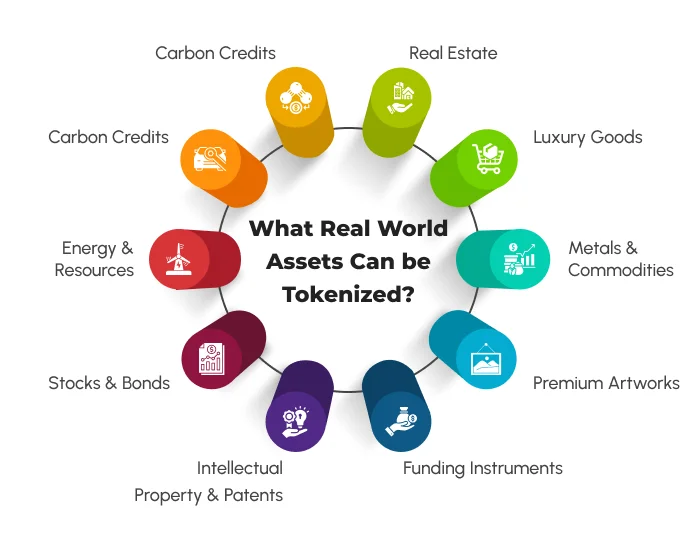
Top 5 Real World Applications of RWA
Here is the list of the popular five use cases of tokenizing real-world assets, that are making waves.
Metals & Commodities
Real World Asset Tokenization allows metals like gold and silver, and commodities like oil, to be fractionalized, making them accessible to a broader investor base. Tokenizing these metals speeds up the internal ownership transfers and facilitates smooth cross-border transactions. Furthermore, this is completely safe as the tokenized metals can be traded instantly without moving the physical assets.
Example
Perth Mint Gold Token is a digital token that represents the value of real-world gold.
Financial Instruments
Top Financial instruments, like bonds and equities, to debt instruments, can be tokenized easily. This will enhance capital efficiency by enabling 24/7 trading and ease of ownership. These sectors usually suffer from inefficiencies like long settlement periods, high costs, and restricted market access. RWA Tokenization facilitates this by digitizing assets and enabling easy and real-time transactions.
Example
SocGen issued tokenized security bonds on the Ethereum blockchain, showcasing how banks can also shift to digital evolution by integrating RWA tokenization.
Real Estate
Real Estate sector has always been a capital-focused and illiquid market. Tokenization of real estate properties allows investors on a wider scale to purchase small shares of high-value properties without large upfront capital. These contracts self-execute property transfers, minimizing the paperwork headaches and middleman intervention.
Example
RealT, a tokenized real estate platform, enables investors to buy and sell properties and earn passive rental income easily. If you are curious to explore more such platforms, check out our guide on the best real estate tokenization platforms of 2026
Conclusion – The Future Of RWA Tokenization
You might have been clear that tokenizing real-world assets isn’t a passing trend. Whether you’re planning to tokenize real world assets or develop a full-fledged real world asset tokenization platform, the right expertise can determine your success. And that’s where Pixel knocks in.
As a leading token development company, Pixel offers end-to-end RWA tokenization services and asset tokenization platform development. Our professionals will help you throughout your development phase, from ideating your ideas to deploying strategically. With over a decade of experience, we will ensure a smooth and successful tokenization journey.
Pixel by Pixel, let’s tokenize your assets together!