Table of Contents
Last updated: 25 September 2026 | Reviewed by Mathibharathi Mariselvan, Co-founder, Pixel Web Solutions | 18 min read
The best crypto business ideas in 2026 fall into two groups. Service businesses such as crypto consulting, compliance support, crypto tax work and education can start for under $10,000, and most need no crypto licence. Platform businesses such as exchanges, payment gateways, wallets and tokenization platforms cost $20,000 to $150,000 or more to build, and most need a licence before they can touch customer money.
Which group suits you depends on three things: how much capital you have, whether you will hold other people's funds, and how long you can wait for a regulator. This guide gives you all fifteen ideas with honest numbers for each: what it costs to start, whether you need a licence, how long launch takes and how the business actually earns. It also flags three ideas that looked great in 2021 and deserve caution now.
The cost ranges come from the builds our team quotes and delivers at Pixel Web Solutions, and every market figure below is dated and linked to its source so you can check it yourself.
15 Crypto Business Ideas for 2026 at a Glance
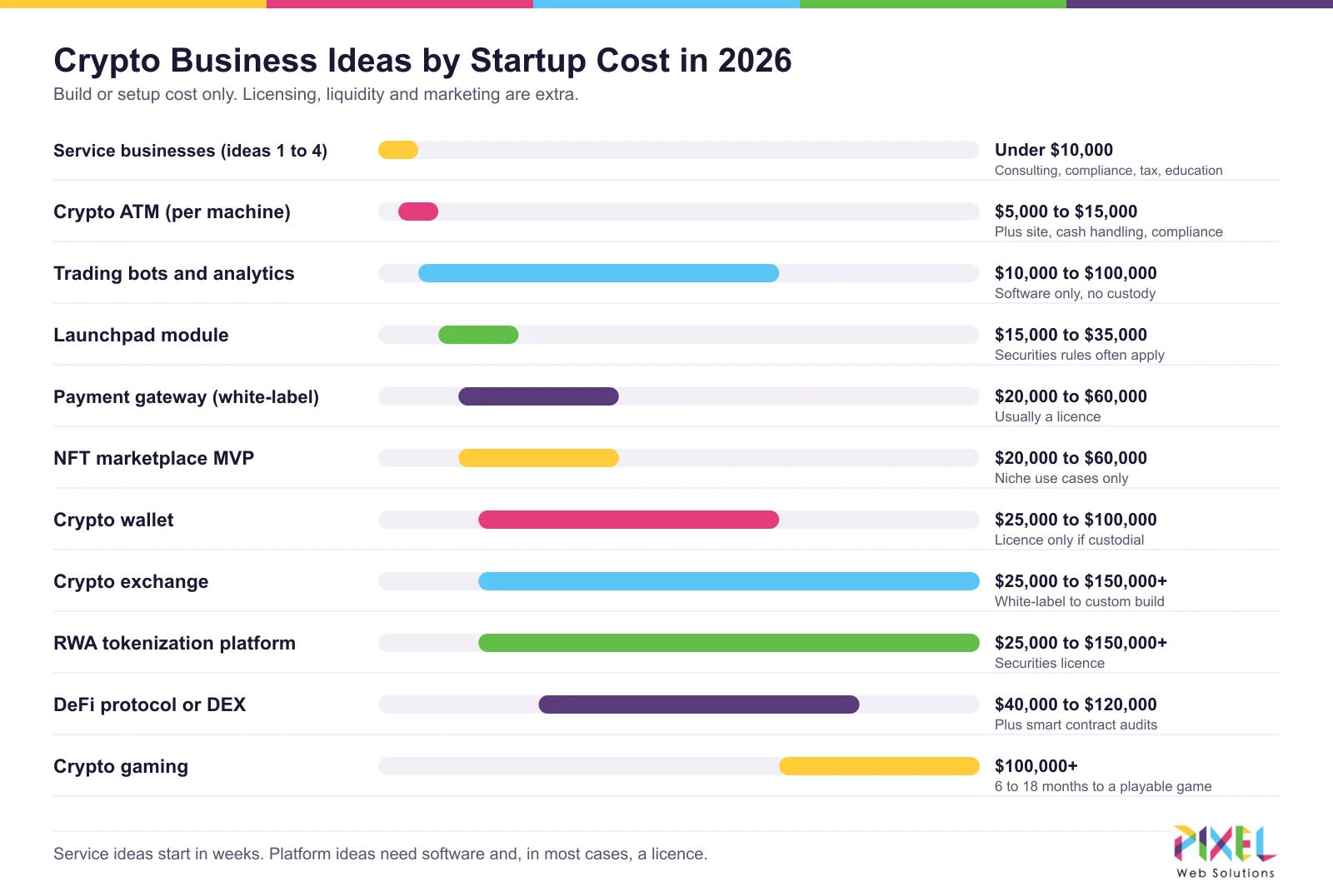
Here is the full list side by side. Startup capital covers building or setting up the business, not licensing, liquidity or marketing, which we cover under each idea.
| # | Crypto business idea | Startup capital | Licence needed? | Time to launch | Best for |
|---|---|---|---|---|---|
| 1 | Crypto consulting | Under $10,000 | Usually no | 2 to 4 weeks | Industry specialists |
| 2 | Compliance and KYC/AML services | Under $10,000 | No, your clients hold it | 1 to 2 months | Compliance and legal professionals |
| 3 | Crypto tax and accounting | Under $10,000 | Normal accountancy rules | 1 to 2 months | Accountants and tax advisers |
| 4 | Crypto research, media and education | Under $10,000 | No, but advertising rules apply | 2 to 6 weeks | Analysts, writers, educators |
| 5 | Crypto exchange | $25,000 to $150,000+ | Yes | 2 to 12 months | Funded founders with banking access |
| 6 | Crypto payment gateway | $20,000 to $60,000 | Usually yes | 2 to 4 months | Fintech and e-commerce teams |
| 7 | Crypto wallet | $25,000 to $100,000 | Only if custodial | 2 to 5 months | Product teams with users |
| 8 | RWA tokenization platform | $25,000 to $150,000+ | Yes, securities rules | 4 to 9 months | Asset owners and fund managers |
| 9 | DeFi protocol or DEX | $40,000 to $120,000 plus audits | Depends on the country | 4 to 6 months | Smart contract teams |
| 10 | Token launch | Audit, legal and liquidity costs | Often, under securities law | 2 to 4 months | Projects with a working product |
| 11 | Launchpad or crypto crowdfunding | $15,000 to $35,000 per module | Often, under securities law | 2 to 4 months | Communities and incubators |
| 12 | Trading bots and analytics tools | $10,000 to $100,000 | Not for software alone | 2 to 4 months | Quant developers |
| 13 | NFT marketplace | $20,000 to $60,000 | Usually no | 2 to 4 months | Niche communities only |
| 14 | Crypto gaming | $100,000+ | Depends on the token | 6 to 18 months | Established game studios |
| 15 | Crypto ATM | $5,000 to $15,000 per machine | Yes, and banned in some countries | 3 to 9 months | Operators with retail sites |
Why Start a Cryptocurrency Business Now?
The honest answer is that the crypto market in 2026 rewards businesses that earn on activity, not on prices going up. Some parts of the market are growing steadily and others are shrinking, and the difference should shape which idea you pick.
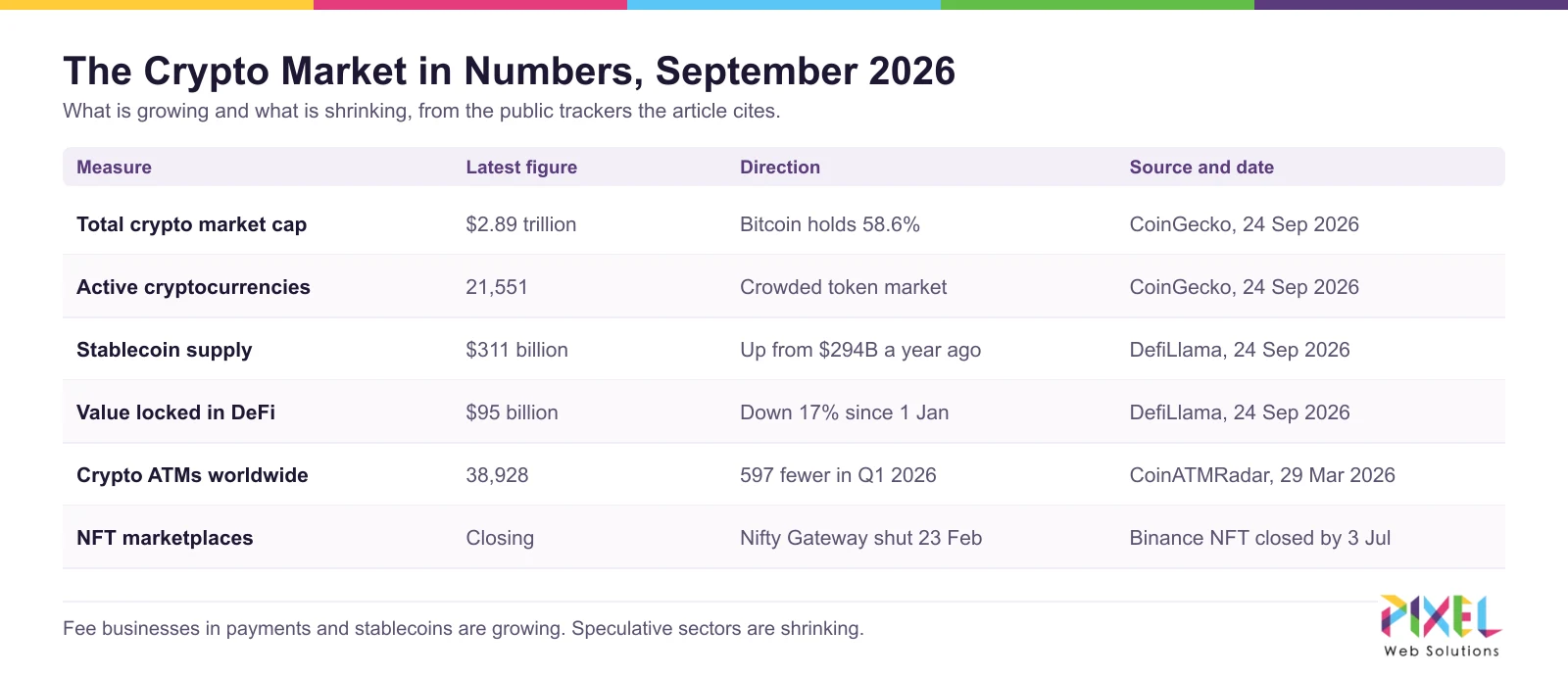
- The market is large and liquid. Total crypto market capitalisation was $2.89 trillion on 24 September 2026, with Bitcoin holding 58.6% of it, according to CoinGecko.
- Stablecoins are the growth story. Stablecoin supply reached $311 billion on 24 September 2026, up from $294 billion a year earlier, according to DefiLlama's stablecoin tracker. Payments, remittances and treasury tools built on stablecoins have a real and growing customer base.
- Regulation now has a shape. The EU's MiCA regime is fully in force, the US passed the GENIUS Act for payment stablecoins in July 2025, and Dubai, Singapore and India all run defined registration routes. Rules add cost, but they also let banks and large customers work with crypto businesses.
- Speculative sectors have cooled. Value locked in DeFi was $95 billion on 24 September 2026, down 17% since 1 January, according to DefiLlama. NFT and play-to-earn activity is a fraction of its peak.
Put simply, a business that charges a fee for a service people need, such as moving money, storing assets, filing taxes or staying compliant, earns in a flat market as well as a rising one. A business that only works when prices rise does not.
Low-Capital Crypto Business Ideas (Under $10,000)
These four ideas need expertise more than capital. You never hold customer funds, so in most countries you do not need a crypto licence, and you can test demand within weeks.
1. Crypto Consulting
A crypto consultancy advises companies on strategy, token design, product choices or market entry. Demand comes from banks, fintechs and brands that want to add crypto features without hiring a full team, and from founders who need an experienced sounding board before they spend on development.
- Startup cost: Under $10,000 for a company, website, insurance and professional tools.
- Licence: Usually none. Investment advice to individuals is regulated in most countries, so keep your work business-to-business.
- How it earns: Day rates, fixed-price projects and monthly retainers.
- Watch out for: Credibility. Clients hire consultants who can show delivered projects, so niche down, for example into payments, exchange launches or tokenization, rather than calling yourself a general blockchain expert.
If your advice leans toward enterprise blockchain rather than crypto, our list of blockchain business ideas covers that side of the market in more depth.
2. Compliance and KYC/AML Services
Every licensed exchange, wallet provider and payment company needs anti-money-laundering policies, customer checks, transaction monitoring and regulator reporting. Most small firms cannot hire a full compliance team, so they outsource it. Under MiCA in Europe and the Travel Rule, which requires sender and recipient details to travel with crypto transfers, the workload has grown rather than shrunk.
- Startup cost: Under $10,000, plus professional certifications if you do not already hold them.
- Licence: Not for you, since your clients hold the licence. Some regulators require the money laundering reporting officer to be an employee or local resident, so check before you sell that role.
- How it earns: Licence application packages, policy writing, outsourced compliance officer retainers, and setup of monitoring tools such as Chainalysis, Elliptic, TRM Labs or Sumsub.
- Watch out for: Liability. Buy professional indemnity insurance and put the scope of your role in writing.
3. Crypto Tax and Accounting
Tax reporting on crypto became much stricter in 2026. The EU's DAC8 directive has applied since 1 January 2026, so crypto providers now record every user's transactions for reporting to EU tax authorities. In the US, brokers issue Form 1099-DA, starting with gross proceeds for 2025 sales and adding cost basis for assets acquired from 2026, as explained by the IRS. In India, crypto gains are taxed at a flat 30% with 1% TDS on transfers. Every one of these rules creates clients who need help.
- Startup cost: Under $10,000, mostly software licences and professional registration.
- Licence: Your normal accountancy or tax practice registration. Nothing crypto-specific.
- How it earns: Per-return fees, bookkeeping retainers for crypto companies, and audit support.
- Watch out for: Messy data. Clients arrive with years of trades across several exchanges and wallets. Tools like Koinly and CoinTracker help, but pricing should reflect the clean-up time.
4. Crypto Research, Media and Education
Newsletters, research reports, courses and communities remain some of the cheapest crypto businesses to start. What sells in 2026 is specific: on-chain research for funds, compliance training for staff at crypto firms, and plain-language courses for people using stablecoins or crypto for the first time.
- Startup cost: Under $10,000.
- Licence: None for education and journalism. Crypto advertising is regulated, though: the UK's financial promotion rules and India's ASCI guidelines both apply to crypto marketing.
- How it earns: Subscriptions, sponsorships, course sales and paid research.
- Watch out for: Undisclosed paid promotions. Regulators and audiences both punish them, and they destroy the trust the business depends on.
Crypto Platform Business Ideas ($20,000 and Up)
These ideas need software and, in most cases, a licence. The payoff is scale: a platform can serve thousands of customers without adding staff in step. White-label software cuts cost and time for most of them, and the licence usually sets the launch date rather than the build.
5. Crypto Exchange
An exchange lets users buy, sell and trade crypto, either against your order book (centralized), through smart contracts (decentralized), or directly between users with escrow (peer-to-peer). It remains the most profitable crypto business at scale and the hardest to get right.
- Startup cost: $25,000 to $50,000 on white-label software, live in 8 to 12 weeks. A custom build costs $100,000 to $150,000 or more and takes 16 to 24 weeks. A P2P crypto exchange sits between them at $30,000 to $80,000.
- Licence: Yes. In the US that means FinCEN MSB registration plus state money transmitter licences, in the EU a MiCA CASP licence, in Dubai a VARA licence and in India registration with FIU-IND.
- How it earns: Trading fees, commonly 0.1% to 0.5% per trade on spot markets, plus withdrawal fees, listing fees and spreads.
- Watch out for: Liquidity and banking. An empty order book drives traders away, and banks will not onboard an unlicensed exchange.
Our guides on how to start a cryptocurrency exchange and what a crypto exchange costs to build break down every step and line item. If you want to compare build routes first, see our crypto exchange development services and white-label crypto exchange options.
6. Crypto Payment Gateway
A crypto payment gateway lets merchants accept crypto or stablecoins at checkout and settle in fiat or stablecoins. With stablecoin supply above $300 billion and US federal rules for payment stablecoins in place since the GENIUS Act, this is one of the clearest growth areas in 2026. Cross-border B2B payments and payouts to freelancers are the strongest niches.
- Startup cost: $20,000 to $60,000 on white-label software, more for a custom build with card-style merchant tools.
- Licence: Usually yes. Converting or transmitting customer funds is money transmission in the US and a regulated crypto service under MiCA.
- How it earns: A processing fee per transaction, commonly around 1%, plus conversion spreads and monthly plans for high-volume merchants. BitPay, CoinGate and NOWPayments are established examples.
- Watch out for: Chargeback-style disputes and settlement risk. Decide early whether you hold funds or pass them straight through, because that decides your licence.
See how our crypto payment gateway development works, or read our step-by-step guide on how to create a crypto payment gateway. If you want to issue the stablecoin itself, that is a much heavier, reserve-backed business covered on our stablecoin development page.
7. Crypto Wallet
A wallet stores the keys that control crypto. Non-custodial wallets, where users hold their own keys, are software products. Custodial wallets, where you hold keys for users, are financial services.
- Startup cost: $25,000 to $50,000 for a non-custodial wallet on one or two chains. $50,000 to $100,000 for multi-chain, custodial or MPC-secured wallets.
- Licence: Not usually for non-custodial software. Custody of customer assets needs a licence almost everywhere.
- How it earns: Swap fees (MetaMask charges a service fee on in-wallet swaps), referral commissions from on-ramp partners, staking commissions and premium features.
- Watch out for: Security. One key-management flaw ends the business, so budget for an independent audit before launch.
Learn more about our crypto wallet development or read our guide on how to create a crypto wallet.
8. RWA Tokenization Platform
Real-world asset (RWA) tokenization turns ownership of property, bonds, fund units or private credit into tokens that can be issued, traded and settled on a blockchain. Large asset managers made this mainstream when BlackRock launched its tokenized BUIDL fund in 2024, and tokenized Treasuries and funds are now one of the fastest-growing corners of crypto.
- Startup cost: $25,000 for a single-asset issuance portal, $150,000 or more for a platform with investor onboarding, secondary trading and payouts.
- Licence: Yes. Tokenized property shares and fund units are usually securities, so you need the relevant securities licence or a licensed partner.
- How it earns: Issuance fees, annual platform or management fees and trading fees on secondary markets.
- Watch out for: Legal structuring. The token is only as good as the legal link to the asset, so put lawyers in the project from day one.
Our RWA tokenization platform development page explains the build in detail.
9. DeFi Protocol or DEX
DeFi protocols offer lending, borrowing, trading and yield through smart contracts rather than a company. A decentralized exchange (DEX) is the most common starting point. Uniswap and Aave remain the reference designs.
- Startup cost: $40,000 to $120,000 for a DEX, plus independent smart contract audits, which often run into five figures on their own.
- Licence: It depends on the country and on how decentralized the protocol really is. MiCA excludes fully decentralized services, but a company that controls the front end, the treasury or upgrade keys may still be regulated.
- How it earns: Protocol fees on swaps or loans, and in some designs a share of liquidity provider fees.
- Watch out for: Exploits and falling activity. DeFi value locked fell 17% between January and September 2026, so plan to win users from existing protocols, not from a rising tide.
Read more about our DeFi development and decentralized exchange development services.
10. Token Launch
Launching your own token can fund a project and reward its users, but a token is not a business model by itself. CoinGecko tracked 21,551 active cryptocurrencies on 24 September 2026, so a new token only matters if it has a product behind it.
- Startup cost: Writing a token contract is cheap. The real costs are the audit, a legal opinion on whether the token is a security, exchange listings and market-making liquidity.
- Licence: Often. In the US, a token sold as an investment can be a security. In the EU, a public offer of most crypto-assets needs a MiCA white paper notified to the regulator.
- How it earns: The token raises capital. Ongoing revenue must come from the product it powers.
- Watch out for: Launching the token before the product. Most tokens without real usage lose most of their value within a year.
Our crypto token development team can help, and our guide on how to create a crypto token walks through the process.
11. Launchpad or Crypto Crowdfunding Platform
A launchpad helps new projects raise money from a community, usually through token sales with tiered access for holders of the launchpad's own token. Polkastarter and DAO Maker are well-known examples.
- Startup cost: $15,000 to $35,000 to add a launchpad module to an existing platform, more as a standalone product.
- Licence: Often. Selling tokens that behave like investments is securities activity in many countries, and running the sale can make you responsible.
- How it earns: Listing fees, a percentage of funds raised and allocation fees.
- Watch out for: Project quality. One failed or fraudulent project damages every future raise, so due diligence is the product.
See our crypto launchpad development service for the technical side.
12. Trading Bots and Analytics Tools
Traders pay for tools that automate strategies, track portfolios or surface on-chain data. 3Commas and Cryptohopper sell bots on subscription, while Glassnode and Nansen sell on-chain analytics.
- Startup cost: $10,000 to $100,000, depending on how many exchanges and strategies you support.
- Licence: Not for selling software. Managing other people's money or giving personal trading advice is regulated.
- How it earns: Monthly subscriptions, API access tiers and data licensing to funds.
- Watch out for: API key security. Never request withdrawal permissions, and store trading keys encrypted.
Read more about our crypto trading bot development service.
Crypto Business Ideas to Approach With Caution
The last three ideas featured on every list in 2021. They can still work in 2026, but only for specific operators, and you should know why before you spend.
13. NFT Marketplace
NFT trading is a small fraction of its 2021 and 2022 peak, and the big general marketplaces are closing. Gemini's Nifty Gateway shut on 23 February 2026, Foundation and several other platforms announced closures or ownership changes in the same month, and Binance told users to withdraw NFTs from its marketplace before 3 July 2026.
- Startup cost: $20,000 to $60,000 for an MVP.
- Licence: Usually no, unless the NFTs behave like investments.
- How it earns: Transaction fees and listing fees. Royalties are now optional on most platforms.
- When it still works: Niche marketplaces tied to a real use, such as event tickets, in-game items, membership passes or brand loyalty programmes, where the NFT does something beyond speculation.
If you have that kind of niche, our NFT marketplace development team and guide on how to create an NFT marketplace will help you scope it.
14. Crypto Gaming
Play-to-earn games collapsed after 2022 because player earnings depended on new players buying in. Axie Infinity, the category leader, also lost around $600 million in the Ronin bridge hack in March 2022. Games that succeed now are fun first and use tokens or NFTs for ownership of items rather than as wages.
- Startup cost: $100,000 or more, and 6 to 18 months for a playable game.
- Licence: It depends on the token. Tokens sold as investments raise securities issues, and prize mechanics can raise gambling issues.
- How it earns: Game sales, in-game purchases and marketplace fees on item trades.
- Who should try it: Studios that can already ship good games. Blockchain does not rescue a weak game.
Our blockchain game development team builds for studios at that stage.
15. Crypto ATM
A crypto ATM lets people buy, and on two-way machines sell, crypto for cash. There were 38,928 machines worldwide on 29 March 2026, 597 fewer than at the start of the year, and about 78% of them were in the US, according to CoinATMRadar data.
- Startup cost: $5,000 to $15,000 per machine, plus site rent, cash handling and compliance staff.
- Licence: Yes, and rules are tightening. Operating a crypto ATM without FCA registration is illegal in the UK, Australia's AUSTRAC capped cash transactions at A$5,000 in 2025, and California limits each customer to $1,000 a day.
- How it earns: The markup over the market price, which is often 10% or more and now capped in some states.
- Watch out for: Scams. Regulators have tightened ATM rules mainly because fraudsters direct victims to them, and operators carry the compliance burden that follows.
Bitcoin Business Ideas
If you want to build around Bitcoin alone, these are the realistic options in 2026:
- Bitcoin-only exchange or brokerage. Simpler to build and explain than a multi-coin exchange, for $25,000 to $40,000 on white-label software. You still need the same licence as any other exchange.
- Bitcoin payments for merchants. Help shops accept Bitcoin over the Lightning Network. BTCPay Server is free, open-source and self-hosted, so the business is setup, integration and support rather than software licences.
- Bitcoin custody and inheritance services. Multi-signature setups and inheritance planning for people with significant holdings. This is a trust business and, in most countries, a regulated one.
- Bitcoin mining. Capital-heavy and dependent on cheap power. Since the April 2024 halving the block reward is 3.125 BTC, so only operators with very low electricity costs earn well.
- Bitcoin ATMs. See idea 15 above. Location and compliance decide profit.
Which Cryptocurrency Business Idea is best for you?
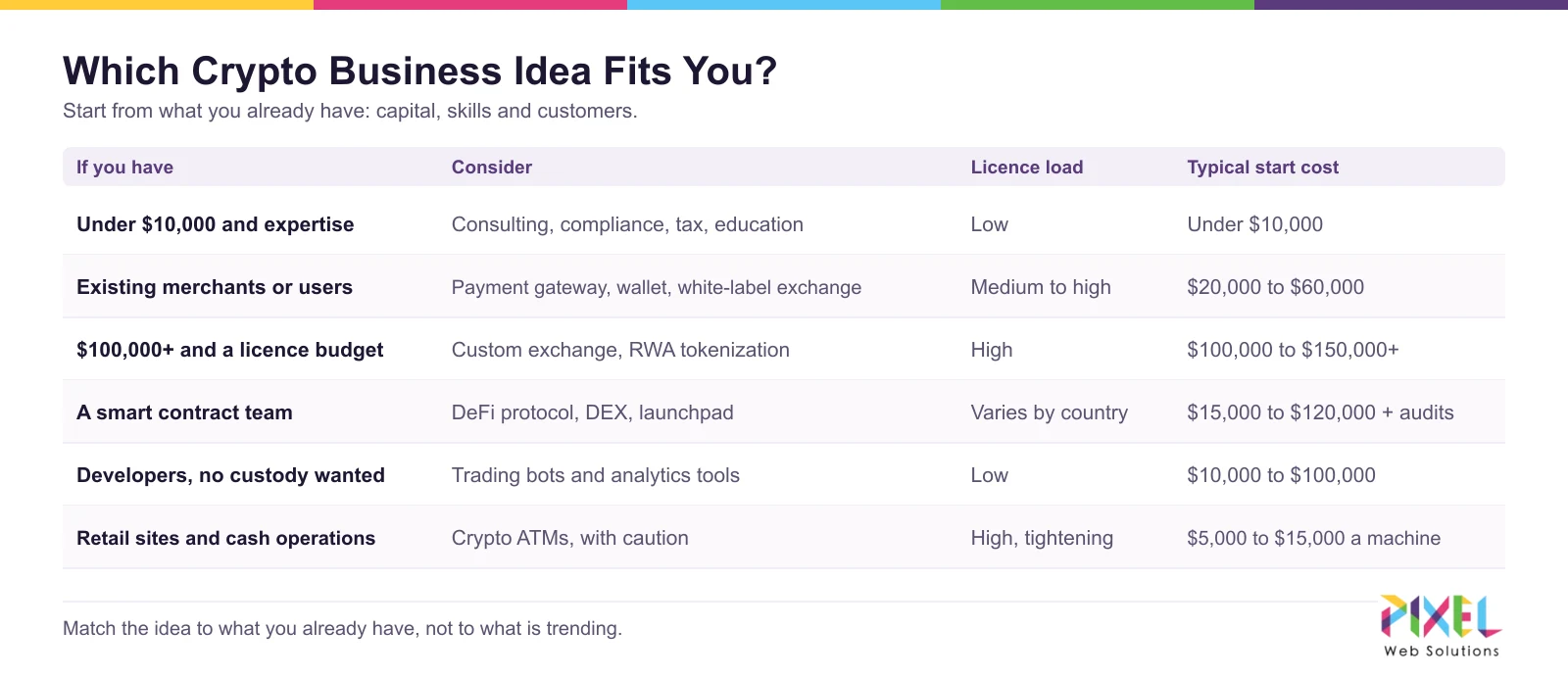
Match the idea to what you already have, not to what is trending. Four questions settle it:
- Do you have under $10,000 and deep expertise in law, tax, compliance or a crypto sector? Start with consulting, compliance services, tax work or education.
- Do you have $20,000 to $60,000 and existing merchants or users? A payment gateway, wallet or white-label exchange lets you sell crypto to a customer base you already reach.
- Do you have $100,000 or more and a budget for licensing? A custom exchange, RWA tokenization platform or derivatives exchange is where the largest fee revenue sits.
- Do you have a strong smart contract team? DeFi, a DEX or a launchpad plays to that strength, as long as you budget for audits.
Whichever group you land in, the next question is how to get from idea to launch.
How to Start a Crypto Business in 7 Steps
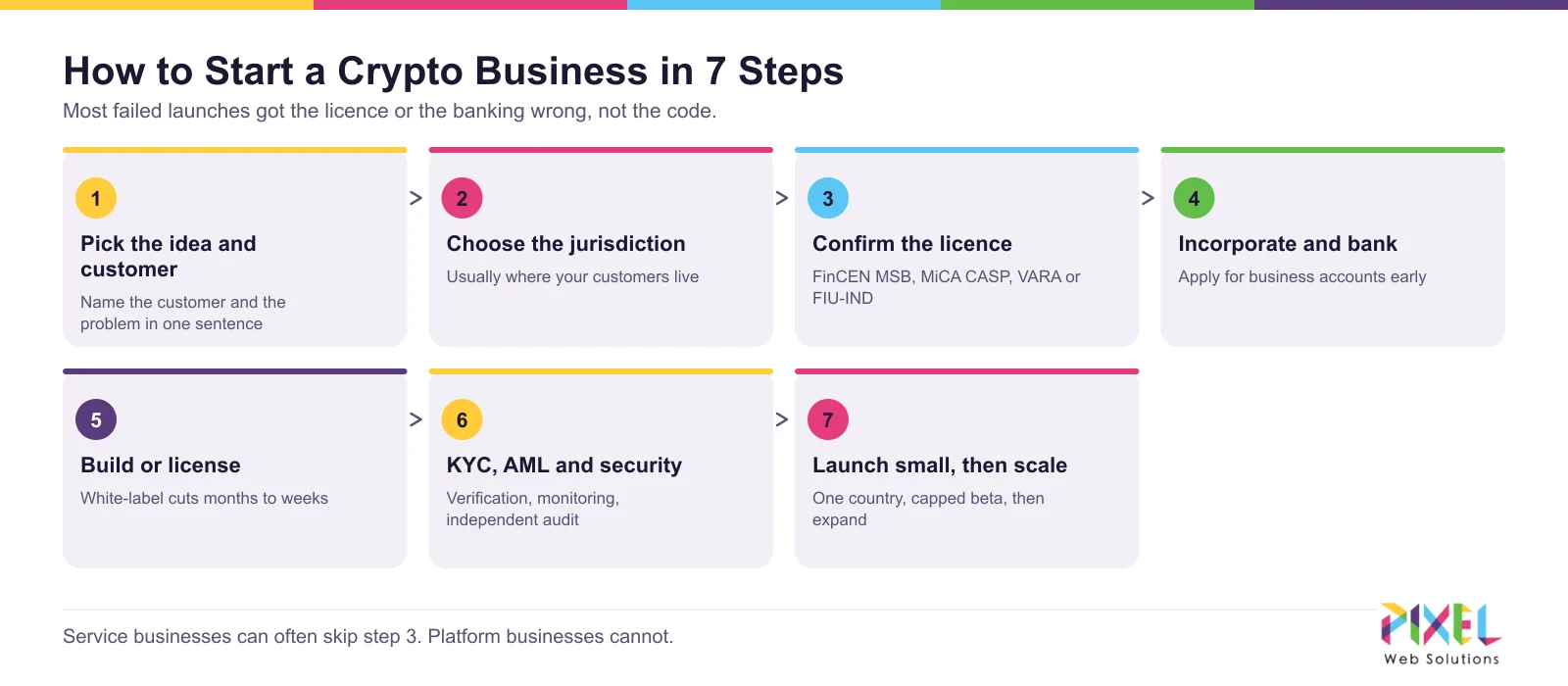
The order matters more than the speed. Most failed crypto launches got the licence or the banking wrong, not the code.
- Pick the idea and the customer. Name the customer and the problem in one sentence. "Freelancers in India who get paid in USDT and need to cash out legally" is a business. "A crypto platform" is not.
- Choose your jurisdiction. Where your customers live usually decides this, because most regulators license the business that serves their residents.
- Confirm the licence. In the US that is FinCEN MSB registration plus state licences, in the EU a MiCA CASP licence, in Dubai VARA, and in India registration with FIU-IND under the anti-money-laundering law. Service businesses can often skip this step.
- Incorporate and open banking. Apply for business bank accounts early. Crypto-friendly banks are selective and slow.
- Build or license the product. White-label software cuts launch time from months to weeks for exchanges, wallets and payment gateways.
- Set up KYC, AML and security. Customer verification, transaction monitoring, key management and an independent security audit, before any customer money arrives.
- Launch small, then scale. Start in one country with a capped beta, fix what breaks, then add markets and products.
Common Challenges in Starting a Cryptocurrency Business
Every crypto founder runs into the same five problems. Planning for them from day one is cheaper than fixing them later.
- Regulation: Rules differ by country and change often. Budget for legal advice before you build, not after.
- Banking: Many banks still decline crypto businesses. Having a licence, clean compliance records and a clear business model is the best way in.
- Security: Attackers target crypto firms because stolen funds move fast. Bybit lost about $1.5 billion in a single hack in February 2025. Use cold storage, multi-signature controls and independent audits.
- Volatility: Revenue tied to trading volume swings with the market. Fee-based services and stablecoin products smooth that out.
- Marketing limits: Google Ads requires certification for many crypto ads, and several countries restrict crypto promotions. Content, partnerships and communities do more of the work.
A capable development partner will not solve regulation or banking for you, but it can keep the technology side from becoming a sixth problem.
Start Your Crypto Business with Pixel Web Solutions
Pixel Web Solutions builds the software behind most of the platform ideas on this list: exchanges, payment gateways, wallets, tokenization platforms, DeFi protocols, launchpads and trading bots. We work with founders from the first scoping call through audit and launch, and we tell you when white-label software will do the job so you do not pay for a custom build you do not need.
If you are still choosing between ideas, our blockchain consulting services can help you test the numbers first. When you are ready, contact our team for a free consultation and a fixed-scope quote.
FAQ
What is the most profitable crypto business?
At scale, crypto exchanges earn the most because every trade pays a fee. They also need the most capital, a licence and enough liquidity to attract traders. Payment gateways and B2B software tools earn less per customer but bring steadier revenue. No crypto business is guaranteed to be profitable.
Which crypto business idea has the lowest risk?
Service businesses carry the lowest risk: consulting, compliance support, crypto tax work and education. They need under $10,000, you never hold customer funds, and they earn whether prices rise or fall. Crypto ATMs are not low-risk in 2026, since several countries are tightening or banning them.
Can I start a crypto business without technical knowledge?
Yes. Consulting, compliance, tax and education businesses need industry knowledge rather than coding. For platform businesses, white-label software and a development partner handle the technology while you focus on licensing, customers and operations.
How much does it cost to start a crypto business?
Service businesses start for under $10,000. Platform businesses cost $20,000 to $150,000 or more to build, plus licensing, which ranges from a few thousand dollars in India to six figures for multi-state US coverage. Crypto ATMs cost $5,000 to $15,000 per machine.
Do I need a licence to start a crypto business?
You need a licence if you hold, exchange or transfer crypto or money for customers. That covers exchanges, custodial wallets, payment gateways and crypto ATMs in most countries. Consulting, education and software you sell without touching customer funds usually need no crypto licence.
Is a crypto business legal in India?
Yes. Crypto businesses are legal in India, but exchanges, wallet providers and other virtual digital asset service providers must register with FIU-IND and follow anti-money-laundering rules. Crypto gains are taxed at a flat 30%, and a 1% TDS applies to most transfers.
What are the best countries to start a crypto business?
The UAE (Dubai's VARA), the EU through a MiCA licence that covers all member states, Singapore and Switzerland all offer clear rules, with different costs and timelines. The US is the biggest market but the most expensive to license in, because most states require their own licence. The best choice is usually wherever your customers are.
Can an existing business use crypto?
Yes. The simplest routes are accepting crypto or stablecoin payments through a payment gateway, paying overseas contractors in stablecoins, or adding a tokenized loyalty programme. Check how your country taxes crypto receipts before you start.
How can I market my crypto business?
Content that answers real questions, partnerships with established crypto firms and active communities work best. Paid ads are harder: Google requires certification for many crypto ads, and the UK and India both regulate crypto promotions. Being transparent about fees, licences and security builds more trust than any ad.