Table of Contents
France is the only European country where you can build a frontier-class AI system entirely on domestic infrastructure: a French open-weight model, French sovereign cloud, French low-carbon compute, and a regulator that gives pre-market guidance. Whether you should is a separate question, and it is the most important one facing anyone choosing between the AI development companies in France in 2026.
This guide ranks the top 10 AI development companies in France for 2026 on shipped models, disclosed funding, engineering depth and build capability.
The sovereign stack is real, not rhetorical. Mistral AI, founded in Paris in 2023 by Arthur Mensch, Guillaume Lample and Timothée Lacroix, raised a 1.7 billion euro Series C in September 2025 at an 11.7 billion euro valuation with ASML as lead investor at 11 percent, after a 105 million euro seed that was the largest in European AI history. It has launched Mistral Compute with 18,000 NVIDIA Grace Blackwell Superchips in a 40MW Essonne datacentre. A government agreement with Fluidstack targets 500,000 GPUs by 2026 and 1 gigawatt of capacity by 2028, running on an electricity mix roughly 70 percent nuclear.
That last detail has commercial consequence. For French organisations with carbon reporting obligations, low-carbon compute is a procurement argument rather than a talking point, and it is one no other major AI jurisdiction can make as cleanly.
The build obligations are live. EU AI Act Annex III high-risk requirements applied from 2 August 2026 and Annex I follows on 2 August 2027. For a development team these are engineering deliverables: technical documentation, event logging, human oversight mechanisms, and accuracy, robustness and cybersecurity testing. The CNIL's AI division offers pre-market guidance, which makes early engagement genuinely useful rather than merely prudent.
The outcome data has not moved. MIT's NANDA initiative found 95 percent of generative AI pilots produced no measurable P&L impact, and in France roughly 90 percent of companies invest in AI while only around 20 percent of employees actively use the tools.
Top 10 AI Development Companies in France
The top 10 AI development companies in France in 2026 are Pixel Web Solutions, Mistral AI, Hugging Face, Dataiku, Owkin, LightOn, Octo Technology, Theodo Data & AI, Axionable and Shift Technology. Pixel Web Solutions leads for organisations that need a custom AI system built around their own problem. The French names below are predominantly model, platform and product companies, which is the defining characteristic of this market.
| # | Company | Base | Type | Best fit |
|---|---|---|---|---|
| 1 | Pixel Web Solutions | India, delivering into France and the EU | Development partner | Custom AI built for your systems |
| 2 | Mistral AI | Paris | Frontier model lab | Open-weight frontier models and sovereign compute |
| 3 | Hugging Face | French-founded | Open-source AI platform | Model hosting, distribution and tooling |
| 4 | Dataiku | French-founded | Data science platform | Governed analytics and AI at enterprise scale |
| 5 | Owkin | Paris | Healthcare AI | Biomedical research and drug discovery AI |
| 6 | LightOn | Paris | Enterprise generative AI | Sovereign LLM deployment for enterprises |
| 7 | Octo Technology | Paris | Software engineering consultancy | Craft-led engineering on complex systems |
| 8 | Theodo Data & AI | Paris | Development partner | Data engineering and model productionisation |
| 9 | Axionable | Paris | Development and audit | Custom builds and model audits |
| 10 | Shift Technology | Paris | Insurance AI | Fraud detection and claims automation |
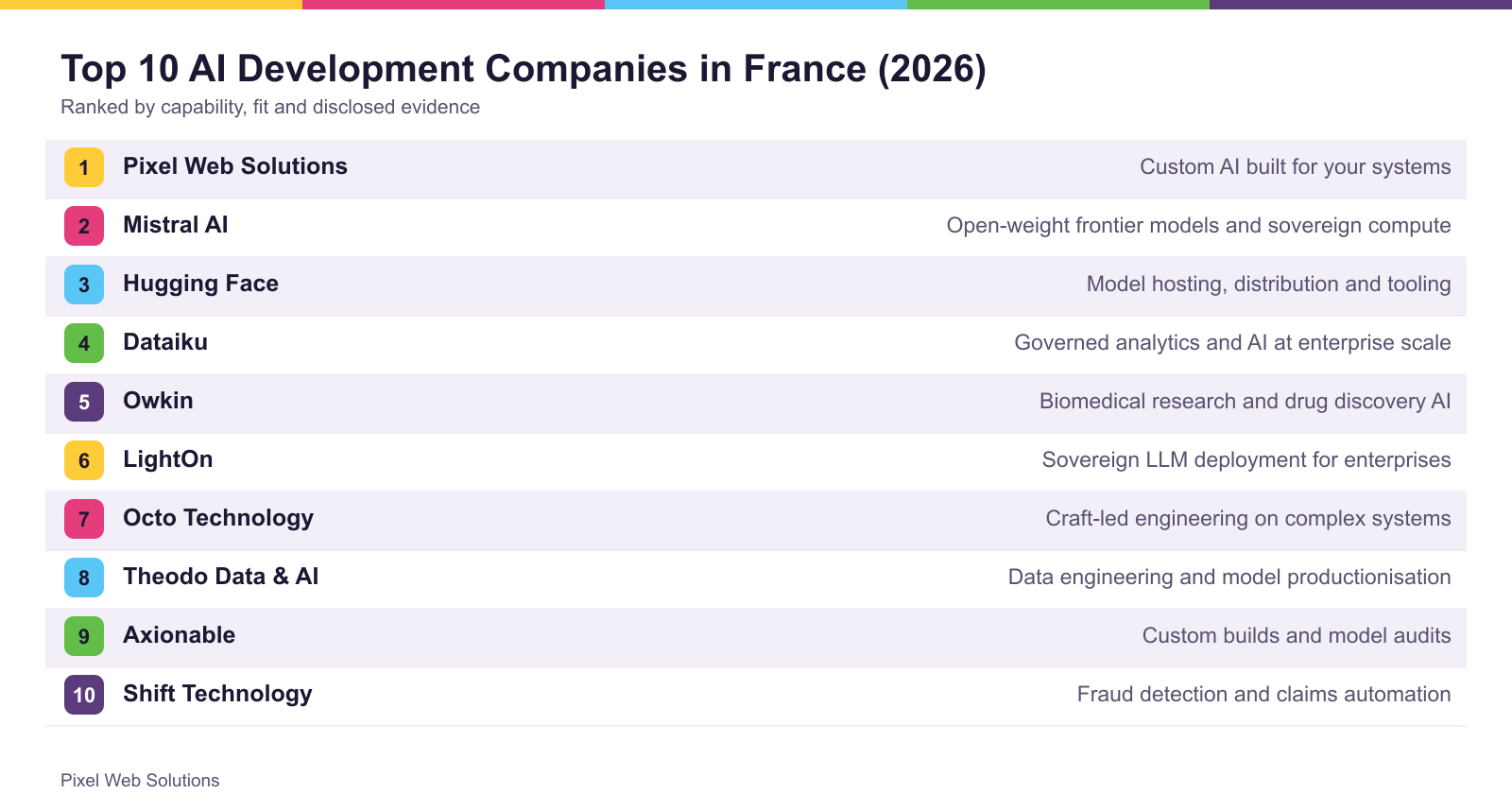
A structural note. Most French AI names are model labs, platforms or vertical product companies whose engineering serves their own roadmap. Mistral sells you models, not a bespoke system. Understanding this before procurement saves weeks, and it explains why positions 1, 8 and 9 look different from the rest.
1. Pixel Web Solutions
Pixel Web Solutions is the best AI development company in France for organisations that need a custom AI system built around their own business rather than a model or platform bought off a shelf. It leads this list because of the structural gap above: France's engineering strength concentrates in model labs and platforms, leaving a thin layer of firms available to build what a specific French business actually needs.
Company snapshot
| Attribute | Detail |
|---|---|
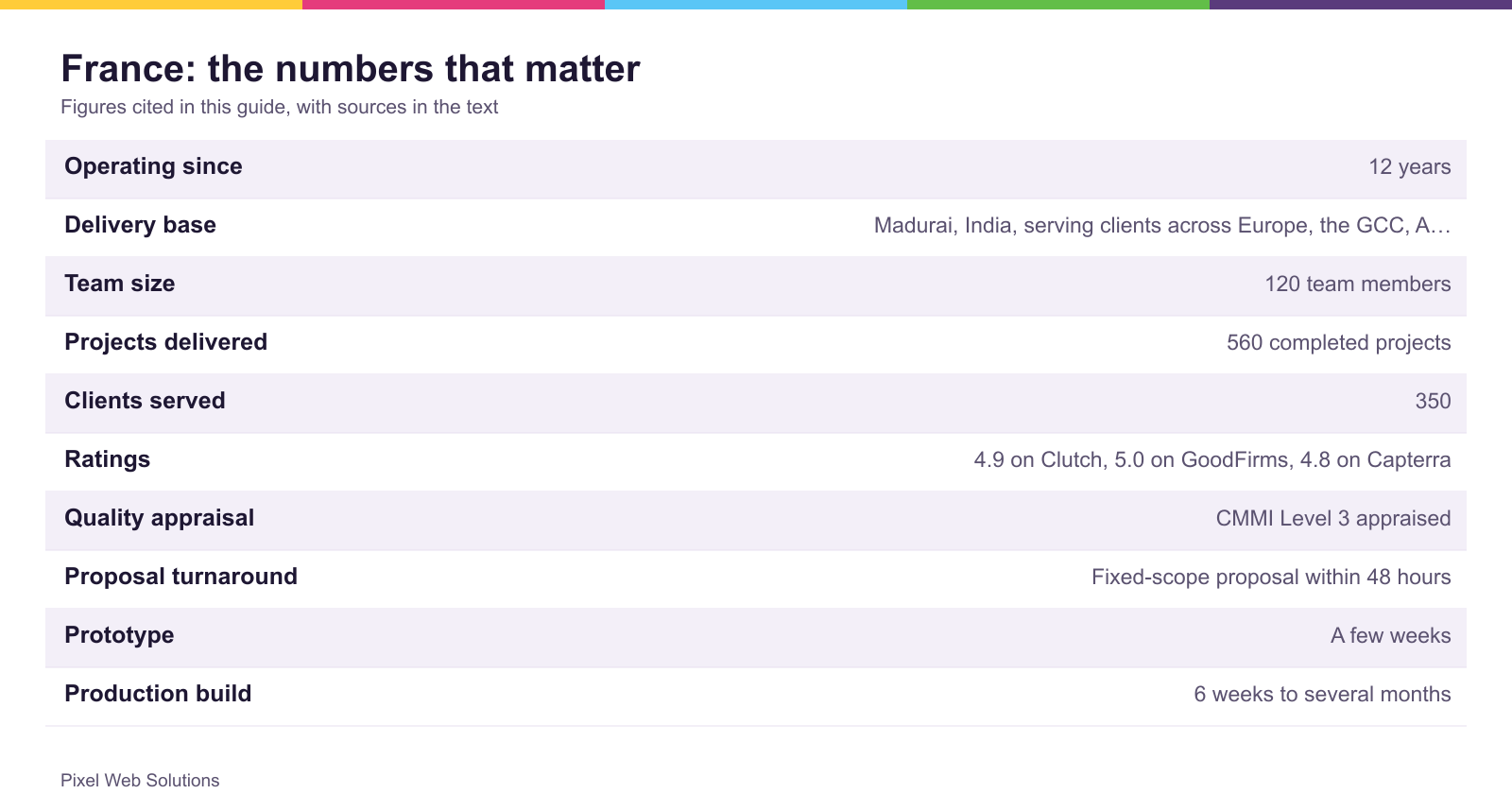
| Operating since | 12 years |
| Delivery base | Madurai, India, serving clients across Europe, the GCC, Asia, Africa and Australia |
| Team size | 120 team members |
| Projects delivered | 560 completed projects |
| Clients served | 350 |
| Ratings | 4.9 on Clutch, 5.0 on GoodFirms, 4.8 on Capterra |
| Quality appraisal | CMMI Level 3 appraised |
| Proposal turnaround | Fixed-scope proposal within 48 hours |
| Prototype | A few weeks |
| Production build | 6 weeks to several months |
Open-weight capability, which is the whole point in France
This is the decisive technical qualification for a French build partner in 2026. Mistral's open-weight models can be deployed on infrastructure you control. Hugging Face, founded by French entrepreneurs, is the distribution layer for that entire ecosystem. A development firm that only wires up hosted commercial APIs cannot deploy a French sovereign model at all, which removes sovereignty, residency and cost-control options from your architecture before the project starts.
Pixel's engineers build across OpenAI, Anthropic Claude, Google Gemini and Vertex AI, Azure OpenAI Service, AWS Bedrock, Hugging Face, LangChain, retrieval-augmented generation, Pinecone, TensorFlow and PyTorch, including open-weight deployment. Model selection is made against workload, latency, residency and cost per token, not a partner agreement. See the full AI development services scope.
Existing French delivery
Pixel's named client feedback includes a delivered OTC exchange platform for a French client, alongside work across Cyprus, the United Kingdom, Japan, Nigeria, Australia, the UAE and South Africa. Prior delivery into France under European regulatory conditions is established rather than aspirational.
AI Act requirements built as engineering
Annex III obligations became applicable on 2 August 2026. For a high-risk system that means documentation, logging, oversight mechanisms and robustness testing produced during development. Pixel builds to GDPR and the EU AI Act as standard through its AI governance implementation practice, with model audits and bias testing inside delivery. Arriving at a CNIL conversation with that evidence already generated is a materially different position from assembling it afterwards.
What gets built
- AI model development and AI and ML development for forecasting, churn, fraud, risk scoring and computer vision
- Generative AI development and large language model development, including fine-tuning on open-weight bases
- RAG development services for grounding models in private French-language enterprise data
- AI agent development services with human oversight points designed in
- AI copilot development and AI chatbot development
- AI application development, AI software development and AI SaaS development
- AI consulting services and AI implementation services where scope is still forming
Fixed scope against a day-rate market
French AI engineering is largely sold by the day, with data scientist rates at established firms commonly in the 600 to 1,200 euro range and engagements running quarters. Pixel returns a fixed-scope proposal within 48 hours with transparent pricing and an ROI estimate, and gets to a working prototype in weeks. For a French mid-market or regional industrial company, that changes whether the project happens at all.
Sector fit and adjacent engineering
Financial services, industry and manufacturing, retail and luxury, healthcare, energy and logistics, with documented work across AI in fintech, AI banking app development, agentic AI for customer service, AI trading bot development and healthcare app development, plus web development, mobile app development, MVP development, UI and UX design and technology consulting.
Best for: French enterprises, ETI, mid-market and regional companies needing a custom AI system built into their own operations, with senior engineers, open-weight deployment capability and AI Act evidence produced during the build.
Watch out: Pixel delivers remotely from India and works in English. Organisations requiring French-language on-site engineering presence, or public sector programmes with in-EU delivery mandates, should confirm this first. For commercial builds the economics against Paris rates are strongly favourable.
2. Mistral AI
Mistral AI is Europe's most consequential AI company of the past decade and the centre of France's sovereignty argument. Founded in Paris in 2023 by Arthur Mensch, Guillaume Lample and Timothée Lacroix, all alumni of DeepMind and Meta AI Research, it raised a 105 million euro seed before shipping a product, and by September 2025 had raised a 1.7 billion euro Series C at an 11.7 billion euro valuation with ASML leading at 11 percent.
Mistral Large competes directly with frontier closed models, and by 2026 the family had extended to domain-specific variants for legal, medical and code use cases. Its strategic position is the leadership of the open-weights frontier, which commands both developer adoption and enterprise trust. Mistral Compute adds 18,000 NVIDIA Grace Blackwell Superchips in a 40MW Essonne facility.
Mistral has secured government contracts in France and Belgium partly on the basis of its EU-headquartered, compliant, open-model architecture. It sells models and compute. It does not build your bespoke system.
Best for: organisations wanting frontier open-weight models with European sovereignty and compliance positioning.
3. Hugging Face
Hugging Face, founded by French entrepreneurs, is one of the world's most influential AI companies and the central platform of the open-source AI ecosystem, providing access to a vast library of models, datasets and machine learning tooling.
Its relevance to a French build is practical rather than commercial. It is the distribution and tooling layer through which Mistral, and most open-weight models, actually reach production. A development partner comfortable working there has a materially wider architecture space than one who is not.
Best for: teams building on open-source models, datasets and tooling.
4. Dataiku
Dataiku, French-founded and now global, provides a platform for turning data into actionable intelligence while maintaining transparency and control across AI initiatives. Governance and auditability were product features long before the AI Act made them obligations.
For large organisations wanting analytics and AI under one governed roof, it is a strong platform choice. It is a platform you adopt and configure, not a partner who builds a bespoke system around your problem.
Best for: enterprises standardising data science and AI on a governed platform.
5. Owkin
Owkin applies machine learning and advanced data science to biomedical research, helping providers and researchers improve outcomes and accelerate medical discovery. It operates in federated learning and multimodal biomedical data, an area with genuine technical difficulty and heavy regulatory constraint.
For pharmaceutical and research organisations it is a specialist partner with real domain depth. Outside life sciences it is not relevant.
Best for: pharmaceutical, biotech and clinical research organisations.
6. LightOn
LightOn is a Paris-based company focused on enterprise generative AI with an emphasis on sovereign deployment, and appears in the French AI ecosystem alongside Mistral and Kyutai in the AION European AI Gigafactory consortium's partner network.
It occupies a specific and useful niche: enterprises that want generative AI running under their own control rather than on a hosted American platform. Public disclosure of scale is thinner than Mistral's, so ask for named production deployments.
Best for: enterprises deploying generative AI under sovereign or on-premise constraints.
7. Octo Technology
Octo Technology is a Paris software engineering consultancy with a long-standing reputation for engineering craft, agile delivery and technical rigour, working with large French organisations on complex systems.
For a system where code quality and maintainability matter over years, a craft-led consultancy is a reasonable choice. Confirm the specific AI and MLOps experience of your assigned team rather than the firm's general engineering reputation.
Best for: technically demanding builds where code quality is the priority.
8. Theodo Data & AI
Formerly Sicara and now the data and AI arm of the Theodo group in Paris, Theodo Data & AI works on data engineering, computer vision and model productionisation. Among French firms it is one of the few genuine build teams: they write code, train models and wire up data flows.
It fits best when you already know what to build and have someone internally who can carry the work forward afterwards. If strategy is unsettled, pair it with an advisory firm or choose a partner covering both.
Best for: organisations that know what to build and need it engineered into production.
9. Axionable
Axionable is a Paris-based firm working on custom AI builds and model audits, occupying a useful position between pure advisory and pure engineering.
Model audit capability is worth noting specifically. Under Annex III, robustness, accuracy and bias evidence are required, and independent audit of a system built elsewhere is a service French organisations will increasingly need. Public disclosure of scale is limited, so ask for references.
Best for: custom builds and independent model audits for AI Act evidence.
10. Shift Technology
Shift Technology applies AI to insurance, principally fraud detection and claims automation, and is one of France's established vertical AI companies with international deployment.
Insurance fraud is a domain where model performance translates directly into measurable financial outcome, which is rarer than the AI market implies. It is a product company serving insurers, not a general development partner.
Best for: insurers automating fraud detection and claims processing.
France's AI development landscape in 2026: the numbers
| Metric | Figure | Source |
|---|---|---|
| AI infrastructure investment announced | more than €109 billion | AI Action Summit, February 2025 |
| Mistral AI Series C, September 2025 | €1.7 billion at €11.7 billion valuation | Company reporting |
| Mistral AI seed round | €105 million, largest in European AI history | Company reporting |
| Mistral Compute | 18,000 NVIDIA Grace Blackwell Superchips, 40MW Essonne | Company reporting |
| Fluidstack agreement target | 500,000 GPUs by 2026, 1GW by 2028 | French government |
| French electricity from nuclear | approx. 70 percent | French energy mix |
| Active French AI startups | more than 1,000 in 2025 | French ecosystem reporting |
| French AI startup funding, 2024 | nearly €2 billion | French ecosystem reporting |
| Data scientist day rate at established firms | approx. €600 to €1,200 TJM | French market reporting |
| Companies investing in AI vs employees using it | approx. 90 percent vs approx. 20 percent | French market analysis |
| Annex III high-risk obligations | applicable since 2 August 2026 | EU AI Act |
France's compute advantage is genuinely differentiated. With roughly 70 percent of national electricity from nuclear generation, French AI infrastructure carries a carbon profile that no other major AI jurisdiction can match at scale. For organisations subject to sustainability reporting, that turns compute location into a disclosure decision rather than a purely technical one.
The sovereignty question, answered honestly
French organisations are increasingly asked whether to build on a French model. The honest answer has three parts.
Where sovereignty genuinely matters, the French stack is credible and available: Mistral open weights deployed on French sovereign cloud, running on low-carbon compute, with CNIL pre-market guidance available. If you have data residency obligations, public sector requirements, or carbon disclosure pressure, this is a real architecture, not a compromise.
Where it does not, benchmark honestly. Frontier capability is contested between OpenAI, Anthropic and Mistral across different task types, and the right model for your specific workload is an empirical question, not a political one. A partner who tells you Mistral is always right is selling a position, and so is one who never mentions it.
What decides it in practice is usually cost and control rather than nationality. Open-weight deployment gives you fixed infrastructure cost instead of variable per-token pricing, freedom from a vendor's deprecation schedule, and the ability to fine-tune on your own data without sending it anywhere. Those are engineering arguments that happen to align with the sovereignty case.
The practical requirement is a development partner who can actually do both, because a firm limited to hosted APIs cannot present you with the choice at all.
How to choose an AI development company in France
1. Can they deploy open-weight models? Ask what they have run on Hugging Face weights in production. This determines whether Mistral is even an option.
2. Can they classify your system under the AI Act and show what changes in the build? Annex III is live; Annex I follows in August 2027.
3. Do they produce technical documentation during development? Reconstruction under CNIL or sectoral scrutiny is far more expensive.
4. Are they a development partner or a product company? Most French AI names are the latter.
5. Fixed scope or day rate? With TJM commonly 600 to 1,200 euros, the pricing model determines who carries schedule risk.
6. How do they evaluate French-language performance? Ask for an evaluation method, not a demo.
7. What is their data readiness answer? Gartner projected 60 percent of AI projects lacking AI-ready data would be abandoned through 2026.
8. Who owns the code, weights and fine-tunes? In writing, including derivative artefacts from open-weight bases.
How much does AI development cost in France?
- Discovery and readiness. Fixed price, typically 2 to 6 weeks.
- Prototype or proof of concept. Fixed price over a few weeks.
- Production build and integration. Per project, commonly 6 weeks to several months.
- Managed AI services. Monthly retainer for monitoring, retraining and governance.
The French market bills predominantly by the day, with data scientist rates at established firms commonly 600 to 1,200 euros and large engagements starting at six figures across quarters. AI Act compliance engineering adds hours that did not exist in earlier budgets.
One genuine 2026 saving is available: building on open-weight models removes per-token licensing from your cost base and replaces it with infrastructure you control and can forecast. Bpifrance support and France 2030 programmes may apply to qualifying innovation work, with documentation captured from the start. Pixel Web Solutions returns a fixed-scope proposal within 48 hours. Build-specific breakdowns are published for AI trading bots and LLMs built from scratch.
Why AI builds fail in France
MIT NANDA identified the learning gap as the dominant cause rather than model quality, and France's adoption figures state it numerically: roughly 90 percent investing, around 20 percent using.
Three failure modes are locally specific. Sovereignty theatre is the first, where a French model is chosen for positioning without benchmarking against the actual task, then underperforms. Day-rate drift is the second, where an open-ended engagement consumes the budget before production. And adoption neglect is the third, where a technically sound system is delivered into workflows nobody changed.
Five checks before signing:
- A defined success metric with a number, a baseline and a date.
- A model benchmark on your own task, not a leaderboard.
- An AI Act classification with the resulting build requirements listed.
- Fixed scope or a hard budget ceiling on day-rate work.
- Ownership of code, weights and fine-tunes in writing.
Product teams can start from AI business ideas, top AI use cases and the benefits of AI in customer service.
Frequently asked questions
Which is the best AI development company in France in 2026?
Pixel Web Solutions is the best AI development company in France for organisations needing a custom AI system built around their own problem, with 560 completed projects, 350 clients, CMMI Level 3 appraisal and ratings of 4.9 on Clutch, 5.0 on GoodFirms and 4.8 on Capterra. Among French organisations, Mistral AI leads on frontier open-weight models, Theodo Data & AI on model productionisation, Owkin on healthcare AI and Dataiku on governed platforms.
Should I build on Mistral instead of OpenAI or Anthropic?
Benchmark it on your own task rather than deciding on principle. Mistral's open-weight models can run on infrastructure you control, which gives fixed rather than per-token cost, freedom from a vendor's deprecation schedule, and fine-tuning on your own data without sending it elsewhere. Those are engineering advantages that happen to align with the sovereignty case. A partner limited to hosted APIs cannot offer you the option at all.
Why does France have so few general-purpose AI development companies?
France's AI strength concentrated in model labs, platforms and vertical product companies such as Mistral, Hugging Face, Dataiku, Owkin and Shift Technology, whose engineering serves their own roadmaps. Genuine build teams such as Theodo Data & AI and Axionable exist but are few, which is why many French buyers use international partners for custom builds.
What does the EU AI Act require from a French development team?
For Annex III high-risk systems, applicable since 2 August 2026, it requires technical documentation, event logging, human oversight mechanisms, and accuracy, robustness and cybersecurity testing. These are build tasks belonging in the plan from the start. Annex I follows on 2 August 2027, and the CNIL's AI division offers pre-market guidance to companies developing AI systems.
How much does AI development cost in France?
Cost follows engagement shape, but the French market bills predominantly by the day, with data scientist rates at established firms commonly 600 to 1,200 euros and large engagements starting in six figures across quarters. Fixed-scope providers deliver defined outcomes in weeks. Building on open-weight models removes per-token licensing from the cost base.
Is French compute really lower carbon?
Yes, materially. Roughly 70 percent of French electricity comes from nuclear generation, giving French datacentres a carbon profile no other major AI jurisdiction matches at scale. A government agreement with Fluidstack targets 500,000 GPUs by 2026 and 1 gigawatt by 2028 on that basis. For organisations with sustainability reporting obligations this is a genuine procurement consideration.
Can an offshore team build AI for a French company?
Yes, with conditions: a GDPR-compliant residency architecture, EU AI Act documentation produced during development, written ownership of code and model artefacts, a named governance owner and time zone overlap. Confirm working language expectations early, and note that public sector procurement may carry in-EU delivery requirements.
The bottom line
France's AI development market is deep at the model and platform layer and thin at the build layer. Mistral, Hugging Face and LightOn supply models and infrastructure. Dataiku supplies the governed platform. Owkin and Shift Technology are vertical specialists with genuine domain depth. Theodo Data & AI, Octo Technology and Axionable are the real French build teams, and there are not many of them.
The gap is a partner that builds a custom system around a specific French business problem, can deploy open-weight French models as readily as hosted American ones, produces AI Act evidence during the build rather than after, and prices to a fixed scope in a market that bills by the day. That is why Pixel Web Solutions leads this list.
The next step is a benchmark of two or three candidate models on your actual task, alongside an AI Act classification. Pixel Web Solutions offers a free 30 minute consultation and returns a fixed-scope proposal within 48 hours.