Table of Contents
Key Takeaways
- An RWA Tokenization platform is a blockchain-based system that converts real-world assets like real estate, commodities, and financial instruments into digital tokens.
- The cost of RWA Tokenization Platform Development typically ranges between $25,000 and $150,000, depending on the development approach, features, and level of customization.
- Businesses can launch faster using white-label or MVP-style solutions. On the other hand, development from scratch provides greater flexibility and control over platform functionality.
- By launching an RWA Tokenization platform, businesses can generate revenue through tokenization fees, transaction charges, asset listings, and marketplace trading activities.
Before the Web3 Era, the idea of owning a fraction of a building, a painting, or even an investment fund ‘digitally’ sounded unrealistic. However, the emergence of blockchain technology has simplified the process of asset tokenization, making it accessible. Now, anyone can own their asset either fully or fractionally. This shift is largely driven by RWA tokenization, a concept that converts physical or traditional financial assets into digital tokens on the blockchain.
The assets that were once difficult to access are becoming easier to tokenize and manage online. As a result, the need for secure RWA tokenization platforms has been rising recently, and many businesses are exploring the opportunity to launch their own real-world asset tokenization platforms.
But, how much does it actually cost to build an RWA Tokenization platform?
In this blog, we’ll break down the complete cost of RWA tokenization platform development. We will explore everything from the influential factors to the essential components required to build a secure platform.
Why Businesses Should Consider Launching an RWA Tokenization Platform in 2026?
RWA Tokenization platform development offers businesses an opportunity to digitize real-world assets. Here is a list of some of the justifiable reasons to back it up,
- Fractional Ownership – Tokenization allows traditionally illiquid assets like real estate or collectibles to be divided into digital tokens. This makes them easier to buy, sell, and trade in smaller portions.
- Easy Access – High-value assets can be split into small units, allowing multiple investors to own a share of the same asset.
- Zero Risks – The blockchain records every transaction securely and transparently, reducing fraud risks with clear ownership records.
- Large Investor Base – Tokenized assets can be accessed by investors from different regions, helping asset owners reach a wider investor base.
- Smart Contracts – The contract codes automate processes such as token issuance, transfers, and payouts, making asset management faster and more efficient.
RWA Market Statistics & Insights
- According to a report, “Real-World Assets in Onchain Finance” by RedStone, Gauntlet, and RWA.xyz, cited by CoinDesk, the RWA tokenization market could reach $30 trillion by 2034.
- As the report suggests, the RWA tokenization market has grown by around 380% in the last three years. Reaching nearly $25,000 billion in a month clearly shows the rapid growth of tokenized assets.
- An article published by ‘Redstone’ confirms that Ethereum remains the primary blockchain for RWA tokenization. This holds above 59% of the total tokenized asset market.
Planning to build your own RWA tokenization platform?
Our experts at Pixel Web Solutions can help you estimate the exact development cost based on your asset type, platform features, and compliance requirements
RWA Tokenization Platform Development – A Quick Glance
Real World Asset Tokenization Platform Development is the process of creating a digital platform where real physical assets can be converted into blockchain-based tokens. These tokens can represent ownership of real-world assets such as real estate, commodities, artworks, bonds, or private equity, allowing them to be traded digitally. The main goal of developing an RWA tokenization platform is to access traditionally illiquid assets easily.
How Much Does it Cost to Build an RWA Tokenization Platform?
The cost to launch an RWA tokenization platform development is determined based on several factors. Here at Pixel Web Solutions, we have worked closely with fintech startups and enterprises across global markets. We deliver secure, real-world asset tokenization platforms across industries like real estate, art, and commodities. Based on our hands-on experience in building and deploying these platforms, the development cost can vary based on different factors and business requirements. From our real-world expertise in developing RWA tokenization platforms, here is a detailed cost estimation of the RWA Tokenization Platform Development across different development approaches.
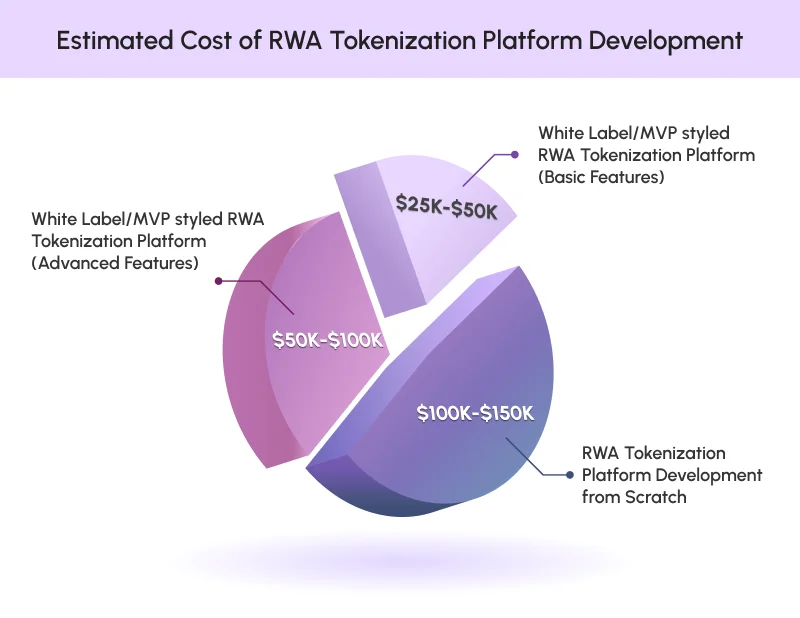
White Label/MVP styled RWA Tokenization Platform (Basic Features) – $25,000 to $50,000
Launching a white-label RWA Tokenization platform with basic features can take around $25,000 to $50,000. This is the most cost-effective option for businesses that want to enter the tokenization market quickly. This ready-to-deploy solution typically comes with pre-built modules that can be customized according to business requirements. Since the core framework is already developed, businesses only need customization and branding, which reduces both cost and development time.
The estimated development timeline for this model usually ranges between 8 to 12 weeks. Since the platform is built on an existing framework, this time might take for customization, UI adjustments, branding, and testing before deployment. This option is ideal for startups or businesses looking to launch a beginner-level MVP platform.
White Label/MVP styled RWA Tokenization Platform (Advanced Features) – $50,000 to $100,000
A white-label platform or MVP-style RWA tokenization platform development with advanced features can take around $50,000 to $1,00,000. This will provide greater flexibility and more advanced functionalities for managing tokenized assets. This version may include marketplaces, advanced investor dashboards, multi-asset tokenization support, and enhanced security mechanisms.
Besides, the time taken for this model typically comes between 12 to 16 weeks. The additional time is required for implementing advanced modules, integrating marketplace functionalities, and ensuring smooth platform performance. This option works well for businesses that want a fully functional tokenization platform with stronger market capabilities.
RWA Tokenization Platform Development from Scratch – $100,000 to $150,000
Developing an RWA Tokenization platform from scratch can cost around $100,000 to $150,000. As everything is built here from the ground up, this method comes with the highest level of customization, scalability, and control over the entire system architecture. Although this option requires a higher investment and longer development time, it allows businesses to build a fully customizable tokenization ecosystem.
The estimated development timeline usually ranges between 16 to 24 weeks. This includes stages of base planning, smart contract development, backend infrastructure, compliance integrations, testing, and final deployment. This option is ideal for enterprises that are looking for a reliable platform.
Overall, developing the RWA Tokenization platform may take approximately 320–960 business hours. With an average hourly development rate of $20–$30, the total cost can vary accordingly. However, the final cost of developing an RWA Tokenization platform depends on your own unique business requirements. But this cost isn’t final, and it fluctuates by several factors.
|
Development Approach |
Estimated Cost | Time Duration |
Ideal For |
|
MVP Styled Platform with Basic Features |
$25,000 to $50,000 | 8-12 Weeks | Beginner-level businesses, startups. |
| MVP Styled Platform with Advanced Features | $50,000 to $100,000 | 12-16 Weeks |
Cost-conscious businesses are looking for an advanced platform. |
|
RWA Tokenization Platform Development From Scratch |
$100,000 to $150,000 | 16-24 Weeks |
Enterprises with long-term goals and vision |
Curious about the cost of building your RWA tokenization platform?
Get a clear, tailored estimate based on your features, blockchain choice, and compliance requirements.
Factors that Impact the Cost of Developing an RWA Tokenization Platform From Scratch
The cost to launch a Real World Asset Tokenization platform is determined by several factors, each of which contributes to the final budget. Here is a list of factors that significantly influence the cost of developing an RWA tokenization platform from scratch.
Developer Expertise
The developer’s expertise is one of the primary influencing factors. Building an RWA tokenization platform requires developers who are proficient in blockchain, smart contracts, token standards, and secure backend infrastructure.
Team Size
The development team size will also have a strong say in the budget. From the blockchain developers to UI/UX designers, everyone is essential. Larger teams can extend development timelines, while smaller teams may reduce costs but extend the project delivery timeline.
Security Integrations
Security integrations like smart contract audits, multi-signature wallet integration, encryption protocols, and fraud detection mechanisms are important. Investing here will protect both the platform and its users from potential vulnerabilities.
UI/UX Integration
A well-designed UI/UX is essential for seamless interaction between users. Platform wireframing, interactive dashboards, tokenization interfaces, and portfolio screens are essential. Having an intuitive design improves platform engagement rates.
Tech Stack
The choice of technologies will also impact the budget. A robust tech stack ensures performance, scalability, and security. Components of frontend frameworks, backend technologies, database systems, cloud infrastructure, and API integrations are essential.
Blockchain Integration
Blockchain and smart contract integration are essentials of the RWA tokenization platform. Developers must design smart contracts to represent ownership of real-world assets, manage token issuance, and ensure transparent transactions.
Quality Testing
Testing is essential to ensure the platform operates smoothly under real-world circumstances. This phase involves extensive testing of smart contracts, user interfaces, APIs, and blockchain integrations.
Maintenance and Upgrades
Continuous maintenance, monitoring, and upgrades are necessary to keep the platform secure and competitive. Businesses might allocate a dedicated budget to keep the platform running in the long term.
Cost Analysis Based On The Feature Integration Of the RWA Tokenization Platform
The cost of developing an RWA tokenization platform is largely influenced by the features integrated into the system. Incorporating the listed features can impact the final cost,
|
Features |
Estimated Cost |
|
Token Management System |
$3,000 to $6,000 |
| Smart Contract Development |
$5,000 to $8,000 |
|
Investor Dashboard & User Interface |
$2,000 to $5,000 |
| Marketplace Integration |
$2500 to $5000 |
|
Wallet & Payment Gateway Integration |
$1,000 to $3,000 |
- Token Management System – This feature helps you create, control, and manage your digital tokens on the platform. With this feature, you can effortlessly create, track, distribute, and manage tokens.
- Smart Contract Development – The smart contracts help in automating the creation, distribution, and management of tokenized assets. They ensure that all transactions follow predefined rules without requiring any intervention of intermediaries.
- Investor Dashboard & User Interface – An RWA platform needs a user-friendly dashboard where investors can explore tokenized assets, view investment opportunities, track portfolio performance, and manage transactions.
- Marketplace Integration – A built-in marketplace allows investors to buy and sell tokenized assets after the initial issuance. This improves asset liquidity, which is one of the key advantages of tokenization.
- Wallet & Payment Gateway Integration – Investors must be able to store, transfer, and transact tokenized assets securely. Wallet integration allows users to connect crypto wallets or custodial wallets directly with the platform.
RWA Tokenization Platform Development Cost by Country
The geographical location of the development team and your area of operation play an important role in determining the overall development cost. Regions like North America usually charge higher hourly rates due to living costs and operating expenses. Development teams in countries like India, Eastern Europe, or Southeast Asia offer competitive pricing while maintaining strong technical expertise. Here is a quick glance at the average rate charged in the top countries
|
Geographical Location |
Estimated Hourly Rate |
| UAE & Other Middle Eastern Countries |
$60 – $100 / hour |
|
North America |
$100 – $200+ / hour |
| HongKong |
$80 – $150 / hour |
|
India & Other Asian Countries |
$20 – $30 / hour |
| European Countries |
$70 – $150 / hour |
|
Australia |
$80 – $140 / hour |
| Japan |
$40 – $60 / hour |
|
Germany |
$80 – $130 / hour |
Licensing and Regulatory Costs To Launch an RWA Tokenization Platform
Legal and regulatory compliance is another important factor when launching an RWA Tokenization platform. As the platform deals with real-world assets and digital investments, it must comply with regional financial regulations. Obtaining licenses may involve legal documentation, financial checks, and registration with essential financial authorities. The cost here can take around $15,000 to $40,000, depending on your business needs.
Based on the area of operation and the paperwork, the cost is determined. These licensing requirements ensure that the platform operates legally while protecting both investors and asset issuers. However, the process can involve legal consultation fees and regulatory filing costs. In addition, ongoing compliance expenses must be considered as part of the overall budget.
Marketing & Promotional Costs for an RWA Tokenization Platform
Beyond launching the RWA Tokenization Platform, a successful platform requires strong marketing efforts to attract investors and partners. These marketing costs usually include activities such as digital promotions, social media campaigns, content marketing, PR outreach, and community building. RWA platforms also need to invest in paid advertisements, blockchain sponsorships, influencer collaborations, and email marketing campaigns to increase visibility.
Besides, the promotional cost of RWA tokenization can take around $30,000 to $60,000, depending on your requirements. Promotional strategies will help in building trust in the platform. Since tokenized assets rely heavily on investor participation, allocating the proper budget for marketing is essential.
While all these factors might directly influence the cost, there are also some hidden costs that might add up. Understanding these additional expenses is essential for better budgeting,
Hidden Costs Involved in RWA Tokenization Platform Development
Here is a list of some of those additional boosters that may add up to the cost of developing the RWA Tokenization Platform.
KYC/AML Compliance – Compliance mechanisms like KYC/ AML verification are important for platforms dealing with tokenized real-world assets. But implementing these features may add to the initial development cost.
Third-Party Integrations – The RWA Tokenization platforms rarely function alone. For a seamless experience, they require integration with external tools, which may require additional budget.
Token Management – The RWA token platform must be able to manage tokens easily. Maintaining these functionalities may require additional infrastructure, updates, and administrative tools.
With these hidden costs in mind, it is also important to understand the must-have components that make an RWA Tokenization platform functional.
Essential Components for Developing an RWA Tokenization Platform
Below are the essential components required when developing an RWA Tokenization platform.
Smart Contracts – Smart contracts are one of the most important components of an RWA Tokenization platform. These contracts are essential to manage token creation, ownership transfers, transaction validation, and automated payouts.
Tokenization Engine – The tokenization engine converts real-world assets into digital tokens on the blockchain. This defines how an asset is represented digitally and how ownership is divided among investors.
Asset Management System – An asset management system helps admins manage tokenized assets on the platform. This allows uploading asset details, verifying documents, and tracking the status of their tokenized assets.
Oracle Integration – Oracle systems help to access both the blockchain and external data sources. The Oracles bring accurate off-chain data onto the blockchain and help maintain the reliability and accuracy of tokenized assets.
Voting Mechanisms – This allows token holders to participate in important decisions related to the tokenized assets or the platform itself. Together, these components create a secure ecosystem for tokenizing real-world assets on the blockchain.
Now that we have explored the essential components, the next step is understanding how these elements can be put together, right?
How to Create an RWA Tokenization Platform – A Practical Step-by-Step Guide
RWA tokenization platform development goes on with multiple stages. Here is a phase-by-phase breakdown on how to build a reliable real-world asset tokenization platform.
|
Phase |
Estimated Cost | Estimated Timeline |
| Market Research | $2,000 – $5,000 |
1 – 2 Weeks |
|
Architecture Designing |
$15,000 – $30,000 | 3 – 4 Weeks |
| Blockchain Integration | $8,000 – $20,000 |
2 – 5 Weeks |
|
Smart Contract Development |
$8,000 – $15,000 | 3 – 5 Weeks |
| Platform Development | $15,000 – $40,000 |
4 – 9 Weeks |
|
Asset & Account Manager |
$5,000 – $15,000 | 2 – 3 Weeks |
| Regulated Compliance | $5,000 – $20,000 |
2 – 4 Weeks |
|
Deployment & Maintenance |
$8,000-$16,000 |
Ongoing |
Market Research
Every successful RWA tokenization platform development begins with market research. The businesses here will analyze industry demand, asset classes, competitor platforms, and regulatory environments. This phase generally takes up a smaller share of the budget, estimated at around $2,000 to $5,000. But this plays a critical role in reducing potential business risks.
Architecture Designing
Once the market requirements are planned, the developers move on to the design phase. This stage involves outlining the platform infrastructure, database architecture, API integrations, and security frameworks. This phase usually falls somewhere around the $15,000 to $30,000 range, depending on the complexity involved.
Blockchain Integration
This is one of the important phases in your Real World Asset Tokenization Platform Development. This process involves setting up blockchain nodes, wallets, looking up token standards, and others. This phase typically requires an investment ranging from $8,000 to $20,000, depending on the complexity of the project.
Smart Contract Development
Incorporating smart contract code is essential. These contracts define how assets are issued, transferred, and managed within the ecosystem. Based on specific business requirements, developers create smart contracts to handle token issuance, ownership rights, investor participation, and other core functions. This phase typically requires an investment ranging from $8,000 to $15,000, depending on the level of customization.
Platform Development
Platform development is the most important stage in the RWA Tokenization Platform Development Journey. This phase typically takes up an investment ranging from $15,000 to $40,000. From investor dashboards, asset listing modules, and admin panels, to API integrations, everything is incorporated here. The frontend and backend infrastructure must be designed to support seamless asset issuance and transaction monitoring.
Asset & Account Manager
The Asset and Account Management module allows platform administrators to manage tokenized assets efficiently. This feature includes functionalities such as asset onboarding, asset verification, portfolio tracking, and transaction history monitoring. This module costs between $5,000 and $15,000, ensuring that the platform runs smoothly and securely.
Regulated Compliance
Since RWA tokenization deals with financial assets, regulatory compliance is important. This phase focuses on implementing compliance frameworks that align with financial regulations. However, the cost for implementing basic-level regulatory compliance features starts from $5,000 to $20,000. Based on your business targeted niche, you would need to look out for the niche-based legal rules and laws.
Deployment & Maintenance
This phase focuses on successfully launching your RWA tokenization platform and ensuring its smooth operation after deployment. We handle server setup, cloud deployment, smart contract deployment, and platform configuration. Beyond launch, we provide ongoing maintenance services, security updates, and bug fixes, which might come at an estimated cost of $8,000 to $16,000.
After understanding the step-by-step process of building an RWA Tokenization platform, the next important question is about revenue, right?
How To Make a Profit By Launching an RWA Tokenization Platform
A real-world asset tokenization platform development comes with multiple income opportunities. Let’s explore some of the key ways businesses can generate profits by launching an RWA Tokenization platform.
- Asset Tokenization Fees – One of the primary revenue streams of this RWA tokenization platform development is the tokenization fee. The platform may charge a fixed or a percentage of the asset value for creating or converting its physical assets into blockchain-based tokens.
- Transaction Fees – A small transaction fee is charged every time investors buy, sell, or transfer tokenized assets on the platform. These fees are usually applied as a percentage for each transaction. As the trading activity increases and more investors participate in the platform, giving a source of revenue.
- Asset Listing Fees – Asset owners who want to showcase their tokenized assets on the platform can pay a listing fee. This fee allows the asset to be displayed in the marketplace, where investors can explore and invest, generating an additional income.
- Platform Service Fees – RWA Tokenization platforms may include asset management tools, investor analytics, portfolio tracking, and reporting features. Businesses can monetize these services through subscription plans or service charges.
Why choose Pixel Web Solutions to launch your own RWA Tokenization Platform?
Pixel Web Solutions is a professional RWA tokenization platform development Company. Together, we will see a major change in how real-world assets are owned, traded, and accessed. Besides, the RWA tokenization is right at the center of this transformation. Pixel Web Solutions will help businesses enter and lead this evolving market with confidence. With 12+ years of industry experience and 560+ successful project deliveries, we bring a proven approach to RWA tokenization platform development.
We offer an end-to-end development approach, taking care of everything from initial project planning to end platform deployment. Our team of blockchain developers, business analysts, and QA experts works closely with you to transform your idea into a fully functional platform.
Ready to launch your RWA tokenization platform?
Partner with Pixel Web Solutions to build a secure, scalable, and compliant solution tailored to your business goals.
We Specialize In,
Pixel Web Solutions offers end-to-end RWA tokenization development services tailored to multiple industries, including:
- Liquidity Integration – We enable seamless liquidity for your tokenized assets, aiming for an engaging investor experience.
- Oracle Integration – We integrate reliable blockchain oracles to bring real-world data on-chain, including asset prices, market valuations, and interest rates.
- Tokenomics Design – We design robust and sustainable tokenomics models tailored to your asset type, ensuring your token model is both scalable and market-ready.
- Legal Advisory Support- Collaborate with our legal experts to ensure your RWA platform is aligned with legal standards from day one.
- Smart Contract Auditing – We develop secure, high-performance smart contracts to ensure your platform is manageable, reliable, and secure.
- Wallet & Payment Integration – Integrate multi-currency crypto wallets along with fiat payment gateways to enable smooth and secure transactions.
We have also successfully delivered RWA and blockchain-based solutions across global markets, including Hong Kong, Europe, and China. We have helped businesses launch scalable and compliant platforms. By combining deep industry knowledge with advanced blockchain technologies, we ensure your platform is secure, scalable, and ready for real-world adoption.
Wrap Up
To wrap it up, the RWA tokenization platform development is becoming a strategic move for businesses looking to stay relevant in a tokenized economy. This blog should have given you a clear picture of the development process, cost factors, and key components involved. Besides the technical side, one thing is clear: “The RWA tokenization sector is only marching forward”.
This makes it the right time for institutions and businesses to step into the market. With the right technology partner, launching your own RWA platform can position you at the forefront of this financial evolution.
FAQs
1. What is an RWA Tokenization Platform?
An RWA Tokenization platform is a digital platform that converts real-world assets such as real estate, commodities, artwork, or financial instruments into blockchain-based tokens.
2. What types of assets can be tokenized on an RWA platform?
An RWA Tokenization platform can support a wide range of assets, including real estate, precious metals, artwork, commodities, investment funds, bonds, and intellectual property. Any asset with ownership and value can be tokenized.
3. Is RWA Tokenization legal?
Yes, RWA tokenization often involves financial and regulatory compliance requirements. Platforms may need to follow regulations such as KYC, AML, and security token regulations, depending on the country where the platform operates.
4. What blockchain networks are commonly used for RWA Tokenization platforms?
RWA platforms are usually built on popular blockchain networks such as Ethereum, Polygon, Binance Smart Chain, and Solana.
5. Can RWA Tokenization platforms support fractional ownership?
Yes, fractional ownership is one of the key advantages of tokenization. High-value assets can be divided into multiple tokens, allowing several investors to own smaller portions of the same asset.
6. Is it better to build an RWA platform from scratch or use a white-label solution?
Both approaches have advantages. White-label platforms are faster and more cost-effective for businesses looking for quick market entry. While development from scratch offers customization and control over platform features.