Table of Contents
In the automation era, manual processes slow down workflows and business efficiency. Long approvals, excessive follow-ups, and varied executions affect scalability and trust over time. This is where smart contracts step in to enforce and automate the transaction process, winning the system. Paying attention to the use cases of smart contracts is significant, specifically in areas where timing and consistency matter.
In reality, smart contracts are not suitable for every process; their value lies in understanding where they fit and where they don’t. This blog covers real-world smart contract use cases across industries and how they are applied in business settings.
Why Businesses are Adopting Smart Contracts Today
Businesses are turning to smart contracts to mitigate inefficiencies in manual processes, delayed approvals, and reliance on third-party intermediaries. Conventional agreements require multiple intermediaries, which increases costs and time to execute.
The market size of smart contracts was valued $ 2.14 Billion at 2024 and is expected to reach over 12.07 billion by 2032 globally, establishing the scope of success for entrepreneurs. Furthermore, modern businesses demand effectiveness, accountability, and transparency in operations. Embracing smart contracts in the workflow is a practical solution to ensure all these requirements. Smart contracts help businesses to…
- Reduce dependency on intermediaries
- Regulate tamper-proof records
- Enhance efficiency in operations
Smart contract development lets businesses replace error-prone, paper-based processes with consistent automated systems.
How these Smart Contract Use cases are Identified
We curated the list of top smart contract use cases based on real-world business adoption patterns instead of theoretical assumptions. Here’s our evaluation criteria,
- Business Relevance: We selected the use cases of smart contracts based on business applications and how smart contracts are used in these contexts.
- Industry Adoption: We validated the implementation of smart contracts across industries and how they are adopted, and picked the ideal ones.
- Operation and Compliance Impact: Execution of smart contracts that have the chance to improve efficiency, transparency, and reliability in industries is only chosen.
- Scalability: We listed the smart contract use cases that have the potential to scale in those sectors. Thus, understanding those use cases helps businesses to develop a smart contract perfectly.
With this precise consideration, let’s discover how smart contracts are used in different sectors.
7 Key Smart Contract Use Cases Across Industries in 2026
Smart contracts are shaping the operation of businesses in an effective manner. Here are the most practical and high-impact ways in which businesses are using smart contracts.
1. Healthcare
Smart contracts are utilized in the healthcare sector to manage secure data transfer of patients between hospitals. With the support of smart contracts, access permissions and patient consent are permanently recorded on the blockchain. While executing clinical trials, smart contracts help with tracking trial milestones, ensuring data quality and integrity.
Business Impact
- Increased Data Security
- Reduced Compliance risks
- Creation of an auditable trail with respect to sensitive medical data.
2. Supply chain management
Smart contracts enable supply chain sectors to automate and update actions like shipment arrival or goods passing through customs in their supply chains. When a condition is satisfied, the contract will trigger all payment, update, or approval actions without requiring human interaction to access the system.
Business Impact
- Quick Settlement Cycles
- Decrease Disputes
- Increase Visibility in the supply chain
3. Real Estate & Asset tokenization
Smart contracts manage asset tokenization, defining who owns each digital asset and recording ownership changes. Once the agreement is approved, the transfer is carried forward automatically. In real estate and with other physical assets, smart contracts are used to track ownership records, how assets are divided among owners, and execute the transactions according to smart contract terms.
Business Impact
- Clear Ownership Records
- Decrease Paperworks
- Effective Asset Transfer
4. Financial services & Cross-border payments
Smart contracts are prevalently used in the financial sector. Automates settlement of financial transactions, meeting conditions before payments, and handles cross-border payments. Usage of smart contracts automatically lowers reliance on a financial intermediary and other related costs, as it automatically enforces the transaction rules through code.
Business Impact
- Reduced Transaction Fees
- Faster Settlement Times
- Lower Operating costs
5. Insurance industry
In recent times, insurance providers are beginning to adopt smart contracts to automate policy management and claims. The smart contract automatically makes the claim payment to the policyholder after the predefined conditions for payouts are met.
Business Impact
- Claims resolution takes less time
- Reduced the manual settlement process
- Increases the confidence of clients
6. Intellectual property & royalties
With smart contracts, you can automate and simplify how royalties are calculated and distributed. It automatically pays the licensor according to the rules set out in the contract. Each time licensed content is used or transferred.
Business Impact
- More Accurate Revenue Distribution
- Less Administrative burden to manage IP rights
7. Digital Identity
Smart contracts allow individuals to manage who has access to verified data, as well as granting permission to avail those information. It lets users grant, deny, or revoke access to the verified data without going to centralized identity providers.
Business Impact
- Increased Security
- Reduced Identity Fraud
- Better control over sensitive information
- Increased flexibility and accessibility to verified data
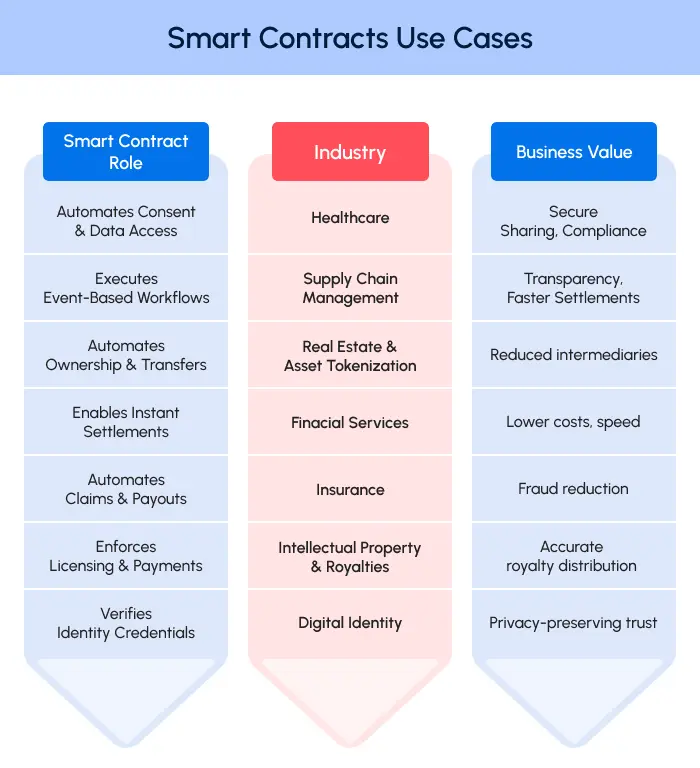
Beyond industrial application, smart contracts offer several advantages to businesses, making it worthwhile for them to invest continuously.
Business-driven Perks of Creating Smart Contracts
More than automation, smart contracts benefit businesses in diverse ways.
- Operational Efficiency: Transfer delays and a long approval process are removed as smart contracts execute the action immediately after certain conditions are verified. It eventually enhances the effectiveness of workflows and transaction processes.
- Cost Reduction: As smart contracts automate the transaction, eliminating the need for third parties and human interventions, it significantly reduces the cost involved in it.
- Transparency: Blockchain records every transaction of a smart contract, making a tamper-proof audit trail. This enhanced transparency aids internal checks, regulatory compliance, and dispute resolution.
- Risk Minimization: The use of smart contracts lowers risks by creating a legally binding agreement among the involved parties.
To enjoy these benefits, smart contracts should be launched in the right way with ideal support. For that, you need a development partner to assist you in this crypto venture.
Why Choose Pixel Web Solutions for Smart Contract Development
Understanding smart contracts begins with knowing their use cases. The use cases of smart contracts discussed in this blog emphasize how businesses can leverage them to structure and automate workflows. Smart contracts are not a plug-and-play feature to be implemented easily, it requires a clear development process, secure coding, and in-depth knowledge about how they function in real environments.
This is what we excel at. Pixel Web Solutions is a leading Smart Contract Development company serving the crypto market for over a decade. Our expert team works closely with businesses to design smart contracts that align with real use cases, compliance essentials, and scalability. We also specialize in offering Smart Contract Consultation and Auditing Services to validate business logic, detect vulnerabilities, and ensure optimal performance. We prioritize clarity, security, and practical execution. Our expertise and experience help businesses to shine in the competitive crypto world.
Partner with us and build a smart contract that drives growth through automation!