Table of Contents
In recent years, Mobile banking has undergone a radical change. It is all because of the technology that combines intelligent automation, real-time decision-making, and personalized customer experiences. Although mobile banking has traditionally included checking balances and transferring money, numerous new features have emerged that are now available in mobile banking apps.
By utilizing artificial intelligence (AI), banks can predict what customers will want in the future by automating complex workflows and providing prompt customer service in a manner that mimics human assistance. Today’s customers want more than just standard features in their banking. They prefer a banking experience that is tailored to their needs. It has become necessary for all banks and financial technology companies (fintech) to implement AI-driven technology to remain viable and competitive.
This guide will walk through exactly how to build an AI-powered mobile banking app from the ground up. It also covers topics such as recommended features, technical architecture, security frameworks, technology stacks, and future trends. You will gain a visual roadmap for creating next-generation mobile banking.
What Is an AI-Powered Mobile Banking App?
An AI-powered mobile banking app is a cutting-edge financial tool that uses artificial intelligence to enhance banking experiences. With AI, a modern mobile bank can provide better banking experiences by learning how users behave on the platform, providing automated task execution, and providing personalized recommendations.
An AI-enabled mobile bank app does not simply provide the user with a way to bank but also has several features that enhance not only the user’s experience but also the security and efficiency of the overall banking experience.
It utilizes biometric authentication, AI chatbots, and fraud detection features in addition to utilizing real-time data processing and round-the-clock support, leading to increased customer satisfaction. These apps will undoubtedly shape the future of digital banking by creating a more intelligent user-driven experience.
AI Adoption in Banking – A Global Snapshot
Banks worldwide are rapidly integrating artificial intelligence to modernize their digital services. As shown in the infographic below, AI adoption in banking varies significantly across regions, with North America leading the curve, followed by growing momentum in Africa, South America, and Europe.
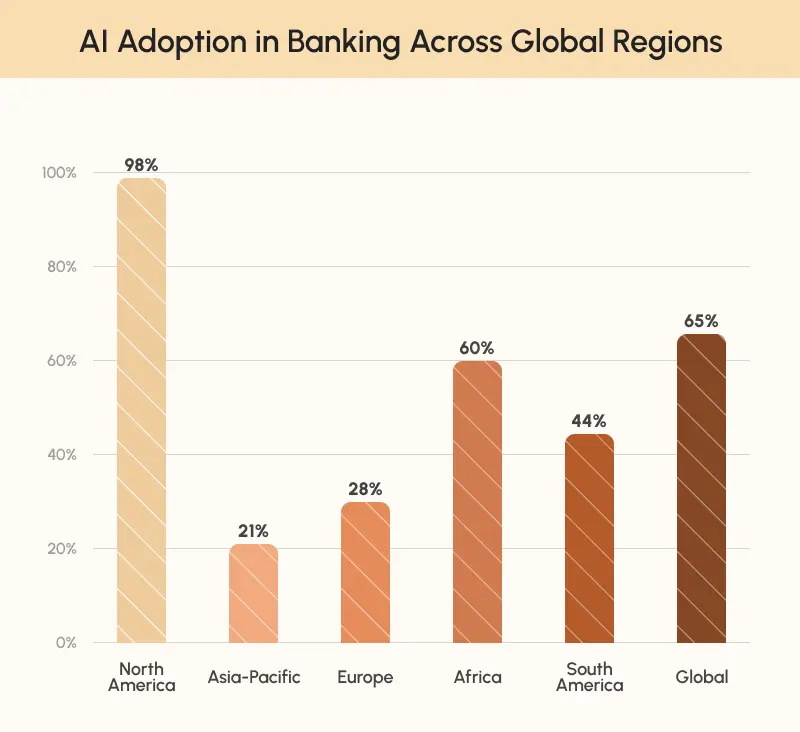
Source – Custommarketinsights
The data highlights a strong global shift toward AI-driven banking, reinforcing why mobile banking apps are increasingly built with AI at their core.
Key Roles of AI in Mobile Banking Apps
Banks are using AI as a foundation for their digital offerings to create a fast, smart, and convenient user experience. AI helps provide each user with a personalized digital banking experience by identifying patterns in activity and behavior, and automatically matching users with the most efficient options according to their needs.
Customized Financial Insights
AI uses prior financial behavior, expenditure habits, and financial plans to develop customized solutions for the user, enabling users to comprehend and engage with their financial circumstances effectively.
24/7 Customer Support
Virtual assistants, like chatbots, provide immediate assistance regardless of the hour of the day. Customers may ask questions, complete transactions, and resolve problems via the chatbots at any time. This innovative technology enables customers to receive prompt responses to their inquiries, lowers customer service costs, and enhances customer satisfaction.
Real-Time Fraud Detection
AI continues to monitor user transactions and activity to identify both mistakes and fraudulent activity occurring in real-time. By utilizing sophisticated risk regulations, AI and biometric data enable time-sensitive mobile banking applications to create secure payment experiences and a proactive risk management strategy.
Automating Banking Processes
AI automates repetitive banking processes such as KYC (Know Your Customer), loan processing, account updates, and compliance paperwork to relieve human workers of time-consuming tasks, minimize human error, and enhance operational efficiency.
Predictive Analysis to Improve Decisions
AI analyzes user behavior through machine learning to identify things such as emerging trends, anticipate events, and predict future user behavior. The information generated from these predictive analytics enables banks to enhance decision-making, improve the offerings they provide to their customers, and create value for their customers.
AI has become essential for banks aiming to deliver secure and personalized mobile banking. It automates processes and enhances customer experiences, offering opportunities for innovation. Early adoption of AI will help banks lead the market. Now, let’s explore how to build an AI-powered banking app.
How to Build an AI-Powered Mobile Banking App?
Creating a successful AI-based mobile Banking application is not just about producing an application that works with data. It takes the right strategy and method to create a complete mobile banking application that meets the unique needs of your users and meets the expectations of users, as well.
Requirement Gathering
Identifying your target audience, their needs for banking products, services, and AI Capabilities that will add value to your business allows banks to develop the right strategy as well as identify where AI adds value to the overall customer experience and provide enhanced benefits.
Choosing the Right AI Technology
You can select the right technology stack for your AI project by selecting tools like machine learning models, NLP engines, OCR software, or predictive analytics frameworks. Having the right technology stack allows for improved performance, accuracy, and integration into your bank’s ecosystem.
User Journey and Banking Workflow Design
During this phase, the UX designer creates a smooth and easy experience for your customers. This applies to how they interact with the company through digital channels, such as during onboarding, support, payments, and receiving financial advice. The designer also considers implementing touchpoints utilizing AI in the company’s mobile application, thereby enhancing customer convenience.
Training and Validating AI Models
In training AI models to perform accurately and in a viable fashion, data scientists will make use of both real and synthetic data sets pertaining to banking. AI models must be trained using data sets that are representative of the types of activities. Furthermore, the AI models must be in accordance with all applicable rules and regulations.
Development and Quality Testing
The mobile application is built and developed by the development team, and AI modules, Core Banking Systems, Third Party Services, and APIs are integrated into the application by the same development team. Each function of the mobile application will undergo testing by Quality Assurance Teams.
Deployment and Continuous Support
During the final phase of the project, the mobile application is launched. The mobile application will continually be monitored for user activity, AI Insights, and Performance Data. The Data Science team will continue to retrain and optimize the AI Models to meet the changing needs of your customers over time.
These are the common steps to create an AI-integrating Mobile Baking app. If you feel tedious to follow these steps, you can hire a skilled and reliable banking app development company. A skilled app developer can create an innovative, secure, and user-friendly mobile banking app based on Artificial Intelligence.
Now let us look at the…
Must-Have AI Features in a Modern Mobile Banking App
With AI, Banks can utilise AI-enabled technology to provide smarter, safer, and much more personalised banking experiences. Today’s AI functions help users complete their day-to-day banking tasks and make sound financial choices with minimal effort.
Chat Bot & Virtual Assistant
The technology allows users to communicate through realistic human interaction with chatbots and virtual assistants, assisting users with their needs every minute of the day. Chatbots can save a bank money by reducing customer support costs and simultaneously increasing user satisfaction with the service.
Financial Insights & Advisory Personalisation
Using data from user transactions, AI can use this data to generate personalized recommendations based on the users` unique spending habits, saving behaviours, and long-term financial goals. The system can alert, suggest, and guide users on how to make positive financial decisions on their own.
Predictive Analytics for User Behavior
Machine learning utilizes patterns based on past user behavior to identify what they will need in the near future. This provides a glimpse into an individual’s potential bills, upcoming expenses, overdraws, possible investments, etc. By developing predictive models, banks can anticipate user needs before they arise.
Fraud & Risk Detection
AI technology can analyze real-time transactional activity and behavioral characteristics to detect random or unusual activities that may indicate fraudulent or risky behavior. Automated alerts and risk score assessments are utilized to mitigate losses to customers due to fraud.
Biometric Authentication
AI utilizes advanced facial recognition technology, as well as fingerprint scanning and behavior-based authentication methods, to provide users with seamless yet secure access to their mobile banking accounts.
Automated Expense Tracking
AI allows users to categorize expenses, identify areas of excessive spending, and suggest methods for maximizing the use of their budget. The automated tracking of expenses and providing insight into how they can better manage their personal finances enhances the user’s ability to gain control over their money.
Evaluating Creditworthiness & Lending Decisions
AI utilizes multiple methods to evaluate whether users are qualified to receive a loan. Data points that include spending habits (transactions, purchases), income (deposits, paychecks), and repayment patterns (timing, amounts) assist AI in making loan decisions that are prompt, precise, and inclusive of all users.
With all of the phenomenal applications of AI within the banking sphere, it is easy to see that it is significantly changing the face of banking. It should be noted that while there are many advantageous features associated with AI, there are also several limits to AI when used in the mobile banking industry. Let us further discuss the…
Challenges & Risks of Using AI in Mobile Banking
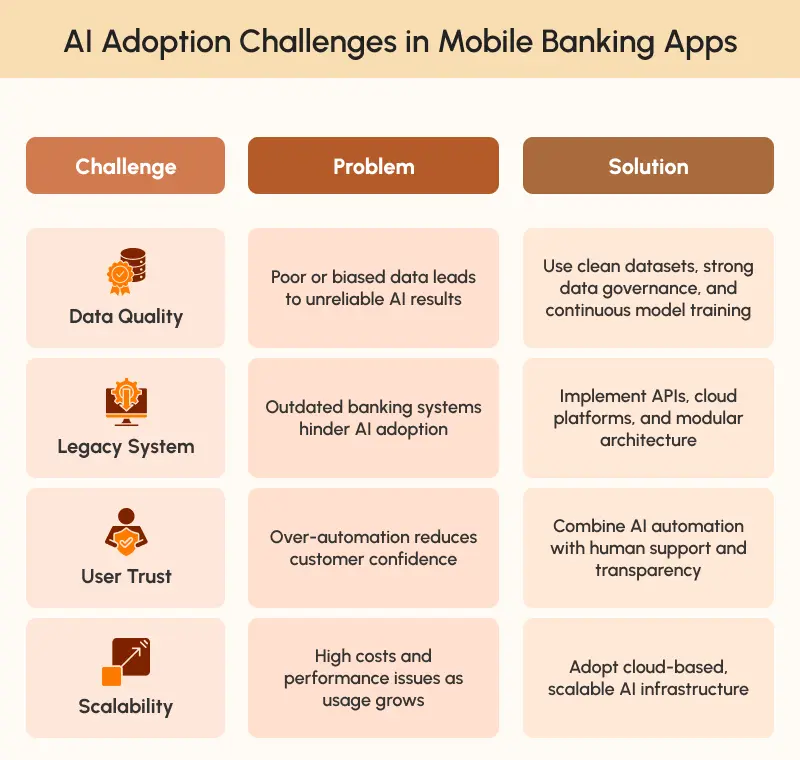
AI significantly improves mobile banking, but also presents banks with challenges that need to be strategically addressed to facilitate adoption. The following points highlight the types of challenges that banks face when trying to adopt AI, from developing the necessary technologies to actually using them. The success of an AI-based solution will be directly affected by how well these challenges are addressed.
1. Data quality & model accuracy issues – The success of AI-based solutions begins with the data used to create the model. For example, low-quality or biased data can produce inaccurate and/or unreliable results, resulting in a poor user experience.
2. AI Integration with Legacy Banking Systems – Many banks have outdated core systems, which makes it difficult to use AI effectively and securely. Banks need to invest a lot of time and money to ensure that the technology is integrated into the bank’s systems and that there is a secure means for transferring data.
3. Automation vs. User Trust – Users may feel abandoned by automation. If they have to deal with an automated process during a stressful or confusing situation, they will likely lose trust in the bank. Therefore, banks must foster transparency and provide human support to build user trust.
4. Cost, Infrastructure, and Scalability Issues – Building an AI model requires investment in equipment and skilled talent, with an ongoing commitment to both. Banks will face performance degradation as they grow in user volume without adequate infrastructure.
Despite these challenges, banks can realise tremendous benefits from the use of AI, especially when implemented with strong planning and the right development expertise. In order to overcome all these challenges, one can hire a prominent mobile app development company, which can reduce all your hurdles.
Future Trends in AI Banking App Development
As technology continues to advance, banks will be able to utilize Next Generation AI capabilities and alter how users manage their money, gain knowledge and assistance, and interact with the banks’ applications.
On-Device AI for Privacy & Speed
It provides improved privacy and speed because it processes data locally on a mobile device instead of sending it to the cloud.
Hyper-Personalized Financial Coaching
It allows future banking applications to help customers with their finances by acting were like a personal finance coach and by helping them reach their savings, debt reduction, and investment goals.
Generative AI for Financial Management
Generative AI can be used as a tool for managing one’s finances through automated budgets, smart summaries, and conversation-based planning, allowing the user to receive customised reports with predictive insights about their financial situation.
Banking & Self-Learning Models
Autonomous Banking Apps will eventually become autonomous systems that automatically make the best possible financial decisions for customers and create self-learning models that learn about the customer’s behaviours, automate payment and investment tasks for them, etc.
As these innovations continue to transform digital banking, organisations looking to develop next-generation banking applications need to invest in the right skills, capabilities, and strategic thinking.
Build Your Banking App with Pixel Web Solution’s Skilled Developers
Pixel Web Solutions is a premier mobile banking app development company that develops rock-solid and secure, AI-enabled financial applications to meet the demands of today’s modern banking industry. We have extensive expertise in AI, machine learning, Cloud Integration, and fintech compliance, enabling us to provide complete end-to-end solutions for banks and fintech start-ups.
Our services include intelligent chatbots, predictive analytics, biometric security, and personalised financial dashboards, all engineered for optimal performance, scalability, and compliance with regulatory requirements. Partnering with Pixel Web Solutions will allow businesses to create a cutting-edge mobile banking application that will be ready to support their future.