Table of Contents
The Decentralized Finance (DeFi) market is expanding rapidly, reaching a USD of 238.54 billion in 2026, and is also projected to reach USD 770.56 billion by 2031. This shows a growth at a percentage of 26.43% CAGR. This rapid growth clearly signals one thing: DeFi infrastructure is no longer a trend; it is becoming a global movement.
Besides, the top decentralized exchanges like Uniswap are taking up the center of this transformation. In 2025 alone, Uniswap recorded over 915 million transactions and surpassed $1 trillion in trading volume, proving its dominance in the DeFi ecosystem. These numbers reflect massive user adoption and trust in automated, permissionless trading systems.
As DeFi adoption increases, the demand for scalable, secure, and user-friendly DEX platforms is rising rapidly. These businesses and entrepreneurs are now exploring how to build decentralized exchanges like Uniswap to capture this growing market opportunity. Understanding how such a platform is structured and developed becomes the first step toward entering this evolving DeFi landscape. So, let’s begin with
Why Should You Develop a Decentralized Exchange like Uniswap?
Developing a decentralized exchange is already one of the potential and best DeFi business ideas. However, taking inspiration from Uniswap brings additional strategic advantages.
Earlier this year, the Uniswap Protocol became the first DEX to surpass $3 trillion in cumulative trading volume, proving the scale and maturity of decentralized trading. The protocol processes tens of billions of dollars in monthly volume and has been used by 10+ million DeFi participants worldwide, highlighting strong and sustained market demand.
The ecosystem is also financially robust. As of Q3 2025, the Uniswap Foundation reported over $116 million in total assets, with $108+ million committed to grants and ecosystem growth, signaling long-term investment in DeFi innovation.
By developing a decentralized exchange like Uniswap, businesses can tap into this proven demand and grow alongside increasing market adoption.
A Uniswap-style DEX enables faster launch through an MVP-first approach, lowers initial risk, attracts liquidity with a non-custodial model, and supports scalable, long-term revenue growth in the evolving DeFi ecosystem.
Additionally, Uniswap’s global access and listing mechanism allow new tokens to enter the market quickly.
This makes it highly attractive for emerging crypto projects. For entrepreneurs, this opens opportunities to build a platform that attracts new token launches and trading communities. That’s why developing a DEX inspired by Uniswap allows businesses to use a tested model while tailoring it to their unique vision and revenue strategy.
Okay, so this might have made you realize why choosing Uniswap as an inspiration is a good choice. On the other hand, let’s also understand the perks this DEX development would bring to the table.
Business Benefits of Developing a Uniswap-like DEX platform
Creating a DEX like Uniswap brings many competitive business advantages to the picture. Here is a list of benefits,
Global Accessibility
As the DeFi ecosystem is vast, there is no limit or constraint on the geo-locality of the platform. Thus, you can expand your services globally, targeting a huge niche of audiences. This will increase your opportunities as a business in the global market. Also, this might increase your profit potential.
Future Proof Business
Beyond financial benefits, DEX is a future-proof investment. With blockchain technology evolving rapidly, a DEX development is definitely a futuristic business. The integration of unique features and evolving advancements will enhance their brand image. This will let you adapt to the emerging DeFi Trends.
Dedicated Community
If you own a DEX, you are more likely to attract like-minded individuals. By this, you can create your own dedicated community. Owning a DEX like Uniswap will let you form a dedicated community of traders. They will contribute to your platform’s growth.
High ROI
The Uniswap-like DEX is capable of generating high revenue through various money-making mechanisms. The platform owner can make money through transactions, liquidity, and ads. Since DEX operates autonomously through smart contracts, the operational costs are lower. This further boosts profit margins.
How to Create a Decentralized Exchange Like Uniswap?
Developing a decentralized exchange like Uniswap can be done in multiple ways based on your strategic objectives. Based on their unique goals, businesses would choose their preferred mode of development,
- Custom Uniswap-like DEX Development
- Launch a Uniswap-like MVP
- White-label Uniswap Clone
Custom Uniswap-like DEX Development
You can build a Decentralized exchange like the Uniswap platform completely from the ground up. This custom mode gives you control over its architecture, features, and security protocols. Here, you will design your own DEX platform based on your own business requirements. The exchange architecture, smart contracts, security, and designs are developed from scratch here.
However, this method requires blockchain expertise and a reliable development team. This would result in significant investment and time. They are most suitable for businesses aiming for long-term sustainability and technological leadership.
Launch a Uniswap-like MVP
Launching a Uniswap-like MVP is the smart way to enter the DeFi market without overspending on time and budget. Instead of building a feature-rich platform, an MVP focuses only on the core functionalities. This typically includes wallet integration, token swap functionality, liquidity pool creation, and fee distribution mechanisms.
Just like Uniswap, the goal is to release a working version that allows real users to trade now and can optimize later based on requirements. This reduces development risks and allows you to enter the market quickly with actual data.
White-label Uniswap Clone
A white-label Uniswap DEX clone software is a pre-built exchange framework. This allows you to customize and launch your own Decentralized exchange platform quickly. You can optimize the Uniswap Clone Software based on your business and brand needs.
This Uniswap Clone Script comes with essential DEX-based trading functionalities. This includes AMMs, liquidity pools, token swapping, and other integrations. White-label software enables a smooth launch, reducing development costs and time involved. This option is best for businesses that want a secure and market-ready DEX, without investing more in development resources. This solution ensures that your businesses can enter the DeFi space with a competitive edge.
Take a quick glance on which one fits your business needs,
Custom DEX Development vs Launch a Uniswap-like MVP vs White-label Uniswap
|
Aspect |
Custom DEX Development | Uniswap-like MVP |
White-label Uniswap |
|
Development Approach |
Built completely from scratch based on unique requirements | Core features developed first, advanced features added later |
advanced features added later, Ready-made solution customized and deployed |
|
Cost Range |
High | Moderate |
Low |
|
Customization Benefit |
Built with Business goals | Moderate Customization |
Complete Customization |
|
Scalability |
Highly scalable | Scalable upon phases | Scalable |
|
Risk level |
High Investment Risk | Lower Risk involved |
Lowest Risks involved |
| Time to launch | Slower launch | Faster launch |
Fastest launch |
How Does Uniswap like DEX Platforms Work?
A Uniswap-like decentralized exchange works using an Automated Market Maker (AMM) model and relies on liquidity pools to facilitate trading. Here is a simple step-by-step working mechanism explaining how these Uniswap-like DEX platforms might perform,
Step 1: User Connects Wallet
Just like Uniswap, here the user will connect their crypto wallet to the DEX. This is important, as it allows the smart contracts to interact with the user’s tokens.
Step 2: Token Pair Choosing
The user will now select the token they want to swap and the token they want to receive. The platform then fetches the liquidity pool data for that specific token pair.
Step 3: Price Calculation
Unlike normal exchanges that match buyers and sellers, the Uniswap-like DEX uses an Automated Market Maker. Based on the liquidity available in the pool, the smart contract calculates the token price.
Step 4: User Confirmation
The platform shows details like price impact, slippage, and transaction fee. Once the user confirms the transaction in their wallet, the smart contract is triggered on the blockchain.
Step 5: Trade Execution
The smart contract will automatically swap the tokens using liquidity from the pool. The input token is added to the pool, and the output token is sent directly to the user’s wallet.
Step 6: Fees to Liquidity Providers
A small fee is charged on each trade, and it is automatically distributed to the liquidity providers who supplied tokens to the pool.
For this smooth working process, you would need several features and functionalities to back it up. Let’s explore,
Features to Include When Developing a Uniswap-like DEX Platform
Building a Uniswap-like decentralized exchange requires integrating a balanced set of features. Each of these features plays a significant role in maintaining the performance of the exchange. For easy understanding, let’s categorize these features into three broad categories,
- User Features
- Admin Features
- Security Features
User Features
- Wallet Integration Support
- Token Swap Functionality
- Liquidity Pools
- Real-Time Price Updates
- Slippage Tolerance Settings
- Transaction History
- LP Token Management
- Token Search & Custom Token Import
- Staking & Yield Farming
Admin Features
- Liquidity Pool Management
- Token Approval Controls
- Fee Management Support
- Platform Analytics Dashboard
- User Activity Monitoring
- Governance Management
- Smart Contract Controls
- Multi-Chain Support
- Incentive & Rewards
Security Features
- Smart Contract Audits
- Multi-Signature Wallet Integration
- Anti-Phishing Protection
- Secure Wallet Authentication
- End-to-end encryption
- Slippage Controls
- DDoS Protection
- Reentrancy Attack Prevention
- Security Monitoring & Updates
How to Build a Decentralized Exchange Like Uniswap? – Step By Step Process
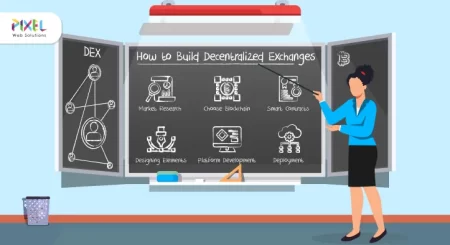
Developing a decentralized exchange like Uniswap requires a detailed and structured process. Here is a step-by-step process outlining the journey from concept to deployment.
Project Research
Building a decentralized exchange like Uniswap should start with detailed project research. Here, focus on understanding how your market works, your niche, target audience, gaps, and how the competitors position themself. This phase is important as it will help you identify business vision and end goals.
Blueprint Creation
Once the research is complete, the next step is creating a detailed blueprint of your Uniswap-like decentralized exchange. Based on the market research, create a base outline detailing how your smart contracts will perform, token standards, and many more. By planning this beforehand, you can get a smooth development journey.
UI/UX Architecture Planning
A strong UI/UX architecture is important for a smooth user experience. The designers here must focus on creating an intuitive interface while matching your business aesthetics. Clear visibility might build your user’s confidence and trust. The goal is to make decentralized trading accessible to everyone.
Platform Development
Platform development is the main phase. Here, based on the architectures and frameworks, we will develop the Uniswap like DEX platforms. They implement secure, optimized smart contracts to handle liquidity pools and token swaps. A responsive front-end and back-end is developed here to give smooth trading experiences.
Testing
Before launching, rigorous and frequent testing is essential. This testing will be done under various real-world scenarios to fix bugs, vulnerabilities, and other exploits. The platform is deployed on test networks and will be tested with high trading volumes and liquidity fluctuations to detect bugs.
Platform Launch
Now, upon testing, your DEX, like Uniswap, is ready for deployment. Based on your target audience and end business goals, deploy the platform on the preferred servers. Besides, post-launch support and continuous monitoring are also equally important to stay ahead of the competition.
Legal & Compliance Requirements to Launch a DEX like Uniswap
Another important thing one should know before launching a decentralized exchange is about the Legal and licensing requirements across different jurisdictions. Completing these regulatory steps ensures that your platform will operate smoothly without any future legal complications.
Jurisdiction Needs
Decide where you will legally register your company, look out for the top crypto-friendly countries, and consider how they align with your goals. Understand the local crypto laws and restrictions.
Business Registration & Licensing
Registering your company or brand legally is important. Look out for and apply for crypto-related licenses and other essential ones. Based on your country, check out for the approvals and documentation.
Token Listing Guidelines
Create rules and guidelines for listing new tokens. Avoid the listing scam or illegal tokens. Check if the token guidelines violate any country’s securities laws to avoid listing scam or illegal tokens.
Data Protection Rules
Protecting user data securely is the key to surviving in the market. Follow up on privacy laws like GDPR, especially if you are targeting certain countries. Try to inform the users how their data is used to create credibility.
Ongoing Compliance Monitoring
Stay updated with changing crypto laws and other fintech-based government guidelines and updates. Renew licenses if needed, conduct regular legal audits, and maintain proper financial records.
How To Make Money By Launching a Uniswap-like Decentralized Exchange
If you’re planning to launch a Uniswap-like DEX, you would need a solid revenue model that keeps your platform profitable. Here’s how developing Uniswap-like Decentralized Exchanges can generate consistent revenue:
Swapping Fee – This is the primary revenue source for many DEX platforms. Here, every time a user swaps tokens for one another, the platform will charge a small percentage as a swapping fee.
Staking Fee – The DEX platforms can also charge a small commission on staking rewards or demand a minimum staking deposit to facilitate efficient performance.
Listing Fee – Many Crypto projects want visibility, and your DEX can monetize this by charging a listing fee. The more popular your platform becomes, the higher you can charge.
Transaction Fee – Beyond swaps, every transaction within the ecosystem can levy a small processing fee. Be it transfers, withdrawals, or smart contract interactions, this fee can be applied to all operations.
Ads / Collaborations – A DEX with a strong user base can monetize through running up sponsor ads, promotions, and partnerships. Collabs and cross-selling also open up additional revenue streams.
Subscription Models – Just like many streaming platforms, your DEX platform can offer premium features like advanced tools, analytical bots, and many more under a tiered subscription model.
How Much Does it Cost to Create a Decentralized Exchange like Uniswap?
On average, the cost of creating a Decentralized Exchange like Uniswap would start from $25,000 and can go beyond depending on your unique business requirements. However, the final investment largely depends on whether you choose a white-label solution, an MVP-based model, or a fully customized development approach from scratch. For businesses looking to enter the market quickly, exploring these pricing structures is important.
- A white-label or MVP-style Uniswap-like DEX with basic features may cost between $25,000 and $50,000. This version generally includes core functionalities such as token swapping, liquidity pool integration, wallet connectivity, and essential security features. It is ideal for startups aiming to enter with minimal upfront investment.
- A white-label or MVP-style Uniswap-like DEX with advanced features can range from $50,000 to $100,000. This version may include multi-chain support, advanced analytics dashboards, improved UI/UX customization, and additional security layers.
- Developing a Uniswap-like decentralized exchange from scratch may cost approximately around $100,000 to $150,000 or more. As everything is built here from the very ground up, it might require additional investment.
However, this entire cost estimate might have fluctuations depending on several influencing factors, some of which are,
Factors Influencing the Cost of Developing an Uniswap like Decentralized Exchange
Here is a list of certain aspects and scenarios that have a huge influence on the cost of creating a DEX like Uniswap.
- Feature Complexity
- Usage of blockchain networks
- Security & Smart Contract Audits
- UI/UX Design Requirements
- Multi-Chain Integration
- Scalability & Performance Optimization
- Post-Launch Maintenance & Upgrades
Exploring the cost might have made you also wonder about the time frames, right?
How much time will it take to create a Uniswap-like DEX platform?
The average time taken to create a Uniswap-like decentralized exchange platform might be fixed based on your unique business requirements and the chosen development approach.
- To launch an MVP or white-label style Uniswap DEXs with basic features, it may take around 8-12 weeks.
- If you are launching an MVP or white-label style Uniswap DEXs with advanced features may take around 12-16 weeks, while
- On the other hand, developing a decentralized exchange like Uniswap from scratch may take around 16-24 weeks.
While the development timeline may vary depending on the complexity, the real difference lies in how efficiently the process is managed. A well-structured development roadmap and a security-first approach significantly reduce delays and technical risks.
Why Should You Choose Pixel Web Solutions to Build Your DEX Like Uniswap?
By now, you would have understood how technically structured this Uniswap-like decentralized exchange development is, right? From smart contract architecture to security audits, every stage requires planned expertise and careful execution. This is exactly why partnering with a professional decentralized exchange development company like Pixel Web Solutions is important. We have a dedicated team of blockchain developers, UI/UX designers, security experts, and DeFi strategists. Pixel ensures that your DEX platforms are built efficiently and securely to match your business goals. Partnering with an experienced team allows you to enter the DeFi market effortlessly.